Bible, Church and Reason
Summary
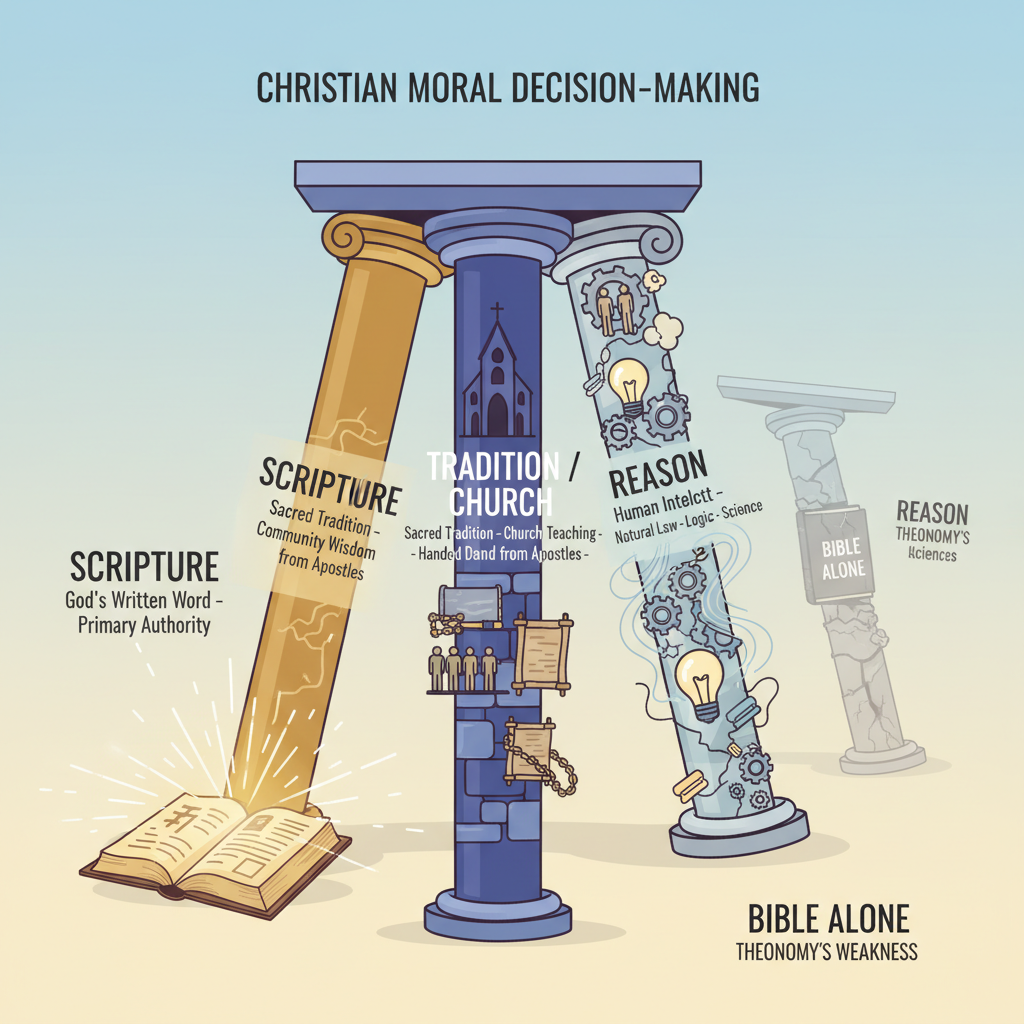
Heteronomous Christian Ethics ("Hetero" = different/other; "Nomos" = law) means ethics are governed by several sources, not just one. Unlike Theonomy (Bible alone), this view argues that the Bible is essential but not sufficient on its own. It needs interpretation through Tradition (The Church) and Reason.
Key Perspectives:
Roman Catholic (The Three Sources):
- Scripture: The primary revelation
- Sacred Tradition: Wisdom handed down from Apostles and Church Fathers
- Magisterium: The official teaching authority (Pope and Bishops)
- Reason (Natural Law): Human reason can discover God's moral laws in nature
Protestant/Anglican (Prima Scriptura):
- Rejects the absolute authority of the Pope (Magisterium)
- Prima Scriptura: Bible is primary authority but understood through Tradition and Reason
- Richard Hooker: Famous "Three-Legged Stool" analogy
Detailed Explanation
Why isn't the Bible Enough? (The Heteronomous Argument)
Heteronomous thinkers argue that Sola Scriptura (Bible alone) is dangerous or impossible because:
The Bible is Silent on Modern Issues
It doesn't mention IVF, nuclear weapons, or cyberbullying. We need Reason to apply biblical principles to new contexts.
The Bible Requires Interpretation
It contains poetry, history, and letters. You need Community/Tradition to know how to read it correctly (e.g., why ignore "do not eat pork" but keep "do not steal"?).
The Bible Didn't Write Itself
The Church existed before the New Testament. The Church decided which books went into the Bible (Canonization). Therefore, the Church has authority alongside the Bible.
Historical Context Matters
Understanding the original audience and cultural setting is essential for proper application of biblical texts to contemporary situations.
The Roman Catholic Model (Scripture + Tradition + Magisterium)
For Catholics, moral truth is like a tripod. If you remove one leg, it falls.
Sacred Tradition
This isn't just "old habits." It is the living transmission of the Gospel. Catholics believe Jesus taught the Apostles things that weren't all written down, passed on through the Church.
The Magisterium
We need a referee. If two people disagree on what the Bible means, who decides? The Pope and Bishops are believed to be guided by the Holy Spirit to give the definitive interpretation.
Reason (Natural Law)
Because humanity is made in God's image (Imago Dei), even non-Christians can use Reason to know right from wrong. This connects Christian ethics to the wider world (Universalism).
Example: The Bible says "Thou shalt not kill." The Magisterium clarifies that this includes abortion and euthanasia (See: Veritatis Splendor).
The Protestant/Anglican Model (Prima Scriptura)
This is a "middle way" between Catholic authority and Evangelical "Bible Only."
Richard Hooker (16th Century)
An Anglican theologian who argued against Puritans (who wanted Bible only). He said God gave us Reason and we should use it. He developed the famous "Three-Legged Stool" analogy.
1. Scripture
The highest authority. If Tradition contradicts Scripture, Scripture wins.
2. Tradition
The "vote of our ancestors." If Christians have believed X for 1,500 years, we shouldn't change it lightly.
3. Reason
Necessary to apply Scripture to daily life and check for superstition.
Modern Thinkers: Philip Turner & Richard Hays
They emphasize that ethics is done within a community. We don't read the Bible as isolated individuals; we read it together with the historic church to avoid "individualism." This communal reading helps prevent idiosyncratic interpretations and grounds ethics in the wisdom of the whole Church.
Critique of Heteronomy
It's Too Human
Protestant Theonomists (like Barth) argue that relying on "Reason" or "Tradition" lets sinful humans distort God's commands to suit themselves.
Which Tradition?
Traditions often disagree (e.g., Catholic Tradition forbids contraception; Anglican Tradition allows it). How do you choose?
Reason is Subjective
What seems "reasonable" to a modern Westerner might seem sinful to a 1st-century Christian.
Scholarly Perspectives
"Sacred Tradition and Sacred Scripture form one sacred deposit of the word of God, committed to the Church... The task of interpreting the Word of God authentically has been entrusted solely to the living teaching office of the Church."
Dei Verbum (Vatican II Document) — This defines the Catholic position. The Bible is not an isolated book; it is a "deposit" kept safe by the Church. You cannot separate the text from the community that protects it.
"What Scripture doth plainly deliver, to that the first place both of credit and obedience is due; the next whereunto is whatsoever any man can necessarily conclude by force of reason; after this, the voice of the Church succeedeth."
Richard Hooker, Laws of Ecclesiastical Polity — This outlines the hierarchy. Bible is #1 ("first place"). But Reason is #2 ("force of reason"). Tradition ("voice of the Church") is #3. This contrasts with Catholicism where Scripture and Tradition are often seen as co-equal.
Key Takeaways
Quick Reference: Key Terminology
| Term | Definition |
|---|---|
| Heteronomy | Ethics governed by multiple sources (external to the self), such as Bible + Church + Reason |
| Prima Scriptura | "Scripture First." The Bible is the primary authority, but not the only one |
| Magisterium | The official teaching authority of the Roman Catholic Church (Pope/Bishops) |
| Sacred Tradition | The oral teachings of Jesus/Apostles handed down through the Church, carrying authority alongside Scripture |
| Natural Law | The belief that moral rules are written into the universe/nature and discoverable by Reason |
| Richard Hooker | Key Anglican thinker associated with the balance of Scripture, Tradition, and Reason |
Exam Tips
- Contrast is Key: Always contrast this with Theonomy. Theonomists say "The Bible says X, so do X." Heteronomists say "The Bible says X, but Tradition interprets it as Y, and Reason tells us Z."
- Catholic vs. Protestant Heteronomy: Be careful not to mix them up. Catholic: Tradition/Magisterium has binding authority (infallible). Anglican/Methodist: Tradition/Reason are helpful guides, but fallible. Scripture is the final test.
- Application: If asked about a topic like Genetic Engineering, a Heteronomous Christian would say: "The Bible doesn't mention genes. So we look to Church teaching on the sanctity of life (Tradition) and use our scientific understanding (Reason) to decide."
- Evaluation: Is Heteronomy "watering down" God's word (Barth's critique)? Or is it the only "sensible" way to live in a complex modern world?