The Bible as the Only Authority
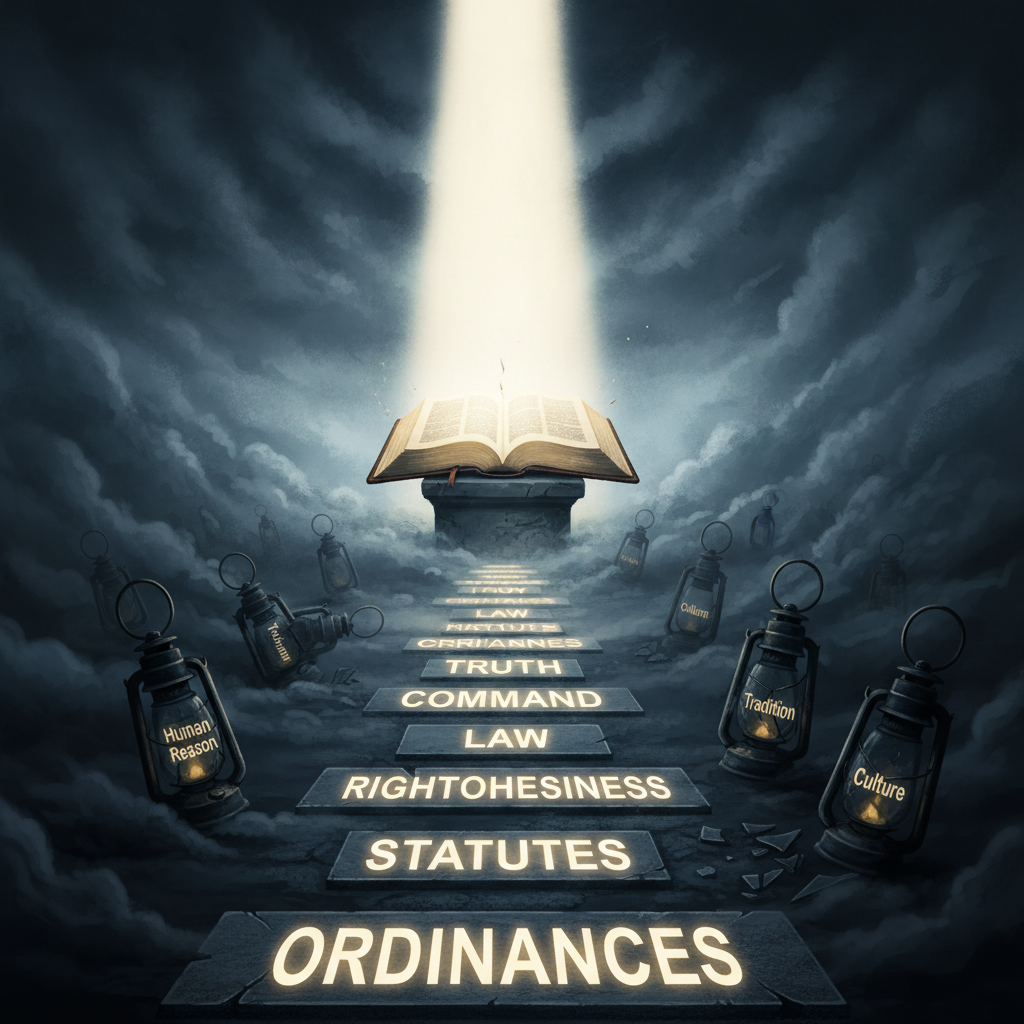
Summary
Theonomous Christian Ethics (ethics governed by God) often asserts that the Bible is the only authority for moral decision-making. This view is commonly known as Sola Scriptura ("Scripture Alone"). The Bible is seen as divinely inspired, infallible, inerrant, and self-authenticating—requiring no external validation from Church tradition or human reason.
Core Beliefs:
- The Bible is the Word of God: It is divinely inspired, infallible (cannot fail), and inerrant (contains no errors)
- Propositional Revelation: God communicates clear facts and rules (propositions) in the Bible, such as the Ten Commandments
- Self-Authenticating: The Bible doesn't need the Church or human reason to prove it is true; it stands alone
- Obedience: Christian ethics is simply about reading and obeying these commands
Detailed Explanation
What is Theonomous Ethics?
Etymology
Theonomy comes from the Greek theos (God) and nomos (law). It means ethics are governed by God's law. For many Protestants (especially Evangelicals), the only reliable source of God's law is the Bible.
Theonomy (Accepted)
Ethics governed by God's law alone (the Bible). The only reliable source of moral truth.
Heteronomy (Rejected)
Ethics governed by several sources (e.g., Bible + Church Tradition + Reason, typical of Catholicism).
Autonomy (Rejected)
Ethics governed by the self (e.g., Reason alone or Situation Ethics).
The Bible as "Propositional Revelation"
Key Technical Term
Propositional Revelation means God reveals Himself in facts, sentences, and commands that are objectively true. When the Bible says "Do not murder," it is a direct proposition from God.
Implication: Moral decision-making isn't a guessing game. You don't need to "feel" what is right; you simply look up God's proposition in the text.
The Argument for "Scripture Alone" (Sola Scriptura)
1. Human Reason is Fallen
Thinkers like St. Augustine and John Calvin argued that human reason was corrupted by the Fall (Original Sin). Therefore, we cannot trust our own logic or conscience to figure out right from wrong. We need an external, perfect standard: The Bible.
2. The Bible is "God-Breathed"
The key proof-text is 2 Timothy 3:16:
"All Scripture is God-breathed and is useful for teaching, rebuking, correcting and training in righteousness."
3. Limit of Church Authority
Reformers like Martin Luther argued that the Church is made of fallible humans who can make mistakes. Only the Bible is the unchangeable standard against which even the Pope must be judged.
Key Thinker: Richard Mouw (The Moderate Theonomist)
Essential for Evaluation in Essays
Richard Mouw defends the Bible's authority but adds nuance. He navigates the middle ground between ignoring God's specific rules and worshipping the text without understanding its context.
Against Situation Ethics
Mouw rejects the idea (popularized by Joseph Fletcher) that the only biblical command is "love." He argues the Bible contains many specific commandments that are still relevant today.
The Problem of "Bibliolatry"
However, Mouw warns that we must not turn the Bible into an idol. We cannot just pick random verses out of context. We must look at the whole narrative of the Bible to understand God's will.
Key Thinker: Karl Barth (The Critique of Literalism)
Used to Critique Strict Biblicism
Karl Barth maintains a high view of Scripture while warning against treating it as a static rulebook.
The Three Forms of the Word
Barth argued Jesus is the true Word of God. The Bible is a witness to that Word.
The Danger
If we treat the Bible as a static rulebook of "divine facts," we limit God. We make the book into a "paper pope."
The Event
Revelation is an event that happens when God speaks through the text to the reader. The text itself is human and fallible, but God uses it to reveal perfect truth.
Problems with "Bible Only" Ethics
The Problem of Interpretation
Even "literalists" interpret. They choose to follow the ban on theft but ignore the ban on eating shellfish or wearing mixed fabrics. This suggests they are unconsciously using reason or culture alongside the Bible.
The "Silent" Bible
The Bible is the only authority? What does it say about IVF, AI, or nuclear weapons? A strict theonomous approach struggles to apply ancient texts to modern technology without using Reason (Heteronomy).
Scholarly Perspectives
"All Scripture is God-breathed and is useful for teaching, rebuking, correcting and training in righteousness, so that the servant of God may be thoroughly equipped for every good work."
2 Timothy 3:16-17 — This is the foundational text for Theonomous ethics, used to argue that the Bible contains everything necessary for moral life ("thoroughly equipped"), implying no other source is needed.
"We must be careful not to turn our high regard for the Bible into a kind of bibliolatry... But we must also avoid the opposite danger... of failing to take seriously the specific commands and guidelines that God has given us."
Paraphrase/Summary from The God Who Commands (1990) — Mouw navigates the middle ground. He criticizes Situation Ethics for ignoring God's specific rules, but criticizes Fundamentalism for worshipping the text without understanding its context.
Key Takeaways
Quick Reference: Key Terminology
| Term | Definition |
|---|---|
| Theonomy | Ethics governed by God (specifically God's laws) |
| Sola Scriptura | The belief that the Bible is the only supreme authority for faith and practice |
| Biblicism | A reliance on the literal interpretation of the Bible as the final truth |
| Propositional Revelation | The idea that God reveals Himself in objective facts, statements, and commands |
| Bibliolatry | Making an idol out of the Bible (worshipping the book rather than the Author) |
| Inerrancy | The belief that the Bible contains no errors of any kind |
| Hermeneutics | The science/method of interpreting the Bible |
Exam Tips
- It's not just "Reading the Bible": Don't just say "Christians read the Bible." Use terms like Propositional Revelation and Theonomy.
- The Problem of Interpretation: A major weakness is that even "literalists" interpret. They follow the ban on theft but ignore bans on shellfish or mixed fabrics—suggesting unconscious use of reason or culture.
- The "Silent" Bible: What does it say about IVF, AI, or nuclear weapons? Strict theonomy struggles to apply ancient texts to modern technology without using Reason (Heteronomy).
- Mouw is your "Evaluation" Hero: Use Richard Mouw to save the Theonomous view. He admits we interpret but insists we must still look for the "Divine Command" rather than just doing whatever we feel is loving.
Visual Metaphor: Sources of Light
Theonomy (Bible Only)
One single, high-powered spotlight (The Bible) cutting through the darkness. Sharp, clear, and focused. If you step outside the beam, you are in the dark.
Heteronomy (Multiple Sources)
A chandelier with three bulbs: Bible (central), Church (Tradition), and Reason. They overlap to illuminate corners the Bible might not reach directly.
Autonomy (Self)
The individual is holding a flashlight (Reason/Conscience). They decide where to point it.