Different Christian Views on Election
Summary
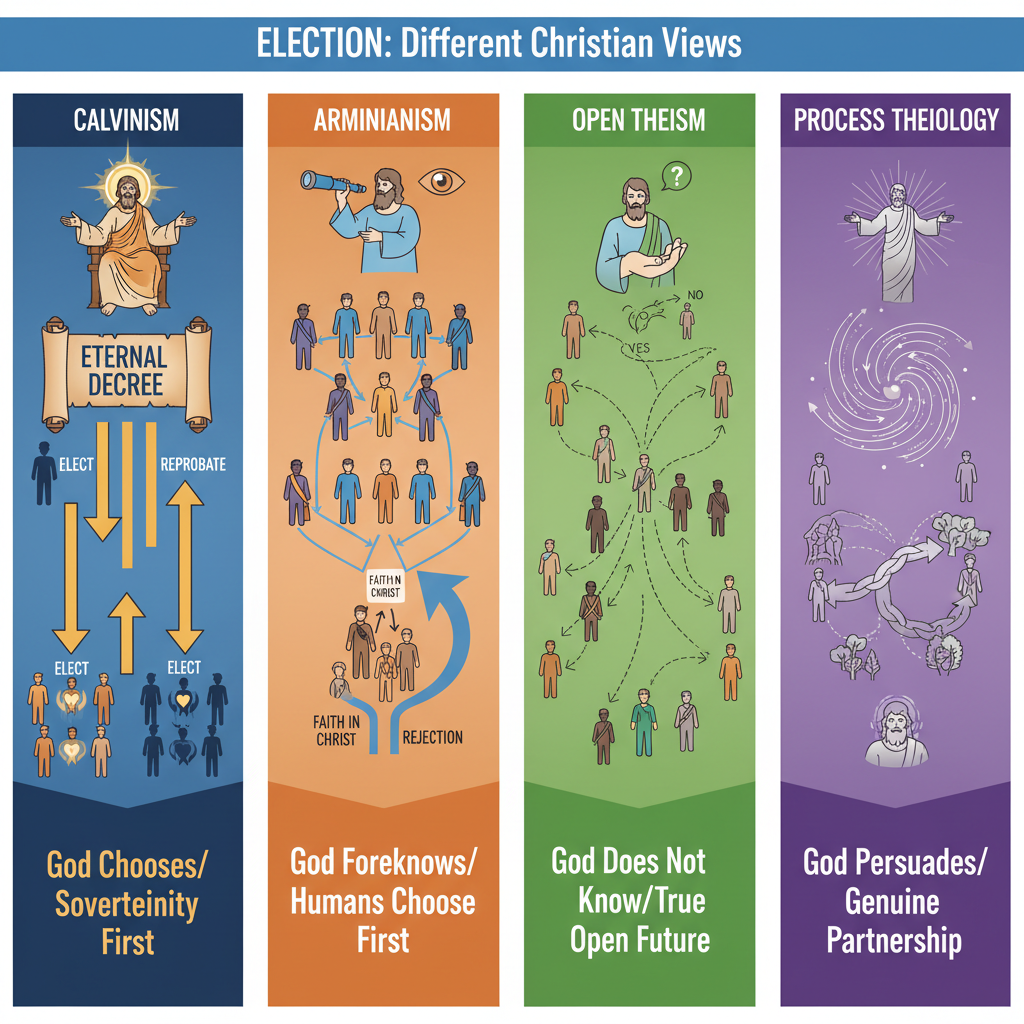
Election (or Predestination) is God's choice of certain people for salvation—but Christians sharply disagree on what this means. The central question is: "On what basis did God choose to save some individuals?" The answer reveals four fundamentally different theological views: Calvinism (God freely chooses based on sovereign grace alone), Arminianism (God foreknows who will freely believe), Open Theism (God cannot know future free choices), and Process Theology (God persuades but doesn't determine outcomes).
Detailed Explanation
The Theological Background: Why Election Matters
Scriptural Basis:
Scripture speaks of election in passages like:
- Ephesians 1:4-5: "God has chosen us in [Christ]...to be holy and blameless before him in love"
- Romans 8:29: "Those whom he foreknew he also predestined"
- 1 Peter 1:1-2: "Chosen according to the foreknowledge of God"
The Core Problem Election Attempts to Answer:
If God is truly omniscient (knows all things), how can human beings have genuine free will? If God knows before creation who will believe and who won't, aren't our choices predetermined? Election doctrines attempt to explain how divine foreknowledge and human freedom coexist.
Pastoral Significance:
Election is not abstract speculation but assurance of God's love—it affirms that our lives are in God's hands rather than in the grasp of capricious fate.
View 1: Calvinism (Unconditional Election)
Definition:
"God has chosen from eternity those whom he will bring to himself not based on foreseen virtue, merit, or faith in those people; rather, his choice is unconditionally grounded in his mercy alone."
Key Features:
God's Sovereignty is Primary:
- God's sovereignty is supreme—God absolutely controls all things
- God the Father elects some people for salvation
- God the Son dies for the elect
- God the Spirit sanctifies the elect throughout their lives
- All takes place through God-given means: preaching, sacraments, etc.
Election is Unconditional:
- God's choice is not based on foreseen faith, virtue, or merit—the individual's choice doesn't determine election
- Election flows solely from God's mercy and sovereign will
- God freely chooses to save specific individuals before time began
Double Predestination (Reprobation):
- Calvin teaches that election logically requires its counterpart: reprobation
- Those God does not elect are predestined to damnation
- Calvin: "Whom God passes over, he condemns"
- Key distinction: Salvation presupposes no human merits (pure grace); damnation presupposes human sin (just judgment)
- The reprobate are damned because of their sin, not because God arbitrarily chose their damnation
Assurance Through Christ:
- Although we cannot directly know if we're among the elect, assurance comes through finding grace in Christ
- Calvin: Christ is the "mirror of election"—we contemplate our election in Christ's saving work
Strengths:
- Preserves God's absolute sovereignty and omniscience
- Takes God's transcendence seriously—God is not bound by human choices
- Emphasizes grace alone—nothing we do earns salvation
Weaknesses:
- Theodicy problem: If God predestines people to damnation, how is God just?
- Pastoral concern: Does this undermine motivation for evangelism?
- Moral objection: Seems unfair that God would create people He knows will be damned
Calvin's Solution to Theodicy:
Twofold causality: All praise for salvation goes to God (election); all blame for damnation goes to humans (sin). The elect's salvation is God's gracious choice; the reprobate's damnation is their just punishment for sin. These two causal chains "always harmonize in the sovereign will."
View 2: Arminianism (Conditional Election)
Definition:
Election is based on God's foreknowledge—God foreknows (foresees) who will freely choose to believe, and elects those individuals.
Key Features:
God's Foreknowledge is Primary:
- God's omniscience comes first—God knows what humans will freely choose
- "Foreknowing is foreseeing"—God foresees the future free choices of humans
- Based on this foreknowledge, God then makes His electing decision
Election is Conditional:
- Election depends on a human condition: freely choosing faith in Christ
- God foresees that specific individuals will freely choose to believe, and then afterwards chose to save those individuals
- The decisive factor in election is what humans freely choose, not what God chooses
Prevenient Grace Enables Choice:
- How can humans freely choose God if the Fall enslaved their will? Through prevenient grace
- Prevenient grace is grace that goes before (precedes) and restores to all humans the freedom of will lost in Adam's Fall
- Prevenient grace provides the ability to choose or reject God—it's given universally but resistible
- Some accept it; others reject it
Key Difference from Calvinism:
- Calvinist: God's foreknowledge = foreloving (personal commitment to specific individuals beforehand)
- Arminian: God's foreknowledge = foreseeing (knowledge of what humans will freely do)
Possibility of Apostasy:
- Some Arminians argue that if someone abandons faith later, their election is undone
- A person can be in a state of grace but later reject God and be consigned to Hell
Strengths:
- Preserves human freedom: Humans genuinely choose to believe
- Preserves God's justice: Damnation is for rejecting God's offer
- Preserves universal offer: Prevenient grace makes salvation available to all
- Motivates evangelism: Humans genuinely respond to the Gospel
Weaknesses:
- Threatens God's sovereignty: Human choice determines salvation
- Logical objection: How can God's "knowledge" be certain without determining?
- Circularity problem: God foresees choice, then elects based on foreseen choice
View 3: Open Theism
Definition:
God does not know in advance what free humans will choose. The future is genuinely open, containing possibilities God knows but hasn't determined.
Key Features:
God Cannot Know Future Free Choices:
- "Since God himself cannot know in advance what free human beings will do in response to the gospel call to faith, he cannot elect them (or anyone for that matter) to salvation"
- Free acts are unknowable even to God before they occur in time
- This is not a limitation on God's power, but a logical necessity of freedom
Divine Self-Limitation:
- God sovereignly chooses to limit His control to preserve genuine human freedom
- God "delegates responsibility" and "is willing to share power with humans"
- God and creation collaborate as partners
Election Cannot Be Traditional:
- Open theists cannot affirm the traditional Arminian view (based on foreknowledge of future free choices)
- Because the future is genuinely open, God cannot know in advance who will choose faith
- Therefore, traditional election (predestination to salvation/damnation) is logically impossible
God's Providence is Non-Meticulous:
- God doesn't have "a detailed divine blueprint for my life"
- God governs through general providence, not specific control of every event
- God responds and adapts to human choices in real time
Strengths:
- Maximizes human freedom: Choices are genuinely undetermined
- Solves theodicy: God isn't responsible for evil He didn't foreknow
- Makes prayer meaningful: God genuinely responds to our requests
Weaknesses:
- Limits God's omniscience: God doesn't know everything
- Undermines prophecy: How can God predict the future if He doesn't know it?
- Reduces assurance: God cannot guarantee our salvation
View 4: Process Theology
Definition:
God cannot coerce or determine outcomes but only persuades creation toward good. God and creation are in genuine partnership, with both contributing to the unfolding of reality.
Key Features:
God Persuades, Not Coerces:
- God cannot unilaterally determine any outcome
- God works by persuasion, lure, and invitation—not by force or decree
- God offers possibilities and invites creation to actualize them
Genuine Partnership:
- God and creation are co-creators of reality
- The future emerges from the interplay of divine persuasion and creaturely response
- God is affected by creation—God feels our joys and sorrows
Election Reimagined:
- Traditional election (God choosing specific individuals) is impossible
- God invites all toward salvation but cannot guarantee any individual's response
- Salvation is a collaborative process, not a divine decree
God is Dipolar:
- Primordial nature: God's eternal, unchanging vision of possibilities
- Consequent nature: God's changing experience as creation unfolds
- God is both eternal and temporal, both infinite and finite
Strengths:
- Solves theodicy completely: God cannot prevent evil
- Relational: God is genuinely affected by and responsive to creation
- Empowers humans: We are genuine partners with God
Weaknesses:
- Radically limits God: God cannot guarantee anything
- Departs from tradition: Rejects classical theism entirely
- Undermines hope: Can God really save us if He can only persuade?
How the Views Compare
| Question | Calvinism | Arminianism | Open Theism | Process Theology |
|---|---|---|---|---|
| Does God know future free choices? | Yes, determines them | Yes, foresees them | No, future is open | No, future is open |
| Basis of election? | God's sovereign will alone | Foreseen faith | No traditional election | No election possible |
| Is election unconditional? | Yes | No (conditional on faith) | N/A | N/A |
| Human freedom? | Compatible (determined but free) | Libertarian (genuinely free) | Libertarian (genuinely free) | Libertarian (genuinely free) |
| God's sovereignty? | Absolute | Self-limited | Self-limited | Inherently limited |
| Can salvation be lost? | No (perseverance) | Possibly yes | Yes | Yes |
Scholarly Perspectives
John Calvin on Unconditional Election:
"God has chosen from eternity those whom he will bring to himself not based on foreseen virtue, merit, or faith in those people; rather, his choice is unconditionally grounded in his mercy alone."
Calvin on Double Predestination:
"We call predestination God's eternal decree, by which he determined with himself what he willed to become of each man. For all are not created in equal condition; rather, eternal life is foreordained for some, eternal damnation for others."
Clark Pinnock on Open Theism:
"Since God himself cannot know in advance what free human beings will do in response to the gospel call to faith, he cannot elect them (or anyone for that matter) to salvation."
Pinnock on Divine Self-Limitation:
"God 'delegates responsibility', 'is willing to share power with humans', is 'a God who experiences human history with us', is 'open to what we do', and 'lets the world do things on its own'."
Alister McGrath on Election's Pastoral Function:
"Election is an assurance of God's love—it affirms that our lives are in God's hands rather than in the grasp of capricious fate."
Key Takeaways
The Central Question
"On what basis did God choose to save some individuals?" This question divides Christians into four camps with fundamentally different answers.
Sovereignty vs. Freedom
The debate centers on balancing God's sovereignty (control over all things) with human freedom (genuine choice). Different views prioritize one over the other.
Foreknowledge Debate
Calvinists say foreknowledge = foreloving (God's commitment). Arminians say foreknowledge = foreseeing (God's knowledge). Open theists deny foreknowledge of free acts entirely.
Pastoral Implications
Election doctrines affect how Christians understand assurance, evangelism, prayer, and God's character. Each view has different practical consequences.