Purgatory
Summary
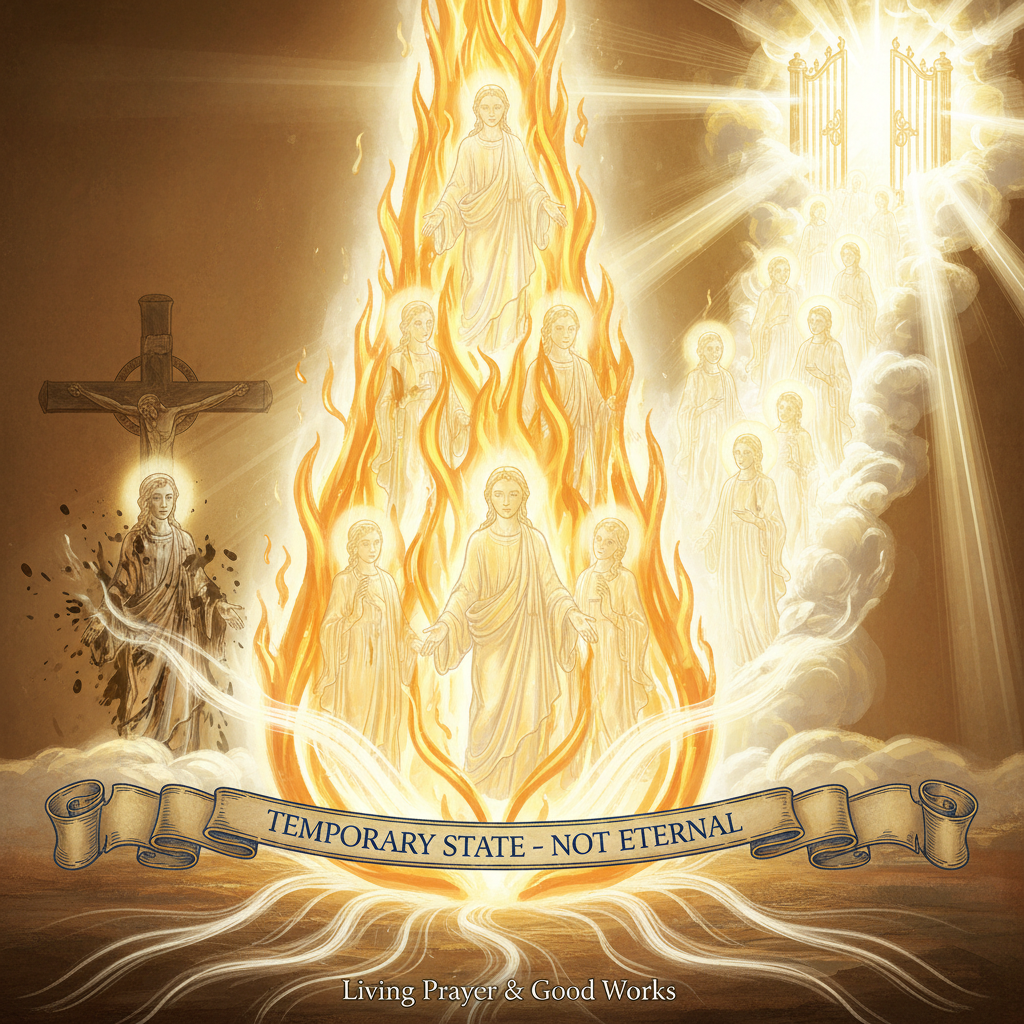
Purgatory, according to Catholic doctrine, is a temporary intermediate state after death for purification before entering heaven. It is for those who die in God's grace but with unconfessed venial sins—minor sins that don't destroy the state of grace but still attach us to temporal things. The cleansing fire of purgatory is purifying, not torment-filled like hell, and souls eventually ascend to heaven after purification. The living can assist souls in purgatory through prayers, Masses, and good works (Intercessory Prayer). Purgatory solves the moral problem: eternal hell seems unjust for minor sin, yet heaven is unsuitable for an unrepented sinner.
Detailed Explanation
Definition and Nature of Purgatory
Catholic Church Teaching:
Purgatory is "the state of those who die in God's friendship, assured of their eternal salvation, but who still have need of purification to enter into the happiness of heaven".
Latin Meaning:
Purgatorium comes from the Latin word meaning "to purge" or "to make clean".
Key Distinctions:
- Not Hell: Purgatory is NOT a place of eternal punishment or damnation
- Not Heaven: Purgatory is NOT immediate entry into heaven
- Intermediate State: It's a temporary condition between death and final entry into heaven
- For the Faithful Only: Purgatory is only for those who die in God's grace/friendship (have faith and have been forgiven mortal sins)
The Gold Furnace Analogy:
Just as dross (impurities) is burned away from gold in a furnace, leaving pure gold, so purgatory is a process where venial sins and spiritual impurities are cleansed, leaving the soul pure enough for heaven.
The Moral Problem Purgatory Solves
The Dilemma:
Catholic theology identifies a moral justice problem:
- It seems unjust to condemn someone to hell for a minor venial sin (e.g., a lie told without serious malice)
- But it also seems contrary to God's holiness to allow an unrepented sinner directly into heaven
- Solution: A temporary purifying state makes sense morally and theologically
Example:
Someone dies after:
- Confessing serious (mortal) sins and being forgiven ✓
- Living faithfully ✓
- But failed to confess minor sins like pride, jealousy, or petty theft (venial sins) ✗
This person is going to heaven (has faith and forgiveness) but is not perfectly pure for heaven's holiness—so enters purgatory for temporary cleansing, then heaven.
What is Cleansed in Purgatory?
Venial Sins:
Purgatory primarily addresses venial sins—minor sins that don't destroy the state of grace but still attach us unhealthily to creatures/temporal things.
Unhealthy Attachments:
- Not guilt, but consequences: If mortal sins are forgiven through confession, their guilt is gone; but venial sins may linger as spiritual impurities or excessive loves of temporal things
- Example: A soul may be forgiven of pride but still has the habitual attachment to seeking human praise. Purgatory cleanses this attachment.
Temporal Punishment:
- Distinct from guilt: Guilt is removed through confession, but temporal (time-bound) punishment may remain
- Like earthly consequences: If you confess stealing and are forgiven, you may still need to make restitution—similarly, spiritual consequences of sin may need to be worked through in purgatory
The Fire of Purgatory
Physical or Spiritual?
The Catholic Church teaches that purgatory involves actual fire, though theologians debate whether this is literal physical fire (like earthly fire) or metaphorical spiritual fire (God's transformative presence burning away impurity).
Aquinas's View:
Aquinas argues for literal, corporeal fire—the same fire that will punish the damned, but experienced differently:
- The damned: Experience it as torment and suffering
- The blessed in purgatory: Experience it as purifying and transformative
Transformative, Not Punitive:
Unlike hell's fire (which torments), purgatory's fire is cleansing and restorative, preparing the soul for heaven.
Duration of Purgatory
- Not Specified: The Catholic Church does not specify how long souls remain in purgatory
- Duration Varies: Different souls have different levels of spiritual impurity; some may be cleansed quickly, others may take longer
- Not Time-Bound Like Earth: It's unclear whether purgatory's time operates like earthly time—it may be a spiritual state not bound by temporal clocks
Intercessory Prayer: Helping Souls in Purgatory
Catholic Practice:
The living can assist souls in purgatory through:
- Prayers for the deceased
- Masses offered for the souls
- Good works and penances offered on their behalf
- Indulgences (remission of temporal punishment)
Scriptural Basis:
Catholic theology points to 2 Maccabees 12:44-45 (deuterocanonical text): "It is therefore a holy and wholesome thought to pray for the dead, that they may be loosed from sins"
How It Works:
- Indulgences: The Church can grant indulgences—remission of temporal punishment—for prayers and good works
- Plenary Indulgence: A full remission of temporal punishment for a seven-day exercise of prayer
Communion of Saints:
This doctrine affirms the communion of saints—the living and dead remain connected through prayer and spiritual support.
Purgatory in Scripture (Catholic Interpretation)
Main Texts:
1 Corinthians 3:11-15:
"If anyone builds on this foundation using gold, silver, costly stones, wood, hay or straw, their work will be shown for what it is, because the Day will bring it to light. It will be revealed with fire, and the fire will test the quality of each person's work."
Catholic interpretation: The fire tests and purifies our works; those with impurities (venial sins) will be burned away.
2 Maccabees 12:44-45:
"It is therefore a holy and wholesome thought to pray for the dead, that they may be loosed from sins."
This explicitly supports prayer for the dead to help them be freed from sins.
Matthew 12:31-32:
"Whoever speaks against the Holy Spirit will not be forgiven, either in this age or in the age to come."
Catholic reading: Implies that some sins CAN be forgiven in the age to come, supporting purgatory.
1 Peter 3:18-19:
"Christ also suffered...that he might bring us to God...in which he went and preached to the spirits in prison."
Catholic view: Christ preached to those in an intermediate state (spirits in prison/limbo), showing intermediate states exist.
Protestant Objections to Purgatory
Main Criticisms:
1. Not Clearly in Scripture:
- Purgatory is never explicitly named in the Bible
- 2 Maccabees is considered apocryphal by Protestants (not canonical Scripture)
- Other texts are interpreted differently by Protestants
2. Undermines Christ's Work:
- Christ's sacrifice was complete: "By one sacrifice he has made perfect forever those who are being made holy" (Hebrews 10:14)
- Purgatory suggests Christ's work wasn't fully sufficient—we must still be purified
- Grace doctrine: Through Christ, we're declared righteous; no further cleansing is needed
3. Justification by Faith, Not Works:
- Purgatory can imply that our sanctification (becoming holy) is necessary for salvation, but Protestants teach justification is by faith alone
- Prayer and indulgences for the dead may imply human works can help salvation, which Protestants reject
Different Christian Views on Purgatory
Catholic Church:
- Affirms purgatory as essential doctrine
- Temporary state of purification for those destined for heaven
- Living can help through prayers, Masses, and indulgences
Eastern Orthodox Church:
- Rejects formal purgatory doctrine
- But accepts that souls may be in a state of growth/improvement after death
- Prays for the dead but doesn't affirm purgatorial fire
Protestantism (Mainline & Evangelical):
- Rejects purgatory as unbiblical
- Teaches direct entry to heaven or hell after death
- Some Lutheran and Wesleyan traditions allow for some post-mortem growth but not a formal purgatory
Limbo:
- Catholic theology historically taught "limbo of the fathers"—a temporary state for Old Testament saints before Christ's resurrection
- Some speculate limbo was similar to purgatory, showing the concept of intermediate states isn't unbiblical
Scholarly Perspectives
Quote 1: Purgatory's Moral Justification
"It seems unjust for someone to be condemned to eternal hell for a minor venial sin, yet it also contradicts God's holiness to allow an unrepented sinner directly into heaven. Therefore, purgatory—as a temporary intermediate state of purification—provides the moral and just solution. Those in God's grace who have unconfessed venial sins enter purgatory where the cleansing fire purges them, leaving them pure enough to enter heaven's joy."
Source: Catholic Catechism. Explains the theological logic behind purgatory as a solution to the justice problem of venial sin.
Quote 2: Aquinas on Purgatorial Fire
"Venial sin in one who dies in a state of grace is remitted after this life by the fire of Purgatory. The soul in purgatory experiences this fire voluntarily and through God's grace, and this voluntary acceptance of punishment produces an actual movement of charity and contrition that cleanses the soul from venial sin. The same fire torments the damned, but purifies and transforms the blessed destined for heaven."
Source: Aquinas, Summa Theologiae, Supplement, Part III. Explains how purgatory's fire is not arbitrary punishment but a transformative process enabled by grace.
Key Takeaways
- Purgatory is temporary: Not eternal like hell, but a passing state before entering heaven
- For the faithful with minor sins: Those in God's grace with unconfessed venial sins go to purgatory
- Cleansing, not torment: Unlike hell, purgatory's fire is purifying and transformative
- Moral justice: Purgatory solves the justice problem—neither condemning to hell for minor sin nor allowing unpurified entry to heaven
- Prayers help: The living can assist through prayers, Masses, good works, and indulgences
- Communion of saints: Affirms the spiritual connection between living and dead
- Aquinas's teaching: Fire in purgatory cleanses by producing voluntary contrition and charity through grace
- Not universal: Only Catholic doctrine formally affirms purgatory; Protestants reject it as unbiblical
- Scriptural basis (Catholic view): 1 Corinthians 3:11-15 (testing fire), 2 Maccabees 12:44-45 (prayer for dead), Matthew 12:31-32 (forgiveness in age to come)