Hell
Summary
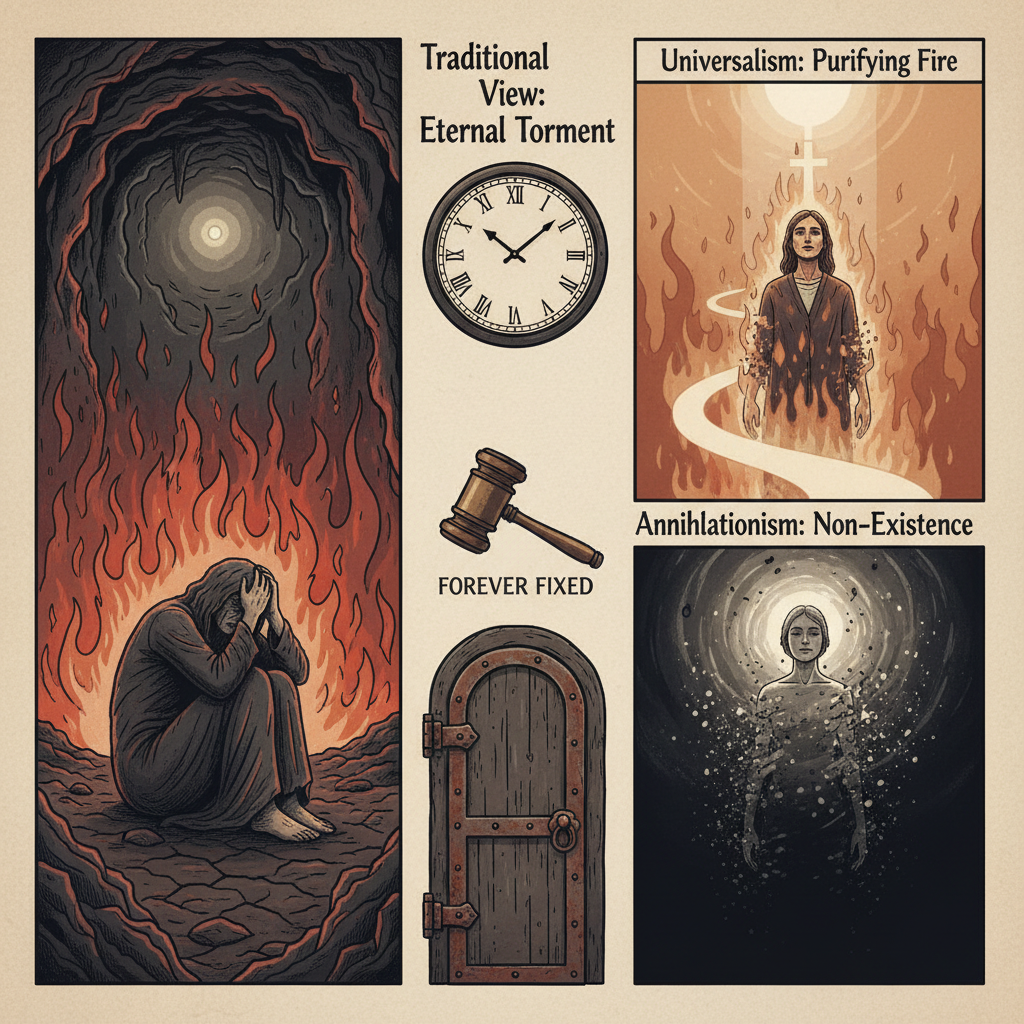
Hell, in Christian theology, is the state or place of eternal punishment and separation from God for those who die in mortal sin or reject God's offer of salvation. The primary punishment is being forever cut off from God's presence, love, and grace (Pain of Loss), while the secondary punishment involves conscious suffering (Pain of Sense). After death, the will becomes forever fixed—no repentance is possible. Three main Christian views exist: Traditionalism (eternal conscious torment), Universalism (temporary purifying punishment leading to eventual reconciliation), and Annihilationism (the damned cease to exist rather than suffering eternally).
Detailed Explanation
Traditional View: Eternal Conscious Torment
Definition:
Hell is an eternal state of separation from God where the damned suffer eternally for their rejection of God and unrepented mortal sins.
Two Types of Suffering in Hell:
1. Pain of Loss (Primary):
- Separation from God: Forever cut off from God's presence, love, mercy, and forgiveness
- Loss of Beatific Vision: Unlike the blessed in heaven, the damned will never see God face to face
- Permanent Loss: This separation is irrevocable and irreversible—no second chances
- Agony of Deprivation: Since humans are made for union with God, separation from Him is the ultimate loss
2. Pain of Sense (Physical/Mental):
- Fire: Jesus and Scripture describe hell as a place of "unquenchable fire" and "furnace of fire"
- Aquinas's Defence: Aquinas argues this fire is real, corporeal fire that will torment both souls and (after resurrection) resurrected bodies
- Mental Torment: The damned will experience endless remorse, guilt, shame, and self-condemnation
- Absence of Goodness: Hell is a state of perpetual sinfulness with no virtue, no growth, no beauty
Why Eternal? The Doctrine of Fixed Will
Augustine and Aquinas argue that the eternity of hell is not inherent to the punishment itself—it's a consequence of fixed will.
- After death, repentance is impossible: Like clay pottery in a kiln, once our life is finished, our choice is forever set
- The damned choose hell: They actively refuse God's mercy even if it were offered, so they remain separated
- God respects their choice: God does not force the damned into heaven; He respects their free rejection of Him
Aquinas's Teaching on Hell:
- The damned would actually be more miserable in heaven because God's love (which burns as fire to those who reject Him) would be even more agonising
- Those in hell understand God's justice and accept their punishment as deserved
Scriptural Basis:
- Matthew 25:41: "Depart from me, you cursed, into the eternal fire"
- 2 Thessalonians 1:8-9: "Punished with everlasting destruction and shut out from the presence of the Lord"
- Revelation 20:10: "The devil...will be tormented day and night for ever and ever"
Strengths and Weaknesses of the Traditional View
Strengths:
- Consistent with Scripture and Tradition
- Takes human freedom seriously—respects people's choice to reject God
- Maintains justice—the damned receive consequences for freely chosen sins
Weaknesses:
- Disproportionate punishment: Infinite eternal punishment for finite sins seems unjust (Hume's proportionality argument)
- Problem of omniscience: If God knows before creation who will be damned, why create them?
- Incompatible with omnibenevolence: Eternal torture seems at odds with God being all-loving
Alternative View 1: Universalism (Universal Reconciliation)
Definition:
Hell is not eternal, but a temporary state of purification through which even the most hardened sinners will eventually pass before being reconciled to God.
Core Beliefs:
- Everyone will eventually go to heaven—though some take much longer than others
- Hell is therapeutic, not retributive—it's designed to heal and transform, not eternally punish
- God's love is ultimate—God will not allow anyone to be eternally separated from Him
Hick's Soul-Making Theodicy:
- God allows free will and evil to enable spiritual and moral growth ("soul-making")
- Even Hitler might need eons in a purifying state to transform morally
- But eventually, everyone will freely choose God through the process of purgation and healing
Scriptural Support (Universalist Reading):
- 1 Timothy 2:4: "God wants all people to be saved"
- Romans 5:18: "The gift of grace overflowed to all people"
- Revelation 21:4: "He will wipe every tear from their eyes. There will be no more death or mourning or crying or pain"
Strengths:
- Preserves God's omnipotence and benevolence—God will ultimately save everyone
- Proportional punishment—finite sins receive finite punishment, not infinite
- Respects God's love—God never gives up on anyone
Weaknesses:
- Reduces moral accountability: If everyone goes to heaven eventually, why live morally?
- Contradicts Scripture: Jesus warns of "eternal fire" and "outer darkness"
- Controversial tradition: Most Christian churches reject universalism as heretical
Alternative View 2: Annihilationism (Conditional Immortality)
Definition:
The damned do not exist eternally—they are annihilated or cease to exist rather than suffering eternally.
Core Beliefs:
- Immortality is not inherent: Humans only exist eternally if God grants it
- The wicked are not granted immortality: They experience a "second death" (cessation of existence)
- Hell is the absence of existence, not eternal conscious torment
Biblical Support:
- Matthew 10:28: Jesus says "Fear him who is able to destroy both soul and body in Gehenna"
- 2 Peter 2:12: The wicked "will be destroyed"
- The word "Gehenna" (Jesus's term for hell) originally meant a garbage dump where refuse was burned/destroyed, not an eternal prison
How It Works:
- After judgment, the wicked are destroyed like a consumed fire—they no longer exist
- This is punishment because non-existence is the ultimate deprivation
- It's final and irreversible, but not an eternity of suffering
Strengths:
- Avoids the cruelty of eternal torture—more merciful than eternal conscious torment
- Scriptural support—the language of "destruction" and "consumption" in Scripture
- Proportional—finite sins result in finite punishment (cessation) rather than infinite
Weaknesses:
- Contradicts immortality doctrine: Conflicts with belief that the soul is immortal
- Less scriptural support: Requires reinterpreting much of the Bible's teaching on eternal fire
- Unpopular tradition: Most Christian denominations reject it
The Problem of Hell (Theological Challenge)
The Central Problem:
Hell seems incompatible with God's omnibenevolence (all-loving nature).
The Argument:
- Disproportionality: No matter how evil a person's finite sins are, infinite eternal punishment is disproportionate. Example: Even Hitler's infinite wickedness was finite in scope and duration. How is eternal torment just?
- Omniscience Problem: If God knows before creation who will be damned, why create them at all? This seems cruel and wasteful.
- Free Will Problem: How can people freely choose damnation if God created them knowing they would?
Theological Responses:
- Aquinas: The eternity comes from fixed will (refusal of repentance), not cruelty—God respects the damned's choice
- Libertarian Free Will: Humans have genuine libertarian freedom, so God cannot know with certainty who will be damned
- Soul-Making Theodicy (Hick): Hell is temporary and therapeutic, eventually leading to universal reconciliation
- Annihilationism: The punishment is finite (cessation), making it proportional
Different Christian Denominational Views
| Denomination | View of Hell |
|---|---|
| Catholic Church | Hell exists and is eternal. Self-exclusion: People choose hell by finally refusing repentance at death. Primary punishment: Separation from God's beatific vision. Purgatory: A temporary state for those who die in venial sin. |
| Protestant Evangelical | Traditional eternal torment is the mainstream view. Hell is punishment for rejecting Christ and dying in sin. |
| Latter-Day Saints (LDS) | Multiple levels of afterlife ("degrees of glory"). Hell (Spirit Prison) is temporary—even those who reject Christ can repent in the afterlife. |
| Liberal/Progressive Christianity | Many reject literal hell. Some embrace universalism or annihilationism. |
Scholarly Perspectives
Traditional View (Aquinas)
"Hell is eternal because repentance is no longer available after death. Our decision for or against God becomes forever fixed at the moment of death, like clay pottery placed in a kiln. The damned experience separation from God—the loss of the beatific vision—which is the chief punishment. Those in hell would be more miserable in heaven because God's love burns as fire to those who have rejected Him. God does not drag unwilling souls to heaven; He respects their choice to be separated from Him."
Source: Aquinas, Summa Theologiae; contemporary Catholic theology.
Context: Defends the justice of eternal hell by arguing it results from fixed will and God's respect for freedom, not arbitrary cruelty.
Universalist View (John Hick)
"Hume's proportionality argument shows that infinite eternal punishment for finite sin cannot be just. A truly omnibenevolent God would not create beings only to torture them eternally. Instead, hell is a temporary, therapeutic state through which even the most hardened sinners eventually pass through purification and transformation, ultimately being reconciled to God. This preserves both God's justice and God's love."
Source: John Hick's soul-making theodicy; philosophical critique of hell.
Context: Presents the universalist solution to the problem of hell, arguing for proportional finite punishment and universal reconciliation.
Key Takeaways
Hell is separation from God
The primary punishment is forever losing the Beatific Vision—being cut off from God's presence.
Self-chosen
Hell is not arbitrarily imposed—it's the consequence of freely rejecting God.
Fixed will
After death, repentance is impossible; the will becomes eternally set.
Three main views
Traditional (eternal torment), Universalism (temporary purification), Annihilationism (cessation of existence).
Problem of hell
Seems unjust and incompatible with God's love (Hume's proportionality argument).
Aquinas's defence
The eternity comes from fixed refusal to repent, not cruelty; God respects freedom.
Quick Reference: Hell Concepts
| Concept | Meaning |
|---|---|
| Hell | Eternal state of separation from God for the unrepentant |
| Pain of Loss | Primary punishment—deprivation of God's presence |
| Pain of Sense | Secondary punishment—physical torment and mental anguish |
| Fixed Will | After death, one's choice is unchangeable and eternal |
| Gehenna | Jesus's term for hell; originally a garbage dump (destruction) |
| Universalism | All will eventually be reconciled to God |
| Annihilationism | The damned cease to exist; not eternal conscious torment |
| Soul-Making | Hick's theodicy—suffering enables spiritual growth |
| Problem of Hell | Hell seems incompatible with God's omnibenevolence |