Heaven
Summary
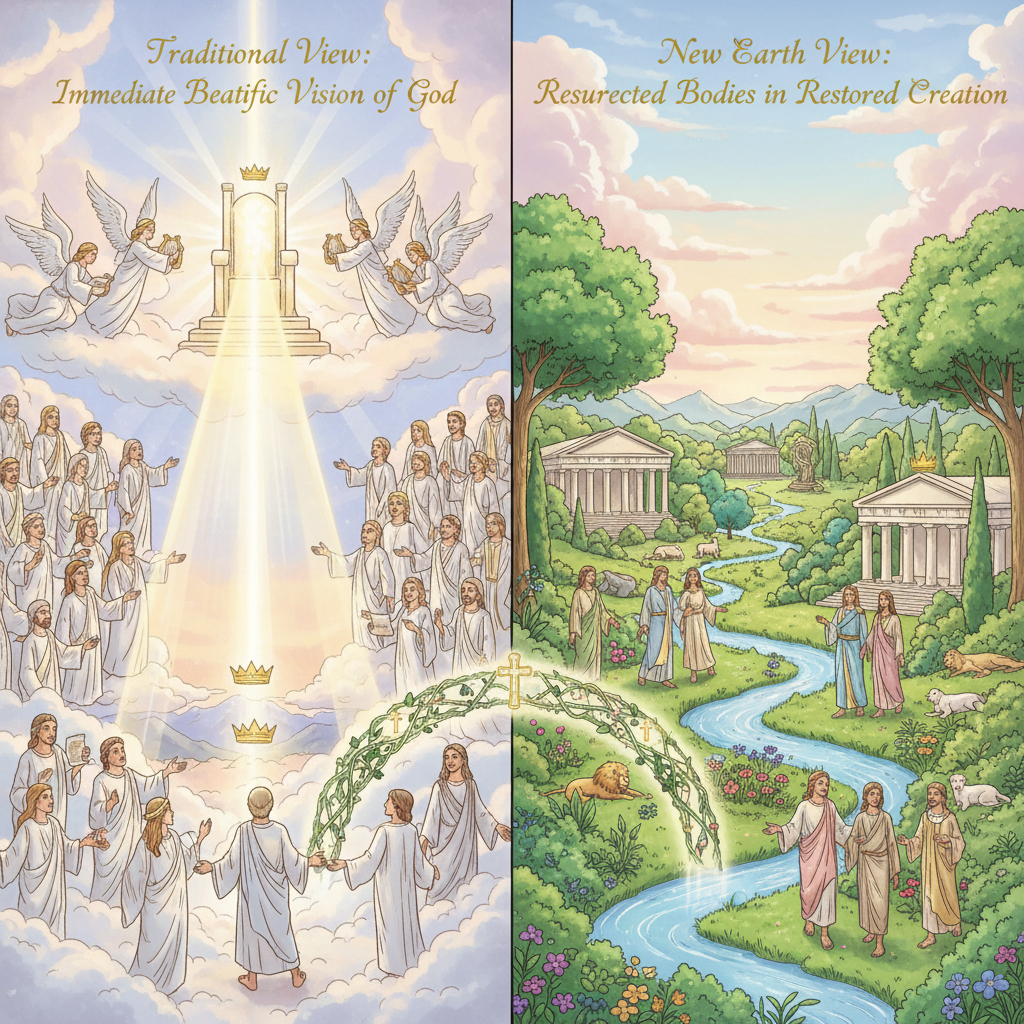
Heaven, in Christian theology, is the ultimate destination and fulfilment of believers—the state of perfect happiness and communion with God after death. At its heart is the Beatific Vision: seeing God "face to face" in direct, perfect knowledge. Heaven means supreme happiness, freedom from sin, suffering, and death, and eternal communion with Christ, angels, and all the saints. Two main views exist: the Traditional View (an ethereal spiritual realm where souls immediately experience the Beatific Vision) and the New Earth View (the future restoration of creation where resurrected bodies will live eternally in a perfected physical world).
Detailed Explanation
What is Heaven?
Definition from Catholic Teaching:
"Heaven is the ultimate end and fulfilment of the deepest human longings, the state of supreme, definitive happiness."
Core Characteristics:
- Perfect Knowledge: Direct vision of God (Beatific Vision)
- Perfect Happiness: Complete joy and fulfilment
- Eternal Life: Immortality; no death, suffering, sin, or evil
- Community: Communion with God, Christ, angels, and all the blessed
- Reward: Recognition and approval for faithful living
The Beatific Vision: The Heart of Heaven
Definition:
The immediate, direct knowledge and vision of God—seeing God "face to face" rather than through faith or reason.
Key Features:
- Direct Union: No intermediary between the soul and God
- Perfect Knowledge: Complete understanding of God's essence and nature
- Perfect Love: In seeing God's infinite goodness, we are perfected in loving Him
- Supreme Happiness: Because God is ultimate perfect goodness, union with Him brings supreme definitive happiness
Why Only the Beatific Vision Satisfies:
- Reason is insufficient: Human rational knowledge can only reach God indirectly through inference about the sensible world
- Faith is incomplete: Faith, while true, always contains some imperfection—it doesn't fully grasp the object of faith
- The Soul's Fundamental Desire: Humans have an innate desire to know God directly, not just about God; only the Beatific Vision satisfies this desire
Aquinas's Teaching:
Aquinas argues that our perfect happiness and final end can only be the direct union with God Himself, not with any created thing. In this seeing/knowing, we also perfectly love God.
Traditional View: Ethereal Heaven
Description:
Heaven is an ethereal, spiritual realm (not a physical place) where souls exist in a state of direct communion with God.
Key Beliefs:
- Immediate Transition: After death, the soul goes directly to heaven (or hell), not waiting for resurrection
- Disembodied Existence: Souls are non-physical, spiritual entities
- The Beatific Vision: Souls experience direct vision of God
- Communion: Souls pray for each other and intercede for the living
- Purgatory (Catholic View): Some souls go to purgatory first to be purified before meeting God
Strengths:
- Fits with immediate post-mortem experiences described in Scripture
- Explains Jesus's promise to the thief on the cross: "Today you will be with me in paradise"
- Emphasises spiritual union with God as the ultimate goal
Weaknesses:
- Disembodied existence seems impersonal and abstract
- Doesn't account for the resurrection of the body emphasised in Scripture
- Can seem like escape from the world rather than renewal of creation
New Earth View: Resurrected Physical Heaven
Description:
Heaven is not a separate spiritual realm but the future transformation of the physical earth.
Key Beliefs:
- Resurrection of the Body: Our physical bodies will be raised and transformed into "spiritual bodies" (1 Corinthians 15)
- Earth Renewed: God will restore creation to its pre-Fall perfection—a "New Earth" without death, pain, or corruption
- Physical but Transformed: The resurrected bodies will be physical but glorified—like Jesus's resurrection body, which could appear/disappear but was still recognisable
- Embodied Existence: We will live in a physical community—gardens, cities, relationships—not as disembodied spirits
- Kingdom on Earth: Jesus taught us to pray: "Your kingdom come, your will be done, on earth as it is in heaven"—suggesting God's rule will come to earth
N.T. Wright's Argument:
- The Incarnation (God became flesh in Jesus) and Resurrection (Jesus rose physically) suggest God values the physical world
- God's ultimate plan is not spiritual escape but renewed creation
- We should care for the earth now because it will be restored eternally
Strengths:
- Emphasises bodily resurrection central to Christian faith
- Takes the physical world seriously—God created it; He'll restore it, not destroy it
- Motivates environmental stewardship and earthly action
- Fits Jesus's resurrection model
Weaknesses:
- Doesn't clearly explain the intermediate state (what happens to believers between death and resurrection)
- Seems to defer hope to a distant future rather than present communion with God
Heaven as Reward: The Doctrine of Eternal Rewards
Catholic and Christian Teaching:
Heaven is not just a free gift to all believers—there are also eternal rewards based on faithful living.
How Rewards Work:
- Acceptance vs. Approval: All believers who trust in Christ receive unconditional acceptance (cannot be lost)
- But rewards are different: They are given for approval of God—for living faithfully, serving others, and glorifying Christ
Examples of Rewards:
- Sharing in Christ's rule and authority
- Greater joy and intimacy with God
- Honour and glory before the angels and saints
- Responsibilities in God's renewed kingdom
The Parable of the Sheep and Goats (Matthew 25):
- Jesus separates the righteous (sheep) from the unrighteous (goats)
- The sheep are those who cared for the poor, sick, and marginalised ("Whatever you did for the least of these, you did for me")
- Both go to eternal destinations (heaven/hell), but there's a judgment of works determining reward level
Why Rewards Matter:
- God recognises faithfulness: The words "Well done, good and faithful servant" will be an eternal crown
- Motivation for faithful living: Christians are called to live righteously, not just for salvation, but for approval and reward
- Actions matter: Even though salvation is by grace, our choices and service have eternal significance
Different Christian Denominational Views
| Denomination | View of Heaven |
|---|---|
| Catholic Church | Supreme happiness in communion with the Trinity, Mary, angels, and saints. Some souls go through Purgatory first. Beatific Vision is central. |
| Protestant Mainline | Emphasis on resurrected embodied existence in a renewed creation. Less emphasis on purgatory. Focus on future kingdom coming to earth. |
| Evangelical Protestantism | Emphasis on eternal life and rewards. Strong focus on faithful living earning heavenly rewards. Both spiritual communion and future bodily resurrection. |
| Seventh-Day Adventists | Heaven is God's throne room where He resides. Believers will be resurrected and given immortal bodies. |
| Latter Day Saints (LDS) | Three levels ("degrees of glory")—celestial, terrestrial, and telestial kingdoms. Different levels based on faithfulness. |
Heaven as Symbolic/Psychological (Modern Secular View)
Alternative Interpretation:
Some liberal Christian theologians argue that heaven may be:
- Psychological symbol for human happiness and fulfilment
- Symbolic representation of union with God and moral transformation in this life
- Not a literal place or afterlife, but spiritual realities accessible now
Theological Basis:
Jesus said the kingdom of God is "within you" (Luke 17:21). Spiritual transformation and union with God can happen in this life.
Critique:
This view weakens belief in actual resurrection and eternal life, making Christianity primarily about earthly ethics rather than eschatological hope.
Scholarly Perspectives
Aquinas on the Beatific Vision
"The immediate knowledge of God which the blessed enjoy in Heaven... When the soul beholds God face to face and sees Him as He truly is, the created intelligence finds perfect happiness. This vision is called 'beatific' because in beholding God, who is fullness, beatitude, and perfection itself, the soul experiences supreme definitive happiness—the fulfilment of all human longing."
Source: Aquinas, Summa Theologiae; Catholic Encyclopedia on Beatific Vision
Context: Explains how the Beatific Vision is the core of heaven—direct knowledge of God in perfect love and happiness.
N.T. Wright on the New Earth View
"'Your kingdom come, your will be done, on earth as it is in heaven.' This prayer suggests that God's plan is not for us to escape to heaven, but for heaven to come to earth. The resurrection of Jesus was bodily resurrection—not spiritual escape. God will ultimately renew all creation, and the righteous will live eternally in resurrected bodies in a perfected, restored earth. This is not dualism (spirit vs. matter), but the unity and redemption of all creation."
Source: N.T. Wright and contemporary Christian theology
Context: Presents the eschatological view of heaven as renewed creation—emphasising physical resurrection and earthly restoration rather than a purely spiritual realm.
Scriptural Basis
1 Corinthians 13:12
"Now we see in a glass darkly; but then face to face"
2 Corinthians 5:2
Our eternal "house...eternal in the heavens"
Revelation 21:3-4
"I saw the Holy City, the new Jerusalem, coming down out of heaven... now the dwelling of God is with men, and he will dwell with them... no more death or mourning or crying or pain"
1 Corinthians 15
Paul describes resurrection as receiving imperishable, spiritual bodies
Matthew 6:10
"Your kingdom come, your will be done, on earth as it is in heaven"
Key Takeaways
Heaven is Communion with God
The Beatific Vision—direct, perfect knowledge and love of God—is the heart of heaven.
Supreme Happiness
Heaven fulfils the deepest human longing—union with ultimate perfect goodness.
Two Views Coexist
Traditional: Ethereal realm with immediate Beatific Vision. New Earth: Future physical restoration with resurrected bodies.
Rewards Matter
Eternal rewards are given for faithful living; our actions have cosmic significance.
Communion of Saints
We will live in community with Christ, saints, angels, and loved ones.
No More Suffering
Freedom from death, pain, sin, temptation, and evil—complete restoration.
Embodied or Spiritual?
New Earth view emphasises physical resurrection; traditional view emphasises spiritual communion (both can coexist).
Kingdom Comes to Earth
Jesus taught us to pray for heaven to come to earth, not for us to escape to a distant realm.