Ephesians and Mulieris Dignitatem
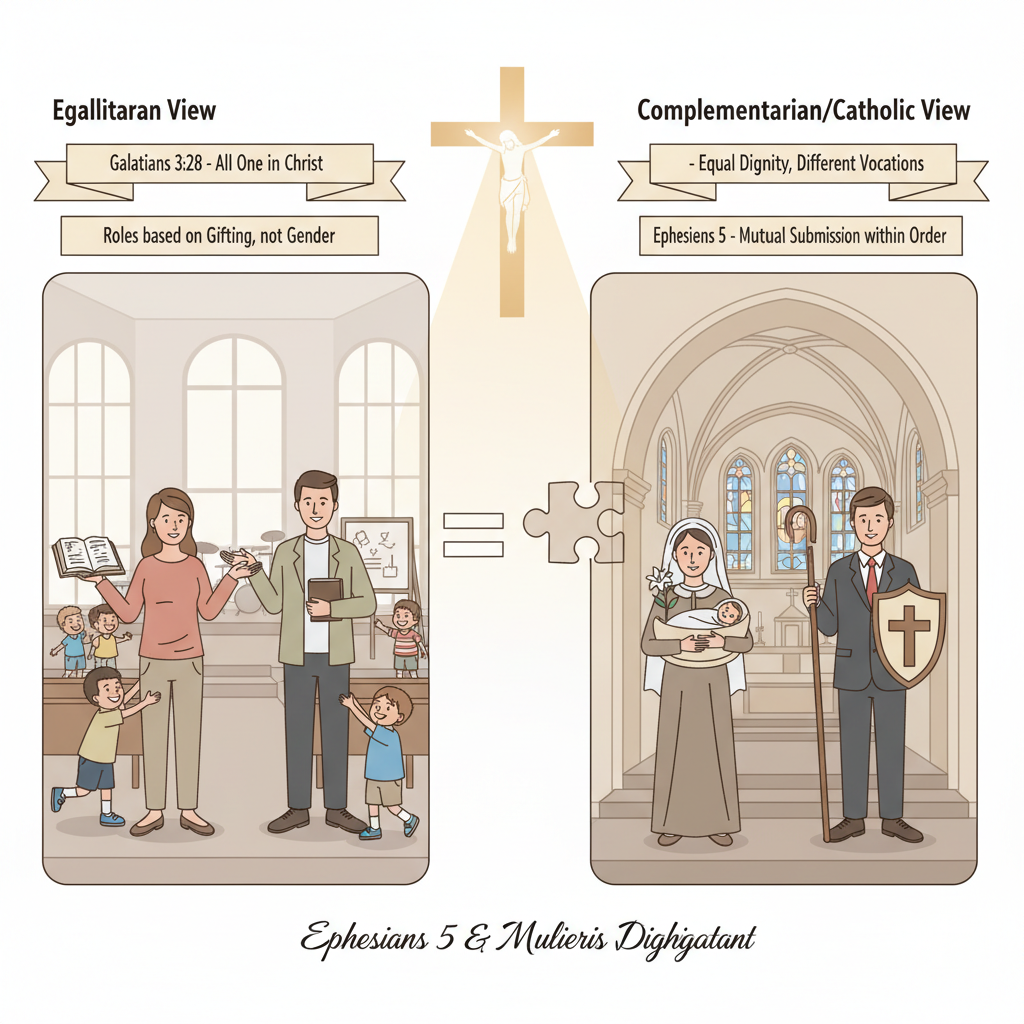
Mulieris Dignitatem and Ephesians 5: A visual contrast between Egalitarianism and Complementarianism. Left side (Egalitarian): Men and women shown as equal figures sharing diverse roles interchangeably, based on Galatians 3:28. Right side (Complementarian): Men and women shown with distinct but equally valuable roles, symbolizing mutual submission and specific vocations (motherhood/virginity for women), as interpreted by John Paul II. Center: A stylized image of Mary (Theotokos) and Christ, illustrating the theological archetypes of gender dignity. This illustration visually contrasts the Egalitarian and Complementarian views. The left side emphasizes Galatians 3:28, showing men and women as interchangeable partners (equals sign), reflecting the belief that roles are based on gifts, not gender. The right side emphasizes Ephesians 5 / Mulieris Dignitatem, showing men and women with distinct symbols (nurturing vs. leading) connected by a puzzle piece, reflecting the belief that distinct natures fit together to form a whole. The central Christ figure shows that both sides claim to be honoring God, just through different theological lenses.
Summary
This topic explores how Christians understand the roles of men and women, focusing on Ephesians 5:22-33 and Pope John Paul II's 1988 document Mulieris Dignitatem ("On the Dignity of Women").
The Key Text: Ephesians 5:22-33
- Traditional Reading: Wives should submit to their husbands because the husband is the "head" of the wife, just as Christ is head of the Church. This supports Complementarianism (men and women have different, complementary roles).
- Modern/Egalitarian Reading: The passage begins with "Submit to one another" (v21). Paul is redefining marriage as mutual submission. The husband's "headship" is defined as sacrificial love (dying for her), not domination.
The Key Document: Mulieris Dignitatem (1988)
- Written by Pope John Paul II to clarify the Catholic view of women in response to feminism.
- Main Argument: Men and women have equal dignity (both made in God's image) but different vocations.
- Complementarity: Women have a specific "genius" oriented toward motherhood (physical or spiritual). They are not "lesser" than men, but they are different. Therefore, women cannot be priests, but they are spiritually equal.
The Conflict:
- Christian Egalitarians say gender roles are man-made and should be abolished (Galatians 3:28: "There is no male and female").
- Christian Complementarians (like Catholics and Evangelicals) say gender roles are God-designed and essential for human flourishing.
Detailed Explanation
Ephesians 5:22-33 – The "Household Code"
This is the most controversial passage on gender in the New Testament.
The Text:
"Wives, submit yourselves to your own husbands as you do to the Lord. For the husband is the head of the wife as Christ is the head of the church... Husbands, love your wives, just as Christ loved the church and gave himself up for her." (Ephesians 5:22-25)
Interpretation A: The Complementarian View (Traditional)
- Hierarchy: God created an order. God → Christ → Husband → Wife.
- Headship: "Head" means leader/authority. The husband has the final say and responsibility.
- Submission: Wives honor God by voluntarily following their husband's leadership.
- Love: Husbands must not be tyrants; they must lead with sacrificial love, providing and protecting.
Conclusion: Men and women are equal in worth (salvation) but different in role (function). Women should not be pastors or heads of homes.
Interpretation B: The Egalitarian View (Modern/Feminist)
- Context is King: You must start with verse 21: "Submit to one another out of reverence for Christ." This governs everything that follows.
- Mutual Submission: Paul isn't commanding a one-way hierarchy. He is telling everyone to submit.
- Subverting Patriarchy: In Roman culture, the paterfamilias (father) had total power (life and death) over his wife and slaves. Paul tells husbands to love their wives "as Christ loved the church" (i.e., by dying for them). This was a radical reduction of male power, turning a boss into a servant.
Conclusion: Paul was pushing marriage toward equality as much as his culture could handle. Today, we should follow the trajectory toward full equality.
Mulieris Dignitatem ("On the Dignity of Women")
This 1988 Apostolic Letter by Pope John Paul II is the definitive Catholic response to feminism.
Theotokos (Mary as Prototype)
The ultimate human being (besides Jesus) is a woman, Mary. This proves women have infinite dignity. Mary represents the "feminine genius" of receptivity and bringing forth life.
Equal but Different
John Paul II rejects the idea that "equality" means "sameness." He argues that modern feminism makes a mistake by encouraging women to become like men ("masculinization").
Two Vocations
Women are oriented by nature toward Motherhood (nurturing life) or Virginity (dedicated entirely to God). Even women who are not biological mothers are called to "spiritual motherhood" (nurturing others).
The Effect of Sin
Genesis 3:16 ("He shall rule over you") is a curse, not a command. Male domination is a result of sin. Jesus came to break this curse and restore the mutual partnership of Adam and Eve.
Mutual Subjection
Interestingly, John Paul II interprets Ephesians 5 as teaching "mutual subjection"—husband and wife submitting to each other—moving away from rigid traditional hierarchy while maintaining gender differences.
Critical Evaluation (A-Level Analysis)
Is "Motherhood" limiting?
Critics (like Simone de Beauvoir or Feminist Theologians) argue that defining women by their biology ("essentialism") restricts their freedom. What about women who can't or don't want to be mothers? Is their dignity less?
Is "Separate but Equal" possible?
Egalitarians argue that whenever you enforce different roles, the "female" role ends up being subordinate. Can you really have "equal dignity" without "equal power" (e.g., priesthood)?
The Problem of Abuse
Critics of the traditional Ephesians reading argue that teaching wives to "submit" has historically been used to justify domestic abuse and silence women.
Scholarly Perspectives
Quote 1 (Biblical Text - The Egalitarian Key):
"Submit to one another out of reverence for Christ."
Source: Ephesians 5:21 (The Bible).
Context: This verse immediately precedes the "Wives submit" passage. Egalitarians argue it is the "lens" through which the whole text must be read—teaching mutual submission rather than male hierarchy.
Quote 2 (Pope John Paul II - Essentialism):
"In the name of liberation from male 'domination', women must not appropriate to themselves male characteristics contrary to their own feminine 'originality'. There is a well-founded fear that if they take this path, women will not 'reach fulfilment', but instead will deform and lose what constitutes their essential richness."
Source: Mulieris Dignitatem, Section 10 (1988).
Context: This summarizes the Catholic "Complementarian" argument against secular feminism. It claims that women have a distinct "nature" or "originality" (femininity/motherhood) and that trying to be "like men" (e.g., priests, or shedding domestic roles) actually harms women.
Key Takeaways
Key Terminology:
Mulieris Dignitatem
"On the Dignity of Women." 1988 letter by Pope John Paul II defending Catholic gender views.
Complementarianism
The view that men and women are equal in worth but have different, God-given roles (Catholic/Evangelical).
Egalitarianism
The view that men and women are equal in worth AND role; gender should not limit ministry or authority.
Mutual Submission
The interpretation of Ephesians 5:21 that husband and wife submit to each other.
Theotokos
"God-bearer" (Mary). Used in MD to show the supreme dignity of women.
Essentialism
The belief that men and women have distinct "natures" or "essences" (e.g., women are naturally nurturing).
Feminine Genius
John Paul II's term for the specific strengths of women (receptivity, sensitivity to the human person).
Exam Tips:
- Don't just say "Catholics are sexist." You must understand the nuance of John Paul II's argument. He condemns sexism and male domination as sin. He argues for "equal dignity." The debate is whether "different roles" inevitably leads to sexism.
- Ephesians 5 is a battleground. You need to be able to present both the Traditional (Hierarchy) reading and the Modern (Mutual Submission) reading clearly.
- Link to Secularism: How does Mulieris Dignitatem respond to secular feminism? It agrees that women have been oppressed (due to sin) but disagrees with the solution (masculinization). It offers "Christian Feminism" instead.
- Evaluation Tip: Ask whether "biological essentialism" (defining women by motherhood) is still relevant in a world where women are CEOs, soldiers, and leaders. Does Mulieris Dignitatem liberate women or put them on a pedestal to keep them out of power?