Christian Attitudes to Motherhood and Family Structure
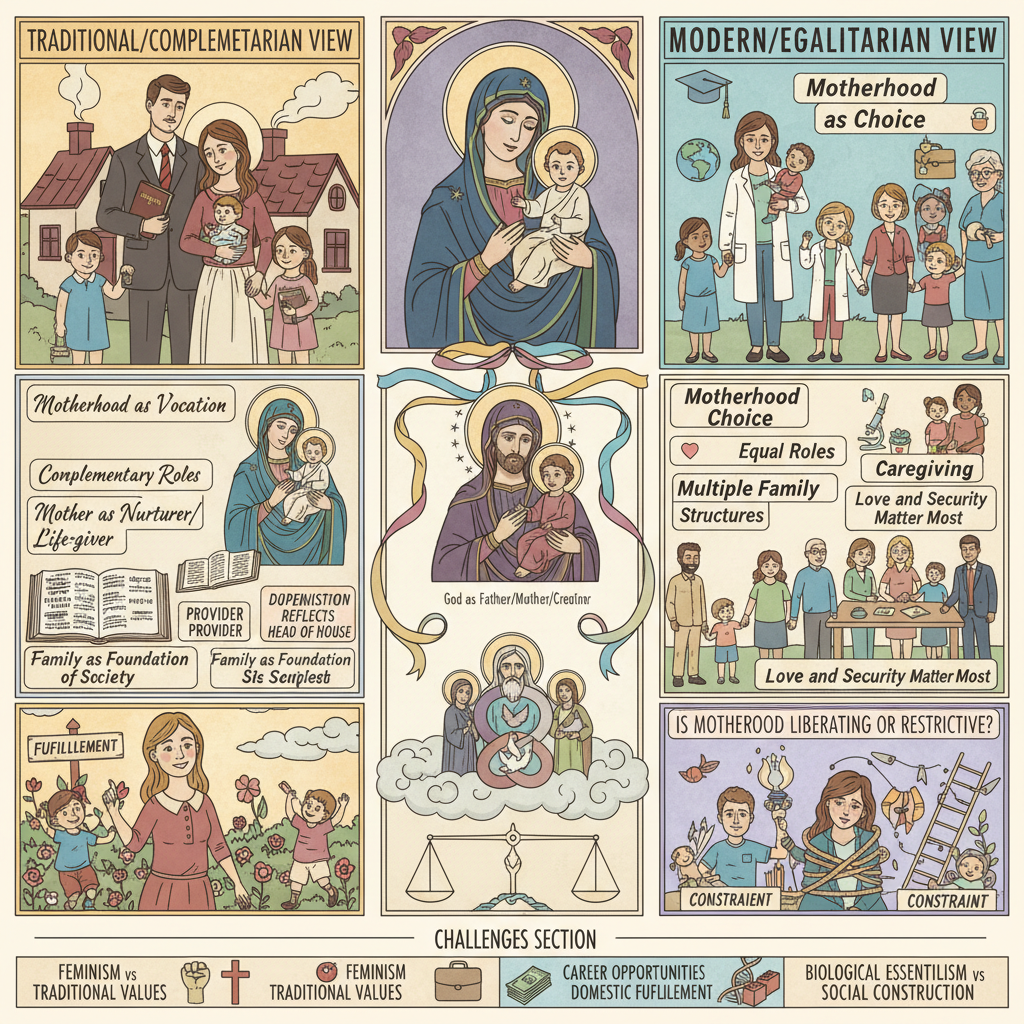
Christian Attitudes to Motherhood and Family Structure: Traditional complementarian view (left) emphasizes motherhood as a woman's primary vocation, supported by theological emphasis on Mary and the sanctity of the home. Modern egalitarian view (right) celebrates diverse family structures and equal roles regardless of gender, prioritizing love and security. The center shows Mary as a bridge figure, and the debate over whether motherhood is liberating or restricting reflects genuine tensions in contemporary Christian thought. This illustration depicts the range of Christian attitudes toward motherhood and family structure: The left side shows the traditional/complementarian view emphasizing motherhood as a central vocation, with Mary as an ideal, and the nuclear family as God's design. The right side shows the modern/egalitarian view celebrating diverse family structures (single parents, same-sex couples, working mothers) and motherhood as a choice among many valid vocations. The center uses Mary as a bridge figure, reminding viewers that even in traditional Christianity, women are more than mothers—Mary is also intercessor, church leader, and symbol of the Church itself. The bottom section visually represents the core paradox: "Is motherhood liberating or restricting?" acknowledging that the answer depends on context, choice, and freedom. The illustration emphasizes that this is a genuine theological and social debate, not one side being simply "right" and the other "wrong."
Summary
Christian attitudes to motherhood and family vary widely between traditional/conservative and modern/egalitarian perspectives.
Traditional/Conservative Christian View:
- Motherhood is a woman's primary vocation: Women are called to be wives and mothers, creating a "domestic haven" for family
- Complementary roles: Men provide/lead; women nurture/support. This reflects God's design and the Trinity
- Mary as model: The Virgin Mary, mother of Jesus, is held up as the ideal of motherhood—selfless, life-giving, joyful
- Family structure matters: The traditional nuclear family (married mother and father with children) is God's design for human flourishing
Modern/Egalitarian Christian View:
- Motherhood is a choice, not a requirement: Women can be fulfilled through careers, ministry, education, singleness, or motherhood
- Equal roles: Parenting responsibilities should be shared equally between mothers and fathers, regardless of gender
- Diverse families are valid: Single mothers, same-sex parents, adoptive families, childless couples—all are legitimate Christian family structures if founded on love and commitment
- What matters is love: "As long as children are loved, feel secure and are provided for, then the structure of the family does not matter"
The Core Tension:
Is motherhood liberating or restricting? Christians genuinely disagree.
The Traditional Christian View: Motherhood as Vocation
Biblical Foundations
Conservative Christians appeal to:
- Eve as "Mother of All the Living" (Genesis 3:20)—her name defines her role
- Ephesians 5:22-33 (wives submit to husbands as the Church submits to Christ)
- Titus 2:3-5 (women as homemakers)
- 1 Timothy 2:14-15 (women's "salvation" comes through bearing children)
The Theological Case
Complementarity
Men and women are "designed" to complement each other. Men lead and provide; women nurture and support.
Motherhood as Divine Gift
Having a child is described as a unique, irreplaceable gift of self. A mother gives her body and soul to create new life.
Mary as Archetype
Mary's motherhood is the ultimate Christian ideal. She is the most honored woman in Christianity because she bore Christ.
Spiritual Motherhood
Even unmarried women are called to motherhood—spiritually nurturing others, as the Church "mothers" believers.
Pope John Paul II's "Feminine Genius"
In Mulieris Dignitatem, John Paul II argues:
- Women have a unique capacity for self-giving and receptivity—literally opening their bodies to receive and nurture life
- This is not a weakness but a profound spiritual gift
- Society benefits when women exercise this "genius" in the home and broader society
- But: Equal dignity means women cannot be confined to the home. Their genius should be recognized in all spheres—work, leadership, ministry
Martin Luther's Reformed View
Luther argued:
- Raising children is a spiritual vocation as sacred as priesthood
- He famously said parenting is such a serious calling that "God, with all his angels and creatures, is smiling" when parents do it well
- Family life is a place where Christians experience union with Christ's sufferings and resurrection—the daily struggles of parenting are a "cross-marked vocation"
The Appeal of the Traditional View
Many traditionalists find this view beautiful because it:
- Honors motherhood and domestic work (which society often undervalues)
- Provides clear purpose and identity for women
- Emphasizes that family is foundational to society and faith
- Doesn't require women to become like men to be valued
The Modern/Egalitarian Christian View: Motherhood as Choice
Biblical Foundations
Egalitarian Christians appeal to:
- Galatians 3:28: "There is neither male nor female...in Christ Jesus"
- Jesus defending Mary of Bethany: Mary chose to sit at Jesus's feet learning like a disciple (Luke 10:38-42). Jesus approved, not condemning her for "shirking" domestic duties
- Priscilla the Tentmaker: A woman who traveled, worked, and taught alongside her husband (Acts 18:26)
- Women Prophets and Leaders: Deborah, Miriam, Esther, etc., showing women in authority
The Theological Case
God's Design is Broader
Humans are designed for diversity of vocations, not predetermined by gender. A woman can be equally called to be a lawyer, pastor, soldier, or CEO as a mother.
Motherhood Is One Option
Being a mother is valuable, but so is being single, childless, a scholar, or a spiritual leader.
Complementarity Leads to Hierarchy
Historically, "complementary roles" always end up with men in power and women subordinate.
Love and Security Matter Most
What children need is love, stability, and spiritual formation. This can come from diverse family structures.
Problems with Traditional Motherhood Theology
- It has justified abuse: Historically, telling women to "submit" and stay in the home has enabled domestic violence
- It wastes talent: Women doctors, teachers, preachers are not allowed to use their gifts
- It treats motherhood as escape: Rather than women being "confined" to motherhood, they should be free to choose it
- It pressures childless women: Women who can't or don't want children are made to feel like failures in God's eyes
The Appeal of the Modern View
Many modern Christians find this view compelling because it:
- Affirms human freedom and dignity
- Recognizes that women are individuals, not predetermined by biology
- Aligns with contemporary experience—many fulfilled Christian women are not mothers
- Celebrates diverse family structures as legitimate
The Motherhood Paradox: Liberating or Restricting?
Is Motherhood Liberating?
- Motherhood is a profound form of self-gift—creating and nurturing new life is deeply meaningful
- It connects women to the divine creative power
- Motherhood can be deeply fulfilling and joyful
- Mary's example shows that feminine power lies in receptivity and life-giving, not in domination
- For some women, motherhood is their truest calling and greatest joy
Is Motherhood Restricting?
- Motherhood can be socially enforced, not freely chosen
- Women can be prevented from pursuing other callings (ministry, work, education) because they're expected to be mothers
- Idealization of motherhood can justify unpaid domestic labor and financial dependence on men
- Saying women have a "genius" for motherhood can exclude them from leadership
- Biological essentialism has historically been used to keep women out of power
The Answer: Both/And
- Motherhood can be profoundly liberating for a woman who freely chooses it
- Motherhood can be restricting if imposed or if it becomes the only acceptable role
- The key is freedom of choice, not whether motherhood itself is good or bad
Christian Attitudes to Family Structure
The Traditional View
- Nuclear family is God's design: A married mother and father are the ideal environment for raising children
- Divorce is sinful: Most conservative Christians believe divorce should be avoided except in extreme cases (adultery, abuse)
- Same-sex partnerships are wrong: The complementary union of male and female is essential to marriage
- Children need both mother and father: Each brings necessary qualities (protection/provision from father; nurture from mother)
The Modern View
- Family is culturally variable: There's no single "perfect" family structure. It's largely a Western, middle-class, 20th-century invention
- Diverse structures are valid: Single mothers, same-sex parents, adoptive families, extended families—all are legitimate if they provide love, security, and spiritual formation
- What matters is the quality of relationships: Family function (love, security) matters more than form (nuclear vs. extended, etc.)
- Law should reflect reality: Christians should accept and support diverse families
Middle Ground
Some Christians hold:
- The traditional family is ideal but not exclusive as the only valid form
- Single mothers, divorced people, same-sex couples should be accepted and included in Christian community without judgment
- Jesus's inclusive love supersedes strict family definitions
Scholarly Perspectives
Quote 1 (Traditional: Mary as Model):
"Mary's motherhood of Jesus is a model for all Christian motherhood. In bearing Jesus, Mary gives herself completely in the act of motherhood—she is 'life-giver' in the most profound sense. The essence of the feminine genius lies in this capacity for self-gift in motherhood, both biological and spiritual. This is not a limitation but a calling of infinite dignity."
Source: Synthesized from Mulieris Dignitatem (Pope John Paul II, 1988).
Context: Represents the Catholic/Traditional view of motherhood as a sacred vocation grounded in women's unique capacity for receptivity and life-giving.
Quote 2 (Modern: Motherhood as Choice):
"Some Christians argue that being a mother is restrictive; others argue that being a mother is liberating. The answer depends on whether motherhood is freely chosen or socially enforced. As long as children are loved, feel secure and are provided for, then the structure of the family does not matter."
Source: Jessie Bernard (feminist sociologist).
Context: Represents the Modern/Egalitarian view that prioritizes freedom of choice and diversity of family structure over adherence to traditional motherhood ideology.
Key Takeaways
Key Terminology:
Motherhood as Vocation
The view that motherhood is a sacred calling and woman's primary purpose
Motherhood as Choice
The view that motherhood is one option among many for women's fulfillment
Feminine Genius
John Paul II's term for women's unique capacity for self-gift in motherhood
Spiritual Motherhood
The idea that even non-biological mothers spiritually nurture others
Nuclear Family
A married couple with their biological children (traditional ideal)
Diverse Family Structures
Single-parent, same-sex, adoptive, extended families, etc.
Essentialism
The belief that gender roles are fixed by nature/biology
Family as Vocation
The belief that raising a Christian family is sacred spiritual work
Key Exam Points:
- The genuine tension is real: Don't dismiss traditional views as purely sexist or modern views as purely selfish. Both have valid insights
- Mary is key to understanding Catholic views: Understanding her as "Theotokos" (God-bearer) helps explain why Catholics see motherhood as spiritually central
- "Liberating or restricting?" is THE question: Use this paradox as the organizing framework
- Link to gender roles: Motherhood attitudes directly flow from complementarian vs. egalitarian views
- Evaluate: Can Christianity hold traditional views on motherhood while also supporting women in leadership? Or are these incompatible?