Jesus as the Incarnation of Female Wisdom (Sophia)
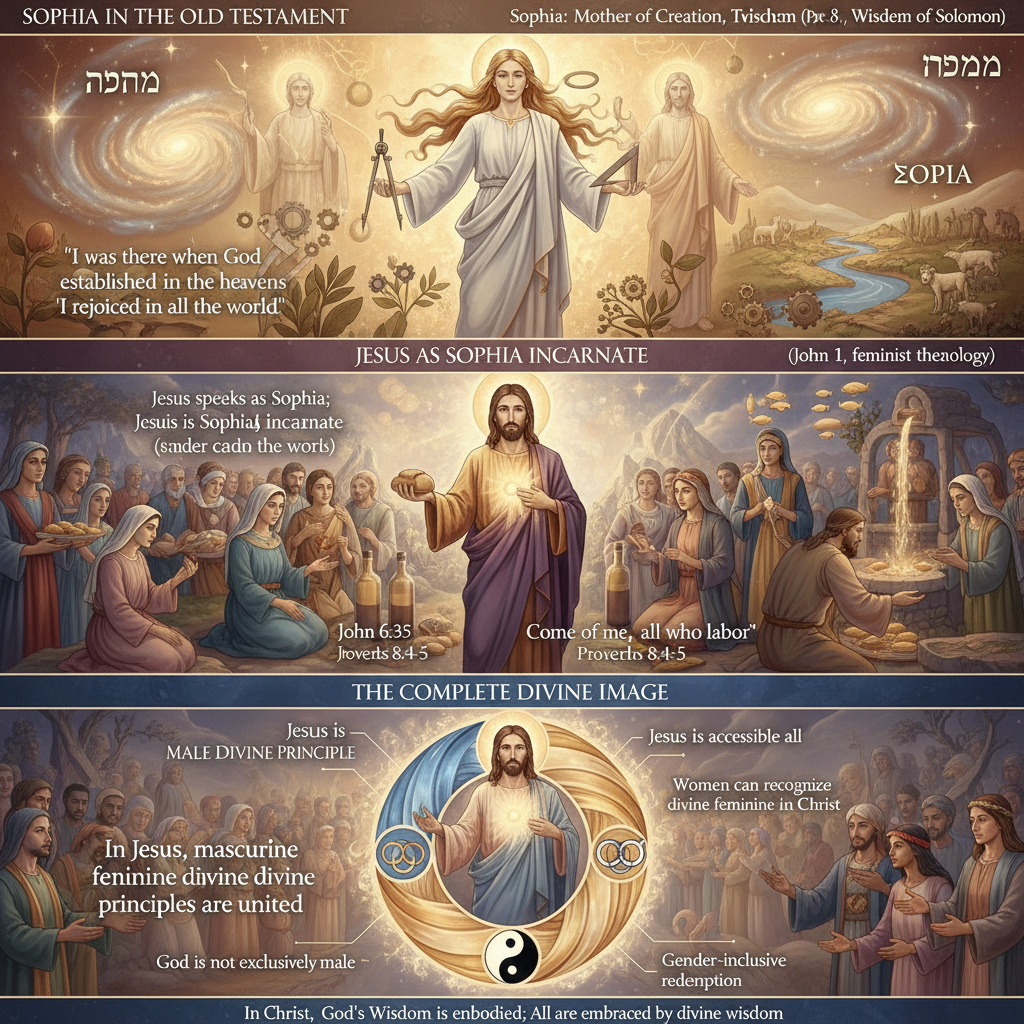
Jesus as the Incarnation of Female Wisdom (Sophia): From Old Testament personification of Wisdom as a feminine, creative, life-giving divine principle, to Jesus as Sophia Incarnate in the New Testament. Jesus embodies Sophia's qualities: teaching, nurturing, healing, creating. Together with his incarnation as the Word (Logos), Jesus represents a gender-inclusive revelation of God that integrates masculine and feminine divine principles. This illustration shows the theological development from Sophia in the Old Testament to Jesus as Sophia incarnate. The top section depicts Sophia in the Hebrew scriptures: a feminine, creative, nurturing, life-giving divine principle present at creation. The middle section shows Jesus embodying Sophia's characteristics through teaching, healing, nurturing, and inclusive relationship with disciples—demonstrating wisdom's qualities, not warrior power. The bottom section shows Jesus as the integration of both Logos (masculine, rational divine principle) and Sophia (feminine, relational divine principle), forming a complete, gender-inclusive revelation of God. The illustration emphasizes that understanding Jesus as Sophia makes him spiritually accessible to women and shows God's nature as encompassing both masculine and feminine divine dimensions.
Summary
Sophia (Greek for "Wisdom") is a feminine divine principle found throughout the Old Testament and early Christian theology. The key theological claim is that Jesus IS Sophia incarnate—the female Wisdom principle made flesh.
The Key Theological Claim:
- In the Old Testament, God's Wisdom is personified as a FEMALE figure (Proverbs 8, Wisdom of Solomon, Sirach)
- In the New Testament, Jesus is identified with this female Wisdom principle. Jesus IS Sophia incarnate
- Implication: If Jesus embodies female wisdom, then Jesus is gender-inclusive and accessible to women, not exclusively male in spiritual significance
The Theological Significance:
"Sophia is the feminine personification of the divine...She incarnates in Jesus of Nazareth. In other words, Jesus speaks of himself as Sophia."
This means Jesus is both: Logos (the Word): The divine rational principle, traditionally masculine; AND Sophia (Wisdom): The divine creative, life-giving principle, traditionally feminine. Together: A complete, gender-inclusive revelation of God.
Sophia in the Old Testament: God's Feminine Wisdom
Who is Sophia?
In Hebrew, the word for wisdom is "Chokmah"—a feminine noun. In the Greek translation (Septuagint), it becomes "Sophia".
Proverbs 8: Sophia Speaks
In Proverbs 8, Sophia personifies herself as a woman:
"I was with [God] when the heavens were established... I was the master worker...the Lord created me first, before anything else...Rejoice in the whole world, rejoicing in the world, delighting in the sons of men."
Existed Before Creation
"created me first"
God's Partner in Creation
"master worker"
Brings Joy and Life
"rejoicing in the world"
Teaches and Nurtures
"delighting in the sons of men"
Wisdom of Solomon (Apocrypha)
Even more developed portrait of Sophia:
"Sophia is a breath of the power of God...She is fairer than the sun...She is the fashioner of all things...She is the mother of all good things."
Key Characteristics of Sophia
Creative Power
She shapes creation alongside God
Mother/Nurturer
She gives life and sustains all things
Teacher/Enlightener
She offers wisdom and understanding
Relational
She dwells among humans, seeking relationship
All-Encompassing
She fills all creation with her presence
Why Feminine?
- The Hebrew grammar requires it—"Chokmah" is grammatically feminine
- Wisdom's functions (creativity, nurturing, life-giving) were associated with feminine qualities in ancient thinking
- This shows God is not exclusively "male" but has feminine dimensions
Jesus as Sophia Incarnate: The New Testament Connection
The Gospel of John (Chapter 1)
Scholars note that what John says about the Logos (Word) was previously said about Sophia in Jewish tradition.
Traditional View:
"In the beginning was the Word [Logos], and the Word was with God, and the Word was God...And the Word became flesh and dwelt among us."
Feminist Reinterpretation:
"In the beginning was Wisdom [Sophia], and Wisdom was with God, and Wisdom was God...And Wisdom became flesh in Jesus and dwelt among us."
Why This Works
Both the Logos and Sophia were:
- Present with God before creation
- God's partner in creation
- Divine principle incarnate in Jesus
- Mediators between God and humanity
The Point:
John could have used either term. By using Logos instead of Sophia, he obscured the female wisdom principle but didn't eliminate it.
Jesus's Words and Actions as Sophia Language
"I Am" Sayings (John)
Jesus uses language previously attributed to Sophia:
| Jesus's Saying | Sophia Parallel | Meaning |
|---|---|---|
| "I am the bread of life" (John 6:35) | Sophia offers nourishment and sustenance | Jesus sustains spiritual life |
| "Come to me, all who labor" (Matthew 11:28) | "Come, eat my food, drink my wine" (Proverbs 9:5) | Jesus as teacher/nurturer offering rest |
| "I am the light of the world" (John 8:12) | Sophia as enlightenment, illumination | Jesus reveals truth/wisdom |
| "Whoever finds me finds life" (applied to Jesus) | Sophia gives life (Proverbs 8:35) | Jesus is the source of life |
Jesus's Teaching Style
Teaching/Empowering
Jesus taught disciples (especially women, breaking norms)
Nurturing
Jesus fed the hungry, healed the sick
Creative
Jesus's miracles reveal creative power (water to wine, multiplying bread)
Relational
Jesus emphasized relationship, not domination
All these are Sophia's qualities, not warrior king qualities.
Jesus's Treatment of Women
Mary of Bethany (Luke 10:38-42)
Jesus affirmed her choice to be a disciple, saying her place at his feet (learning position) was better than Martha's service
Samaritan Woman (John 4)
Jesus had theological conversation with a woman—radical for breaking both gender and ethnic taboos
Woman Caught in Adultery (John 8:1-11)
Jesus defended her and offered forgiveness, not condemnation
Mary Magdalene (John 20)
Jesus appeared to her first after resurrection—the primary witness to resurrection
All these actions show Jesus recognizing women's dignity and intellectual capacity—embodying Sophia's inclusive wisdom.
The Theological Significance: Jesus as Word AND Wisdom
Two Metaphors for Divine Incarnation
Logos (The Word)
- Associated with rationality, logic, order, authority
- Traditionally masculine in character
- Represents God's external creative power
Sophia (Wisdom)
- Associated with creativity, receptivity, nurturing, relational power
- Traditionally feminine in character
- Represents God's indwelling, transformative presence
Jesus as Both/And
If Jesus is understood as incarnating both Logos AND Sophia, then:
- Jesus represents a complete, integrated revelation of God
- Jesus has both rational and relational aspects
- Jesus demonstrates both authority and nurture
- Jesus is not exclusively masculine in spiritual significance
Quote from Scholars:
"When John writes that the Word became flesh and dwelt among us as Jesus, he could just as well have said that Sophia became flesh and dwelt among us as Jesus. Jesus is the Wisdom/Sophia of God incarnate."
Jesus as Gender-Inclusive Savior
The Problem
If Jesus is understood only as male and as a symbol of male authority, then women may have trouble seeing him as their Savior.
The Solution
If Jesus is understood as incarnating female Wisdom (Sophia), then:
- Women can recognize themselves in Jesus's wisdom, teaching, and care
- Jesus becomes accessible to women not as a male authority figure but as a liberatory, inclusive presence
- God is not exclusively male but includes feminine divine qualities
Ruether's Point:
"If Jesus is properly understood as embodying female wisdom, as Ruether argued he did, then although he is technically male in appearance, nonetheless spiritually he is more inclusive. This fits with Ruether's argument that Christianity underwent patriarchalization—Jesus was a gender inclusive figure which was corrupted by patriarchal reinterpretation."
Sophia in Gnosticism: An Alternative Tradition
Warning: This section is context but goes beyond typical A-level scope.
Gnostic Sophia
In Gnostic Christianity, Sophia is even more central:
- Sophia is a divine feminine principle who fell from grace
- Jesus came to rescue and redeem Sophia—a cosmic love story
- Their reunification symbolizes the soul's return to divine unity
While different from orthodox Christianity, the Gnostic tradition shows how early Christians maintained Sophia as central to salvation theology, suggesting the connection between Jesus and female wisdom was historically significant.
Implications for Feminist Theology
What the Sophia Christology Offers
1. Gender-Inclusive Jesus
- Jesus is not a patriarchal male symbol but a gender-inclusive revelation
- Women can identify with Jesus's wisdom and compassion, not just his authority
2. Feminine Divine Dimensions
- God is not exclusively "Father" and "Male"
- God has feminine dimensions: creative, nurturing, relational
- Language about God should include feminine metaphors
3. Redeemed Christianity
- By recovering Jesus as Sophia, Christianity can be liberated from patriarchy
- The "golden thread" of liberation includes the wisdom/Sophia principle that the Church suppressed
- Women can claim Jesus as their own liberator, not their oppressor
4. Wholeness/Integration
Jesus as both Logos and Sophia suggests that wholeness requires integration of:
- Rational and intuitive
- Authority and vulnerability
- Assertive and receptive
- Masculine and feminine
5. Cosmic Significance
- Sophia was present at creation; Jesus-Sophia reconciles all creation
- Salvation is cosmic and inclusive, not hierarchical
How This Challenges Traditional Christology
Traditional Christology (Patriarchal)
- Jesus is the Son of God (masculine)
- Jesus's maleness is theologically significant—he must be male to represent God the Father
- Leadership in the Church must be male to represent the male Christ
Sophia Christology (Feminist)
- Jesus embodies Wisdom of God—both male and female dimensions
- Jesus's historical maleness is accidental, not essential to his redemptive function
- Jesus's maleness doesn't require male-only leadership; women can equally represent the Christ who embodies Sophia
The Theological Debate
- Conservative Christians argue that Jesus's maleness is essential and biblical symbolism of Father-Son relationship requires masculine language
- Feminist Christians argue that emphasizing Jesus's maleness distorts his message and limits women's access to Christ
- Moderate Christians may argue both Logos and Sophia language is valid and enriching
Criticisms and Limitations
Strengths
- Grounds itself in biblical imagery (Proverbs 8, Wisdom literature)
- Offers a way for women to identify with Jesus without dismissing maleness
- Provides historical precedent (early Christian and Jewish theology)
Limitations
- Historical Question: Did early Christians actually view Jesus as Sophia, or is this a modern feminist reinterpretation?
- Doctrinal Implications: If Jesus is Sophia, does this change the Trinity doctrine? Is Sophia a "fourth" person?
- Risk of Gnosticism: Emphasizing Sophia can slide into Gnostic frameworks that many Christians reject
- Language Limitation: Even if we retrieve Sophia language, it doesn't automatically solve structural patriarchy in churches
Scholarly Perspectives
Quote 1 (The Sophia-Jesus Connection):
"In the first chapter of John, what the author says about 'the Word of God' was said about Sophia in the Jewish tradition. Like the Word, Sophia was present with God before creation. Just as the Word was with God and was God, so Sophia was. And when John writes that the Word became flesh and dwelt among us as Jesus, he could just as well have said that Sophia became flesh and dwelt among us as Jesus. Jesus is the Wisdom/Sophia of God incarnate."
— Marcus Borg and feminist theology scholarship
Quote 2 (Jesus and Feminist Accessibility):
"Sophia is the feminine personification of the divine (not merely the feminine aspect of divinity)...She incarnates in Jesus of Nazareth. The one title attributed to Jesus that scholars believe most likely to have originated with him is 'the child of Wisdom.' If Jesus is properly understood as embodying female wisdom, then although he is technically male in appearance, spiritually he is more inclusive and accessible to women seeking salvation."
— Bruce Sanguin and feminist theology
Key Takeaways for Your Exam
- Know Proverbs 8 and Wisdom of Solomon: These are the biblical foundations for Sophia theology. Be able to describe Sophia's characteristics
- Understand the Logos-Sophia parallel: Show how John could have used either term for Jesus, suggesting they're interchangeable or complementary
- Jesus as Sophia means gender-inclusive: The key insight is that if Jesus embodies female wisdom, women can claim Jesus as their own liberator
- Link to Ruether: This is the continuation of Ruether's argument—she showed Jesus challenged patriarchal expectations; Sophia Christology shows how by embodying female wisdom
- Masculine and Feminine Integration: Understand that Sophia Christology is about integrating masculine (Logos) and feminine (Sophia) divine principles, not replacing one with the other
- Evaluate: Is retrieving Sophia historically accurate or modern eisegesis (reading modern ideas back into ancient texts)? Can Jesus be "both" Logos and Sophia without confusion?