Ruether: Jesus' Challenge to Male Warrior Messiah Expectation
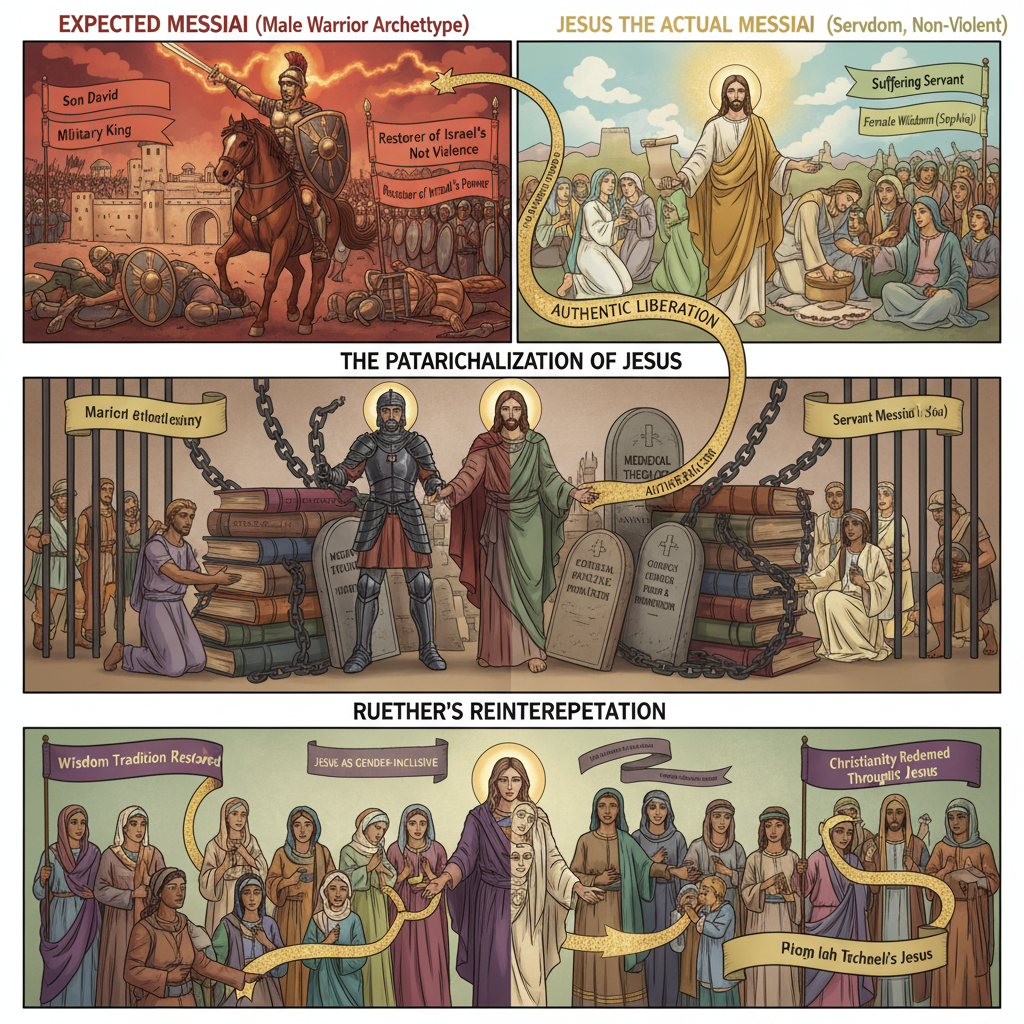
Ruether's Challenge to Male Warrior Messiah Expectation: Expected Messiah (left) was a military king who would defeat Rome; actual Jesus (right) was a non-violent servant who challenged patriarchal structures through healing, teaching, and solidarity with the marginalized. Ruether argues the Church patriarchalized this gender-inclusive, wisdom-based Jesus into a male warrior symbol, obscuring the authentic liberatory Jesus who embodied female wisdom (Sophia) and could liberate women. This illustration visually contrasts the expected male warrior messiah (left) with the actual Jesus (right), and shows how the Church patriarchalized him. The left side emphasizes military power, domination, and exclusively male authority. The right side shows Jesus's actual ministry: non-violence, healing, teaching, solidarity with women and the marginalized, and embodiment of female wisdom (Sophia). The center shows the Church's patriarchalization process, with Ruether's "golden thread" of authentic liberatory teaching running through it. The illustration emphasizes that Ruether sees the authentic Jesus as gender-inclusive and liberatory, but the Church corrupted him into a patriarchal symbol, and that Christianity can be redeemed by recovering this authentic Jesus.
Summary
Rosemary Radford Ruether is a Catholic feminist theologian who argues in Sexism and God-Talk (1983) that Jesus fundamentally challenged the patriarchal expectations of his time, especially the male warrior messiah expectation.
Ruether's Core Argument:
- Expected Messiah: Jewish people in Jesus's time expected a warrior king (like David) who would militarily defeat Rome and restore Israel to power
- Jesus's Reality: Jesus rejected this expectation entirely. Instead, he was a non-violent servant, a healer, and a teacher who associated with women, the poor, and the marginalized
- Jesus as Wisdom: Rather than warrior power, Jesus embodied female wisdom (Sophia)—compassion, self-sacrifice, inclusivity
- The "Patriarchalization" Problem: The early Church distorted this gender-inclusive, liberatory Jesus into a patriarchal male warrior symbol
- The Solution: Christianity can be redeemed by recovering the authentic, feminist-friendly Jesus hidden beneath patriarchal theology
Key Claim:
"The Messiah can only be imagined as a male" in patriarchal Jewish culture. But Ruether argues that the actual Jesus subverted this male warrior expectation by being a non-violent, wisdom-based liberator.
The Jewish Expectation: Messiah as Male Warrior King
First-Century Jewish Context
In Jesus's time, most Jewish people longed for a messiah who would:
- Lead a military revolt against Rome
- Restore Israel as an independent nation
- Be a "Son of David"—continuing the dynasty of the great warrior-king
- Use violence to liberate the oppressed
Why a Warrior King?
Roman Oppression
Roman occupation was brutal. Taxes were crushing, freedoms were restricted, Palestine was under foreign rule.
Scriptural Promises
Jewish Scripture spoke of a Coming King: Passages like Psalm 2 and Isaiah 11 were read as describing a powerful deliverer.
Patriarchal Culture
The Messiah had to be male: In patriarchal Jewish culture, power, authority, and military leadership were exclusively male domains.
Palm Sunday Expectations
When Jesus entered Jerusalem on Palm Sunday, riding a donkey, the crowds literally expected him to establish a military kingdom immediately.
The Disciples' Confusion
After the crucifixion, Jesus's disciples were devastated. They had entirely misunderstood Jesus's mission. They asked: "Lord, will you at this time restore the kingdom to Israel?" (Acts 1:6). They expected a political revolution, not a spiritual one.
Jesus's Actual Life: Non-Violent, Servant, Women-Affirming
What Jesus Actually Did
Jesus rejected the warrior messiah expectation by:
1. Practicing Non-Violence
- When arrested, he told his disciples to put away their swords (Matthew 26:52)
- He refused to lead or advocate for military rebellion
- He emphasized forgiveness and reconciliation, not retaliation
2. Serving Rather Than Dominating
- He washed his disciples' feet—a task of a slave, not a king
- He said: "The greatest among you must be your servant" (Matthew 23:11)
- He presented the messiah as a suffering servant, not a conquering warrior
3. Caring for the Oppressed and Marginalized
- The Samaritan woman at the well (John 4)—breaking cultural taboos
- The woman caught in adultery (John 8:1-11)—defending her when everyone else condemned her
- Mary of Bethany (Luke 10:38-42)—affirming her choice to be a disciple
- He associated with the poor, lepers, tax collectors, and other "sinners"
4. Emphasizing Inner Transformation
- His kingdom is "not of this world" (John 18:36)
- He focused on spiritual liberation from sin, not military liberation from Rome
- He taught that true greatness comes through humility and service, not conquest
Ruether's "Golden Thread": The Authentic Jesus
The Key Concept
Ruether identifies a "golden thread" of authentic teaching running through the Bible and Jesus's teachings that supports liberation, feminism, and equality.
This thread includes:
- The prophetic tradition that God opposes oppression (Amos, Isaiah, etc.)
- Jesus's revolutionary social teaching: "Call no one Father" (Matthew 23:9)—rejecting oppressive hierarchies
- Jesus's affirmation of women in ways that violated social norms
- The early Christian vision (Galatians 3:28): "There is neither male nor female...in Christ Jesus"—a radical egalitarian vision
But:
The Bible also contains patriarchal, oppressive themes. These two threads (liberation and patriarchy) cannot both be authentic revelation from God.
Ruether's Solution:
Separate the golden thread of authentic liberation from the patriarchal corruption. Then, Christianity can be reformed by returning to the authentic, liberatory Jesus.
The Patriarchalization of Jesus: How the Church Distorted Him
What Happened
The early Church, especially over the first five centuries, patriarchalized Jesus.
How This Happened
Incarnation as Power
The Incarnation became about Power, not Vulnerability: The Church emphasized Jesus as Lord and King, a powerful divine figure.
Maleness Elevated
Whereas the historical Jesus transcended gender by including women as equals, the Church used his physical maleness as justification for male-only leadership.
Servanthood Downplayed
Jesus's message about serving the poor and humble was replaced with emphasis on obedience to male authority.
Critique of Power Lost
Jesus's challenge to patriarchal structures was buried under institutional male authority (priests, bishops, Pope).
The Result
Jesus became the symbol of male power and domination, not the liberator of the oppressed. Women were told to obey male authority "as unto Christ"—turning Jesus's message on its head.
Ruether's Quote:
"Christianity has never said that God was literally male, but it has assumed that God represents preeminently the qualities of rationality and sovereign power. Since men were assumed to be rational, they were also assumed to be the image of God. Women, by contrast, were seen as more suited to the body, the material, the domestic realm. This patriarchal distortion has made the Christ symbol inaccessible to women."
Jesus as Wisdom (Sophia): The Gender-Inclusive Messiah
The Sophia Tradition
In Jewish Scripture, Wisdom (Sophia in Greek) is portrayed as FEMALE.
Examples:
- Proverbs 8: Wisdom is a woman who was with God at creation
- Wisdom of Solomon: Wisdom is portrayed as feminine, nurturing, creative
Ruether's Claim
Jesus embodied Sophia—female wisdom—not the male warrior king.
What This Means:
- Jesus's method was persuasion and teaching, not force
- Jesus's power was relational and inclusive, not dominating
- Jesus's kingdom operates on love and mutuality, not hierarchy
- Jesus included women as equals, reflecting wisdom's universal scope
Why This Matters:
If Jesus embodied female wisdom, not male power, then:
- Women are not excluded from redemption or from Christ's example
- Women can see themselves reflected in Jesus, not as subordinates but as equals
- Christianity can be liberated from patriarchy by recovering this authentic Jesus
Ruether's Radical Reinterpretation:
"Although the Messiah can only be imagined as male in patriarchal consciousness, the actual Messiah concept that Jesus embodied is not the Davidic military messiah but a self-sacrificing, redeeming, servant Messiah who is linked to the female notion of wisdom."
The Problem: "Can a Male Savior Save Women?"
Ruether's Foundational Question:
"Can a male Savior save women?"
The Problem
Under patriarchy, where maleness = power and authority, a male Savior reinforces the idea that women need to be ruled by men (even Christ).
Solution
If we understand Jesus as:
- Not primarily as a male symbol of authority but as a servant and liberator
- Embodying female wisdom alongside his historical maleness
- Calling for the subversion of patriarchal oppression
Then Jesus becomes accessible and liberating to women.
Ruether's Critique of Patriarchal Theology
Key Problems Ruether Identifies
1. Male Language for God
"God the Father," "God the King," "God the Warrior" reinforce patriarchy. This is not theological necessity but patriarchal tradition.
2. Mary as Passive Feminine Ideal
Mary is held up as the ideal of feminine virtue: passive, receptive, obedient. This teaches women to be subjects, not agents.
3. Church as "Bride of Christ"
This nuptial imagery supports the idea that women should be passive and subordinate to male headship. It perpetuates patriarchal marriage structures.
4. Women Excluded from Priesthood
The Church claims Jesus was male, therefore priests must be male. But if Jesus's maleness is not theologically essential (just historical accident), women can equally represent Christ.
Ruether's Positive Vision: A Redeemed Christianity
How Christianity Can Be Liberated
1. Recover the Historical Jesus
Study Jesus in his Jewish context, not in patriarchal Church doctrines. See Jesus as a first-century Galilean Jewish prophet.
2. Read Through the "Golden Thread"
Identify passages that support liberation and equality. Critique patriarchal passages as corruptions.
3. Retrieve Female Images of God
Speak of God as Mother, Liberator, Wisdom, Source of Life, not only as Father.
4. Redefine Christology
Present Jesus as embodying wisdom, not warrior power. Emphasize Jesus's radical inclusion of women.
5. Democratize the Church
Reject hierarchical male leadership. Ordain women and include them equally in decision-making.
6. New Language: "God-ess"
Ruether uses "God-ess" to suggest we transcend male-only language and embrace the divine as beyond gender AND including feminine dimensions.
Critiques and Limitations of Ruether's Approach
Strengths
- Shows that Jesus is compatible with feminism
- Recovers authentic Jesus from patriarchal distortion
- Provides a liberatory interpretation of Christianity
Limitations
- Questionable Historical Claims: Some scholars argue Ruether overstates how patriarchal the early Church was
- "Golden Thread" is Selective: Critics argue Ruether cherry-picks texts that support feminism while dismissing patriarchal texts as "inauthentic"
- Diminishes Jesus's Uniqueness: If Jesus is just one example of wisdom among many, what makes him uniquely redemptive?
- Incarnation as "Patriarchal Invention": Ruether's claim that virgin birth stories were invented by patriarchy is contested
Scholarly Perspectives
Quote 1 (The Patriarchalization of Jesus):
"The Messiah can only be imagined as a male in patriarchal consciousness. But although the historical Jesus was male, the actual Messiah concept that Jesus embodied is not the Davidic military messiah but a self-sacrificing, redeeming, servant Messiah who is linked to the female notion of wisdom. The early Church patriarchalized this gender-inclusive, liberatory Jesus into a symbol of male power and authority, thereby excluding women from redemption and access to Christ."
— Rosemary Radford Ruether, Sexism and God-Talk (1983)
Quote 2 (The Liberatory Jesus):
"Jesus of the Synoptic Gospels is a prophet who breaks social taboos, proclaims a reversal of the social order where domination and oppression are ruled out in favor of equality and mutuality. Jesus shows special concern for women and rejects male warrior messiah expectations. The authentic Jesus is a liberator who embodies female wisdom and calls for the subversion of patriarchal oppression."
— Ruether and OCR sources
Key Takeaways for Your Exam
- Know the Contrast: The expected messiah = warrior king; the actual Jesus = non-violent servant. This contrast is crucial.
- Patriarchalization is the Key: Ruether doesn't claim Jesus was feminist but rather that the Church patriarchalized him, turning a liberatory figure into a patriarchal symbol.
- The Golden Thread: Use this concept to show how Ruether separates authentic from inauthentic biblical material.
- Sophia/Wisdom: Understand that Ruether uses the feminine wisdom tradition to reframe Jesus as inclusive and non-dominating.
- "Can a male Savior save women?": This is Ruether's foundational problem. She solves it by showing Jesus as embodying wisdom, not male power.
- Evaluate: Is Ruether's "golden thread" approach too selective? How do we distinguish authentic from inauthentic biblical material?
| Concept | Meaning |
|---|---|
| Male Warrior Messiah | The expected messiah—a military king like David who would defeat Rome |
| Patriarchalization | How the Church distorted the liberatory Jesus into a symbol of male authority |
| Servant Messiah | Jesus's actual role—non-violent, humble, serving the oppressed |
| Sophia (Wisdom) | Female wisdom principle in Jewish Scripture that Jesus embodied |
| Golden Thread | The thread of authentic liberation running through the Bible |
| Redeemed Christianity | Christianity freed from patriarchy by recovering the authentic Jesus |
| God-ess | Ruether's term for God beyond male-only language |