Augustine on God's Grace
Summary
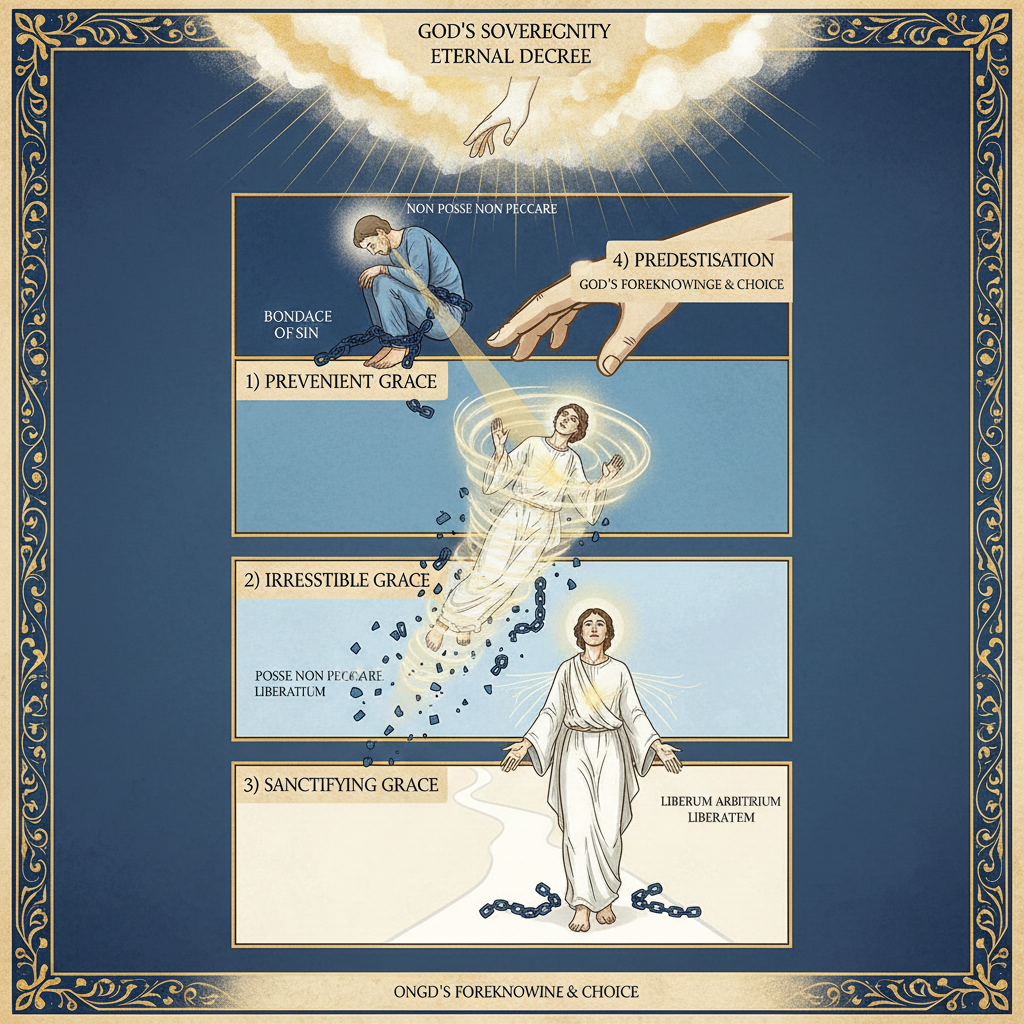
Grace, for Augustine, is God's free, unmerited gift that overcomes human bondage to sin and enables us to choose the good. It's not something we earn; God gives it freely to those He has predestined before the world was created. There are three key types: Prevenient Grace (precedes human action, awakening conscience and drawing us toward faith), Irresistible Grace (once given to the elect, cannot be rejected—it transforms the will unfailingly), and Sanctifying Grace (ongoing grace that transforms us into righteousness through the Holy Spirit). Grace transforms us from "non posse non peccare" (unable not to sin, enslaved) to "posse non peccare" (able not to sin, free), creating a "liberated free will" (liberum arbitrium liberatum) that desires and freely chooses the good.
Detailed Explanation
The Problem Grace Solves: Bondage of Will
Human Condition After Original Sin:
- We have free will (ability to choose), but it's enslaved by concupiscence (uncontrollable desire)
- We know what's good but can't do it (Romans 7: "I do not do the good I want to do")
- Without grace, free will can only choose sin—it's like a prisoner's freedom within a prison cell
Why Free Will Alone Isn't Enough:
- The law says "Don't sin," but knowing the law actually increases concupiscence (the forbidden fruit becomes more tempting)
- Simply having knowledge and free will doesn't enable us to choose the good
Prevenient Grace (Grace That Precedes)
Definition:
Grace that goes before human choice or action, initiating the process of salvation.
How It Works:
- The First Wish: Grace awakens in us the first wish to please God
- Conscience Stirred: Grace convicts us of sin, showing us our need for God
- Faith Enabled: Grace empowers us to respond to the Gospel when we hear it
- Not Forced: Prevenient grace doesn't force—it enables and invites
Universal or Particular?
- Augustine's view: Prevenient grace is not universal—God gives it only to the elect (those He has predestined to salvation)
- Catholic theology: Prevenient grace is available to all, though not all accept it
- Wesleyan theology: Prevenient grace is universally offered, enabling all to respond
Key Insight:
Prevenient grace answers the Pelagian challenge: "If we're enslaved by sin, how can we freely turn to God?" Augustine responds: "Grace precedes and enables the first movement toward God."
Irresistible Grace (Grace That Cannot Be Resisted)
Definition:
For those whom God has predestined, grace is irresistible—it unfailingly transforms the will.
How It Works:
- God, through grace, makes the will willing to choose the good
- The will is not forced (that would violate freedom), but transformed so it freely desires what's good
- Example: A prisoner freed from chains doesn't have to walk—but if freed, they will walk. Grace is like those chains breaking
Why Irresistible?
- If grace were resistible (could be rejected), then human resistance could thwart God's will
- This would make grace not truly God's grace—it would depend on us
- Augustine insists: Grace must be efficacious (actually effective) to be worthy of the name
Limited to the Elect:
- Augustine teaches that God predestines some to salvation (the elect)
- For these chosen ones, grace is irresistible and infallible
- For others, God withdraws grace or doesn't offer it
The Transformation of the Will
From Bondage to Freedom:
Grace transforms our will from enslaved to liberated:
| State | Condition | Freedom |
|---|---|---|
| Non Posse Non Peccare | "Unable not to sin" (pre-grace) | Enslaved—can only sin |
| Posse Non Peccare | "Able not to sin" (with grace) | Free—can choose the good |
| Posse Non Velle Peccare | "Able not to want to sin" (perfection) | Perfectly free—don't even desire evil |
True Freedom:
Augustine teaches that true freedom is not the ability to do anything, but the ability and desire to do the good. A slave obeys against his will. A free person desires and freely does what their master commands. Grace creates this holy bondage—we are enslaved to God but perfectly free because we love our Master's will.
Sanctifying Grace (Ongoing Transformation)
Definition:
The grace that continuously transforms us into righteousness, making us increasingly holy and loving.
How It Works:
- Grace pours God's love into our hearts (Romans 5:5)
- This love transforms us—makes us more just, righteous, compassionate, and holy
- Not by external commands, but by internal transformation of the heart
- The Holy Spirit indwells us, working to conform us to Christ's image
Justification Through Sanctification:
- Augustine's unique view: We are justified by becoming righteous, not just declared righteous (this differs from later Protestant doctrine)
- God's grace transforms us from sinners into saints, and this transformation justifies us
- The result: We become fit for salvation because grace has actually made us righteous, not just covered our sin
Predestination: Grace Rooted in God's Choice
Definition:
God's eternal decision, before time began, to choose certain people (the elect) for salvation through Christ.
Why Predestination?
Augustine grounds predestination in grace because:
- Grace must be free: If God's gift of grace depends on our merits, it's not grace—it's payment
- Grace must be particular: God gives grace to some, not all, choosing freely
- Grace must be efficacious: It must actually accomplish salvation, not depend on us resisting
Election of Grace:
Augustine's phrase "election of grace" means: Election (predestination) IS grace—they're the same thing. God's choice to save certain people is itself grace—an act of God's mercy. This protects grace from becoming merited, resistible, or dependent on human choice.
The Difficulty:
If God predestines some to salvation and others to damnation:
- Doesn't this make God unjust? Augustine responds: No, because all deserve damnation. Saving some is mercy; damning others is justice.
- Doesn't this eliminate human responsibility? Augustine responds: No—God chooses through our free choices. We freely choose, but God's grace ensures we choose right.
The Mystery:
Augustine acknowledges this is a "mystery" we cannot fully understand—how God's sovereignty (predestination) and our freedom (genuine choice) both stand true.
Grace and Free Will: Cooperation (Synergy)
Augustine's Resolution:
Free will and grace are not opposed—they cooperate:
- Free will = our genuine ability to choose
- Grace = God's empowerment of that choice
How They Work Together:
- God gives a precept (command): "Do not sin"
- We try using our free will but fail (enslaved by concupiscence)
- God offers grace through Christ and the Holy Spirit
- Grace strengthens our will
- We freely choose to obey, now empowered by grace
Augustine's Analogy:
Like a teacher and student: the teacher provides the knowledge (grace), the student learns and practices (free will). Both are necessary.
Scholarly Perspectives
Augustine on Grace and Free Will
"God's precepts would be of no use to a man unless he had free choice of will. But free will alone is not enough—concupiscence mastered us. Therefore, grace renders its help. Were not this help given, then the law would be nothing but the strength of sin."
Source: Augustine, On Grace and Free Will
Context: Augustine explains the relationship between free will and grace—both are necessary. The law shows what's right; free will enables choice; but only grace enables us to actually choose the good.
Augustine on Irresistible Grace
"The grace of God through Jesus Christ our Lord must be understood as that by which alone men are delivered from evil, and without which they do absolutely no good thing."
Source: Augustine, Enchiridion
Context: Augustine's stark claim about the necessity of grace—not just helpful, but absolutely essential for any good act.
Augustine on Sanctifying Love
"God's love has been poured out into our hearts through the Holy Spirit, who has been given to us." (Romans 5:5)
Source: Romans 5:5, key to Augustine's theology
Context: This verse is central to Augustine's doctrine—grace doesn't merely declare us righteous; it pours love into our hearts, transforming us from within.
Key Takeaways
Bondage of Will
Without grace, our will is enslaved to sin—we can only choose evil.
Prevenient Grace
Grace that precedes and enables our first movement toward God.
Irresistible Grace
For the elect, grace unfailingly transforms the will to choose the good.
Sanctifying Grace
Grace that continuously transforms us, making us actually righteous.
Transformation of Will
Grace moves us from "unable not to sin" to "able not to sin."
Predestination
God's eternal choice of the elect is itself grace—unmerited favor.
Grace and Free Will Cooperate
Not opposed—grace empowers genuine freedom to choose the good.
Quick Reference: Augustine's Doctrine of Grace
| Aspect | Meaning |
|---|---|
| Prevenient Grace | Grace that precedes and awakens the first desire for God |
| Irresistible Grace | Grace given to the elect that cannot be rejected |
| Sanctifying Grace | Ongoing grace that transforms us into righteousness |
| Non Posse Non Peccare | "Unable not to sin"—our state before grace |
| Posse Non Peccare | "Able not to sin"—our state with grace |
| Liberum Arbitrium Liberatum | "Liberated free will"—free will empowered by grace |
| Election of Grace | God's predestined choice to save the elect; the choice itself IS grace |
| Synergy | Grace and free will cooperate—God empowers, we freely choose |
Strengths and Weaknesses
Strengths
- Preserves God's sovereignty in salvation
- Explains how enslaved sinners can turn to God
- Protects grace from becoming merited or earned
- Grounded in Scripture (Romans 5, Romans 9, Ephesians 2)
- Coherently reconciles free will and divine grace
Weaknesses
- Predestination seems to make God unjust—why save some and not others?
- If grace is irresistible, is human choice genuine?
- The "mystery" of sovereignty and freedom may be a logical contradiction
- Seems to limit God's universal love if grace is only for the elect