Original Sin
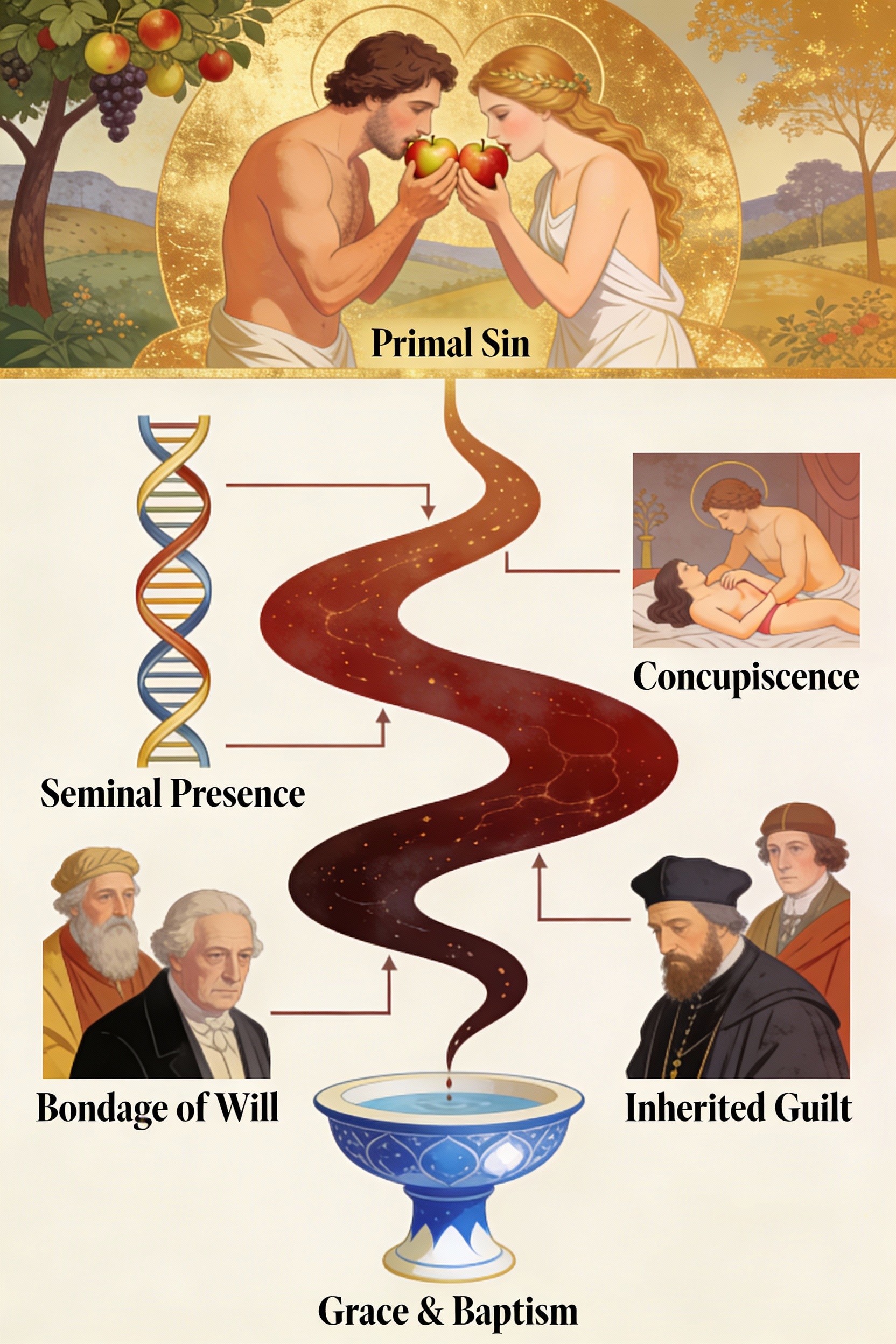
Summary
Original Sin, according to Augustine, is the corruption of human nature inherited from Adam and Eve's disobedience in the Garden of Eden. It's not just a bad action; it's a fundamental corruption of our very being. All humans were "seminally present in Adam's loins"—we literally existed in Adam at the moment he sinned, so we all participated in his sin. Original Sin is transmitted through sexual intercourse via concupiscence (uncontrollable sexual desire). Because of Original Sin, we are born with a "bondage of the will"—we can't help but sin. We deserve punishment (damnation) not for doing Adam's sin, but for being corrupted by it. The only cure is God's grace through baptism and Christ's sacrifice on the Cross.
Detailed Explanation
Part 1: The Primal Sin (Adam and Eve's Disobedience)
The First Sin:
- God commanded Adam and Eve not to eat from the Tree of Knowledge
- They freely chose to disobey—an act of pride (wanting to be like God)
- This first sin corrupted human nature itself
Part 2: Seminal Presence (We Were All in Adam)
Augustine's Most Controversial Claim:
"We were all in [Adam]... we all were that one man who fell into sin"
Key Points:
- All future humans existed "seminally" (as seeds) in Adam's loins at the moment he sinned
- When Adam's nature became corrupted ("vitiated"), all of humanity was corrupted simultaneously
- We don't need to commit a personal sin to be sinful—we inherit sin through our biological existence
Part 3: Transmission Through Sexual Intercourse and Concupiscence
Concupiscence as the Key Mechanism:
- Concupiscence = overwhelming sexual desire that overpowers reason
- Sexual desire is inherently sinful because it involves loss of rational control (even in marriage)
- Every sexual act (even between spouses) is accompanied by concupiscence, which transmits Original Sin to offspring
Why Christ was Virgin-Born:
Only a virgin birth could prevent concupiscence from infecting Jesus with Original Sin.
Important Caveat:
Augustine later clarified that concupiscence is not itself sin, but rather the sign and vehicle of sin's transmission.
Part 4: The Bondage of the Will (Non Posse Non Peccare)
The Enslaved Will:
- Original Sin creates a "bondage of the will"—we are enslaved to sin
- Unlike Adam, who had the ability not to sin (posse non peccare), we have no ability not to sin (non posse non peccare)
- Even when we know what's good and want to do it, we can't—our will is divided
St. Paul's Example (Romans 7):
"I do not do the good I want to do, but the evil I do not want to do—this I keep on doing"
Key Insight:
This bondage is not unfair punishment because we are born as corrupted beings who deserve punishment.
Part 5: Inherited Guilt and Damnation
The Harsh Reality:
- We inherit not just a predisposition to sin but actual guilt from Adam
- Even infants who have committed no sin are guilty and damned if they die unbaptized
Augustine's Defense:
This seems harsh, but Augustine argues: the guilt is factually transmitted through our birth; God isn't unjust for judging us as sinful beings.
Augustine's Theodicy (Defense of God)
The Problem:
If God is omnipotent and omnibenevolent, why do humans have a natural predisposition to sin?
Augustine's Solution:
- God didn't create humans with sin; humans created sin through their own free choice
- The predisposition to sin came from Adam's freely chosen disobedience, not from God
- Therefore, God is not responsible for the evil in human nature; humanity is
The Analogy:
Augustine asks: If your city were in a catastrophic war, would you go help neighbors, or hunker down with your family? Most would choose self-preservation. This inclination toward self-love over love of others is Original Sin—it's not God's fault; it's ours.
The Pelagian Controversy
Who was Pelagius?
A British theologian who rejected Augustine's doctrine of Original Sin.
Pelagius's Argument
- Humans have free will just like Adam and Eve did
- Free will means we are capable of not sinning (posse non peccare)
- If we weren't capable of not sinning, God couldn't hold us responsible or judge us
- We are sinners because we choose to sin, not because we inherit sin from Adam
Augustine's Counter-Argument
- Humans do have free will, but it's now enslaved by sin (non posse non peccare)
- Free will alone doesn't help—we need God's grace to enable us to avoid sin
- Responsibility doesn't require the ability not to sin; it requires a choice to sin (which we make)
Historical Outcome
Augustine won. The Church declared Pelagianism a heresy and officially adopted Augustine's doctrine of Original Sin and the necessity of grace.
The Role of Grace
Without Grace
- We are trapped in chains of bondage—enslaved to sin with a divided will
- We want to turn to God but can't do it on our own
With God's Grace
- Grace is prevenient (comes before)—God initiates
- Grace rehabilitates the will, enabling it to turn toward God
- Grace and free will cooperate—we are freed, but freedom is enabled by grace, not destroyed
This is how Augustine reconciles predestination (God's sovereignty) with free will (human responsibility).
Scholarly Perspectives
Augustine on Seminal Presence
"We were all in [Adam]... we all were that one man who fell into sin. We existed in merely a seminal nature from which we were to be begotten, but when that became vitiated through sin, it became impossible for anyone to be born without original sin. In Adam all sinned, so to speak, en masse."
Source: Augustine, On Original Sin
Context: Describes Augustine's controversial doctrine of seminal presence—we were literally in Adam when he sinned, so his guilt is transmitted to all humanity through biological reproduction.
Augustine on Grace and Free Will
"The nub of the problem was to reject the notion that the will is free to choose unless it is made free by God's grace. Free will without grace is useless to us without God's help. The remedy for the bondage of sin requires more than freedom of the will; it requires the grace of God to rehabilitate and enable the will."
Source: Adapted from Augustine's Confessions and On the Bondage of the Will
Context: Augustine's resolution of the tension between free will and grace—we have freedom but are enslaved by sin; only grace can free us.
Key Takeaways
Original Sin is Inherited Corruption
Not just individual choices—we inherit a corrupted nature from Adam.
Seminal Presence
Augustine's radical claim that we literally existed in Adam when he sinned.
Concupiscence Transmits Sin
Original Sin is transmitted through sexual reproduction via uncontrollable desire.
Bondage of the Will
After the Fall, we are "non posse non peccare" (unable not to sin).
Grace is Essential
Only God's prevenient grace can rehabilitate and enable the will.
Pelagian Heresy
Augustine's view defeated Pelagianism and became orthodox Christian teaching.
Theodicy
God is not responsible for human sin; humanity freely chose to corrupt itself.
Quick Reference: Original Sin Doctrine
| Concept | Meaning |
|---|---|
| Primal Sin | Adam and Eve's disobedience; the first sin that corrupted human nature |
| Seminal Presence | We all existed in Adam's loins; we sinned when he sinned |
| Concupiscence | Uncontrollable desire (especially sexual); the vehicle of sin's transmission |
| Inherited Guilt | We are born guilty, not for actions we committed but for being corrupted beings |
| Bondage of Will | We cannot help but sin; we lack the ability not to sin |
| Non Posse Non Peccare | "Not able not to sin"—the human condition after the Fall |
| Grace | God's gift that rehabilitates the will and enables us to escape sin |
| Predestination | God foreknows who will be saved; doesn't contradict free will because grace enables it |
Strengths and Weaknesses
Strengths
- Explains universal human sinfulness without blaming God
- Reconciles free will and grace coherently
- Accounts for moral responsibility even in a fallen world
- Grounded in Scripture (Genesis 3, Romans 5, Romans 7)
Weaknesses
- Seminal presence is hard to comprehend—how can we literally be in Adam?
- Infants are damned for a sin they didn't commit—seems unjust
- Augustine's link between lust and sin transmission is controversial
- Pelagian challenge: If we can't help sinning, how are we responsible?