Revealed Knowledge Through Jesus Christ
Summary
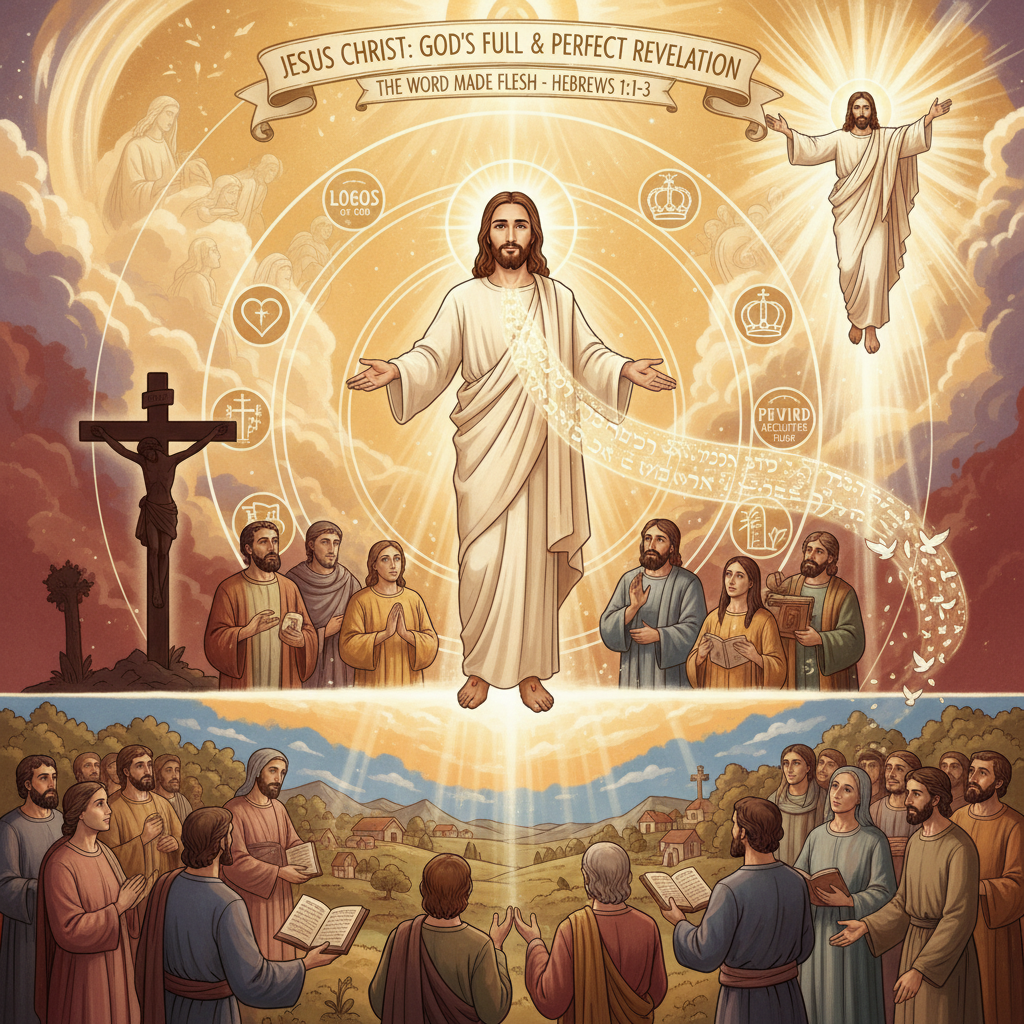
Jesus Christ is God's full, perfect, and final revelation—the ultimate self-disclosure of who God is and what God does. He is the Word of God (Logos): the personal expression of God's nature incarnate. Jesus is God incarnate—God became human while remaining fully God. He reveals God's nature ("the exact imprint of the Father's nature" - Hebrews 1:3), God's love (through His life, death, and resurrection), and serves as the perfect mediator bridging the gap between God and humanity.
Detailed Explanation
Jesus as the Word of God (Logos)
Definition of Logos:
The Greek term "logos" (Word) means God's self-expression, creative power, and revelatory nature.
"In the beginning was the Word, and the Word was with God, and the Word was God... Through him all things were made." — John 1:1-3
What This Means:
- The Word (Logos) is God's agent of creation and revelation
- Just as God's word creates in Genesis ("God said, 'Let there be light'"), the Logos creates and sustains the universe
- Just as God's word accomplishes His purposes (Isaiah 55:10-11), Jesus the Logos carries out God's redemptive purposes
- Jesus is God's personal self-expression—the way God communicates who He is
Jesus as Creator and Sustainer
"He is the radiance of the glory of God and the exact imprint of his nature, and he upholds the universe by the word of his power." — Hebrews 1:2-3
This Means:
- Jesus doesn't just create the universe initially; He continuously sustains it
- The ordering principle that holds creation together is Jesus Himself
- This reveals Jesus's infinite power and transcendence
Jesus as Revealer
"No one has ever seen God, but the one and only Son, who is himself God and is in closest relationship with the Father, has made him known." — John 1:18
The Passage Combines Two Ideas:
- Jesus is the ordering principle behind the universe (Logos)
- Jesus is the revealer of God to humanity
Therefore: to know creation is to know something about Jesus; to know Jesus is to know God.
The Incarnation: God Becoming Human
What is the Incarnation?
The incarnation is God's act of becoming human in Jesus Christ. Jesus was born of Mary, lived a human life, and was fully human—yet He is also fully God, not just a human prophet, but divine.
Why the Incarnation Reveals God:
"In the incarnation, Jesus reveals to us who God is by revealing to us what God does in the work of redemption. This is what the incarnation is: the Trinity setting into motion a divine rescue mission."
What This Means:
- We learn about God's character by observing God's actions in Jesus
- God's love, mercy, justice, and power are all displayed in the incarnation and redemptive work
- The incarnation is not incidental but central to God's self-revelation
Jesus: Fully God and Fully Human (Hypostatic Union)
The Hypostatic Union is the doctrine that Jesus is one Person with two complete and distinct natures: fully God and fully human.
Two Complete Natures
Jesus has two distinct natures that remain separate. Not 50% God and 50% human, but 100% God and 100% human.
One Person
Despite having two natures, Jesus is one person. The divine and human are united without mixing, changing, dividing, or separating.
No Loss of Divinity
"Remaining what he was, he became what he was not"—Jesus remained fully God while taking on human nature.
Each Nature Retains Its Properties
Divine nature: omniscience, omnipotence, eternality. Human nature: limited knowledge, physical vulnerability, emotional depth.
What Jesus Reveals About God
God's Power
- Calmed the wind and waves with a word (Mark 4:39)
- Healed the sick and raised the dead
- Forgave sins (authority over spiritual realm)
God's Love
- Came to save the lost (Luke 19:10)
- Died for our sins (Romans 5:8)
- Rose from the dead, conquering death
God's Humility
- Born in a manger
- Washed his disciples' feet
- Suffered and died like a criminal
God's Holiness
- Lived a morally perfect, sinless life
- Fulfilled all Old Testament prophecies
- Reveals God's absolute moral perfection
God's Justice & Mercy
- Death satisfies God's justice regarding sin
- Resurrection shows God's mercy and grace
- Perfect balance of justice with mercy
God is Triune
- The Father sent the Son into the world
- Jesus reveals the Father (John 14:9)
- The Holy Spirit comes through Jesus's work
Jesus as Perfect Mediator
Definition of Mediator:
A mediator is an intermediary who brings parties together and facilitates relationship between them.
"For there is one God and one Mediator between God and men, the Man Christ Jesus, who gave Himself a ransom for all." — 1 Timothy 2:5-6
The Problem Jesus Solves:
Humans are sinful; God is holy—the gap between them is unbridgeable by humans alone. We needed someone who is both fully God and fully human.
Three Ways Jesus Functions as Mediator:
1. Representing God to Humanity
Jesus reveals who God is through His life and teachings. "I and the Father are one" (John 10:30). By knowing Jesus, we know God.
2. Representing Humanity to God
Jesus experiences human existence while remaining sinless. He can sympathize with human struggles (Hebrews 4:15) and advocates for us to the Father.
3. Facilitating Restored Relationship
Through Jesus's death and resurrection, the gap between sinful humans and holy God is bridged. "No one comes to the Father except through me" (John 14:6).
The God-Man Interface: Jesus is described as "the common medium that both we and our heavenly Father can relate to"—just as a computer interface allows humans to interact with complexity, Jesus as the God-man allows humanity to relate to God's infinite nature.
Jesus Reveals God's Love Through Redemption
Why the Incarnation Happened:
- God loves humanity so deeply that God became human
- God took on human form to make salvation possible
- God "wants sinful man to have eternal life because he is forgiving and loving"
How Jesus's Death Reveals God's Love:
"While we were still sinners, Christ died for us." — Romans 5:8
Christ "gave Himself a ransom for all"—meaning Jesus's death is the price God pays to free us from sin. This reveals that God is willing to suffer for our sake.
What Jesus's Resurrection Reveals:
The resurrection is the ultimate confirmation of Jesus's identity as God's Son: "declared to be the Son of God in power by his resurrection from the dead" (Romans 1:4). This reveals that God has power over death and offers eternal life to those who believe.
Jesus Reveals God's Glory
What is God's Glory?
God's "glory" is His ultimate nature, beauty, power, and splendor—the overwhelming sense of God's greatness.
"He is the radiance of the glory of God." — Hebrews 1:3
What This Means:
- Just as the sun's radiance is the light shining from the sun, Jesus is the light shining from God
- Jesus radiates or displays God's glory to us
- In Jesus, we see God's supreme greatness and beauty
The Transfiguration (Mark 9:7):
Jesus was transfigured before the disciples, radiating divine light. A voice from heaven said: "This is my Son, whom I love. Listen to him!" This event reveals Jesus's divine glory while He was still on earth.
Jesus as the Exact Image of God
"He is... the exact imprint of [God's] nature." — Hebrews 1:3
What This Means:
- Just as a signet ring leaves an exact imprint in wax, Jesus is the exact expression of God's nature
- Seeing Jesus is seeing God's nature directly
- Jesus is not a partial representation or approximation of God; He is exact and complete
Implications:
- To understand God, study Jesus
- Jesus's words are God's words
- Jesus's character is God's character
- Jesus's love is God's love
Jesus Completes the Revelation
Jesus as Final Revelation:
"Long ago, at many times and in many ways, God spoke to our fathers by the prophets, but in these last days he has spoken to us by his Son." — Hebrews 1:1-2
What This Means:
- Jesus is God's final word to humanity
- While the Old Testament contained partial revelations (law, prophecy, wisdom), Jesus is the fullness of revelation
- Nothing exceeds or supersedes what Jesus has revealed
- Jesus fulfilled messianic prophecies and brought the Old Testament story to its climax
How Jesus Exceeds Natural Revelation
| Aspect | Natural Revelation | Jesus's Revelation |
|---|---|---|
| Source | Creation, reason, conscience | God Himself incarnate |
| What It Shows | God's power, intelligence, existence | God's nature, love, character, purposes |
| How It Works | Indirect—through observation | Direct—personal encounter with God |
| Completeness | Partial knowledge | Full and perfect knowledge |
| Scope | Universal but limited | Complete self-disclosure |
| Relationship | Knowledge about God | Personal relationship with God |
| Redemptive Content | None—cannot reveal salvation | Full redemptive plan |
Scholarly Perspectives
Quote 1: Jesus as God's Final and Perfect Revelation
"Long ago, at many times and in many ways, God spoke to our fathers by the prophets, but in these last days he has spoken to us by his Son, whom he appointed the heir of all things, through whom also he created the world. He is the radiance of the glory of God and the exact imprint of his nature, and he upholds the universe by the word of his power."
Source: Hebrews 1:1-3
Context: Establishes Jesus as God's final, complete, and authoritative revelation—the fullness of what God has disclosed to humanity.
Quote 2: Incarnation Reveals God Through Redemptive Action
"In the incarnation, Jesus reveals to us who God is by revealing to us what God does in the work of redemption. This is what the incarnation is: the Trinity setting into motion a divine rescue mission. A Triune conspiracy of deliverance. Jesus came to us in humility, revealing that God is willing to humble Himself and suffer for humanity's sake. The manner of the incarnation reveals our need—that we need divine rescue. Christ is the God-man interface, the common medium that both we and our heavenly Father can relate to."
Source: Incarnational theology and mediatorial Christology
Context: Shows how Jesus's actions and suffering reveal God's character and how the incarnation solves the gap between God and fallen humanity.
Key Takeaways
Jesus is the Word of God (Logos)
The living, personal expression of God's nature—God's creative power and revelatory self-disclosure incarnate.
Jesus is God's final revelation
While God spoke through many prophets and in many ways, Jesus is God's complete and ultimate word to humanity.
Jesus is fully God and fully human
One person with two complete, distinct natures—not 50/50, but 100% God and 100% human.
Jesus reveals God's nature
Through His divine authority, power over creation, mercy, and holiness, Jesus shows us who God is.
Jesus reveals God's love
The incarnation and redemptive work reveal God's sacrificial, passionate love for humanity.
Jesus is the perfect mediator
Jesus bridges the unbridgeable gap between sinful humans and holy God, enabling restored relationship.
Jesus's actions reveal God
We understand God's character by what Jesus does—His love, mercy, justice, and power all revealed through His ministry, death, and resurrection.
Incarnation reveals our need
The manner of Jesus's coming—in humility, suffering, and sacrifice—reveals that we desperately need God's rescue and grace.
Quick Reference: Jesus as Revelation
| Concept | Meaning |
|---|---|
| Logos (Word) | God's self-expression, creative power, revelatory nature incarnate in Jesus |
| Incarnation | God becoming human in Jesus Christ |
| Hypostatic Union | Jesus is one person with two distinct natures: fully God and fully human |
| Perfect Mediator | Jesus bridges God and humanity, representing both to each other |
| Radiance of Glory | Jesus displays and radiates God's ultimate nature, beauty, and power |
| Exact Imprint | Jesus is the exact expression of God's nature—seeing Jesus is seeing God |
| God's Ultimate Revelation | Jesus is God's final and complete self-disclosure to humanity |
| Sustainer of Creation | Jesus continuously upholds the universe by His power |
| Redeemer | Jesus's death and resurrection reveal God's love and offer salvation |
| God's Love Incarnate | The incarnation itself expresses God's sacrificial love for humanity |