Revealed Knowledge Through Faith and Grace
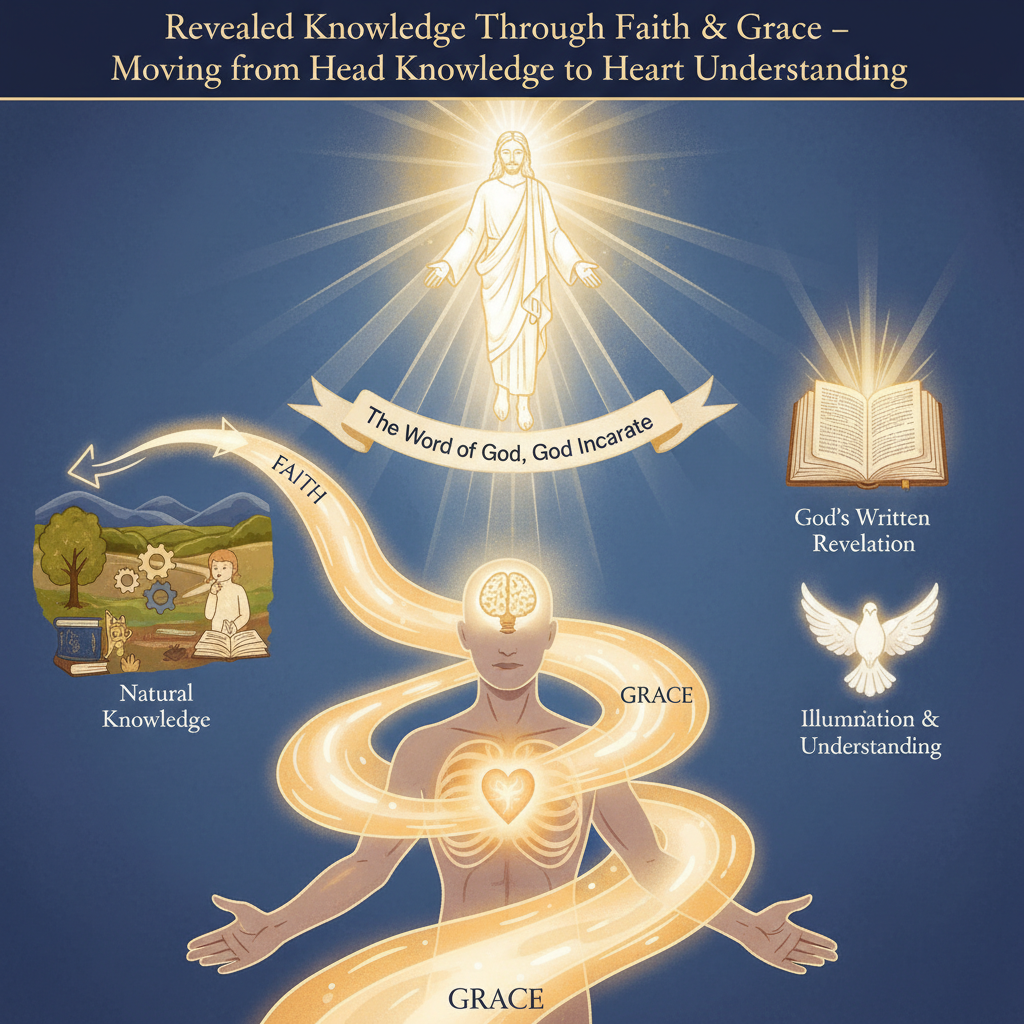
Summary
Revealed knowledge is personal, intimate knowledge of God given directly by God Himself—not gained by human reason alone, but disclosed through God's self-revelation. It comes through faith (personal acceptance and trust in God's revelation), through grace (God's free gift enabling us to receive what we cannot achieve by our own efforts), through Jesus Christ (God's ultimate and perfect self-disclosure), through Scripture (the written record of God's revelation), and through the Holy Spirit (illumination—enabling understanding of God's truth). Natural knowledge can tell us God exists, but only revealed knowledge can show us God's love, mercy, and redemptive purposes.
Detailed Explanation
Definition and Purpose of Revealed Knowledge
What Revelation Means:
The word "revelation" comes from a Greek word meaning "to unveil" or "to disclose". Revealed knowledge is the self-disclosure of God to humanity—God actively taking the initiative to show Himself to us.
Why God Reveals Himself:
According to Christian theology, God's purpose in revelation is to restore the broken relationship between God and humans caused by human sin.
Personal vs. Intellectual Knowledge:
Revealed knowledge is described as "the most personal and intimate knowledge of God"—not merely intellectual understanding (knowing facts about God), but personal encounter (knowing God as a Person).
Two Types of Revelation
General (Natural) Revelation
- Knowledge of God perceived through nature, conscience, and history
- The observable universe indicates a creator
- Moral law within humans indicates divine moral authority
- Available to all people everywhere
- But provides limited knowledge—only that God exists and is powerful
Special (Supernatural) Revelation
- God's self-disclosure through miraculous events, visions, prophecies
- Most importantly, through Scripture and Jesus Christ
- Revealed to specific people at particular times and places
- Provides full, intimate knowledge of God's nature, love, and redemptive plan
Immediate Revelation:
Direct knowledge about God given directly to a person. Example: Moses encountering God in the burning bush.
Mediate Revelation:
Learning about God less directly, often through someone else who has experienced God. Example: Reading the apostles' accounts of Jesus in the Bible.
Jesus Christ: The Ultimate Revelation
Jesus as God's Word:
The New Testament describes Jesus as "the Word of God"—the living, personal embodiment of God's revelation.
"Long ago, at many times and in many ways, God spoke to our fathers by the prophets, but in these last days he has spoken to us by his Son, whom he appointed the heir of all things, through whom also he created the world. He is the radiance of the glory of God and the exact imprint of his nature, and he upholds the universe by the word of his power." — Hebrews 1:1-3
What This Passage Claims:
- Jesus is God's final revelation ("in these last days he has spoken to us by his Son")
- Jesus reveals God's glory ("the radiance of the glory of God")
- Jesus is the exact image of God's nature ("the exact imprint of his nature")
- Jesus is the sustaining power behind creation ("upholds the universe")
Jesus Exceeds Natural Knowledge:
Natural knowledge can know that God exists, but only through Jesus can we know God's love, mercy, forgiveness, and redemptive purposes. "The revelation of Christ far surpasses the general knowledge of God in nature."
Scripture: God's Written Revelation
The Bible as Revelation:
Scripture is God's written revelation—the recorded account of God's self-disclosure throughout history. Biblical personalities like Moses, the prophets, Jesus, and the apostles are considered recipients of direct divine revelation. They carried this revelation to other people through teaching and writing.
Scripture's Role:
- Scripture is the basis for understanding God's truth and walking in relationship with Him
- The Holy Spirit uses Scripture in believers' lives to communicate God's will and truth
- Scripture is God's word in written form
Cannot Be Empirically Validated:
The validity and reliability of revealed knowledge is a matter of faith. It cannot be empirically validated through scientific testing. It requires trust and commitment, not just rational proof.
The Role of Faith in Revealed Knowledge
What is Faith?
According to Aquinas, faith is "an act of the intellect assenting to the truth at the command of the will".
Components of Faith:
- Intellectual component: Understanding/assenting to what is revealed
- Volitional component: An act of the will—choosing to trust and commit
Faith vs. Scientific Knowledge (Aquinas):
Aquinas argued that "we cannot have faith and scientific knowledge about the same thing":
- Scientific knowledge comes from certainty based on empirical evidence
- Faith is about things where certainty is not readily available
- Faith involves trust and commitment beyond what can be proven
Faith and Reason Together:
Reason might provide rational evidence that leads toward belief in God, but revelation and faith are necessary for full understanding and personal relationship.
Faith as a Gift: The Role of Grace
Is Faith a Gift from God?
"For by grace you have been saved through faith. And this is not your own doing; it is the gift of God, not a result of works." — Ephesians 2:8-9
Why Faith Must Be a Gift:
Romans 3:11 states:
"There is none who understands, there is none who seeks for God."
This implies:
- No one naturally seeks God on their own
- Without God's gracious gift of faith, no one would ever believe
- Therefore, faith must be given by God, not achieved by human will
Philippians 1:29:
"For it has been granted to you that for the sake of Christ you should not only believe in him but also suffer for his sake."
Even the believer's act of believing is "granted" by God—it's a divine gift.
Illumination: The Holy Spirit's Role in Understanding
What is Illumination?
Illumination is the theological term expressing the Holy Spirit's role in enabling biblical understanding. Just as physical light enables physical sight, the Holy Spirit's illumination enables spiritual insight.
Biblical Basis (John 1:5, 9):
"The Light shines in the darkness, and the darkness did not comprehend it... the true Light which coming into the world, enlightens every man."
The Holy Spirit's Three Roles in Understanding:
1. Cognitive Illumination
The Holy Spirit brings greater cognitive (intellectual) understanding of Scripture and God's truth.
2. Application and Conviction
The Holy Spirit convicts, convinces, and arouses believers—applying scriptural truths to individual lives, awakening sluggish hearts.
3. Welcoming Truth
The Holy Spirit works primarily in our welcoming of truth—our receptivity and acceptance of what God reveals.
Not Human Achievement:
We do not illuminate ourselves through study or reasoning alone. The Holy Spirit actively illuminates believers through Scripture. We are passive recipients of the Spirit's illuminating work.
Natural vs. Revealed Knowledge Comparison
| Aspect | Natural Knowledge | Revealed Knowledge |
|---|---|---|
| Source | Human reason applied to creation | God's direct self-disclosure |
| Method | Observation, logic, inference | Divine revelation through Jesus, Scripture, Spirit |
| What It Reveals | God's existence, power, intelligence | God's love, mercy, grace, redemptive purposes |
| Accessibility | Universal—available to all | Requires faith and grace |
| Personal Impact | Head knowledge—intellectual assent | Heart knowledge—personal relationship |
| Sufficiency | Insufficient for salvation | Sufficient for full knowledge of God |
Scholarly Perspectives
Augustine on the Necessity of Grace
Augustine taught that "all humans are sinful and have finite minds" (based on Genesis and the Fall of Man). Natural knowledge is insufficient to gain full knowledge of God—our sinful, finite condition prevents us from knowing God through reason and observation alone.
The Solution: "Knowledge of God is possible through faith and grace." Faith is our trusting response to God's revelation; grace is God's enabling gift that makes this faith possible.
Anselm: Faith Seeking Understanding
Anselm developed the concept "faith seeking understanding"—a framework where faith comes first, then understanding follows. The sequence: Faith → Seeking → Understanding (through grace).
"Teach me to seek You, and reveal Yourself to me as I seek, because I can neither seek You if You do not teach me how, nor find You unless You reveal Yourself."
Anselm realized that understanding God "surpassed the limits of his own human and finite abilities." Grace is the essential element by which understanding becomes possible—"faith could not successfully seek and find understanding without grace."
Calvin: The Mind as Passive Receiver
Calvin argued that people should see their mind as nothing more than a "passive reception of the revelation of the Bible."
Implications: Our minds are not active producers of religious knowledge—rather, our minds are passive recipients of God's revealed truth. We receive what God has revealed; we don't construct it. Revealed knowledge "consists primarily of faithfully receiving what is believed to be God's word."
Key Academic Quotes:
"Long ago, at many times and in many ways, God spoke to our fathers by the prophets, but in these last days he has spoken to us by his Son, whom he appointed the heir of all things, through whom also he created the world. He is the radiance of the glory of God and the exact imprint of his nature."— Hebrews 1:1-3
"For now we see only a reflection as in a mirror; then we shall see face to face. Now I know in part; then I shall know fully, even as I am fully known."— 1 Corinthians 13:12
Key Takeaways
- Revealed knowledge is God's direct self-disclosure, not gained through reason alone, but through personal faith in God's revelation.
- Jesus Christ is the ultimate revelation—the full and perfect knowledge of God incarnate.
- Scripture is God's written revelation—the authoritative record of God's self-disclosure through history.
- Faith is not mere intellectual assent but trust and commitment of the will, enabled by grace.
- Grace is essential: Without God's unmerited grace enabling faith, no one would ever believe or understand God.
- Faith as a gift: Even our capacity to believe is given by God—not achieved by human effort alone.
- Holy Spirit illumination: The Holy Spirit enlightens believers to understand Scripture and grasp God's truth—we are passive recipients.
- Anselm's model: "Faith seeking understanding"—faith comes first, then grace enables understanding to unfold progressively.
- Natural knowledge insufficient: While natural knowledge can show God exists, only revealed knowledge discloses God's love, mercy, and redemptive plan.
- Personal relationship: Revealed knowledge brings intimate, personal knowledge of God—not just intellectual facts, but heart knowledge.