Natural Knowledge Seen in Creation
Summary
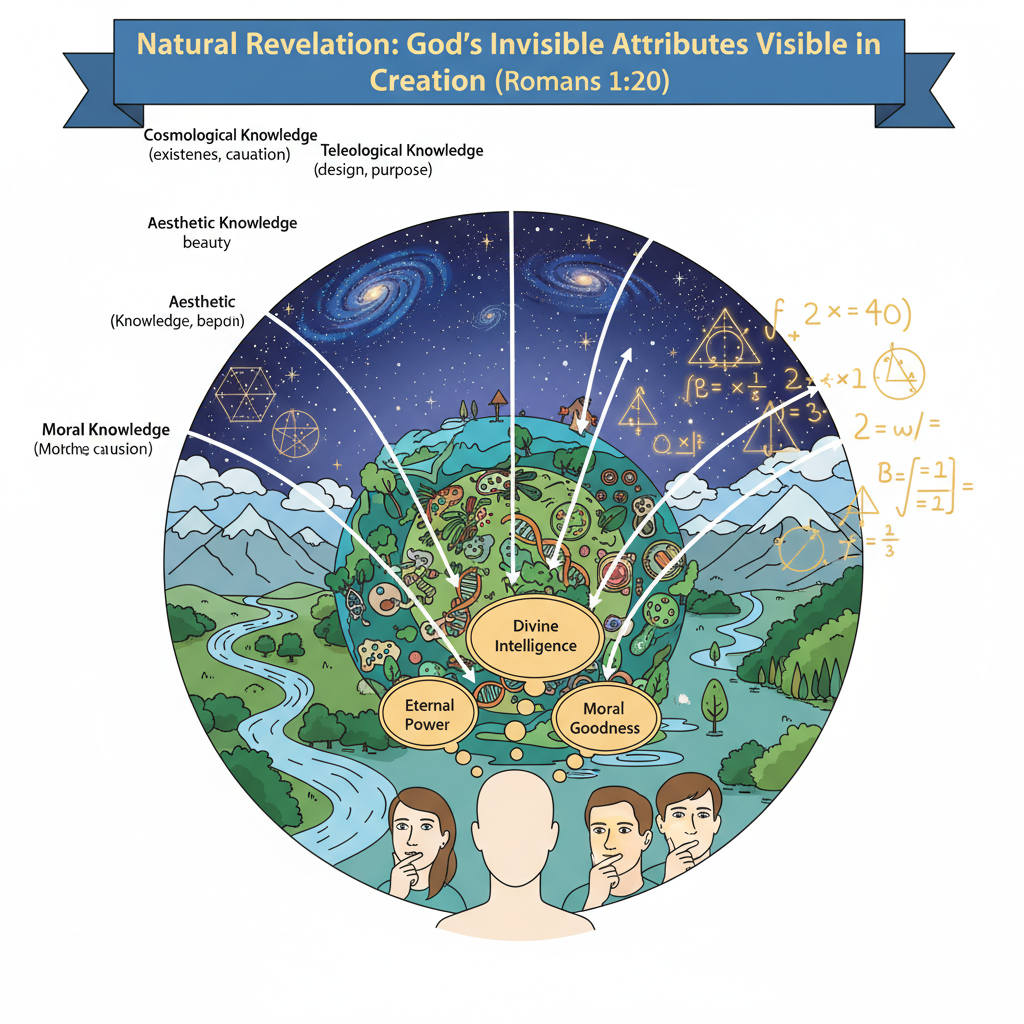
Natural Revelation is God's self-disclosure through creation—the universe and natural world reveal knowledge of God's existence and attributes without requiring Scripture, prophecy, or special revelation. According to Romans 1:20, God's "invisible attributes, namely, his eternal power and divine nature, have been clearly perceived in the things that have been made." Creation reveals God through four main ways: Cosmological Knowledge (existence and causation), Teleological Knowledge (design and purpose), Aesthetic Knowledge (beauty), and Moral Knowledge (conscience and moral law). The conclusion is that "no human can pretend ignorance of God."
Detailed Explanation
What is Natural Revelation?
Definition:
Natural revelation (natural knowledge seen in creation) is knowledge of God's existence and attributes gained through observation and reason applied to the natural world, without special revelation from Scripture or prophecy.
Contrast with Special Revelation:
Special Revelation
God directly communicates through Jesus, the Bible, prophets, miracles
Natural Revelation
God reveals Himself through the created order itself—everyone can observe it
Universal Accessibility:
Because natural revelation comes through creation, it is universally available to all humans everywhere, regardless of education, literacy, access to Scripture, or cultural/geographic location.
Romans 1:19-20: The Scriptural Foundation
The Key Passage:
"For what can be known about God is plain to them, because God has shown it to them. Ever since the creation of the world his invisible attributes, namely, his eternal power and divine nature, have been clearly perceived in the things that have been made."
What This Passage Claims:
- Clarity: God's attributes are "clearly perceived" in creation—not obscure or difficult
- Universality: This clarity has been true "ever since the creation of the world"—always and everywhere
- Visibility of the Invisible: God's invisible attributes become visible through created things
- Knowledge of Two Attributes: At minimum, creation reveals God's eternal power (omnipotence) and God's divine nature (divinity, supreme intelligence)
Implications for Accountability:
Paul concludes that "people are without excuse" (Romans 1:20)—meaning no one can claim ignorance of God, because His revelation is so clear in creation.
The Cosmological Argument (First Cause)
Definition:
The cosmological argument (or argument from causation) claims that everything that exists requires a cause, and this chain of causation must ultimately lead to God as the "First Cause".
Aquinas's Second Way: Motion and Change
- Everything in the world is in motion or undergoing change
- Everything that moves must be moved by something else (nothing moves itself)
- A chain of movers cannot be infinite—it must have a starting point
- Therefore, there must be a First Mover, unmoved by anything else
- "This we call God"
Aquinas's Third Way: Contingency and Necessity
- Everything in the universe is contingent—it could not exist (it's dependent on other things)
- If everything were contingent, then nothing would exist (because contingent things need causes)
- Therefore, there must exist something that is necessary—something that must exist and isn't dependent on anything else
- This necessary being is God
Strengths:
- Based on observable facts about the universe
- Doesn't require a universe with a beginning in time
- Reflects common human reasoning about causation
Weaknesses:
- Special pleading: Why can't the universe itself be necessary?
- Kantian objection: Causality may not apply beyond the world
- Quantum indeterminacy: Does everything require a cause?
The Teleological Argument (Design)
Definition:
The teleological argument (from Greek telos = purpose) claims that the apparent design and purposefulness in nature indicates an intelligent designer—God.
Core Logic:
- The universe exhibits order, complexity, and apparent purpose
- Such design requires an intelligent designer (just as a watch requires a watchmaker)
- The universe's designer is God
William Paley's Watchmaker Argument:
The Analogy:
Imagine finding a watch on the ground. You notice functional complexity (multiple parts precisely arranged) and coordination toward a purpose (all parts work together to tell time). Conclusion: Someone with knowledge designed this watch.
Application to Nature:
- Biological complexity: DNA, cells, organs, organisms are intricately designed systems
- Environmental order: Ecosystems work in harmony; seasons cycle predictably
- Physical laws: Mathematics underlies nature; universal constants enable life
- Apparent purpose: Life survives, reproduces, adapts—suggesting purposive design
Strengths:
- Based on observation of nature's apparent order
- Intuitive—many find design obvious in nature
- Doesn't require advanced physics or mathematics
Weaknesses:
- Hume's dissimilarity: Universe is unlike human artifacts
- Polytheism problem: Why conclude one designer?
- Darwin's evolution: Natural selection explains complexity
Four Types of Natural Knowledge from Creation
1. Cosmological Knowledge (First Cause)
Knowledge gained from observing that everything exists and has a cause:
- The universe exists (observable fact)
- Existence requires explanation (logical principle)
- An ultimate cause must exist → This cause is God
2. Teleological Knowledge (Design and Purpose)
Knowledge gained from observing order, complexity, and purposefulness:
- Nature shows apparent design (observable fact)
- Design implies designer (logical principle)
- An intelligent designer must exist → This designer is God
3. Aesthetic Knowledge (Beauty)
Knowledge gained from appreciating beauty in creation:
- Nature exhibits remarkable beauty
- Beauty reflects the character of its source
- Therefore, God is beautiful and good
4. Moral Knowledge (Goodness and Law)
Knowledge gained from recognizing moral order and conscience:
- Humans have moral sense (conscience)
- This reflects a moral standard beyond ourselves
- This points to a moral lawgiver → God
What Creation Reveals About God
God's Eternal Power:
- The size of the universe (billions of galaxies, each with billions of stars) suggests infinite power
- The continued existence of the universe suggests God continuously sustains it
- Physical laws working consistently suggest divine creative intelligence
God's Divine Nature (Divinity, Godhood):
- Intelligence: The order in nature reveals God's supreme intelligence
- Eternality: The cosmic beginning suggests God exists beyond time
- Transcendence: God is not part of creation but stands above and beyond it
God's Goodness and Moral Law:
- Beauty: The beauty of nature suggests God is supremely beautiful and good
- Order: The orderliness of natural laws suggests God is rational and purposive
- Abundance: Nature provides abundantly for human needs, suggesting God's generosity
- Human conscience: Our moral sense reflects a divine moral standard implanted in us
Limits of Natural Knowledge
What Creation Cannot Reveal:
While Romans 1:20 claims creation reveals God's "eternal power and divine nature," other aspects of God require special revelation:
- God's love and mercy (require Jesus and Gospel)
- God's redemptive plan (require Scripture)
- Christ's incarnation and resurrection (require special revelation)
- God's detailed moral law (beyond what conscience reveals)
- Salvation through faith (requires Gospel)
Why Some Deny Natural Knowledge:
Romans 1:18 notes that some people "suppress the truth":
- Sin corrupts perception: Fallen humans may refuse to acknowledge what creation reveals
- Idolatry: Some create false gods rather than accepting the God revealed in nature
- Rationalization: Moderns may rationalize away the design in nature through materialism
Scholarly Perspectives
Natural Revelation in Creation (Romans 1:19-20):
"For what can be known about God is plain to them, because God has shown it to them. Ever since the creation of the world his invisible attributes, namely, his eternal power and divine nature, have been clearly perceived in the things that have been made... the people are without excuse."
Context: Establishes that creation clearly reveals God's existence and divine attributes, making ignorance of God inexcusable.
William Paley on Design:
"The watch must have had a maker: that there must have existed, at some time and at some place or other, an artificer or artificers, who formed it for the purpose which we find it actually answers; who comprehended its construction, and designed its use... The universe itself exhibits the same mark of purposive design as the watch. Multiple parts precisely arranged coordinate toward the purpose of maintaining life. Such functional complexity reliably indicates an intelligent designer."
Source: William Paley, Natural Theology.
Context: Presents the classic watchmaker analogy for the teleological argument for God's existence based on observed design in nature.
Psalm 19:1-2 on Creation's Testimony:
"The heavens declare the glory of God; the skies proclaim the work of his hands. Day after day they pour forth speech; night after night they reveal knowledge."
Context: Creation continuously communicates God's glory and creative power.
Key Takeaways
Natural revelation: God discloses Himself through creation, enabling universal knowledge of His existence without Scripture or special revelation.
Two divine attributes revealed: Creation clearly reveals God's eternal power (omnipotence) and God's divine nature (godhood, transcendence).
Cosmological argument: Everything requires a cause; an infinite chain of causation must end in God as the "First Cause".
Teleological argument: Creation exhibits design and purposefulness; such complexity indicates an intelligent designer—God.
Paley's watchmaker: Compares nature's functional complexity to a watch's—both reliably indicate intelligent design.
Four types of natural knowledge: Cosmological, teleological, aesthetic, and moral—each reveals aspects of God through creation.
Universal accessibility: Natural knowledge is available to all humans everywhere, not just the educated or Christian.
No excuse for ignorance: Romans 1:20 claims people are "without excuse"—God's revelation through creation is so clear.