Natural Knowledge: An Innate Sense of the Divine
Summary
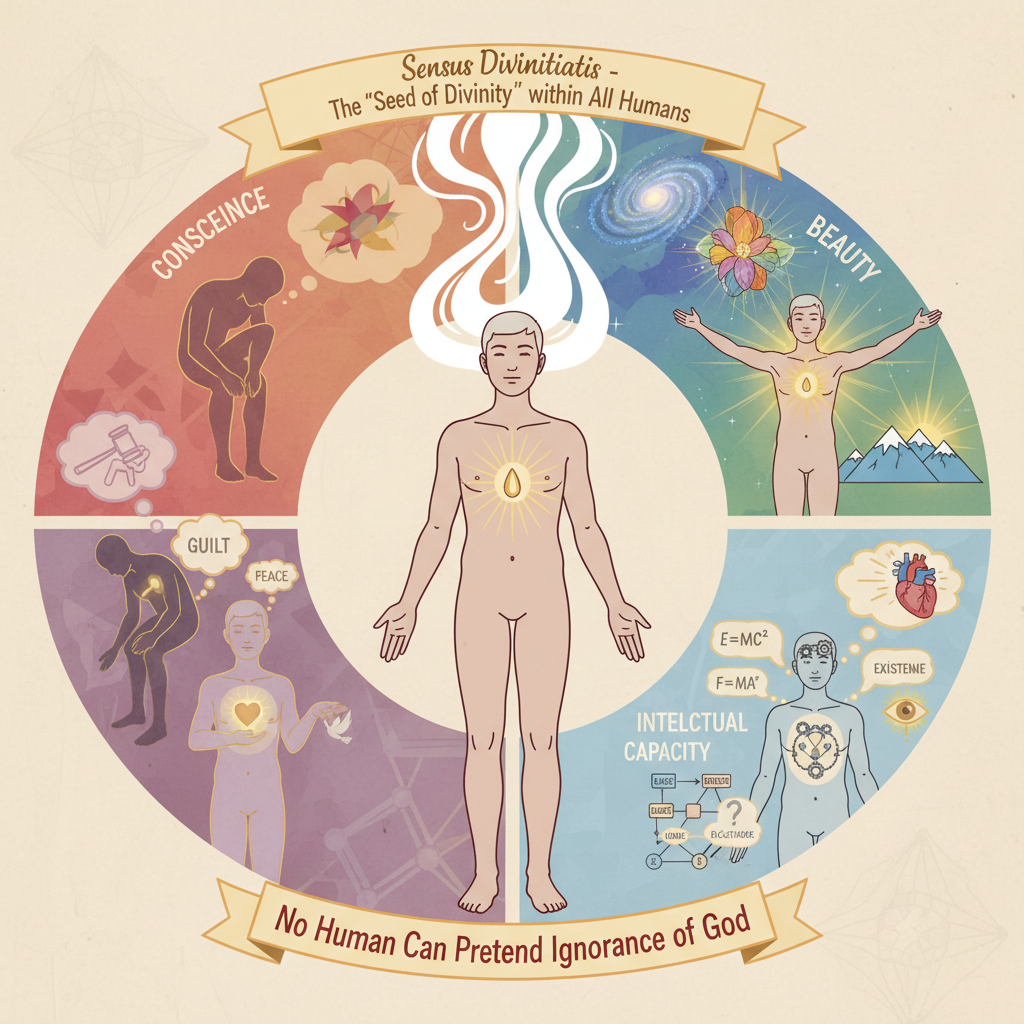
Natural knowledge of God is knowledge gained through human faculties (reason, observation, conscience) without special divine revelation—rather than knowledge given directly by God through Scripture or prophecy. John Calvin argued that all humans are born with an innate sense of the divinecalled the Sensus Divinitatis (Latin for "sense of divinity")—a universal, natural human capacity to sense God's existence, independent of education, culture, or exposure to Christianity. This sense manifests through conscience (moral awareness), beauty (appreciation of creation), and intellectual capacity (reason and reflection). God implanted this sense "to prevent any man from pretending ignorance" of His existence.
Detailed Explanation
Two Types of Religious Knowledge
Christianity recognises two fundamental ways to know about God:
1. Natural Knowledge
Knowledge gained "by ourselves" through human faculties—observation, reason, or an innate sense of the divine.
Example: Seeing design in nature and inferring a Designer
2. Revealed Knowledge
Knowledge given directly by God through special revelation—Jesus, the Bible, prophecy, miracles.
Example: God revealing Himself through Scripture
The Natural Theology Framework
Natural theology assumes that:
- God is the creator of the universe
- Humans are conscious parts of that universe with a natural ability to know their Creator
- The natural world creates a point of contact between humans and God, telling us about His nature
Calvin's Sensus Divinitatis (Sense of Divinity)
Definition:
The sensus divinitatis (Latin for "sense of divinity") is an innate, universal human capacity to sense God's existence.
Alternative Names:
- Sensus deitatis = "sense of deity"
- Semen religionis = "seed of religion"
- The "seed of divinity"—implanted by God in all humans
Key Characteristics:
- Innate (born with it): Not learned but implanted by God at creation
- Universal: Every human has this sense, regardless of culture, geography, or education
- Ineradicable: "Nature herself allows no individual to forget" it
- Natural Instinct: Not requiring intellectual effort; it's a spontaneous human capacity
- Apologetic Value: Grounds for divine accountability—"God himself did this to prevent any man from pretending ignorance"
Three Ways We Experience the Sensus Divinitatis
1. Through Conscience (Moral Awareness)
The Phenomenon: We feel guilt when we do wrong and peace when we do right—an internal moral compass.
What It Reveals:
- This moral sense reveals an innate understanding of God's goodness and moral law
- The conscience testifies to a higher moral authority than ourselves—an objective standard of right and wrong
- We instinctively know we are accountable to someone higher than ourselves
How It Works:
- When we violate conscience (do wrong), guilt arises—proving we know a moral standard we've broken
- When we obey conscience (do right), peace follows—confirming alignment with our true nature
- This suggests the conscience is designed to connect us to God's will
2. Through Beauty (Reflection of the Divine)
The Phenomenon: Humans universally appreciate beauty—in stars, nature, landscapes, human complexity, art, music.
What It Reveals: Beauty serves as "a kind of mirror, in which we may behold God, though otherwise invisible".
Why This Matters:
- The fact that all cultures find beauty in creation suggests something universal is being communicated
- Calvin notes the beauty of the human body and intellectual capacity as evidence of divine design
- The predictable, harmonious order in nature (seasons, mathematics, biology) reflects divine order
How It Works:
- We don't just see beauty; we feel it deeply, suggesting we're recognising something transcendent
- This aesthetic response is universal across cultures—even remote tribes appreciate beauty
- The appreciation of beauty is ineffable and difficult to articulate—suggesting it touches something beyond reason
3. Through Intellectual Capacity (Reason and Reflection)
The Phenomenon: Humans can use reason to reflect on and recognise God's existence.
What It Reveals: We can employ logical reflection to move from observations of the world to conclusions about God's existence.
Examples of Rational Reflection:
- Cause and Effect: "Everything that exists has a cause; the universe exists; therefore, there must be a first cause (God)"
- Order and Design: "Things show evidence of design and purpose; therefore, a designer must exist"
- Complexity: "Living organisms are incredibly complex; complexity suggests intelligence and purpose; therefore, an intelligent creator exists"
How It Works:
- Even without formal training in philosophy or theology, humans can observe the world and draw reasonable conclusions about God
- This is why even remote indigenous peoples have some concept of God/divine being—reason itself testifies to divine existence
- This capacity for reflection is part of our nature as rational beings
Historical Evidence for Sensus Divinitatis
Cross-Cultural Universality of Religion:
Calvin argues that the existence of religion in every human culture is evidence for the sensus divinitatis.
Cicero's Observation:
The Roman philosopher Cicero noted that "all cultures have a sense of an infinite being that is in control of the universe".
Anthropological Support:
- Every human society has some form of religion, worship, ritual, or belief in the divine
- This is not learned culture but a natural human tendency
- The universality of religion across geography, time, and isolation suggests an innate human capacity
The Inference:
If humans everywhere, with zero exposure to Christianity or philosophical training, still develop concepts of God, the sensus divinitatis must be innate and universal.
Thomas Aquinas: Natural Knowledge Through Reason
Different Approach from Calvin:
While Calvin emphasised an innate sense, Aquinas emphasised natural knowledge through reason and observation.
Aquinas's View:
- Human reason is a gift from God; therefore, using reason leads to divine truth
- Reason can gain lesser knowledge of God, including:
- God's existence through cosmological and teleological arguments
- God's moral law through natural law theory
- God's nature by analogy through proportional reasoning
Cosmological Argument (First Way):
- Everything that moves is moved by something else
- A chain of movers cannot be infinite (requires a first mover)
- Therefore, God is the Unmoved Mover who set the universe in motion
Teleological Argument (Fifth Way):
- Things in the world show evidence of design and purpose
- An unintelligent thing cannot direct itself toward a purpose
- Therefore, an intelligent designer (God) must exist to have ordered the world toward its purposes
Key Difference from Calvin:
- Calvin: Sensus divinitatis is an innate, instinctive sense—not requiring formal argument
- Aquinas: Natural knowledge comes through reason and argumentation—a more intellectual/philosophical approach
Plantinga's Reformed Epistemology and Sensus Divinitatis
Modern Defence of Innate Sense:
Philosopher Alvin Plantinga has revived Calvin's sensus divinitatis in contemporary epistemology.
Properly Basic Belief:
Plantinga argues that belief in God can be "properly basic"—warranted without requiring arguments or evidence.
What "Properly Basic" Means:
- Certain beliefs (like "I exist," "I see colours") are justified without evidence
- They are justified because they are produced by reliable cognitive faculties in the right conditions
- Similarly, belief in God could be properly basic if it's produced by a reliable faculty (the sensus divinitatis) in appropriate conditions
Warrant and Design Plan:
Plantinga defines warrant as "the property of beliefs that makes them knowledge". A belief is warranted when:
- Produced by sound cognitive faculties
- In an environment conducive to proper functioning
- In accord with a design plan aimed at truth
Application to Sensus Divinitatis:
If humans are designed with a sensus divinitatis faculty, and this faculty is aimed at achieving true beliefs about God, then belief in God can be warranted without arguments.
Addressing the Atheist Objection:
Critics object that not everyone has a sense of God (atheists exist). Plantinga's Response:
- Sin has a "noetic quality"—meaning sin changes a person's ability to have knowledge and insight
- Just as sin can distort our moral vision, it can also block the sensus divinitatis
- The atheist's lack of sense of God may reflect sinful rebellion or suppression, not the absence of the faculty
- This recalls Romans 1:18-20 ("They suppress the truth in unrighteousness")
Mystical Experience and Intuitive Knowledge
Beyond Reason: Direct Experience of the Divine
William James noted that mystical experience claims to provide direct, intuitive knowledge of God, not mediated by reason.
Noetic Quality:
Mystical experiences have a "noetic quality"—they seem to provide genuine knowledge of ultimate realities (God, the Absolute).
Characteristics of Mystical Knowledge:
- Ineffable: Difficult to articulate in words—more like sensation than conceptual thought
- Authoritative: Feels like direct apprehension of objective reality to the experiencer
- Personal: The knowledge is immediate and particular to the individual—not universally verifiable
- Union with the Divine: Mystical experiences involve a sense of "inner union with the divine" and "oneness with the Absolute"
James's Insight:
"It is a commonplace of metaphysics that God's knowledge cannot be discursive but must be intuitive—constructed more after the pattern of what in ourselves is called immediate feeling, than after that of proposition and judgment."
Relevance to Innate Sense:
Mystical experience might represent the highest form of the sensus divinitatis—the intuitive, non-rational apprehension of God rather than discursive reasoning.
Challenges to the Innate Sense Doctrine
1. No Universal Agreement on God's Nature
If all humans have an innate sense of God, why do they disagree so radically about what God is like?
Responses:
- The sensus divinitatis provides basic awareness of God's existence, not detailed doctrine
- Different cultures elaborate on this basic sense differently based on reason, tradition, and revelation
2. The Atheist Problem
If the sense is universal, how do atheists lack it?
Responses:
- Plantinga: Sin suppresses the sense—atheists have the capacity but it's blocked by rebellion
- Some argue atheists have repressed or rationalised away a sense they originally had
3. Correlation with Education and Culture
Empirically, more educated or secular societies have more atheists—suggesting the sense is culturally suppressed rather than innate.
Responses:
- Calvin would say this reflects "suppression of truth in unrighteousness" (Romans 1:18)
- Modern rationalism may have taught people to discount religious intuition
Quick Reference Table
| Concept | Meaning |
|---|---|
| Sensus Divinitatis | Latin term for "sense of divinity"; innate human capacity to sense God |
| Semen Religionis | "Seed of religion"; the natural human inclination toward divine awareness |
| Natural Knowledge | Knowledge of God gained through human faculties (reason, observation, conscience) |
| Revealed Knowledge | Knowledge directly given by God through Scripture, prophecy, Jesus |
| Universal Capacity | Every human has the sensus divinitatis from birth, across all cultures |
| Three Ways Experienced | Conscience (moral awareness), Beauty (creation's reflection), Intellect (reason) |
| Properly Basic Belief | Belief warranted by reliable faculties in proper conditions, not requiring evidence |
| Noetic Quality | Quality of mystical experience of seeming to provide genuine knowledge of God |
| Sin's Suppression | Sin corrupts the ability to perceive/acknowledge the sensus divinitatis |
Scholarly Perspectives
"That there exists in the human mind and indeed by natural instinct, some sense of Deity, we hold to be beyond dispute, since God himself, to prevent any man from pretending ignorance, has endued all men with some idea of his Godhead. This is not a doctrine which is first learned at school, but one as to which every man is, from the womb, his own master; one which nature herself allows no individual to forget."
Context: Calvin's foundational claim that all humans are born with an innate capacity to sense God's existence, making ignorance of God inexcusable.
"Belief in God is properly basic—warranted as knowledge not because it is based on evidence or argument, but because it is produced by a reliable cognitive faculty (the sensus divinitatis) operating in an environment suited to proper functioning in accord with a design plan successfully aimed at truth. Sin, however, has a 'noetic quality' that can suppress or block this faculty, explaining why some deny what the faculty naturally produces."
Context: Explains how the sensus divinitatis can provide warranted belief without arguments, while accounting for atheism through the doctrine of sin's corrupting influence.
Key Takeaways
- Natural knowledge is gained by ourselves through observation, reason, and innate sense—not given directly by God through revelation.
- Calvin's sensus divinitatis: All humans have an innate, universal capacity to sense God's existence, implanted by God Himself.
- Three manifestations: We experience sensus divinitatis through conscience (moral awareness), beauty (creation's reflection), and intellectual capacity (reason).
- Universal across cultures: The fact that every human society has religion supports the innate sense doctrine.
- No excuse for ignorance: God implanted this sense precisely "to prevent any man from pretending ignorance".
- Aquinas's alternative: While Calvin emphasised innate sense, Aquinas emphasised natural knowledge through reason and argument (cosmological and teleological arguments).
- Plantinga's modern defence: Belief in God can be properly basic—warranted by a reliable faculty without requiring evidence.
- Sin's suppression: Atheism can be explained as sin corrupting or suppressing the sensus divinitatis.
- Mystical experience: The highest form may be direct, intuitive, non-rational apprehension of God through mystical union.