Jesus as Political Liberator
Summary
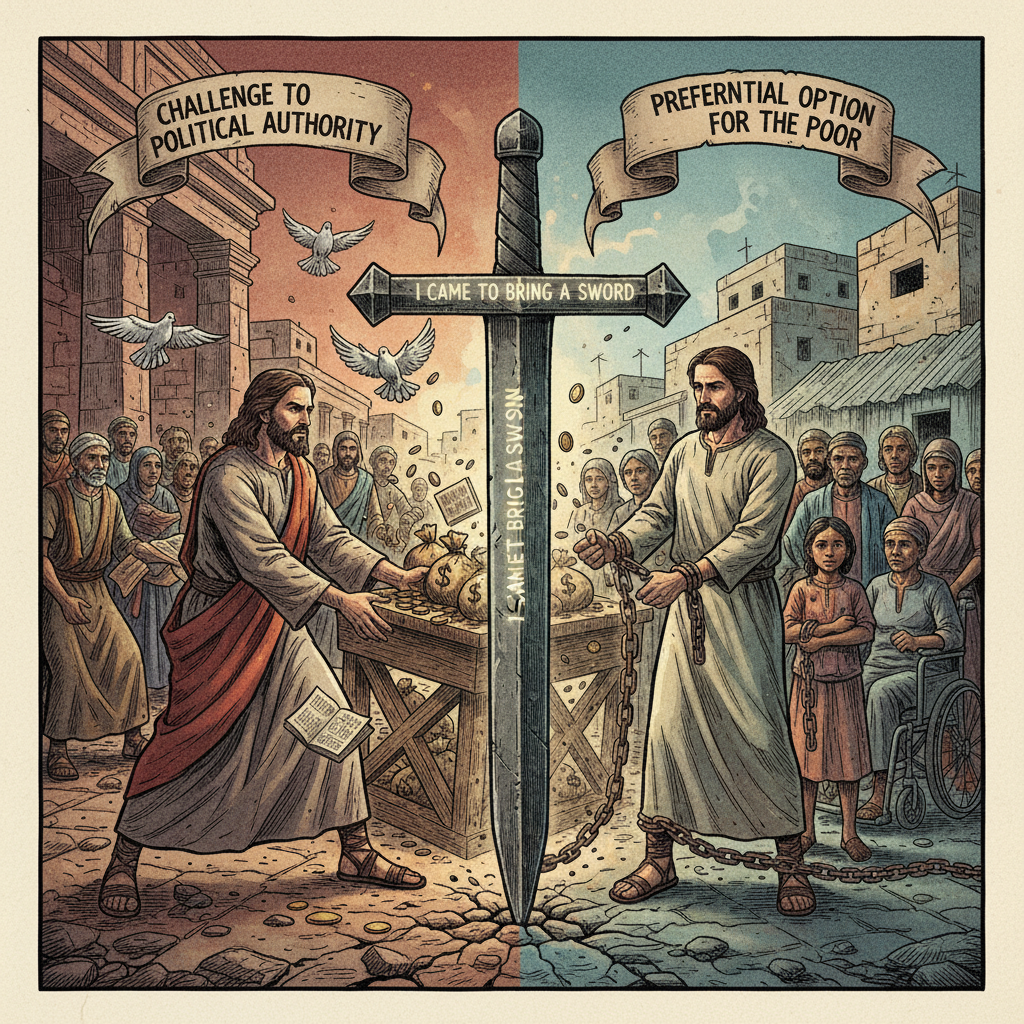
The view of Jesus as a Political Liberator argues that Jesus was not just a spiritual teacher, but a revolutionary figure who challenged the political and social structures of his time. This perspective encompasses two main approaches: the Historical Revolutionary (Zealot View) which sees Jesus as actively opposing Roman occupation, and Liberation Theology which emphasizes Jesus's mission to liberate the poor and oppressed from structural sin.
Two Main Approaches:
- Historical Revolutionary (Zealot View): Scholars like S.G.F. Brandon and Reza Aslan argue the historical Jesus was a Jewish revolutionary who actively opposed Roman occupation and the corrupt Temple authorities
- Liberation Theology: Theologians like Gustavo Gutiérrez and Leonardo Boff argue Jesus's mission was to liberate the poor and oppressed from "structural sin" (unjust social systems)
Detailed Explanation
The Historical Context: Roman Occupation
1st-Century Judea
To understand this view, you must understand the political situation of Jesus's time:
- The Romans occupied the land, taxed the people heavily, and could be brutal
- The Jewish people longed for a Messiah who would be a military king (like David) to drive out the Romans and restore Israel
- The Zealots were a group of Jewish revolutionaries who believed in using violence to overthrow Rome
View 1: The "Zealot" or Revolutionary Jesus
Scholars: S.G.F. Brandon (Jesus and the Zealots), Reza Aslan (Zealot)
The "Peaceful Jesus" is a Cover-Up
Brandon argues that the Gospels (especially Mark) toned down Jesus's radical politics to make Christianity acceptable to Romans after the failed Jewish Revolt (66-70 CE).
Political Friends
Jesus chose disciples who were revolutionaries (Simon the Zealot, Judas Iscariot—whose name might mean "sicarii" or dagger-man).
The Temple Cleansing
This wasn't just religious; it was a political attack on the Sadducean priesthood who collaborated with Rome.
Crucifixion
This was a Roman punishment specifically for political insurrectionists. The two men crucified with him were lestai (bandits/revolutionaries), suggesting Rome saw Jesus as one too.
Scriptural Support:
"Do not suppose that I have come to bring peace to the earth. I did not come to bring peace, but a sword." — Matthew 10:34
"Let the one who has no sword sell his cloak and buy one." — Luke 22:36
View 2: Liberation Theology (Social Liberator)
Scholars: Gustavo Gutiérrez, Leonardo Boff (Latin American theologians)
Social Revolutionary, Not Violent Warrior
Jesus wasn't necessarily a violent warrior, but a social revolutionary who challenged unjust structures.
Preferential Option for the Poor
God sides with the oppressed. Jesus spent his time with the marginalized (poor, lepers, tax collectors), challenging the social hierarchy.
Structural Sin
Sin isn't just individual (lying, stealing); it is institutional (poverty, unfair laws, capitalism). Jesus came to liberate people from these unjust structures.
Orthopraxy over Orthodoxy
"Right action" (fighting injustice) is more important than just "right belief".
The Magnificat (Luke 1:52):
"He has brought down rulers from their thrones but has lifted up the humble."
Mary's prayer is seen as a political manifesto—God overturning unjust power structures.
Key Evidence for Jesus as Political Liberator
Actions
- Cleansing the Temple (a political act against authority)
- Entering Jerusalem as a King (Palm Sunday)
- Associating with outcasts/Zealots (Simon the Zealot)
Words
- "I did not come to bring peace, but a sword" (Matthew 10:34)
- The Magnificat's revolutionary language
- Proclamation of the "Kingdom of God"
Death
- Executed by Rome for sedition (treason)
- Crucifixion was the punishment for political revolutionaries
- Labeled "King of the Jews"—a political charge
Arguments Against Jesus as Political Liberator
The "Spiritual Liberator" View
Rejection of Violence
At his arrest, Jesus heals the ear of the High Priest's servant and tells Peter:
"All who draw the sword will die by the sword." — Matthew 26:52
Not a Political King
When Pilate asks if he is a king, Jesus says:
"My kingdom is not of this world. If it were, my servants would fight." — John 18:36
Render unto Caesar
Jesus refused to ban paying taxes to Rome, separating spiritual duty from political duty (Mark 12:17).
Universal Mission
A political liberator saves one nation (Israel) from one enemy (Rome). A spiritual liberator saves all humanity from the ultimate enemies (Sin and Death).
Scholarly Perspectives
"The God of Exodus is the God of history and of political liberation more than he is the God of nature. God is seen at work in all events of liberation and revolution. He speaks not only through Scripture but also through the political upheavals of our day."
Gustavo Gutiérrez, A Theology of Liberation (1971) — Gutiérrez argues that the Exodus (God freeing slaves from Egypt) is the paradigm for salvation. Salvation is not just going to heaven; it is freedom from oppression now.
"The Jesus of history was a Jewish revolutionary seeking to liberate Israel from Roman rule... [He] was arrested and summarily crucified for sedition."
Summary of S.G.F. Brandon / Reza Aslan's thesis — This view challenges the traditional "gentle Jesus, meek and mild," arguing that the Gospels "sanitized" a radical political figure to survive in the Roman Empire.
Key Takeaways
Quick Reference: Political Liberator Concepts
| Concept | Meaning |
|---|---|
| Zealots | 1st-century Jewish political movement seeking to overthrow Rome through violence |
| Sedition | Conduct or speech inciting people to rebel against the authority of a state (the charge against Jesus) |
| Preferential Option for the Poor | The idea that God specifically sides with the oppressed and marginalized (Gutiérrez) |
| Structural Sin | Sin that exists in social systems (e.g., poverty, racism) rather than just individual actions |
| S.G.F. Brandon | Scholar who argued Jesus was politically aligned with the Zealots |
| Gustavo Gutiérrez | Father of Liberation Theology; views Jesus as liberator from social injustice |
| Magnificat | Mary's song (Luke 1) proclaiming God brings down the powerful and lifts the lowly |
| Cleansing the Temple | Key event used to argue Jesus challenged political/religious corruption forcefully |
It's Controversial
This topic asks which Jesus is the "real" Jesus—the spiritual savior or the political revolutionary?
Context Matters
You can't understand this without knowing about the Roman occupation. Everyone expected the Messiah to be a political liberator.
Actions Speak Louder
Proponents point to the Temple Cleansing and his Crucifixion (a political punishment) as the strongest evidence.
Liberation Theology is Key
Don't just talk about Zealots; you must mention Liberation Theology (Gutiérrez/Boff) which sees Jesus's politics as standing with the poor against "structural sin."
Evaluation Tip
A strong essay might argue that Jesus was a liberator, but his definition of "liberation" was broader than the Zealots'—liberating people from the root cause of oppression (human sin) rather than just the symptoms (Roman rule).