Jesus as Teacher of Wisdom
Summary
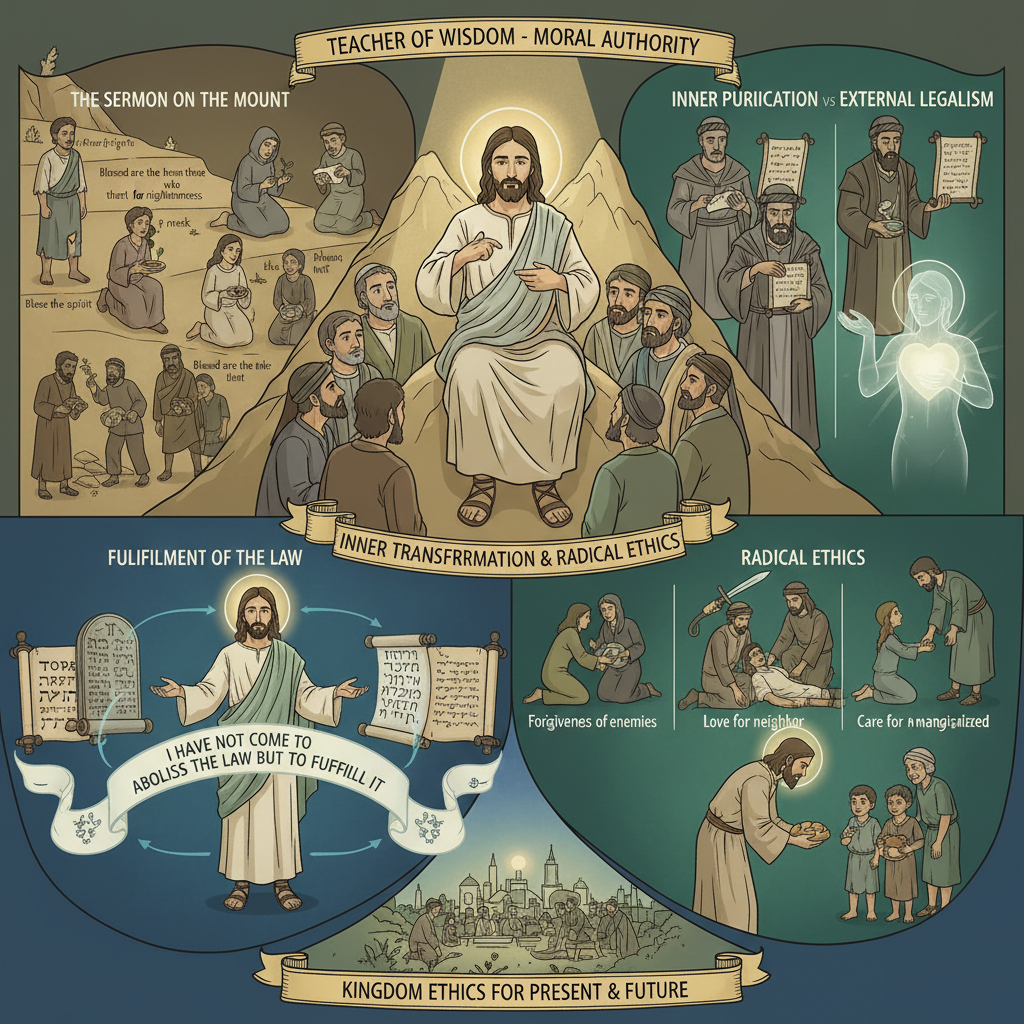
Jesus as a teacher of wisdom means Jesus taught moral and spiritual truths that enlighten and transform human living, developing Jewish ethics beyond external obedience to inner transformation. Jesus took the Torah (Jewish law) and deepened its moral meaning, moving from external rule-keeping to internal transformation. He criticized the Pharisees for focusing on external rituals while neglecting the heart and inner motivation behind actions.
Key Aspects:
- Developed Jewish Ethics: Jesus deepened Torah law from external compliance to internal spiritual transformation
- Inner Purity Over Legalism: True righteousness comes from transformed heart, not external rule-keeping
- The Sermon on the Mount: Jesus's comprehensive moral teaching presenting the Beatitudes and radical ethics
- Unique Authority: Jesus taught "with authority"—not like scribes who quoted tradition, but with personal moral wisdom
Detailed Explanation
Jesus as Teacher: A Role of Authority
The Recognition of Authority
When Jesus taught in synagogues, people recognized He taught with authority—unlike the scribes.
"The people were amazed at his teaching, because he taught them as one who had authority, not as the teachers of the law." — Mark 1:22
The Scribes
- Had knowledge of law and scripture
- Recognized as having legal and religious authority
- Taught by quoting authorities: "Rabbi X said... Rabbi Y said..."
- Authority was derivative—based on tradition and accumulated scholarship
Jesus
- Taught with personal authority
- Said: "I tell you..." or "But I say to you..."
- Authority was direct and inherent—flowing from His own wisdom
- Came from authentic spiritual power and moral wisdom
The Sermon on the Mount: Comprehensive Moral Teaching
The Setting:
Jesus teaches "on the side of a mountain"—presented as the new Moses giving a new law. Just as Moses received the Torah on Mount Sinai, Jesus delivers His authoritative teaching from a mountain.
Matthew 5:17 - Fulfillment, Not Abolishment:
"Do not think that I have come to abolish the Law or the Prophets; I have not come to abolish them but to fulfill them."
What This Means:
- Jesus doesn't reject the Torah; He fulfills and deepens it
- Jesus reveals the true spiritual purpose of the law—beyond mere external compliance
- Jesus presents Himself as continuing the prophetic tradition but with authoritative reinterpretation
The Beatitudes (Matthew 5:3-10)
The Sermon begins with the Beatitudes—Jesus's declaration of who is blessed in God's kingdom. These present a radical reorientation of values—what the world calls blessed (wealth, power, pleasure), Jesus calls cursed; what the world calls shameful (poverty, mourning, meekness), Jesus calls blessed.
"Blessed are the poor in spirit"
Recognizing spiritual need and dependence on God—contradicts worldly self-sufficiency
"Blessed are those who mourn"
Recognizing sin and loss—true blessing involves grief at the world's brokenness
"Blessed are the meek"
Meekness (strength under control) is blessed, not worldly power
"Blessed are those who hunger for righteousness"
Moral passion is the path to fulfillment
"Blessed are the merciful"
Forgiveness and compassion are defining marks of God's kingdom
"Blessed are the pure in heart"
Inner purity leads to intimate knowledge of God
"Blessed are the peacemakers"
Creating peace is the work of God's family
"Blessed are the persecuted"
Following Jesus's ethics may bring worldly opposition, but God's approval is ultimate
Inner Purity vs. External Legalism
Jesus's Criticism of the Pharisees
Jesus persistently accused the Pharisees of hypocrisy and legalism. The problem: They "focus on the minutiae of the law at the expense of the purpose of the law".
Murder and Anger:
"You have heard that it was said to the ancients, 'You shall not murder'... But I tell you that anyone who is angry with a brother will be subject to judgment."
Meaning: The law forbids murder (external act), but Jesus goes to the root: anger (internal motivation).
Adultery and Lust:
"You have heard that it was said, 'You shall not commit adultery.' But I tell you that anyone who looks at a woman with lust has already committed adultery in his heart."
Meaning: The law forbids adultery (external), but Jesus identifies internal lust as already being sin.
The Inner Source of Sin:
"What comes out of the mouth comes from the heart, and these defile you... out of the abundance of the heart, the mouth speaks."
Implication: True purity is internal—it flows from a transformed heart, not from external rule-keeping.
The Six Antitheses (Matthew 5:21-48)
In each case, Jesus takes the external law and reveals its internal, spiritual meaning, calling for deeper transformation than mere compliance.
1. Murder
"You shall not murder" → "Anyone angry with a brother will be judged"
2. Adultery
"You shall not commit adultery" → "Anyone who looks with lust has already committed adultery"
3. Divorce
"A man may give a certificate of divorce" → "Anyone who divorces except for immorality causes adultery"
4. Oaths
"Do not break your oath" → "Do not swear at all—let your yes be yes"
5. Eye for an Eye
"Eye for eye, tooth for tooth" → "Turn the other cheek"
6. Love of Enemies
"Love your neighbor, hate your enemy" → "Love your enemies and pray for persecutors"
Forgiveness: A Central Theme
The Lord's Prayer (Matthew 6:11-12)
"Give us our daily bread, and forgive us our debts, as we also have forgiven our debtors."
- We ask God not to hold our sins against us
- In turn, we should forgive others who sin against us
- Our ability to receive forgiveness is tied to our willingness to forgive
Radical Forgiveness (Matthew 18:21-22)
When Peter asks: "How many times should I forgive my brother? Seven times?"
Jesus responds: "I tell you, not seven times, but seventy-seven times."
Forgiveness is not finite but infinite and limitless—a fundamental orientation.
Jesus's Teaching on the Kingdom
Apocalyptic Eschatology (Traditional Jewish Expectation)
- The kingdom is future—it will come at the end of history
- God will dramatically intervene with cosmic events
- The dead will be raised and judgment will occur
Realized Eschatology (Jesus's Emphasis)
- The kingdom is both present and future
- The kingdom is "here and now" in Jesus's ministry—already breaking into the world
- Yet it also has a future dimension—fully consummated when Christ returns
Matthew 6:10:
"Your kingdom come, your will be done, on earth as it is in heaven."
Jesus calls believers to live out kingdom values now. The future kingdom pulls on the present—we should already embody kingdom ethics. This creates a present-future tension: the kingdom is already but not yet.
The Goal: Moral Perfection
"Be perfect, therefore, as your heavenly Father is perfect." — Matthew 5:48
What This Means:
- Moral perfection is not about following rules, but about becoming like God in character
- It requires complete inner transformation, not just external obedience
- Instead of focusing on external compliance, Jesus calls for inner transformation of heart and motivation
Scholarly Perspectives
Quote 1: Jesus's Authoritative Reinterpretation of the Law
"Do not think that I have come to abolish the Law or the Prophets; I have not come to abolish them but to fulfill them. You have heard that it was said to the ancients, 'You shall not murder'... But I tell you that anyone who is angry with a brother or sister will be subject to judgment. You have heard that it was said, 'You shall not commit adultery'... But I tell you that anyone who looks at a woman with lust has already committed adultery with her in his heart... Be perfect, therefore, as your heavenly Father is perfect."
Source: Matthew 5:17-22, 28, 48.
Context: Jesus's characteristic method of deepening Jewish law from external compliance to internal transformation—taking the Torah's external rules and revealing their spiritual intent requiring complete inner moral transformation.
Quote 2: Jesus's Authority vs. Scribal Authority
"As Jesus sat in the synagogue teaching, people were amazed and said, 'Where did this man get such wisdom and these miraculous powers? He taught them as one who had authority, not as the teachers of the law.' The teachers of the law quoted previous rabbis and relied on tradition for their authority. But Jesus taught with direct personal authority, saying 'I tell you...' and 'But I say to you...' His authority came not from institutional position or accumulated scholarship, but from authentic spiritual power and the moral wisdom of one living honestly according to divine principles."
Source: Mark 1:22; synthesis of Christological scholarship.
Context: Demonstrates that Jesus's authority as a teacher was unique and unprecedented—grounded in personal moral wisdom rather than traditional scholarship.
Tensions and Debates: Can Jesus Be "Only" a Teacher of Wisdom?
Arguments For:
- Jesus clearly taught moral and spiritual wisdom
- His ethical teachings stand on their own merit
- Muslims view Jesus this way (as John Hick notes)
Arguments Against:
- Jesus's self-understanding involved claims to divinity and messianic status
- His teachings presuppose divine authority to interpret the law authoritatively
- A mere moral teacher doesn't claim authority to forgive sins or demand absolute allegiance
- Without the incarnation, Jesus becomes "just another moral teacher" (John Hick)
Key Takeaways
Jesus deepened Jewish ethics
Rather than abolishing the Torah, Jesus revealed its true spiritual intent, moving from external compliance to internal transformation.
Inner purity is the essence
Jesus criticized the Pharisees for focusing on external rituals while neglecting the heart—true purity flows from within.
Moral motivation matters
Jesus emphasized that the intention and motivation behind actions determine their moral value, not just compliance with rules.
Authority is personal
Jesus taught with unique, direct authority unlike the scribes—not quoting tradition but speaking with personal moral wisdom.
Forgiveness is central
Jesus called for unlimited, infinite forgiveness and love of enemies—radical developments of Jewish law.
Kingdom ethics as present reality
The kingdom is "here and now" in Jesus's teaching; believers should live out kingdom values now, not just wait for the future.
Perfection as transformation
"Be perfect as your heavenly Father is perfect" calls for complete inner moral transformation, not just behavioral compliance.
More than "only" a teacher
While Jesus can be recognized as a profound wisdom teacher, His claims to divine authority suggest He is more than a mere moral teacher.
Quick Reference: Teacher of Wisdom Concepts
| Concept | Meaning |
|---|---|
| Teacher of Wisdom | Jesus taught moral and spiritual truths that transform human living and ethical understanding |
| Development of Jewish Ethics | Jesus deepened Torah law from external compliance to internal spiritual transformation |
| Inner Purity Over Legalism | True righteousness comes from transformed heart and motivation, not external rule-keeping |
| Sermon on the Mount | Jesus's comprehensive moral teaching presenting Beatitudes and radical ethical reinterpretation |
| The Beatitudes | Declarations of who is blessed in God's kingdom—a radical reorientation of values |
| Antitheses | Jesus's six reinterpretations of the Law, each going from external to internal |
| Realized Eschatology | The kingdom is both present now and future; present ethics reflect future hope |
| Teaching with Authority | Jesus taught with personal moral and spiritual authority unlike the scribes |
| Moral Perfection as Goal | "Be perfect as your heavenly Father is perfect"—complete inner transformation |