Son of God
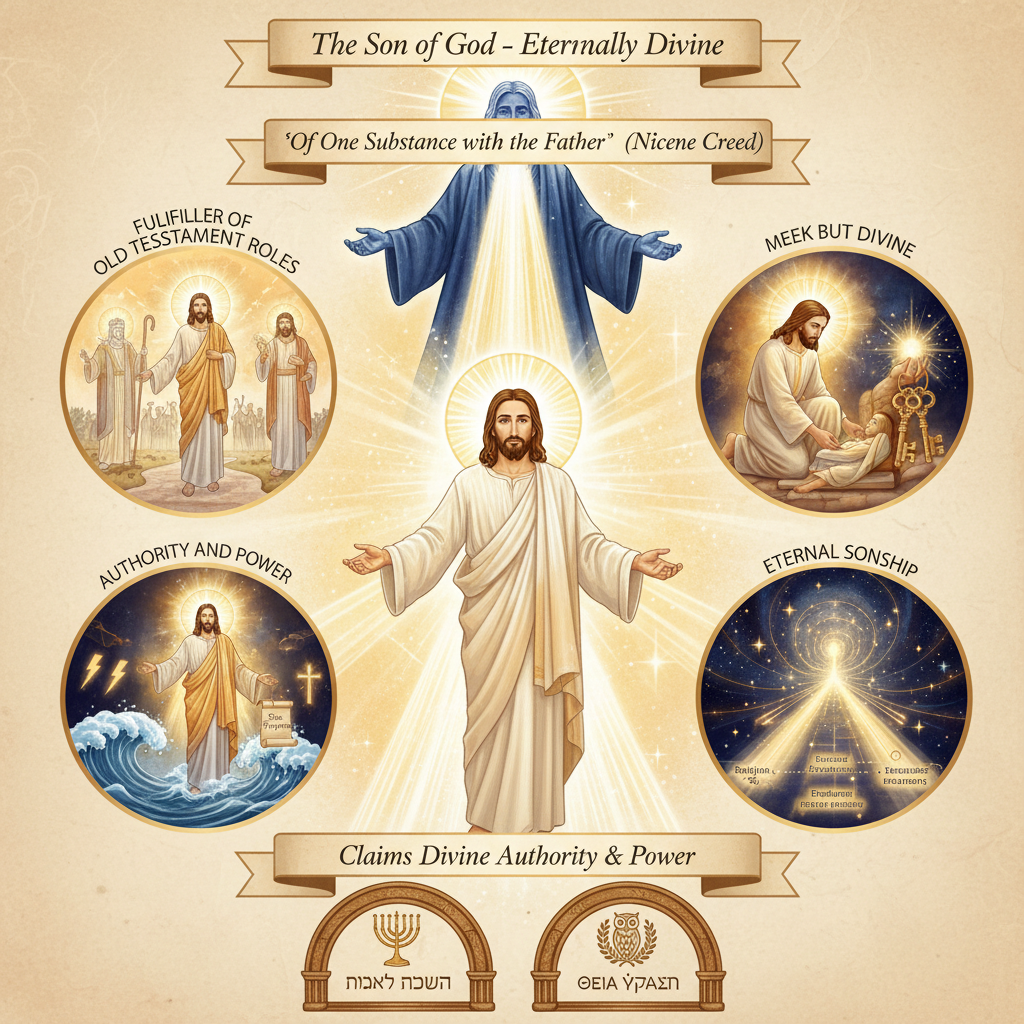
Summary
"Son of God" is a title affirming that Jesus is the divine Son of God the Father—not merely a human king or prophet, but the eternal, second person of the Trinity. Jesus's sonship is unique: not by adoption or appointment, but by eternal nature and divinity. "Son of God" means Jesus is fully divine—"of one substance with the Father" (Nicene Creed). As the divine Son, Jesus serves as the mediator between God and humanity, claiming divine authority to forgive sins, perform miracles, and rule creation.
Key Distinction:
- "Son of Man" = Jesus's humanity and role as Messiah
- "Son of God" = Jesus's deity and divine nature
Together, they show Jesus as fully human and fully God.
Detailed Explanation
Historical Context: The Meaning of "Son of God"
Jewish Background
In Jewish thought, "Son of God" meant an anointed King—someone chosen by God to carry out His will and free Israel.
Used in the Old Testament for:
- Angels (serving God)
- Israel (God's chosen nation)
- The kings of Israel (God's anointed rulers)
- The Messiah (the chosen deliverer)
Greek Background
In Greek thought, "Son of God" meant a human elevated to divine status—a god-man or divine being.
Greeks understood divinity differently than Jews; they were comfortable with semi-divine figures.
How Jesus Used It:
Jesus applied the term to Himself individually, filling it with a meaning that surpassed both Jewish and Greek understandings. Jesus claimed to be the Son of God uniquely—not merely like Adam, Israel, or David—to have an exclusive relationship with the Father, and to possess divine attributes and authority.
The Unique, Eternal Sonship of Jesus
Not Adoption (Rejecting Adoptionism)
The heresy of Adoptionism claimed that Jesus was a mere human whom God adopted as His Son at some point (often at His baptism).
Orthodox Christian Teaching Rejects Adoptionism:
- Jesus is not adopted into divine sonship; He is eternally God's Son by nature
- His sonship is ontological (by His very nature), not honorific (by honor or title)
- There was never a time when Jesus was not the Son of God
John 1:1-3 Establishes Eternality:
"In the beginning was the Word, and the Word was with God, and the Word was God...all things were made through him."
Meaning:
- Jesus did not come into existence when He was born as a baby in Bethlehem
- Jesus existed from eternity past—He is eternally God's Son
- Jesus is God made manifest in human flesh, not God inhabiting a human
Jesus Fulfills Old Testament "Son of God" Roles
The Four Senses of "Son of God":
1. Jesus as the New Adam
- Adam was God's first "son" in the sense of being created in God's image
- Adam failed to obey God and fell into sin
- Jesus, the "last Adam," succeeds where Adam failed—remaining sinless and obedient
- As the true man, Jesus is God's true Son
2. Jesus as the New Israel
- Israel was God's "chosen people" or covenant people
- Israel failed to fully obey the covenant and worship God alone
- Jesus embodies and fulfills what Israel was meant to be—perfectly righteous, perfectly obedient
3. Jesus as the New (and Final) David
- David was God's "anointed king" chosen to rule Israel
- David—and all earthly kings—failed and fell short of perfect justice
- Jesus is the ultimate "anointed king" (Messiah/Christ)—destined to rule eternally
4. Jesus as the Divine Son
- Beyond being a covenant mediator, Jesus is God the Son—the second person of the Trinity
- This surpasses the previous senses—Jesus is not just like Adam, Israel, or David
- He is God Himself
Jesus's Claims of Divine Sonship
Jesus Uses Personal Language:
Jesus refers to God as "my Father"—an unequivocal assertion of intimate divine sonship and unique relationship.
Before the Sanhedrin (Mark 14:61-62):
When asked: "Are you the Messiah, the Son of the Blessed One?" Jesus responded: "I am."
The high priest's reaction: He tore his robe, signifying that he understood Jesus's claim as blasphemous—a claim to be divine.
The Jewish Response: The fact that the Jewish leaders demanded Jesus's execution for blasphemy shows they understood "Son of God" as a claim to divinity.
Divine Attributes and Authority
Jesus Claimed Divine Powers:
1. Forgiveness of Sins
Jesus forgave sins (Mark 2:5-7)
The Jewish leaders correctly responded: "Only God can forgive sins!" By claiming this power, Jesus claimed to be divine.
2. Authority Over Death
Jesus resurrected the dead: "Lazarus, come out!" (John 11:43)
"I am the resurrection and the life. He who believes in me will live, even though he dies" — John 11:25-26
3. Creative Power
Jesus "upholds the universe by the word of his power" (Hebrews 1:3). Jesus sustained all creation in existence—a divine prerogative.
4. Authority Over Nature
Jesus calmed the storm with a word (Mark 4:39) and walked on water (Mark 6:45-52). These demonstrate power over the physical laws of creation.
5. Life in Himself
"As the Father has life in himself, so he has granted the Son also to have life in himself" — John 5:26
This "claim to divine aseity" (self-existence) refers to Jesus's eternal, independent divine nature.
The Council of Nicaea and "Homoousios"
The Arian Controversy (c. 318 CE):
The theologian Arius claimed that Jesus was created by the Father—not eternally divine, but subordinate to the Father.
Arius's argument:
- If Jesus is the "Son," He must have been begotten (created)
- Therefore, there was a time when Jesus did not exist
- Jesus is divine but not equal to the Father
The Council of Nicaea (325 CE):
The church's response was to affirm that Jesus is "begotten, not made" and "of one Being with the Father".
Homoousios (The Key Term):
The Greek word "homoousios" means "of one substance" or "of one being".
The Nicene Creed states: Jesus is "homoousion tō Patri"—"of one substance with the Father".
What This Means:
- Jesus is not merely created, but eternally begotten of the Father
- Jesus is completely divine—He is all that the Father is
- Jesus and the Father share the same divine nature and substance
- There is no time when Jesus was not the Son of God
Arius and Arianism were condemned as heretical, affirming that Jesus's divine sonship is eternal, not created or adopted.
The Temptation and Sonship
The Wilderness Temptation (Matthew 4:1-11):
The devil's temptations all began with "If you are the Son of God..."—attempting to get Jesus to redefine the meaning of "Son of God".
First Temptation: "Turn these stones into bread"
Testing if Jesus would use divine power for personal comfort. Jesus responds: "Man does not live by bread alone"—refusing to misuse divine power.
Second Temptation: "Throw yourself from the temple"
Testing if Jesus would demand divine protection. Jesus responds: "Do not put the Lord your God to the test"—refusing to presume on divine protection.
Third Temptation: "Worship me for all the kingdoms"
Testing if Jesus would pursue worldly power. Jesus responds: "Away from me, Satan!"—refusing to compromise His mission.
Meaning: Jesus's resistance shows that "Son of God" doesn't mean self-indulgent power, but obedient submission to the Father's will.
Gethsemane and the Son's Obedience
Jesus's Agony in the Garden (Matthew 26:39):
"My Father, if it is possible, may this cup be taken from me. Yet not as I will, but as you will."
What This Reveals About Sonship:
- Jesus is fully human—capable of pain, fear, and emotional struggle
- Yet Jesus is fully divine—experiencing divine love and compassion for humanity
- Jesus's human will aligns with the divine will—not by force, but by loving obedience
Jesus's Emotions as Divine Revelation:
Jesus's agony at Gethsemane reveals divine horror at the death of human beings (whom Jesus created and loves), divine compassion for all humanity facing mortality, and that Jesus loves His humanity—loves it as He loves others—and grieves giving it up.
Sonship and Resurrection
Exaltation Through Resurrection:
"Jesus our Lord... was descended from David according to the flesh... was declared to be the Son of God in power according to the Spirit of holiness by his resurrection from the dead." — Romans 1:3-4
Two Interpretations:
- Some see this as adoptionism (Jesus became Son through resurrection)
- Others see this as exaltation (Jesus's eternal sonship was publicly declared/confirmed through resurrection)
Orthodox Understanding: The exaltation interpretation is correct—Jesus was eternally God's Son, but His resurrection exalted and vindicated His divine sonship, proving His identity to the world.
Scholarly Perspectives
Academic Quotes
"The Son of God is begotten, not made, of one Being with the Father. All things were made through him, and without him nothing was made that has been made. We believe in one Lord, Jesus Christ, the only Son of God, eternally begotten of the Father, God from God, Light from Light, true God from true God, of one substance with the Father; through him all things were made."
— The Nicene Creed (325 CE); Council of Nicaea
The church's definitive statement rejecting Arianism and affirming that Jesus's divine sonship is eternal, not created, and that He shares the Father's divine nature.
"Christ Jesus, the Son of God, is God and Man: God before all worlds, man in our world. He is the only Son of God by nature and not by grace. He became also the Son of Man that he might be full of grace as well. His divine sonship is eternal and essential by nature; His human sonship is by grace—the incarnation itself. Jesus fulfills all that Adam, Israel, and David were meant to be, and in doing so, reveals Himself as God's eternal divine Son."
— Augustine of Hippo, On the Holy Trinity
Shows how Jesus's divine sonship and human sonship coexist without confusion, and how He fulfills and transcends Old Testament understandings of sonship.
Key Takeaways
Son of God is not adoption
Jesus's sonship is eternal and essential by nature, not gained through adoption or appointment.
Jesus is eternally divine
There was never a time when Jesus was not the Son of God.
Jewish and Greek meanings unified
Jesus fulfills Old Testament expectations (chosen King/Messiah) while also embodying divine nature (God become human).
Homoousios doctrine
The Council of Nicaea affirmed Jesus is "of one substance with the Father"—completely divine, equal with the Father.
Four senses of "Son of God"
Jesus is the new Adam (true humanity), new Israel (chosen people), new David (anointed king), and God the Son (second person of Trinity).
Divine authority demonstrated
Jesus's claims to forgive sins, resurrect the dead, sustain creation, and control nature prove His divine sonship.
Augustine's synthesis
Jesus is "God by nature" in His divine sonship and "man by grace" in His human sonship.
Temptation and obedience
Jesus's resistance to redefining His sonship and His obedience at Gethsemane show that divine sonship means loving submission to the Father.
Gethsemane reveals divine emotion
Jesus's agony and anguish express divine compassion and love for humanity—revealing God's nature through His human experience.
Resurrection exalts sonship
The resurrection publicly declared and vindicated Jesus's eternal divine sonship to the world.
Quick Reference: Son of God Concepts
| Concept | Meaning |
|---|---|
| Son of God | Jesus's unique, eternal relationship as the divine Son of God the Father |
| Eternal Sonship | Jesus is God's Son by nature, not by adoption or creation; always was and always will be |
| Divine Sonship | Jesus possesses full divinity and equality with the Father |
| Homoousios | "Of one substance with the Father"—Jesus shares the Father's divine nature |
| Adoptionism | Heretical view that Jesus was adopted as Son; condemned as false doctrine |
| Son of Man | Jesus's humanity and role as Messiah; complements "Son of God" (divinity) |
| Incarnation | God's Son taking on human flesh; the descent of the divine into the human |
| Aseity | Divine self-existence—Jesus has "life in himself," a mark of divinity |
| Exaltation | Jesus's resurrection publicly vindicated and demonstrated His divine sonship |