Development of Multi-Faith Societies
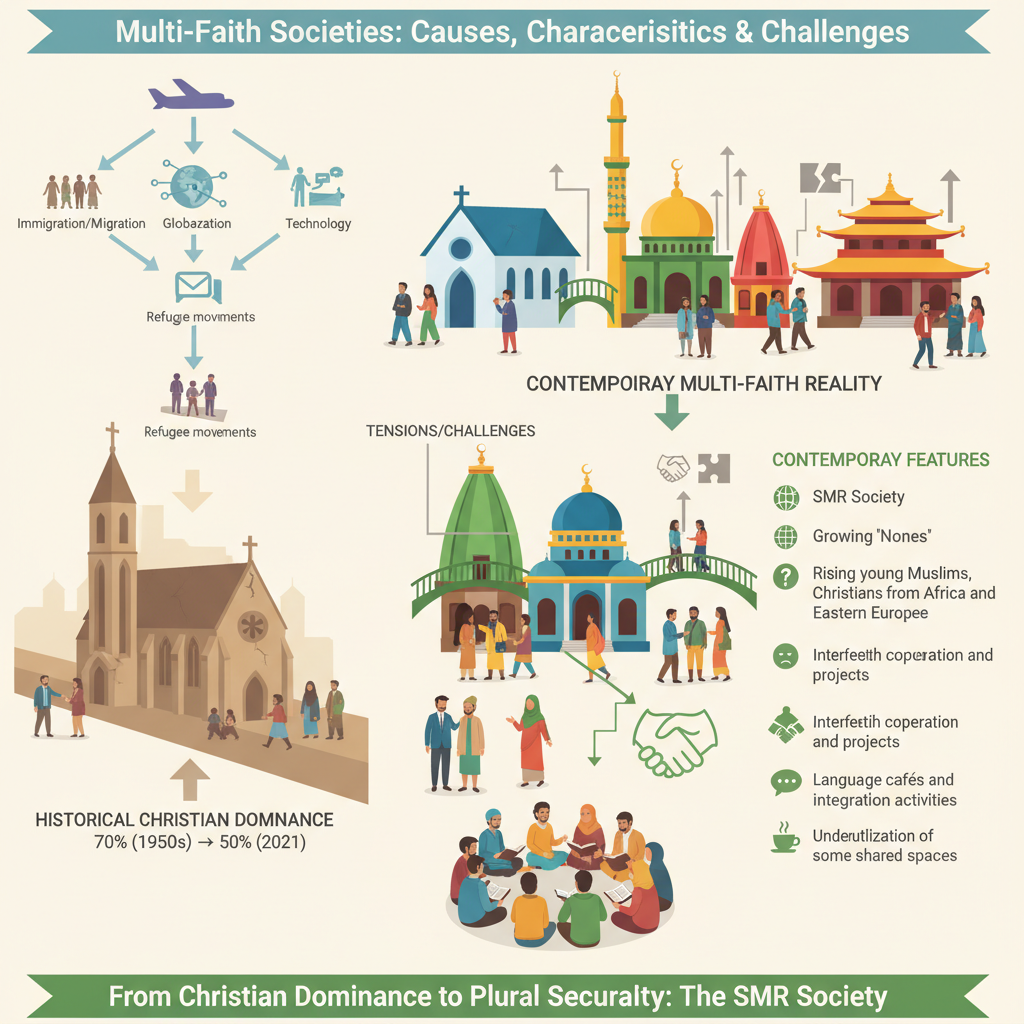
Development of Multi-Faith Societies: Modern communities feature declining Christian dominance, rising religious diversity through immigration and migration, increasing secularization alongside religious revival, and new multifaith cooperation models. Key drivers include globalization, technology, and demographic change. This illustration depicts the development of multi-faith societies: The image shows the transition from historical Christian dominance (church fading into the past) to a contemporary urban landscape with diverse places of worship (church, mosque, temple, synagogue) standing equally prominent. Key drivers are shown at the top (immigration, globalization, technology), while contemporary features are represented (diverse people, interfaith dialogue, community integration projects, language cafés). The bottom shows the paradox of the "SMR Society"—simultaneous secularization (rising "Nones," secular elements) and religious growth (young Muslims, Christian immigration, religious revival). The illustration balances opportunities (vibrant diversity, cooperation, shared spaces) with visible challenges (integration difficulties, some tension), reflecting the complex reality of modern multi-faith communities.
Summary
A multi-faith society is a community where multiple religions coexist and interact, rather than one religion dominating. Most modern Western societies (UK, Europe, North America) have become increasingly multi-faith in the past 50-70 years.
How Multi-Faith Societies Developed:
- Immigration and migration: People moving from Asia, Africa, Eastern Europe, and the Middle East brought their religions with them
- Globalization: Easier travel and communication expose people to diverse beliefs
- Technology: Internet and social media spread religious ideas across borders
- Secularization: Traditional Christianity declined, creating space for other religions
The Paradox (The "SMR Society"):
Modern societies are both Secular AND Multi-Religious:
- The number of non-religious people is rising
- But at the same time, young people and immigrants are becoming more religious, often in non-Christian faiths
- Result: A diverse "marketplace" of beliefs
UK Statistics:
- Christian identification dropped from 70% (2001) to 50% (2021)
- Muslim population rose 150% (2001-2021)
- Average Muslim age: 27 years; average Christian age: 51 years
- In Tower Hamlets (East London), Muslims now outnumber Christians
Detailed Explanation
The Historical Context: Christendom to Post-Christian Society
Christendom (Pre-1960s):
- Christianity was Europe's identity: Being Christian was assumed, normal, built into culture and law
- The Church had institutional power (influence over education, law, morality)
- Other religions (Judaism, Islam) were minorities, often marginalized
The Rapid Secularization (1960s-Present):
- Quick collapse, not gradual decline: Historians like Callum Brown argue secularization was rapid and decisive, especially from the 1960s onward
- Church attendance plummeted
- Christianity lost cultural authority; it became one option among many
- The assumption that Britain was a Christian nation evaporated
Why So Fast?
- Post-WWII social change (women's liberation, sexual revolution, youth culture)
- Decline of institutional religion as a whole (less regular worship)
- Education shifted toward secular subjects and secular worldviews
Immigration and Religious Diversity
The Primary Driver of Multi-Faith Societies:
Immigration is the single biggest factor reshaping religious landscapes.
Key Migration Patterns:
- Commonwealth Migration (1950s-1970s): Immigrants from India, Pakistan, Bangladesh, Jamaica brought Islam, Sikhism, and African Christianity
- EU Migration (1990s-2020s): Polish Catholics, Romanian Orthodox, and other Eastern European Christians
- Post-2000s African Migration: Nigerian, Kenyan, Ghanaian Christians (often Pentecostal/evangelical)
- Recent Refugee Flows (2015+): Syrian, Afghan, Iraqi Muslims fleeing conflict
The Result:
- Christianity in Britain is now increasingly diverse, African, and young (through immigration)
- Muslim population is growing faster than any other group (due to immigration and higher birth rates)
- The "default" religion is no longer Christian; it's increasingly Muslim or "None"
Demographics Tell the Story:
- UK Muslims average age: 27 years
- UK Christians average age: 51 years
- This means Muslims skew younger, Christians skew older. Over time, this demographic shift will change society's religious composition
The "SMR Society" (Secular and Multi-Religious)
A New Model:
Rather than assuming secularization means "less religion," scholars now speak of "SMR society"—where secularization and religious diversity coexist.
High Secularization:
- Church membership declining
- Secular worldviews dominant in science, politics, media
- Move away from traditional Christian morality (e.g., acceptance of LGBTQ+, divorce, cohabitation)
- Anticlerical sentiment (distrust of religious authority)
Simultaneous Religious Growth:
- Committed Christian minorities remain influential
- Muslims and other faiths growing
- Young people showing renewed interest in spirituality and religion
- Even among "Nones" (non-religious), many are attracted to Christian values and social justice
The Key Insight:
Rather than seeing secularization as "the end of religion," the SMR model says religion is being renegotiated. It's no longer culturally automatic; it's a choice. But precisely because it's a choice, committed believers become more visible and engaged.
Causes of Multi-Faith Society Development
1. Globalization
- Easier international travel, trade, and communication
- Religious ideas spread across borders
- People marry across faith boundaries
2. Technology
- Internet provides access to all religions' teachings
- Social media lets religious communities organize and build identity
- Young people learn about faiths different from their own
3. Immigration and Refugees
- People moving for economic opportunity, education, or safety bring their religions
- Creates "natural" religious diversity in communities
4. Secularization of Host Countries
- When the dominant Christian culture declines, minority religions become more visible
- Space opens up for religious expression (no longer suppressed)
- Institutions no longer privilege Christianity
Interfaith Dialogue and Cooperation
What is Interfaith Dialogue?
Discussions between people of different religions about their similarities and differences.
Purposes:
- Build understanding between communities
- Reduce prejudice and stereotypes
- Find common ground on shared values
- Work together on social problems
Example: The Goda Grannar Project (Sweden)
- Christian and Muslim congregations worked together to integrate refugees
- Organized language cafés, social events, employment support
- Benefits: More resources, better services, cross-faith friendships
- Challenges: Initial skepticism within congregations, some refugees wary of religious organizations (due to religious conflict in their homelands)
Key Finding:
When faith-based organizations work together across religious lines, they can achieve more together than separately, access more resources, provide services tailored to newcomers' needs, and counter stereotypes of religion as divisive.
Benefits of Multi-Faith Societies
1. Reduced Religious Conflict
- When people know each other across faith lines, violence and prejudice decrease
- Interfaith dialogue prevents religious extremism
2. Shared Values and Cooperation
- Different religions agree on core values: compassion, justice, service
- Can work together on housing, education, poverty
3. Cultural Enrichment
- Diversity of festivals, art, music, cuisine
- People learn from each other's wisdom traditions
4. Tolerance as a Learned Value
- Growing up in multi-faith communities teaches children tolerance
- Reduces "us vs. them" thinking
Challenges of Multi-Faith Societies
1. Integration Tensions
- Newcomers may face discrimination
- Host communities may fear cultural change
- Language barriers prevent interaction
2. Institutional Discrimination
- Law and policy may still privilege Christianity
- Muslims and others feel excluded from power
3. Conflicting Values
- What if one religion's practices conflict with another's or secular values?
- How to balance religious freedom with social cohesion?
4. Political Polarization
- In some contexts, religion becomes a political marker
- Religious identity politicizes communities
The Role of Religion in Cohesion
Positive View (The Functionalist Perspective):
Religion provides:
- Social cohesion: Shared moral values and solidarity
- Meaning-making: Addresses existential questions
- Community: Belonging and support networks
- Moral motivation: Religions inspire social justice and service
From Separation to Constructive Engagement:
The Old Model (Separation of Church and State): Keep religion private, state neutral/secular, no religious influence on law or policy.
The New SMR Model (Constructive Engagement): Recognize religion's importance for social cohesion, ask "How can churches and religions contribute to the common good?", seek partnership between religious and secular institutions, state facilitates but doesn't control religion.
Scholarly Perspectives
Quote 1: The Rise of Multi-Faith Society
"The growth of globalisation, technology, and immigration have contributed to the emergence of multi-faith societies. This has been accompanied by an increase in interfaith dialogue, meaning discussions between people of different religions about their similarities and differences. While the overall decline of Church membership and the influence of secularism in science and politics continues, there are contrasting developments: practising and committed Christians remain an important minority, new forms of Christianity are developing due to immigration, and Muslim and other religious communities are developing. Demographic trends are clearly in favour of religious populations."
Source: Synthesis of OCR Specification and contemporary research
Context: This captures the paradox of modern society: simultaneous secularization and religious growth, a "SMR Society".
Quote 2: Religion's Role in Civic Life (Habermas)
"The democratic state must not pre-emptively reduce the polyphonic complexity of the diverse public voices, because it cannot know whether it is not otherwise cutting society off from scarce resources for the generation of meanings and the shaping of identities. Particularly with respect to vulnerable social relations, religious traditions possess the power to convincingly articulate moral sensitivities and solidaristic intuitions."
Source: Jürgen Habermas, German philosopher
Context: Argues that modern secular states should recognize religion's unique capacity to provide moral meaning and social solidarity, not marginalizing it.
Key Takeaways
- It's not just immigration: While immigration is the biggest factor, also mention secularization, globalization, and technology
- The demographic time-bomb: The statistics about Muslim youth vs. Christian elderly are crucial. They show future religious composition will shift dramatically
- SMR Society is key concept: Modern Britain is not post-Christian in the sense of being anti-religious. It's secular AND multi-religious—a new hybrid
- Benefits and challenges: Always balance the opportunities (cooperation, tolerance, diversity) with real problems (integration tensions, discrimination, conflicting values)
- Religion's return to public life: Contrary to old secularization theory, religion hasn't vanished. It's now chosen, visible, and more political
- Evaluate: Is multifaith society a success story (tolerance, cooperation) or are underlying tensions being papered over? Can the SMR model really work?
| Concept | Meaning |
|---|---|
| Multi-Faith Society | A community where multiple religions coexist with relatively equal status |
| Christendom | Historical era when Christianity was the assumed, dominant religion in Europe |
| Secularization | Decline of religious practice, belief, and influence on law and culture |
| SMR Society | "Secular and Multi-Religious"—simultaneous secularization and religious diversity |
| Nones | Non-religious or unaffiliated people (increasing in modern societies) |
| Interfaith Dialogue | Discussions between people of different religions about similarities/differences |
| Globalization | Increased international travel, trade, communication enabling religious exchange |
| Faith-Based Organizations (FBOs) | Religious institutions doing social work and community integration |