Christian Responses to Interfaith Dialogue
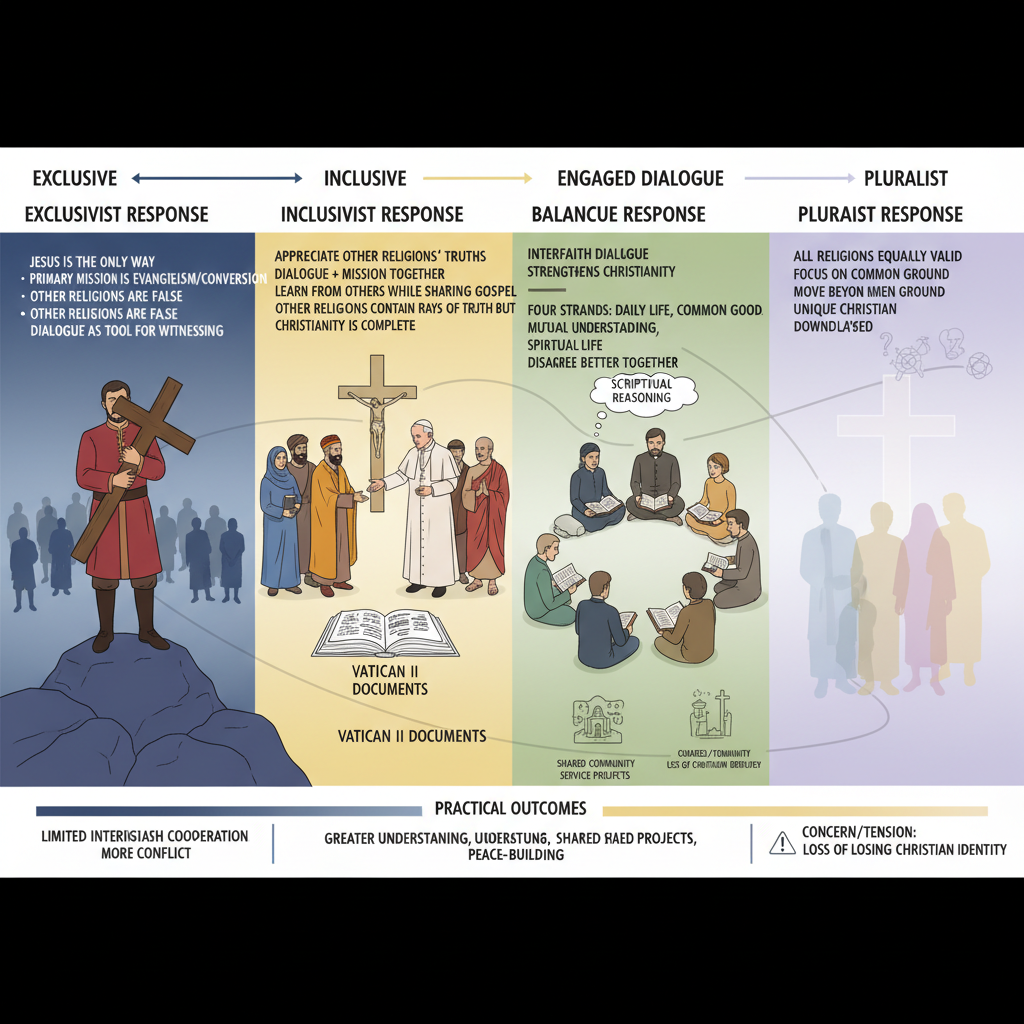
Christian Responses to Interfaith Dialogue: A spectrum ranging from Exclusivist (Christ alone, primary focus on evangelism) through Inclusivist (Vatican II approach: dialogue + mission, respecting other truths) to Engaged Dialogue (mutual understanding, all strands equally valued) to Pluralist (all religions equal, downplaying unique claims). Each response balances openness with preservation of Christian identity. This illustration depicts the spectrum of Christian responses to interfaith dialogue, ranging from Exclusivist (left, Christ-centered, focus on evangelism) through Inclusivist (Vatican II, respecting other truths while maintaining Christian uniqueness), Engaged Dialogue (mutual learning and cooperation), to Pluralist (right, all religions equal). The image shows that each response balances openness/respect with preservation of identity differently. Practical examples are shown (daily conversations, community service, scriptural reasoning, prayer services), illustrating the Four Strands of Dialogue. The spectrum acknowledges that these are not static positions but evolving responses to the challenge of living out Christian faith in multi-faith societies.
Summary
Interfaith dialogue is communication and discussion between people of different religions aimed at mutual understanding and cooperation. Christian responses vary widely across a spectrum from Exclusivism to Pluralism.
The Spectrum of Responses:
- Exclusivists: Focus on evangelism and conversion; see dialogue as a tool to witness to Christ
- Inclusivists (Vatican II): Respect other religions' truths while maintaining that Christ is the ultimate revelation; dialogue and mission work together
- Engaged Dialogue Advocates: Believe interfaith dialogue genuinely strengthens Christian communities and helps achieve the "common good"
- Pluralists: See all religions as equally valid; downplay unique Christian claims
Key Distinction:
There is ongoing debate about whether dialogue and evangelism are compatible. Some see them as conflicting (if you're dialoguing, you're not evangelizing); others see them as complementary (respectful dialogue that doesn't hide the Gospel).
Vatican II Turning Point:
The Second Vatican Council (1962-1965) issued Nostra Aetate, a foundational document that opened Catholicism to interfaith dialogue, respecting truth in other religions while maintaining Christian uniqueness.
Detailed Explanation
What is Interfaith Dialogue?
Definition:
Interfaith dialogue is the sharing and discussing of religious beliefs between members of different religious traditions, with the aim of promoting understanding and respect rather than converting one another.
Key Features:
- Voluntary participation by committed believers
- Mutual listening rather than just talking past each other
- Recognition of differences alongside search for commonalities
- Building relationships across faith boundaries
The Four Strands of Interfaith Dialogue (Church of England Model)
1. The Dialogue of Daily Life
Informal conversations naturally occurring when people discuss their religious beliefs.
Example: A Christian and Muslim coworker discussing their different Friday prayers
2. The Dialogue of Common Good
Different religious believers working together to benefit the wider community.
Example: Christians and Muslims collaborating on food banks, homeless shelters
3. The Dialogue of Mutual Understanding
Formal discussions and debates where believers explain their beliefs to each other.
Example: An interfaith lecture series explaining the Trinity to Muslims, Hindus, and Jews
4. The Dialogue of Spiritual Life
People of different faiths come together for prayer and worship.
Example: A "prayers for peace" service where different faiths pray in the same space
Vatican II and Nostra Aetate: The Catholic Turning Point
Historical Context:
Before Vatican II (1962-1965), the Catholic Church maintained a more exclusivist stance, with little official dialogue with other religions.
Nostra Aetate (1965) Key Points:
- Respect for Other Religions: Other religions (Judaism, Islam, Hinduism, Buddhism) contain genuine truth and holiness
- End to Antisemitism: Explicitly condemned antisemitism and rejected the charge that "the Jews" killed Jesus
- Dialogue and Mission Together: Interfaith dialogue and Christian mission are not opposed
Pope John Paul II's Position:
- Interfaith dialogue allows Christians to uncover ultimate truths
- Other religions like Hinduism and Islam contain key truths that develop moral character
- But Christianity is unique because it offers the only means to salvation
- The Christian duty to bring others to faith remains, even while dialoguing
Scriptural Reasoning: A Model of Engaged Dialogue
What is Scriptural Reasoning?
An interfaith dialogue practice where people from different religions sit together and read, listen to, and reflect on each other's scriptures side-by-side.
How It Works:
- A Christian, Muslim, and Jew might study the same passage (e.g., about Abraham) from their three scriptures
- Each reads their own scripture's interpretation
- They discuss what the passage means in their tradition
- No pressure to reach agreement
Key Features:
- "Disagreeing better": SR teaches participants to appreciate differences rather than smooth them over
- Scripture-centered: Grounds dialogue in each tradition's most sacred text
- Learning enriched: Participants gain deeper understanding of both their own and others' scriptures
- Building bonds: Strong friendships develop across faith lines
The Tension: Evangelism vs. Dialogue
The Core Conflict:
Many Christians see a fundamental tension between evangelism (seeking conversion) and interfaith dialogue (seeking understanding).
The Argument Against Dialogue:
- Dialogue requires acceptance of the other's faith as valid
- But evangelism demands that the Gospel is truth and other religions are incomplete
- How can you both respect someone's faith as valid and try to convert them to Christianity?
- Result: Dialogue "weakens" Christian missionary dynamism
The Evangelical Alternative ("Grace and Truth"):
- Be faithful to God's truth—the whole truth
- Be Jesus-centered in interactions
- Be truthful and gracious in witness
- Be respectful and bold (don't hide convictions)
- Respect religious freedom (no coercion)
The Modern Resolution: "Prophetic Dialogue"
Bridging the Gap:
Modern missiologists propose "Prophetic Dialogue" as a way to hold both poles in creative tension.
What It Is:
- Dialogue: Genuine listening, learning, and partnership with people of other faiths
- Prophetic: Maintaining the church's commitment to the Gospel and justice for the poor
- Service to God's Kingdom: The ultimate goal is not church growth but advancing God's kingdom of justice, peace, and liberation
The New Understanding:
- No longer church-centric: Not about filling pews but about God's kingdom
- Jesus as a model: Jesus engaged dialogically with people—questioning, listening, meeting them where they were
- Common cause: Christians and people of other faiths can work together for justice, even if they disagree theologically
Benefits of Interfaith Dialogue
1. Reduces Prejudice
Personal relationships across faith lines break down stereotypes. Face-to-face dialogue makes it harder to dismiss "the other" as monolithic.
2. Enables Cooperation
Shared projects (food banks, refugee support, environmental work) show religions can work together and achieve more than isolated efforts.
3. Strengthens Christian Identity
Explaining your faith to others deepens your own understanding. Encountering other traditions clarifies what makes Christianity distinctive.
4. Promotes Peace
Dialogue reduces religious conflict. Understanding prevents demonization.
Challenges and Critiques
1. The "Syncretism" Worry
Concern that interfaith dialogue blurs theological boundaries and Christians might absorb non-Christian ideas, diluting the Gospel.
2. The "Relativism" Worry
If we respect all religions equally, aren't we saying truth is relative? The unique salvific role of Christ may be undermined.
3. Dialogue Requires Vagueness
To find common ground, participants must avoid specific doctrines. Dialogue may become superficial, avoiding real disagreements.
4. Evangelical Concern
Some fear dialogue "interferes with God's mission." The Great Commission (Matthew 28:19-20) should take priority over dialogue.
Scholarly Perspectives
"The Catholic Church rejects nothing that is true and holy in these religions. She regards with sincere reverence those ways of conduct and of life, those precepts and teachings which, though differing in many aspects from the ones she holds and sets forth, nonetheless often reflect a ray of that Truth which enlightens all men and women."
— Nostra Aetate (Vatican II Declaration, 1965)
This foundational text shows how the Catholic Church moved from exclusivism toward inclusive respect for other religions, while still maintaining Christian uniqueness.
"Mission is dialogue with others in service of God's kingdom for the poor and marginalized. The shift from church-centeredness to kingdom-centeredness, combined with the awareness that Jesus went about his ministry by means of a self-emptying dialogue with others, reframes Christian mission as both prophetic witness AND genuine openness to the other."
— Michael Amaladoss, SJ, Dialogue and Mission: Conflict or Convergence? (adapted)
Shows the modern resolution: dialogue and mission are not opposed but complementary when both are oriented toward God's kingdom and justice.
Comparison Table: Christian Responses
| Approach | View of Other Religions | Attitude to Dialogue | Attitude to Mission |
|---|---|---|---|
| Exclusivist | False or deficient without Christ | Tool for evangelism | Primary focus; urgent |
| Inclusivist (Vatican II) | Contain rays of truth | Respectful engagement + learning | Continue but sensitively |
| Engaged Dialogue (WCC) | Genuine paths with truth | Mutual learning strengthens faith | Secondary to dialogue |
| Prophetic Dialogue | Valid responses to God | Partner in God's kingdom work | Redefined as kingdom service |
| Pluralist | All equally valid | Highest value; find common ground | Downplayed; risks imperialism |
Key Takeaways
- It's a spectrum, not binary: Never present interfaith dialogue as simply "good" or "bad." Show the range of Christian positions
- Vatican II is turning point: Use Nostra Aetate to show the shift from exclusivism to inclusivism in official Catholic teaching
- Four strands matter: The Church of England model gives concrete examples of how dialogue happens in practice
- The mission/dialogue tension is real: Don't minimize the genuine concern that dialogue might weaken Christian conviction
- Prophetic dialogue is the modern solution: Show how combining prophetic witness with genuine dialogue resolves the tension
- Evaluate: Can Christianity maintain both distinctive truth claims AND genuine respect for other faiths? Or is compromise inevitable?