The Scriptural Reasoning Movement
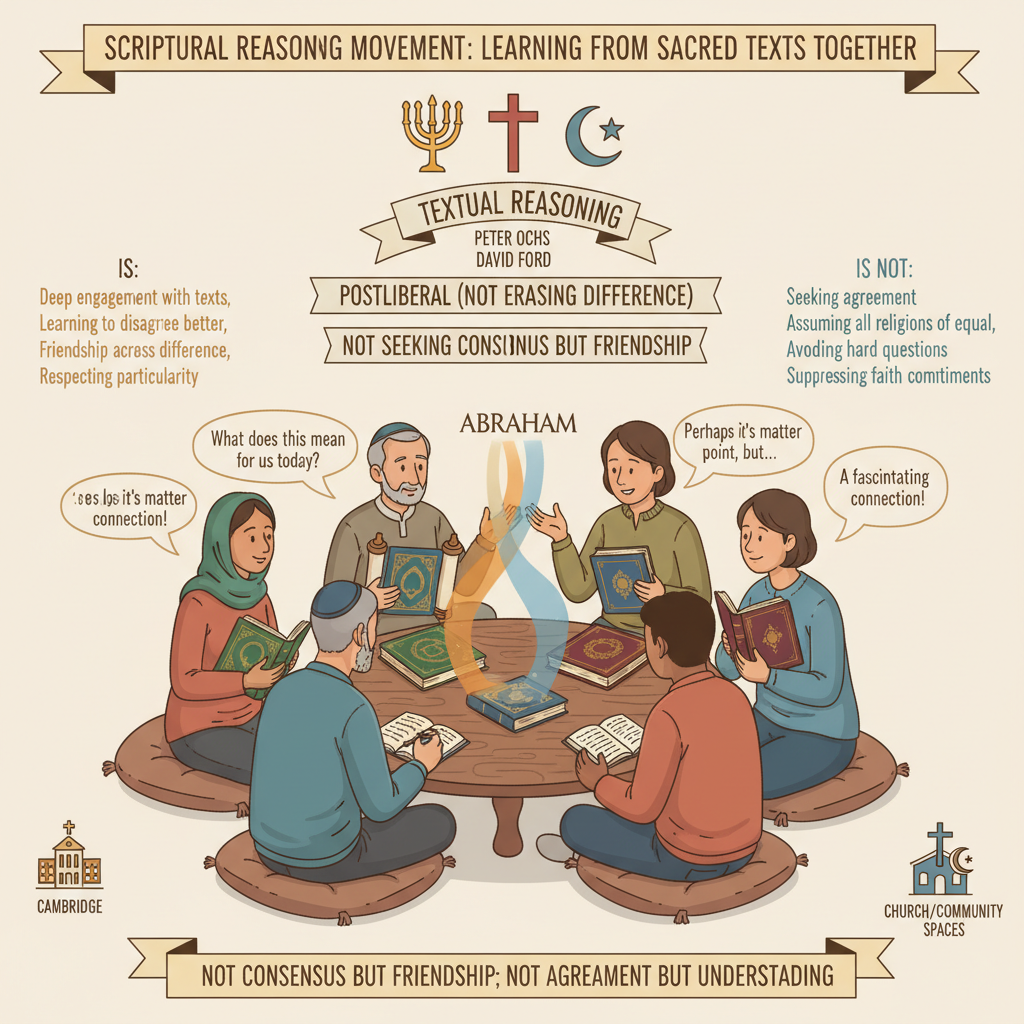
The Scriptural Reasoning Movement: Small interfaith groups of Christians, Muslims, and Jews gather to read and reflect on their sacred texts together. The goal is not agreement but deeper understanding and "learning to disagree better." Founded on friendship and respect for each tradition's particularity, SR demonstrates that committed believers can engage across difference while maintaining their core faith commitments. This illustration depicts The Scriptural Reasoning Movement in practice: A small, intimate circle of Christians, Muslims, and Jews sit together, each holding their sacred texts (Bible, Quran, Torah), engaged in respectful dialogue. The texts are shown as equal but distinct. Speech bubbles show active questioning and discussion. The scene captures the warmth of "friendship not tolerance" and the serious intellectual engagement of "learning to disagree better." In the background, foundational elements are visible (Peter Ochs, David Ford, the Textual Reasoning foundation). The illustration emphasizes both the scholarly rigor and the genuine relationship-building of SR, showing that committed believers can engage deeply across faith boundaries while maintaining their core convictions.
Summary
Scriptural Reasoning (SR) is a contemporary interfaith dialogue practice where people of different faiths (particularly Christians, Muslims, and Jews) come together to read and discuss their sacred texts side-by-side, aiming for deeper understanding and "learning to disagree better".
Core Features:
- Not seeking agreement: Participants don't expect to reach consensus
- Not suppressing difference: Each tradition's distinctiveness is honored and explored
- Friendship as the foundation: Trust and relationship enable genuine dialogue about deepest convictions
- Scripture at the heart: The sacred texts themselves are the focus, not abstract principles
- Learning the practice: SR is learned by doing it, not by reading theory
Key Founders:
- David Ford: Anglican theologian at Cambridge
- Peter Ochs: Jewish theologian
- Founded formally in 1995
The Vision:
"Scriptural Reasoning is a genuine opportunity for committed religious people to engage in inter-faith practice without undermining particularity: here is a way to deepen one's own faith commitment and deepen one's engagement with members of other faiths simultaneously."
Detailed Explanation
Origins: Textual Reasoning to Scriptural Reasoning
Textual Reasoning (Pre-1995):
- What it was: Jewish scholars reading the Talmud together while discussing contemporary Jewish issues
- Innovation: They used multiple interpretive frameworks (traditional rabbinic, postmodern, postliberal philosophy)
- Context: After the Holocaust, Peter Ochs believed Jews needed broadly-sourced methods to address contemporary challenges
The Leap to Scriptural Reasoning (1995+):
- The Idea: If Textual Reasoning worked for Jews studying their own scriptures, why not do it across faith boundaries?
- The Experiment: Christian, Muslim, and Jewish theologians started meeting to read their respective scriptures together
- The Discovery: The practice deepened each person's faith AND their understanding of the others
- The Movement: By creating the Society for Scriptural Reasoning (1995), they formalized and spread this practice globally
How Scriptural Reasoning Works in Practice
The Basic Method:
Step 1: Choose a Theme
Participants select a common topic or theme that appears in multiple scriptures
Example: Abraham (appears in Torah, Bible, and Quran)
Step 2: Prepare Passages
Each religious tradition selects a relevant passage from their scripture
Christians might choose Genesis 12; Muslims might choose Sura 2:124-141; Jews might choose Genesis 12 plus rabbinic commentary
Step 3: Read Aloud
In a small group (typically 8-15 people), each passage is read aloud with reverence
Step 4: Discuss and Reason
Participants ask questions about the passages, explore meanings and interpretations. Discussion can include both agreement AND disagreement
Step 5: Disagree Better
When disagreements arise, they are explored respectfully, not suppressed. No pressure to convince or convert
Key Principles of Scriptural Reasoning
1. Not Seeking Consensus
"The key to SR is not consensus but friendship."
- SR does NOT expect participants to agree
- Core differences in truth claims are acknowledged and respected
- Rather than trying to flatten differences, SR celebrates them
2. Honoring Particularity
Each tradition is allowed to remain faithful to its deepest beliefs.
- Participants don't have to bracket their faith commitments
- A Christian doesn't have to hide that Jesus is central
- A Muslim doesn't hide monotheism
3. Scripture is the Center
Rather than discussing vague spirituality or ethics, SR grounds dialogue in sacred texts.
- This prevents the dialogue from becoming abstract or superficial
- The texts themselves contain the richness and complexity of each tradition
4. Friendship, Not Tolerance
SR is based on genuine friendship and trust, not abstract tolerance.
- Tolerance is often passive ("I'll put up with you")
- Friendship is active engagement: "I genuinely want to understand you"
- This creates safety for real disagreement
Peter Ochs: The "Hearth" Metaphor
Scripture as Warmth in Crisis:
Peter Ochs uses a powerful metaphor: scripture is like a hearth.
"The hearth represents those dimensions of life that members of a religion turn to in times of crisis, tension, or uncertainty in the hope of drawing nearer to the source of their deepest values and identities."
Correcting "Binarism":
Ochs says SR's purpose is to correct "binarism in modern Western civilization"—the either/or thinking that divides the world into opposing camps.
- Modern society tends to think: "Either my religion is true OR yours is"
- Or: "Either we agree OR we're enemies"
- SR teaches a both/and approach: "We can maintain different truth claims AND be in genuine community"
David Ford: Postliberal Theology
What is "Postliberal"?
David Ford insists SR is postliberal—not avoiding hard differences (as liberalism does) but rather accepting and engaging them.
Liberal Approach (What SR Avoids):
- Finds "neutral ground" on which all religions agree
- Suppresses particular doctrines to find commonalities
- Asks people to bracket their faith commitments
- Result: superficial dialogue, but easier to achieve
Postliberal Approach (What SR Does):
- Accepts that religions have genuinely different worldviews
- Allows participants to express their full faith
- Welcomes tension and disagreement
- Result: deeper dialogue that honors real differences
The Vision:
"True dialogue grounds itself in the alternative stories and theologies of the faiths involved. Scriptural Reasoning sees that the natural path or the 'way into' this particularity is through each community's Scriptures."
Dabru Emet: A Fruit of Scriptural Reasoning
What is it?
Dabru Emet (Hebrew for "Speak Truth") is a 2000 Jewish document on Jewish-Christian relations published in the New York Times. Written by four Jewish scholars (including Peter Ochs) and over 200 rabbis and scholars from most strands of Judaism.
Key Affirmations:
- Jews and Christians worship the God of Abraham, Isaac, and Jacob
- Jews can affirm Christians without converting
- Christianity is not idolatry (despite traditional Jewish concerns)
Why it Matters: This shows that SR is not just academic dialogue but produces tangible changes in how religious communities relate.
Strengths of Scriptural Reasoning
1. Maintains Faith Commitments
- Unlike many interfaith initiatives, SR doesn't require watering down beliefs
- A committed believer can participate fully
- You don't have to hide convictions
2. Deepens Understanding
- Participants gain deeper knowledge of their own and others' scriptures
- Real engagement with texts leads to insight
3. Builds Friendships
- Working together through difficulty builds trust
- The practice creates genuine relationships across faith lines
4. Creates "In-Between" Space
- SR creates a unique space where people can meet neither as opponents nor by erasing differences
- You don't have to choose between "staying true to my faith" and "respecting the other"
5. Works in Conflict Zones
- SR is now practiced globally, including in areas affected by religious conflict
- It shows that dialogue is possible even where tensions are high
6. Promotes Peace Without Erasing Justice
- Rather than superficial "peace," SR enables people to pursue justice and peace together
- Maintains distinct perspectives while working toward common good
Criticisms of Scriptural Reasoning
1. The "Liberal Problem" Critique (Gavin D'Costa)
Catholic theologian Gavin D'Costa argues that SR slides back into liberalism despite claims to be postliberal.
- SR claims to allow full faith expression
- But it forbids discussing which religion is true or critiquing other religions
- This is a hidden constraint that suppresses a core element of faith
- Result: Not truly postliberal because it still has a "liberal" rule
2. The Paradox of Postliberalism
If SR truly allows full faith expression, then shouldn't committed Christians be allowed to say "I believe Jesus is the only way and I want you to convert"?
- Most SR groups would regard such explicit evangelism as violating the dialogue
- So despite claims of postliberalism, there IS an unstated "liberal" rule
- This creates tension: "If I'm truly free to express my faith, why can't I evangelize?"
3. The Authority Question
James Gustafson and others question whether SR has the authority to "correct" modernist reason or fundamentalist readings. Can modern practitioners claim knowledge of ancient traditions? Is SR actually faithful to those traditions or a modern innovation claiming ancient roots?
4. The "Canon Within a Canon" Concern
Gustafson notes SR uses "scriptural reasoning" (singular). Who decides which scriptures count? Why focus on Abrahamic religions? The focus on scripture privileges traditions that elevate written text (problematic for oral traditions).
How SR Differs from Other Interfaith Approaches
| Approach | Key Feature | SR Difference |
|---|---|---|
| Pluralism | All religions are equally valid expressions of the same ultimate Reality | SR respects difference; Pluralism erases it |
| Liberal Dialogue | Seeks common ground by bracketing differences | SR engages differences while respecting each tradition's particularity |
| Evangelism | Primary goal is conversion | SR's primary goal is understanding; no conversion pressure |
| Vatican II Inclusivism | Other religions contain rays of truth; Christianity is the fullness | SR doesn't hierarchize religions; each offers rich truths worth exploring |
Scholarly Perspectives
Quote 1: The Vision of Scriptural Reasoning
"Scriptural Reasoning is a genuine opportunity for committed religious people to engage in inter-faith practice without undermining particularity: here is a way to deepen one's own faith commitment and deepen one's engagement with members of other faiths simultaneously. The key to SR is not consensus but friendship."
Source: Foundational SR vision statement, elaborated by David Ford and Peter Ochs.
Context: Captures the essential promise of SR: you don't have to choose between faith commitment and genuine dialogue. They strengthen each other through friendship.
Quote 2: The Postliberal Difference
"Scriptural Reasoning is not about seeking agreement but rather about learning to 'disagree better'...Scriptural reasoning is intended to be postliberal. This means accepting difference rather than trying to carve out a neutral ground which ends up subsuming difference. Postliberal approaches accept that there are genuinely different worldviews and different forms of life. Religions clearly involve critical perspectives on other religions. SR allows participants to express full faith commitments while engaging respectfully with other traditions."
Source: David Ford and related SR literature.
Context: Distinguishes SR from liberal dialogue by honoring real differences rather than erasing them for easy agreement.
Key Takeaways for Your Exam
- It's not just dialogue—it's a practice: SR is learned by doing, not by reading theory. This distinguishes it from abstract interfaith models
- Friendship, not tolerance: Emphasize that SR is based on genuine relationship, not passive tolerance
- Real differences preserved: Unlike Pluralism or liberal dialogue, SR doesn't require erasing differences. It celebrates them
- The postliberal claim is contested: Know D'Costa's critique: does SR truly allow full faith expression or does it have hidden liberal constraints?
- Practical fruit: Point to Dabru Emet and real-world peace-building efforts as evidence that SR produces tangible results
- The paradox: SR claims to be postliberal but forbids explicit evangelism. Is this a contradiction?
- Evaluate: Can committed believers genuinely dialogue while maintaining exclusive truth claims? Or does SR require hidden compromise?