Christian Exclusivism
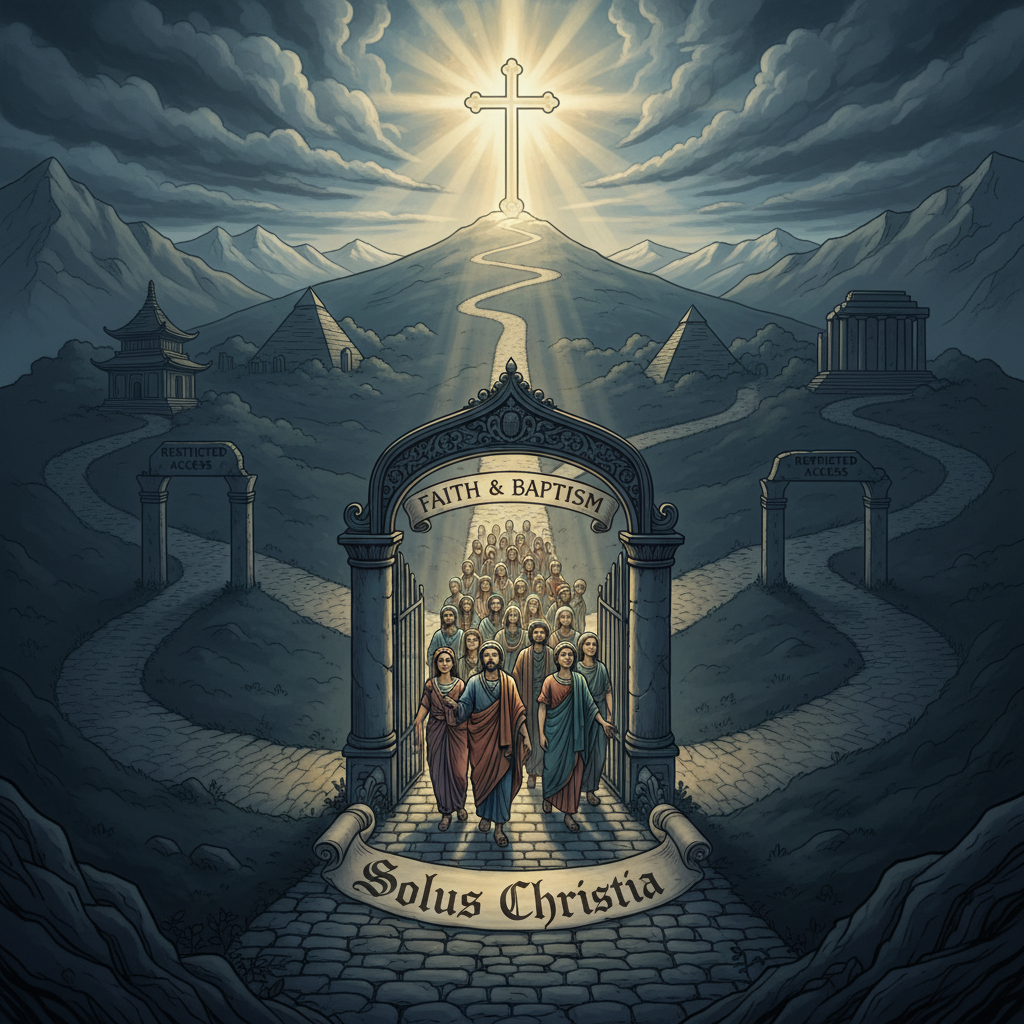
Christian Exclusivism - Solus Christia: This illustration depicts the exclusivist view of salvation. A single illuminated path leads through a gate marked "Faith & Baptism" toward a radiant cross at the summit. People walk this narrow way together under divine light. On either side, other religious buildings (pagoda, pyramid, Greek temple) stand in shadow behind "Restricted Access" gates, representing the exclusivist belief that non-Christian religions cannot provide salvation. The scroll at the bottom proclaims "Solus Christia" (Christ Alone).
Summary
Exclusivism is the theological belief that Christianity is the only true religion and that salvation is available only through faith in Jesus Christ.
Core Belief:
- Solus Christus (Christ Alone): Jesus's death and resurrection are the only means by which sin is forgiven. Without this, humans are separated from God.
- One Truth: Other religions may have some truth (e.g., believing in a Creator), but they are fundamentally flawed because they lack Christ and therefore cannot save.
- Conversion Required: You must explicitly hear the Gospel and accept Jesus to be saved.
Key Thinkers:
- Hendrik Kraemer: Argued non-Christian religions are cultural constructs, not divine revelations. There are no "partial truths" that lead to God without Christ.
- Karl Barth: Argued that all religion (even Christianity as a human institution) is an attempt to reach God and fails. Salvation comes only from God reaching down through Jesus (Special Revelation).
- Gavin D'Costa: A modern theologian who distinguishes between "Restrictive Access" (must hear the Gospel in this life) and "Universal Access" (might hear it after death/in purgatory) exclusivism.
Detailed Explanation
What is Exclusivism?
Exclusivism is the view that there is a specific and unique truth found in Christianity that is necessary for salvation. It rejects Pluralism (all religions lead to God) and Inclusivism (Christ saves, but you don't necessarily need to know his name).
Types of Exclusivism (Gavin D'Costa's Distinction)
Gavin D'Costa, a Catholic theologian, broke Exclusivism down into two types to make it more precise:
Restrictive Access Exclusivism (RAE)
The View: Salvation is restricted to those who hear the Gospel and confess faith in Jesus before they die.
The Logic: "Fides ex auditu" (Faith comes from hearing - Romans 10:17). If you don't hear and believe, you aren't saved.
The Consequence: Those who lived before Jesus, or in countries where Christianity never reached, cannot be saved. (This is often criticized as making God seem unjust or unloving).
Universal Access Exclusivism (UAE)
The View: Christ is the only way (Exclusivist), but God wants everyone to be saved (Universal will).
The Solution: God must provide a way for every single person to hear the Gospel, maybe at the moment of death or in a post-mortem state (purgatory).
The Consequence: You still have to say "Yes" to Jesus eventually, but everyone gets a chance.
Hendrik Kraemer: No "Points of Contact"
Kraemer was a Dutch theologian who wrote The Christian Message in a Non-Christian World (1938).
Context:
He was writing when some missionaries were suggesting other religions could be "preparation" for Christianity.
Argument:
He rejected this. He argued religions are whole systems. You can't pick out "good bits" from Buddhism and say they are like Christianity. It's all or nothing.
Conclusion:
Non-Christian religions are purely human attempts to make sense of the world. They are cultural, not salvific. Only the Gospel is God's direct word.
Karl Barth: Religion vs. Revelation
Barth is famous for saying "Religion is unbelief." This sounds shocking, but he meant:
Religion
Religion is man trying to climb up to God (tower of Babel). It is arrogant and futile. This applies to Islam, Hinduism, and even cultural Christianity.
Revelation
Revelation is God climbing down to man (Jesus Christ).
Theology:
We can only know God because He revealed Himself in Jesus (Special Revelation). Natural Theology (looking at nature/reason) is useless for salvation. Therefore, only Christianity (insofar as it preaches Christ) has the truth.
"Extra Ecclesiam Nulla Salus"
This Latin phrase means "Outside the Church, there is no salvation."
Traditional Meaning:
Historically (e.g., St. Cyprian), this meant if you weren't a baptized member of the Catholic Church, you were damned.
Modern Nuance:
Modern Exclusivists might interpret "The Church" more broadly as "The Body of Believers in Christ," but the core idea remains: you must be connected to Christ to be saved.
Scholarly Perspectives
The Biblical Basis
"Jesus answered, 'I am the way and the truth and the life. No one comes to the Father except through me.'"
— John 14:6
Context: This is the foundational text for Exclusivism. The word "No one" (Greek: oudeis) implies an absolute restriction. It denies the possibility of alternative routes to God.
Hendrik Kraemer on Other Religions
"The Christian revelation places itself over against the many efforts to apprehend the totality of existence... [Non-Christian religions] are all, in the light of the revelation in Christ, error."
— Hendrik Kraemer, The Christian Message in a Non-Christian World (1938)
Context: Kraemer argues that because God has revealed the full truth in Jesus, any system that tries to explain the universe without Jesus is fundamentally erroneous, even if it has nice ethical teachings.
Key Takeaways for Your Exam
It's Not Just "Christians Are Mean"
Don't critique Exclusivism just by saying "it's intolerant." Focus on the theology: If Jesus is God Incarnate, logically, how can there be another way? If there are other ways, was Jesus's death unnecessary?
D'Costa is Essential
Use D'Costa to show nuance. You can be an Exclusivist (Christ is the only way) but still believe God loves everyone and gives them a chance (Universal Access). This solves the "unfairness" problem of RAE.
Barth's Nuance
Remember Barth critiques Christianity too. He isn't saying "Christians are great"; he's saying "Humans are helpless, only Jesus saves." It's about humility, not arrogance.
The Logic
Exclusivism protects the doctrine of the Incarnation and the Trinity. If you remove the uniqueness of Christ, these doctrines collapse.
Key Terminology
Solus Christus
"Christ Alone." The doctrine that Jesus is the only mediator of salvation.
Fides Ex Auditu
"Faith comes from hearing." The belief that you must explicitly hear the Gospel to believe and be saved (Romans 10:17).
Restrictive Access (RAE)
Salvation is limited to those who hear and accept the Gospel during their earthly life.
Universal Access (UAE)
Salvation is only through Jesus, but God ensures everyone gets a chance (perhaps after death).
Extra Ecclesiam Nulla Salus
"Outside the Church there is no salvation."
Special Revelation
Knowledge of God discovered through specific acts (Bible, Jesus), as opposed to General Revelation (Nature). Exclusivists rely on Special Revelation.
Hendrik Kraemer
Theologian who argued non-Christian religions are cultural constructs and "error" compared to the Gospel.