Christian Inclusivism
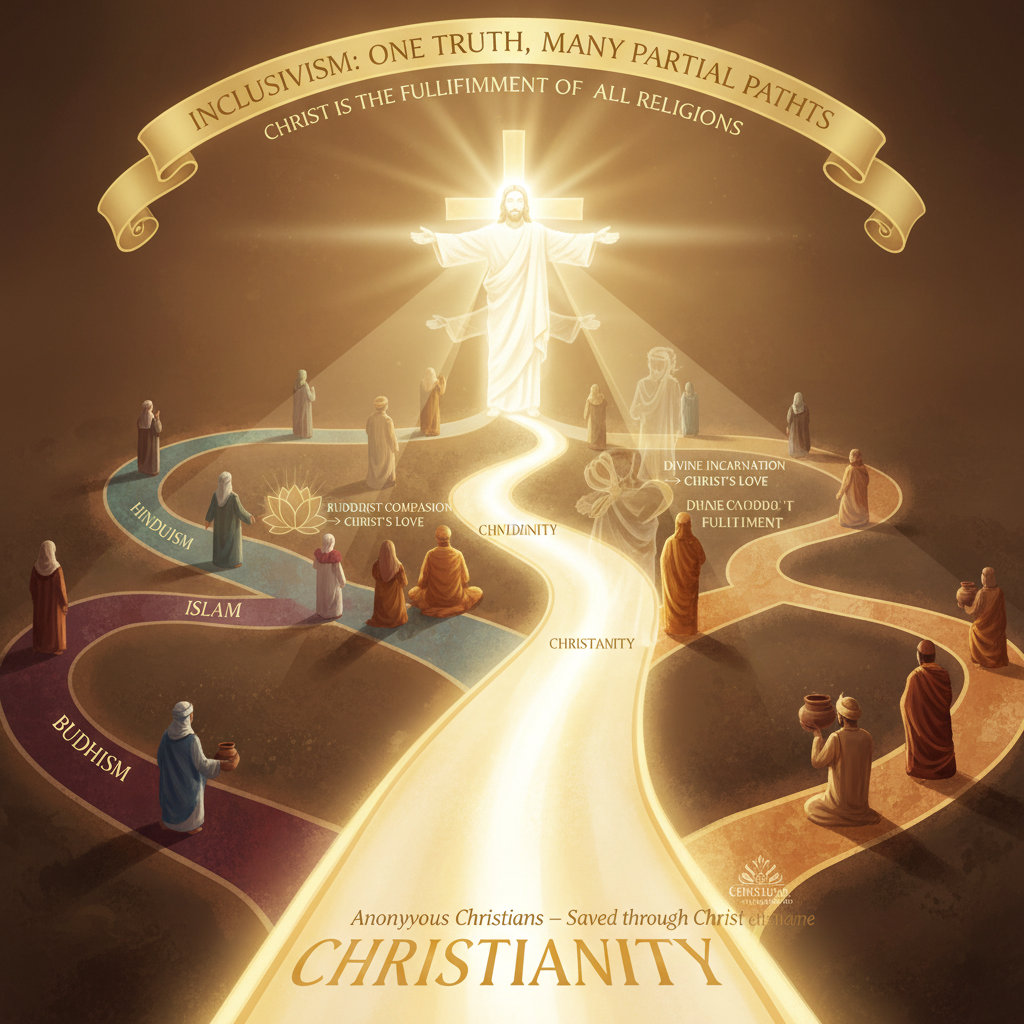
Christian Inclusivism: Multiple religious paths converge toward salvation through Christ, though Christianity offers the most direct and complete route. Non-Christians can be saved through their own religions (possibly as "anonymous Christians"), but all salvation ultimately comes through Christ's redemptive work. This illustration depicts Christian Inclusivism: Multiple religious paths (representing Buddhism, Hinduism, Islam, etc.) are shown as separate journeys, but they gradually converge toward a central destination representing salvation/God. The Christian path is most direct and brightly illuminated, but the other paths are also shown as genuine and containing light. At the center is Christ/the Cross, showing that all paths ultimately lead through His redemptive work, even if travelers don't consciously recognize it (the concept of "Anonymous Christians"). The image emphasizes both Christian uniqueness (brightest, most direct path) and God's broader grace (light in other traditions), illustrating how Inclusivism holds together Christ's centrality with genuine salvation beyond explicit Christian boundaries.
Summary
Inclusivism is the theological belief that Christianity is the one true religion (like Exclusivism), but non-Christians can also be saved through their own religions.
Core Idea:
- Jesus is the only savior: His death and resurrection are the mechanism by which all salvation occurs.
- But you don't need to know his name: A devout Buddhist, Muslim, or Hindu can be saved through Christ's work—even if they don't explicitly believe in Jesus—because they are responding to God's grace in their own religious context.
- Christ is the fulfillment: Inclusivists see other religions as containing partial truths that point toward or are fulfilled in Christ.
Key Thinker:
Karl Rahner: The Catholic theologian famous for the concept of "Anonymous Christians"—people outside the Christian Church who are saved through Christ but don't know his name.
The Middle Way:
Inclusivism balances Exclusivism (Christianity only) with Pluralism (all religions equal). It says: Christianity is supreme, but God's grace operates more broadly than Christians realize.
Detailed Explanation
The Problem Inclusivism Addresses
The Exclusivist Problem:
Exclusivism teaches that only Christians go to heaven. But what about:
- A devout, moral Hindu living in India who never hears the Gospel?
- A Sikh whose charity and devotion are evident, but she doesn't believe in Jesus?
- Ancient peoples before Jesus came?
Exclusivism's Answer: They're damned through no fault of their own (Restrictive Access) or God gives them a chance (Universal Access). But either way, it seems unjust or unloving for God to damn sincere believers in other faiths.
Inclusivism's Solution:
God is more loving and gracious than Exclusivism suggests. If a person responds to God's grace as they understand it (through their religion), Christ's work of salvation covers them, even if they don't explicitly believe in Jesus.
Karl Rahner: The "Anonymous Christian"
The Key Concept:
Rahner coined the term "Anonymous Christian" to describe someone who:
- Is not consciously a Christian (doesn't believe in Jesus by that name)
- Acts like a Christian (shows love, compassion, moral integrity)
- Has implicitly accepted God's grace through their moral and spiritual living
How This Works:
- God offers grace to everyone (1 Timothy 2:4: God desires all to be saved)
- Grace operates beyond official Christianity (through other religions)
- If a person responds faithfully to God as revealed in their own tradition, they are implicitly accepting Jesus's salvation, even if they don't know his name
- The Holy Spirit is active in all cultures and religions, enabling genuine moral and spiritual response
What This Means:
- A Buddhist might be saved through his sincere Buddhist faith, because within that faith he is unknowingly responding to Christ's grace
- A Muslim might be saved through her devotion to Allah, because Allah's work is Christ's work
- They are "anonymous Christians" without knowing it
The Basis: Rahner's Christology
Rahner's approach rests on traditional Christian doctrine:
The Incarnation
Jesus Christ is God made flesh. His redemptive work is universal in scope (1 John 2:2: "He is the atoning sacrifice for our sins... for the sins of the whole world")
Grace Operates Invisibly
God doesn't leave Himself without a witness (Romans 1:20; Acts 14:17). Even non-Christian religions are touched by God's revelation and grace
Thus:
- Christ is the only savior (Exclusivist principle)
- But Christ's grace extends beyond explicit Christian boundaries (Inclusivist principle)
Gavin D'Costa's Refined Inclusivism
The Problem with Rahner:
Some criticize Rahner for being patronizing. It seems to say "Your religion is fine, but really you're a Christian and don't know it," which could seem dismissive of non-Christian traditions on their own terms.
D'Costa's Improvement:
D'Costa (Catholic, modern theologian) refined Inclusivism using the Trinity:
- Jesus is normative (the clearest revelation of God)
- But the Holy Spirit is also active throughout history and cultures, revealing God in ways not limited to Christianity
- God is not fully Jesus; Jesus is wholly God (meaning: God's work goes beyond what Jesus explicitly taught; the Spirit continues revelation)
Christ as Fulfillment
Inclusivists see other religions as partial truths that find their fulfillment in Christ.
Examples:
- Buddhist compassion: Reflects Christ's love for all beings
- Hindu concepts of divine incarnation (Avatar): Foreshadow or parallel the Christian Incarnation
- Islamic monotheism: Affirms belief in God, which Christ affirmed
- Jewish ethics: Jesus fulfilled the Law and Prophets (Matthew 5:17)
The Logic:
If there is one God and one truth, then religions are not wholly false but incomplete without Christ. Like puzzle pieces that only make sense when assembled—other religions have genuine pieces, but Christ shows how they fit together.
The Role of the Holy Spirit in Inclusivism
Inclusivism (especially D'Costa's version) emphasizes that the Holy Spirit is active beyond the Church.
What This Means:
- The Spirit works in cultures, wisdom traditions, and religions outside Christianity
- The Spirit can inspire moral transformation in a devout Muslim or Buddhist
- The Spirit can reveal truth through non-Christian sources
But:
- Jesus remains the normative center for Christians to evaluate all claims
- The Spirit's work in other traditions is real but partial compared to full Christian revelation
Anonymous Christianity and Implicit Faith
Anonymous Christians:
- People who are materially/implicitly Christian (responding to Christ's grace) without formally/explicitly being Christian
- They may have never heard of Jesus but live out Christian virtues
- Rahner's claim: Their moral and spiritual goodness is evidence of God's grace, which is Christ's grace
Implicit Faith:
- A person can have implicit faith (trusting in God's grace, seeking righteousness) without explicit faith (knowing about and believing in Jesus)
- A sincere Hindu prayer for forgiveness and renewal is, implicitly, a response to God's grace
Potential Issues:
Critics argue:
- This could be patronizing: "You're really a Christian even if you don't know it"
- It downplays real differences between religions
- It privileges Christianity as the unspoken standard against which all others are measured
Scholarly Perspectives
Karl Rahner on Anonymous Christianity
"Anyone who accepts his own humanity completely in all its concreteness is by that very fact accepting the acceptance of God's grace, even though he is not reflecting on God conceptually... Thus, if it is true that all men who are saved are saved by Christ, and if it is true that God desires all men to be saved, then it must be possible to be an 'anonymous Christian' even without an explicit profession of faith in Jesus Christ."
— Karl Rahner, Theological Investigations (1961)
Context: This is the foundational text for Inclusivist theology. It argues that sincere moral and spiritual living, even outside Christianity, is a response to Christ's grace—saving grace even without explicit belief.
Gavin D'Costa on the Trinity and Inclusivism
"The Trinitarian doctrine of God facilitates an authentically Christian response to the world religions because it takes the particularities of history entirely seriously. God has disclosed himself in the person Jesus, but the Trinity also affirms that God is constantly revealing himself through history by means of the Holy Spirit. Jesus is wholly God but God is not fully Jesus."
— Gavin D'Costa, Christian Uniqueness Reconsidered (1990)
Context: This shows how modern Inclusivism uses Trinitarian theology to honor both the uniqueness of Christ and genuine revelation through the Spirit in other traditions.
Key Takeaways for Your Exam
It's a Middle Way
Always position Inclusivism between Exclusivism ("Only Christianity") and Pluralism ("All religions equal").
Rahner is Essential
Use the concept of "Anonymous Christians" to show how Inclusivism balances Christian uniqueness with God's universality.
The Justice Argument
Inclusivism solves the Exclusivist problem: How can a sincere, moral Hindu go to hell? Answer: They don't, because Christ's grace reaches them.
D'Costa Improves Rahner
Show that modern Inclusivism (D'Costa) is not patronizing. It genuinely acknowledges the Holy Spirit's work in other religions, not just a hidden Christianity.
Christ is Still Central
Never let the inclusion of other religions overshadow the point: Jesus is the normative revelation and the source of all saving grace.
Evaluate Critically
Critics say Inclusivism is "Exclusivism with a friendly face." Is it genuinely respectful of other religions, or does it ultimately reduce them to stepping stones toward Christianity?
Key Terminology
Inclusivism
Christianity is the one true religion, but non-Christians can be saved through their own traditions
Anonymous Christian
A non-Christian who is materially/implicitly Christian through sincere moral and spiritual living
Implicit Faith
Trusting in God's grace without explicit knowledge of Jesus; responding to God as one understands Him
Christ is the Fulfillment
Other religions contain partial truths that are completed/interpreted through Christ
Karl Rahner
Catholic theologian who developed the concept of Anonymous Christians
Gavin D'Costa
Modern Inclusivist who emphasizes the Holy Spirit's work in other traditions
Normative but Not Exclusive
Jesus is the standard by which all revelation is measured, but not the only locus of God's revelation
Trinitarian Inclusivism
Using Father, Son, and Holy Spirit to explain how God works in Christianity and beyond