Christian Pluralism
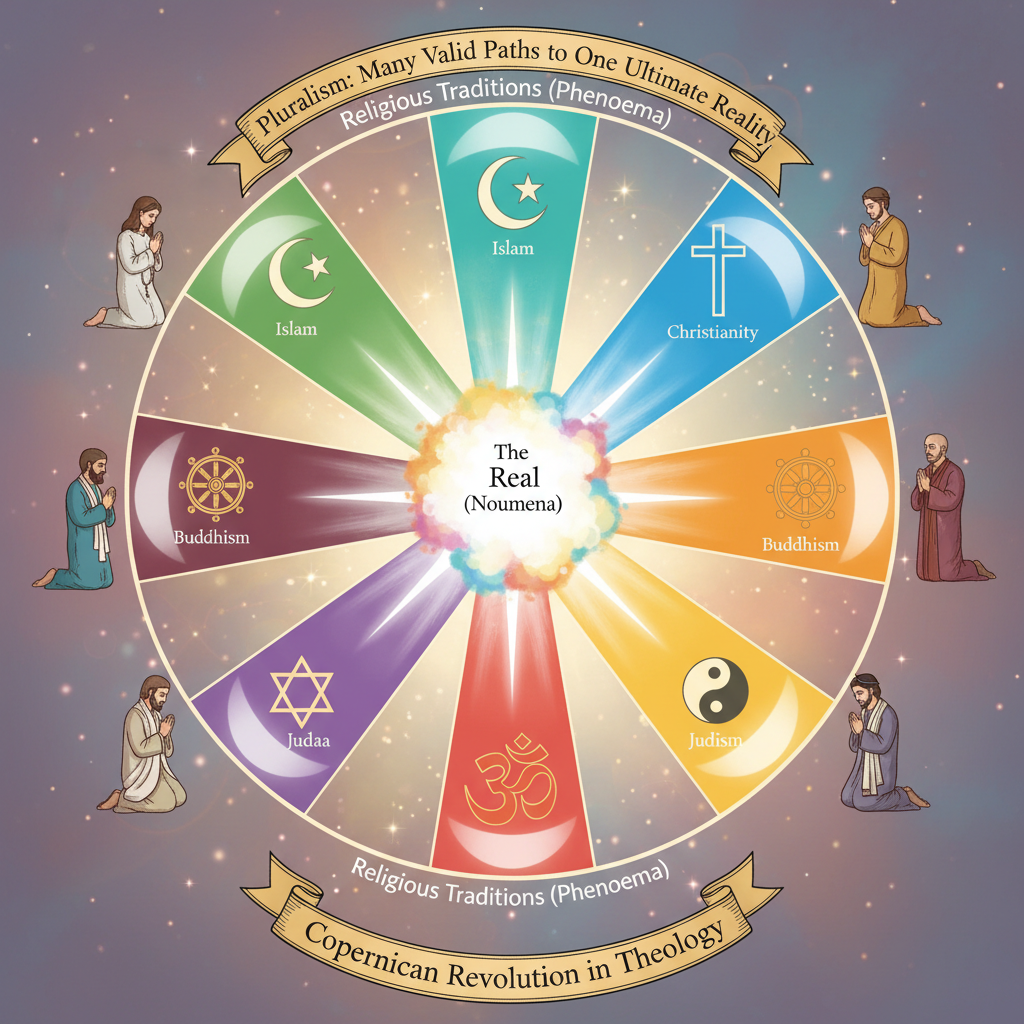
Christian Pluralism: All world religions are equally valid paths to the same transcendent Ultimate Reality. Through a Copernican Revolution in theology, Christianity is repositioned from the center as the norm, allowing all religions to orbit the same universal Reality according to their own cultural and doctrinal frameworks. This illustration depicts Christian Pluralism: Rather than a single path (Exclusivism) or paths converging to Christ (Inclusivism), this shows multiple equally prominent religious paths (Christianity, Islam, Buddhism, Hinduism, etc.) radiating equally from a central transcendent Reality that is beyond naming or comprehension. The center is abstract and indescribable (representing Hick's "The Real"), emphasizing that no religion has privileged access. This is Hick's "Copernican Revolution"—religion is no longer about orbiting the Christian Christ but about orbiting the same universal Reality from different cultural perspectives. The illustration emphasizes equality, diversity, and the humility that our understanding of the transcendent is always limited and culturally conditioned.
Summary
Pluralism is the theological belief that all major world religions are equally valid paths to the same ultimate Reality. There is no single "correct" religion; all are culturally different responses to the transcendent.
Core Belief:
- The Ultimate Reality is beyond description: No religion has a monopoly on truth
- Different religions = Different cultural lenses: Buddhism sees reality one way, Islam another, Christianity another—all equally legitimate
- All religions aim at the same goal: Moral transformation, spiritual awakening, union with the divine—just expressed differently
- Christ is not uniquely ultimate: Jesus is one great mediator among others, not the only one
Key Thinker:
John Hick: The most influential pluralist. He argues for a "Copernican Revolution" in theology: just as Copernicus showed the Earth is not the center of the universe, we must show Christianity is not the center of world religions.
The Logic:
If Christianity genuinely was the only true way, Christians should be noticeably more moral and enlightened than Buddhists or Muslims. Since they're not, all religions must be equally valid.
Detailed Explanation
The Problem Pluralism Addresses
The Question:
If there is one ultimate Reality/God, why do sincere, intelligent people experience it so differently through different religions?
Traditional Answers Have a Problem:
- Exclusivism: Only Christianity is true; everyone else is wrong. But this seems arrogant and unfair
- Inclusivism: Christianity is most complete, but God secretly saves non-Christians through Christ. But this seems patronizing: "You're really a Christian without knowing it"
Pluralism's Answer:
The problem is our assumption that one religion must be uniquely correct. What if all religions are equally valid responses to the same ultimate Reality, just filtered through different cultures?
John Hick: The Copernican Revolution
The Analogy:
- Old astronomy: Earth at the center; sun, planets, stars orbit around it
- Copernican revolution: Sun at the center; Earth is just one planet orbiting it
Hick's Theological Application:
- Old theology: Christ at the center; all other religions orbit around him, graded by closeness to Christianity
- Pluralist revolution: The ultimate Reality/God at the center; all religions (including Christianity) orbit around it, equally
What This Means:
- Decentering Christ: Christianity is no longer uniquely positioned as the standard
- Recentering Reality: Focus on the transcendent Reality itself, which transcends all religious categories
- All religions equal: No religion is the measure; all are equally limited yet valid responses to the infinite
Hick's Use of Kant: Noumena and Phenomena
Kant's Philosophy (Brief Recap):
Immanuel Kant argued that we never experience the world "as it really is" (the noumena). We only experience it as it appears to us through our human cognitive structures (the phenomena).
Hick's Application to Religion:
- The Noumena (The Real): The ultimate Reality as it is in itself, beyond all human concepts, categories, and descriptions
- The Phenomena (Religious Traditions): Different religions are different ways of experiencing and interpreting The Real, filtered through culture and human limitation
Why This Works:
If God/Reality is truly transcendent and infinite, it cannot fit into any single human category (even "Christian" categories). Therefore:
- Buddhism's experience of ultimate emptiness
- Islam's experience of absolute monotheism
- Christianity's experience of the Trinity and Incarnation
- Hindu's experience of Brahman
All are legitimate ways The Real appears to different human minds shaped by different cultures.
Transcendental Pluralism
The Idea:
Because The Real transcends (goes beyond) all human theological categories, we cannot make absolute truth claims about it. Therefore, all religions that aim at the transcendent are equally valid.
Key Insight:
- If you claim "Only Christianity is true," you are claiming special access to the transcendent
- But the transcendent cannot be captured in human language or concepts
- Therefore, claiming exclusivity is logically incoherent for a truly transcendent religion
The Test of Validity:
A valid religion is one that:
- Acknowledges the transcendent
- Produces morally transformed people (compassion, justice, love)
- Engages seriously with the ultimate questions
By these standards, all major religions qualify.
All Religions Produce Moral Fruit
Hick's Empirical Observation:
- Look at the world: Are Christians obviously better, more loving, more just than Buddhists or Muslims?
- The answer is No. Goodness is found in all traditions
- This empirical fact suggests all traditions have equal access to the transcendent
The Counter-Argument (Critiques):
- Critics say this ignores that sin damages all people, even Christians
- It assumes morality is the measure of truth—but what if truth and morality are separate?
- It's empirically weak: you can't measure goodness objectively
The "Liberal Pluralism" Critique
The Critique:
- Selective reductionism: Pluralism takes out the "inconvenient" unique parts of each religion (Christ's divinity, Islamic law, Buddhist non-theism) to make them all fit the same mold
- Christian elements discarded: To make Christianity fit pluralism, you have to remove the Incarnation, Atonement, Resurrection—the things that make Christianity distinctive
- The Result: A "Christianity" unrecognizable to most believers
Hick's Response:
He would say these distinctive doctrines are human cultural interpretations of the transcendent, not essential to the core: responding to ultimate Reality with moral transformation.
Paul Knitter: Jesus as One Mediator Among Many
His Position:
- Jesus is a great mediator, not the only mediator
- Just as Buddha is the enlightened one for Buddhism, Jesus is the incarnation for Christianity
- But there are other incarnations, other bodhisattvas, other great spiritual mediators in other traditions
- Jesus is normative for Christians but not universal
The Logic:
To say Jesus is the only mediator denies that God could work through Muhammad, Buddha, Krishna, or other great spiritual figures. This seems a priori limiting of God's power.
Raimundo Panikkar: The "Intrareligious Dialogue"
His Contribution:
Rather than viewing religions from the outside (comparing them), Panikkar advocated for "intrareligious dialogue"—Christians learning from within the Hindu or Buddhist tradition, not from above.
Key Ideas:
- Faith vs. Belief: All religions share the deeper reality of faith (trust in the transcendent), even if their beliefs (doctrinal statements) differ
- Humans are unfinished: All religions address the human condition—we are "a being not yet finished, growing, becoming, on the way, a pilgrim"
- Pluralism requires humility: We must approach other religions not as judges but as co-pilgrims
Strengths of Pluralism
1. Addresses Religious Diversity
Why are sincere people divided? Pluralism has an answer: because the transcendent is inexhaustible.
2. Promotes Tolerance and Peace
If all religions are equally valid, there is no theological reason for conflict.
3. Respects Non-Christian Traditions
Rather than patronizing them (Inclusivism) or condemning them (Exclusivism), it takes them seriously on their own terms.
4. Pragmatic for Pluralistic Societies
In multi-faith communities, pluralism provides a framework for peaceful coexistence and interfaith dialogue.
Major Critiques of Pluralism
1. It's Self-Refuting
- Pluralism claims "All religions are equally true"
- But that claim itself is an absolute truth claim
- Why should we accept Pluralism's claim over Exclusivism or Inclusivism?
2. It Destroys Christian Identity
- To fit Christianity into pluralism, you must remove doctrines like the Incarnation, Atonement, and Resurrection
- The result is not Christianity but a caricature
- Most Christians throughout history have understood Christ as uniquely divine and salvific
3. It Ignores Real Contradictions
- Theistic religions (Christianity, Islam) contradict non-theistic religions (Buddhism)
- Hick says these are just "different cultural expressions," but you can't have both God and no-God
- Trying to reconcile contradictions forces "special pleading" and "death by a thousand qualifications"
4. It's Intellectually Dishonest
- Hick claims to be neutral about all religions but actually judges religions by Western liberal standards
- He rejects exclusivism as intolerant, showing he does make truth judgments
- It's incoherent to say "All religions equally true" and "Exclusivism is wrong"
5. It's Vague about "The Real"
- What exactly is "The Real"? Hick can't describe it (by definition, it's beyond description)
- This vagueness hides problems: If The Real is truly beyond all description, why assume all religions are equally responding to the same Reality?
6. It Diminishes Salvation
- Traditional Christianity teaches Christ saves us from sin and death
- Pluralism sees Christ as just one teacher among many pointing to the transcendent
- The urgency and uniqueness of the Christian Gospel is lost
Pluralism and Society
Interfaith Dialogue
Pluralism provides strong theological grounds for interfaith engagement—since all religions are equally valid, dialogue aims at mutual learning, not conversion.
Conversion
Conversion is problematic if all religions are equally valid. Trying to convert someone is implying your religion is better. Pluralist Christians often oppose active evangelism.
Social Cohesion
In diverse societies, pluralism helps prevent conflict by legitimizing all faith traditions.
Scholarly Perspectives
Quote 1: Hick's Copernican Revolution
"The traditional dogma has been that Christianity is the centre of the universe of faiths, with all the other religions seen as revolving at various removes around the revelation in Christ and being graded according to their nearness to or distance from it. But it seems to many of us today that we need a Copernican revolution in our understanding of the religions. We should now see all major traditions as comparable responses to the ultimate divine Reality, each serving as a valid path to our human transformation and eventual liberation from the ego."
— John Hick, God Has Many Names and An Interpretation of Religion (1989)
Context: This defines the core of pluralist theology: decentering Christ and Christianity, recentering the transcendent Reality that all religions access.
Quote 2: The Critique - Christianity Loses Its Identity
"The 'Christianity' which is declared to be homogenous with all other 'higher religions' would not be recognizable as such to most of its adherents. It is not Christianity which is being related to other world faiths: it is little more than a parody and caricature of the living faith, grounded in the presuppositions and agendas of western liberalism rather than in the self-revelation of God."
— Modern Christian critic of Hick's pluralism
Context: Shows the strongest criticism: Pluralism must water down Christianity to fit its framework, rendering it unrecognizable.
Key Takeaways
Position it Correctly
Pluralism is the opposite extreme from Exclusivism. Inclusivism is the middle ground.
Hick is Essential
Use the Copernican Revolution analogy to show the core idea. Make it visual and clear.
The Kant Connection
Explain noumena vs. phenomena to show why all religions can be equally valid (they're all limited human responses to the infinite).
The Moral Test
Use Hick's claim that if Christianity were uniquely true, Christians would be noticeably more virtuous. This is powerful but also contestable.
Know the Major Critique
Pluralism seems to require Christianity to abandon its core doctrines (Incarnation, Atonement) to fit the mold.
Evaluate Both Sides
Can you defend pluralism against charges of relativism and patronization? Or does Exclusivism/Inclusivism better preserve Christian identity?
Quick Reference: Key Pluralism Concepts
| Concept | Meaning |
|---|---|
| Pluralism | All major religions are equally valid paths to the same Ultimate Reality |
| The Real (Noumena) | The transcendent Reality beyond all human description (from Kant) |
| Religious Traditions (Phenomena) | Different cultural interpretations of The Real (from Kant) |
| Copernican Revolution | Moving Christ/Christianity from the center to equal status with all religions |
| Transcendental Pluralism | Because The Real transcends human categories, all religions are equally limited/valid |
| John Hick | Main pluralist thinker; uses Kant's epistemology |
| Paul Knitter | Jesus as one mediator among many, not the only one |
| Raimundo Panikkar | Pioneered intrareligious dialogue; emphasized shared faith across traditions |