Apophatic way/via negativa
Summary
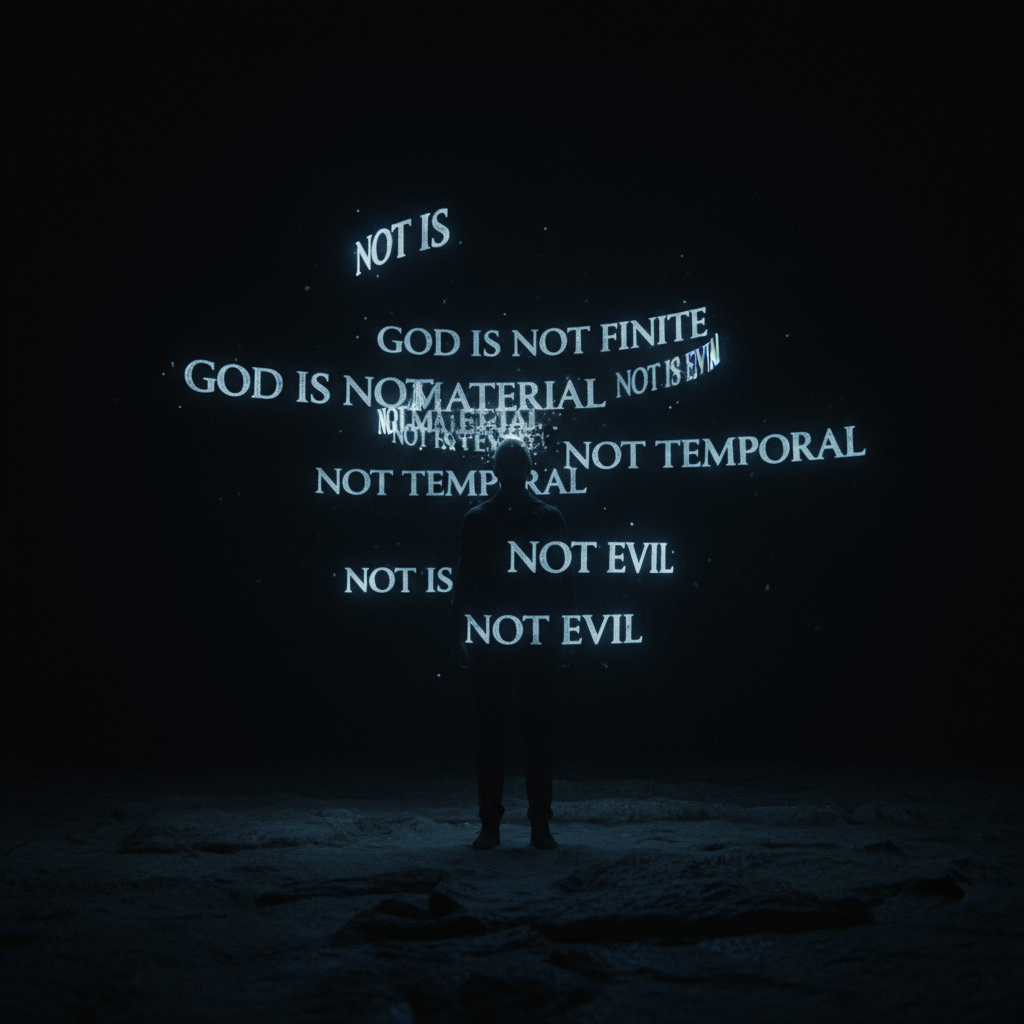
The Apophatic Way (from Greek apophasis = "to deny") or Via Negativa (Latin = "negative way") argues that God is so transcendent and beyond human understanding that we cannot meaningfully say what God IS—we can only say what God is NOT. Pseudo-Dionysius (5th-6th century) taught that God is "beyond assertion and denial"—beyond all language and concepts. When we say "God is not mortal" or "God is not evil," we're not saying God is immortal or good in the way we understand those terms; rather, God is beyond the mortal/immortal and evil/good distinctions entirely. Maimonides used the ship analogy: by learning what a ship is NOT (not a plant, not a mineral, not a sphere), we get closer to understanding what it IS. The goal is mystical union with God through "unknowing"—shutting down intellectual grasping leads to spiritual connection.
Detailed Explanation
What Is the Apophatic Way?
Definition: Apophatic theology (also called negative theology or via negativa) is the theological approach that attempts to describe God by negation—by saying only what God is not.
Etymology: "Apophatic" comes from the Greek word apophasis, meaning "to deny" or "negation". "Via Negativa" is Latin for "the negative way" or "by way of denial".
Core Principle: God is completely ineffable—He cannot be put into words or grasped by human understanding. God is transcendent—"wholly other," radically different from anything we can experience or comprehend. Therefore, the only meaningful way to talk about God is to say what God is not.
The Contrast: Via Negativa vs. Via Positiva
Via Positiva (Cataphatic Way):
The view that we can speak positively about God—we can say what God is.
Examples: "God is loving," "God is powerful," "God is eternal"
Uses affirmations or positive statements.
Via Negativa (Apophatic Way):
The view that we cannot speak positively about God—we can only say what God is not.
Examples: "God is not mortal," "God is not evil," "God is not material"
Uses negations or negative statements.
Pseudo-Dionysius: The Foundational Thinker
Who Was Pseudo-Dionysius?
Pseudo-Dionysius the Areopagite (5th-6th century CE) was the most influential early thinker on apophatic theology. His major work: Mystical Theology. Called "Pseudo-Dionysius" because he wrote under the pseudonym of Dionysius the Areopagite (a biblical figure), but he lived centuries later.
Pseudo-Dionysius' Central Claims
1. God Is Beyond All Language
God is "beyond assertion and denial". God transcends all concepts, categories, and distinctions we can make.
"There is no speaking of it, nor name nor knowledge of it. Darkness and light, error and truth—it is none of these. It is beyond assertion and denial."
— Pseudo-Dionysius
2. Negation Is Not Privation
This is crucial: When we say "God is not living," we don't mean "God is lifeless". Rather, we mean: God is beyond the living/lifeless distinction.
Similarly, when we say "God is not darkness," we're not saying "God is light". We're saying: God transcends the light/darkness distinction entirely.
The Key Insight:
- God does not exist on any spectrum of meaning that we can possibly imagine
- Every human concept involves distinctions (living/lifeless, light/dark, good/evil)
- God is beyond all such distinctions
3. The Goal: Mystical Union Through Unknowing
Accepting the via negativa helps us "break free from our grasping for knowledge of God". This causes an "inactivity of all knowledge" which leads one to be "supremely united to the completely unknown". By this, one "knows beyond the mind by knowing nothing".
Not Intellectual Knowledge: This is not knowledge in the sense of the mind understanding God—that's impossible. It is knowledge gained through "unity" with God—a mystical, experiential connection.
The "Cloud of Unknowing": Medieval mystical text influenced by Pseudo-Dionysius. The metaphor: our intellectual attempts to grasp God create a "cloud" that obscures our spiritual connection. By giving up intellectual understanding, the cloud clears, allowing mystical union.
Moses Maimonides: The Ship Analogy
Who Was Maimonides?
Moses Maimonides (1138-1204) was a medieval Jewish philosopher and rabbi. He developed the via negativa within Jewish thought.
Maimonides' Key Arguments
1. Human Language Is Inadequate for God
The Torah was written by "the sons of men"—in human language. Any attempt to describe God using human language is anthropomorphic (attributing human characteristics to God). This is necessary for the "less intelligent" who need concrete descriptions, but it's a "second-best" approach.
"The sun is hidden to eyes that are too weak to comprehend it."
Similarly, God's true nature is hidden to minds too limited to comprehend Him.
2. Religious Language Is Equivocal
Equivocal language: Words have completely different meanings when applied to different subjects.
When we say "God is good" and "Humans are good," the word "good" means something entirely different in each case. Since we don't know what God is, we don't know what "good" means when applied to God.
3. The Via Negativa Solution
Maimonides' Conclusion:
"Silence is the best praise."
- We should not attempt to directly describe God's nature
- Instead, we should demonstrate God's nature by saying what He is not (via negativa)
The Ship Analogy
Maimonides' Famous Example:
Imagine someone who knows that something called a "ship" exists, but doesn't know exactly what the name applies to.
Maimonides then runs through examples of negative language:
- A ship is not a sphere
- A ship is not a flat object
- A ship is not a property
- A ship is not a plant
- A ship is not a mineral
The Claim: By hearing what a ship is not, the person gets closer to knowing what a ship is. Eventually, through process of elimination, they can narrow down what a ship must be.
Application to God: Similarly, by saying what God is not (not mortal, not evil, not material, not limited), we get closer to understanding God.
Strengths of the Via Negativa
Strength 1: Preserves God's Transcendence
The main strength of the via negativa is that it is true to God's transcendence and otherness. Almost all theologians agree that God is transcendent—beyond human understanding. Rudolf Otto called God "wholly other"—radically different from anything we experience. Augustine commented: "Whatever we can comprehend is not God".
The Via Negativa Honors This: By refusing to make positive claims about God, the via negativa avoids limiting or misrepresenting God. It prevents anthropomorphism (projecting human qualities onto God). It maintains the proper sense of humility and awe before the divine mystery.
Strength 2: Avoids Idolatry
Making positive statements about God using human concepts risks idolatry. Idolatry: Believing earthly, creaturely things are God or represent God. Idolatry can lead to worship of nations, ideologies, or movements. After the Fall, human reason is corrupted and cannot reach God or God's true morality.
Via Negativa's Protection: By saying only what God is not, we avoid confusing God with anything creaturely. We acknowledge that our concepts are inadequate and don't capture God's essence.
Strength 3: Leads to Mystical Union
Pseudo-Dionysius' Argument: The via negativa functions by shutting down our attempt to intellectually grasp God. This frees our mind to develop a more spiritual connection to God. Through "unity" with God, we achieve a knowledge that transcends intellectual understanding.
Support from William James: William James studied mysticism and found that mystical union is universally attested across religions. The via negativa aligns with this universal mystical tradition.
By giving up rational attempts to understand God, we clear away the obstacles to direct spiritual experience. This is a much more defensible sense in which we can get "nearer" to God through negation.
Strength 4: Distinguishes Transcendence from Immanence
Critics point out that the Bible uses positive language about God (e.g., "God is love"). The response makes a distinction between:
1. God's Transcendence:
God's actual but unknowable being. This can only be described negatively.
2. God's Immanence:
God's actions in the physical world. This can be described positively, since we're describing God's actions, not His unknowable nature.
Implication: All biblical language about God refers to God's immanence (His actions), not His transcendence (His essence). Therefore, the via negativa remains consistent with Scripture.
Criticisms of the Via Negativa
Criticism 1: Brian Davies' "God-Shaped Hole"
Brian Davies argues that the via negativa doesn't work the way Maimonides claims. The ship example fails because:
We only get closer to describing what a ship is if we already know what it is:
Hearing "not a plant, not a mineral, not a sphere" helps only if we have prior knowledge of ships. If we have no concept of what a ship is, negative descriptions don't help us.
Describing everything a ship is not leaves a "ship-shaped hole":
We can imagine the category "ship" being carved out by eliminating everything it's not.
But:
Describing everything that God is not does NOT leave a "God-shaped hole" in our imagination. Why? Because God is infinite and transcendent—not a category we can imagine.
Davies' Conclusion: We don't get closer to describing what God is by saying what He is not. The via negativa is ineffective as a method of gaining knowledge about God.
Criticism 2: Aquinas' Rejection—Not What People Want to Say
Aquinas claims that negative language is "not what people want to say when they talk about God". Talking about God via negativa is not how most religious believers actually want or intend to talk about God. When believers say "God is loving," they mean to affirm something positive about God, not just deny that God is unloving.
Evidence from Worship and Scripture: The religious language you hear during worship and in the Bible is not consistent with the via negativa. Prayers, hymns, and biblical passages overwhelmingly use positive language about God.
Implication: The via negativa is disconnected from actual religious practice and belief. It's a philosophical theory that doesn't reflect how believers actually experience or speak about God.
Criticism 3: Hick's Contradiction
John Hick's Objection: It is a contradiction to say: (1) God is beyond human comprehension, AND (2) God can be known through the Bible.
The via negativa claims God is completely unknowable. But if God can be known through Scripture, storytelling, and symbolic language in the Bible, then the via negativa is wrong. The "only way to talk of God" is not by using negative terms—the Bible shows us we can use positive and symbolic language.
Criticism 4: Tells Us Nothing About God
Saying what something is not gives no indication of what it actually is. How useful is it to say: "X is not a car, not a dog, not blue, not square"? This tells us nothing about what X actually is.
Applied to God: The via negativa doesn't tell believers anything about God's nature or religious belief. It leaves us with an empty concept—a pure mystery that provides no guidance.
Brian Davies' Version: "Only saying what something is not gives no indication of what it actually is". We need positive content to have meaningful knowledge.
Criticism 5: How Can We Judge What God Is Not?
How can we describe what God isn't if we have no idea what God is? How can we make judgments about something we haven't experienced?
The Logic: To say "God is not X," we must have some concept of what God is. Otherwise, how do we know that "not X" is a true statement about God? But the via negativa claims we have no concept of God. This creates a contradiction.
Response to Criticisms: Defending the Via Negativa
Response 1: Maimonides vs. Pseudo-Dionysius
Maimonides' version (the ship analogy) may have gone too far. We cannot get "nearer" to knowledge of God through process of elimination the way we can with a ship.
But: Pseudo-Dionysius' approach is more successful. Via negativa functions by shutting down our attempt to intellectually grasp God, which gets in the way of knowing God through "unity" with God.
This is a much more defensible sense in which we can get "nearer" to knowledge of God through negation—not through intellectual understanding, but through mystical experience.
Response 2: Against Aquinas' Criticism
Aquinas' criticism is unsuccessful because Pseudo-Dionysius explains that "unity" with God can be gained once we give up on attempting to understand God through reason.
The spirituality involved in a relationship with God is not only captured but strengthened once we give up on our false and spiritually distracting rational conception of God. What people "want to say" about God may reflect spiritual immaturity. True spiritual maturity involves recognizing God's transcendence and approaching Him through unknowing rather than conceptual knowledge.
Scholarly Perspectives
"There is no speaking of it, nor name nor knowledge of it. Darkness and light, error and truth—it is none of these. It is beyond assertion and denial. We make assertions and denials of what is next to it, but never of it, for it is both beyond every assertion, being the perfect and unique cause of all things, and, by virtue of its preeminently simple and absolute nature, free of every limitation, beyond every limitation; it is also beyond every denial."
"Silence is the best praise. We can say that God is not mortal and God is not evil. By saying what God is not, we avoid anthropomorphizing God and we demonstrate the nature of God by via negativa."
Key Takeaways
- ✓Via negativa/apophatic way: say what God is NOT, not what God IS
- ✓God is ineffable (cannot be put into words) and transcendent (beyond understanding)
- ✓Pseudo-Dionysius: God 'beyond assertion and denial'—beyond all language and concepts
- ✓Negation ≠ privation: 'God is not living' means beyond living/lifeless distinction, not lifeless
- ✓Goal: mystical union through 'unknowing'—shut down intellect to achieve spiritual connection
- ✓Maimonides: ship analogy—learning what ship is NOT helps identify what it IS
- ✓'Silence is best praise'—equivocal language (different meanings) fails; via negativa succeeds
- ✓Strength: preserves transcendence; avoids anthropomorphism; prevents idolatry
- ✓Strength: leads to mystical experience through giving up rational grasping
- ✓Davies' criticism: doesn't leave 'God-shaped hole'; only works if we already know what God is
- ✓Aquinas' criticism: 'not what people want to say'—disconnected from worship and Scripture
- ✓Hick: contradiction to say God unknowable yet knowable through Bible
- ✓Defense: Pseudo-Dionysius' mystical union approach more successful than Maimonides' elimination approach