Cataphatic way
Summary
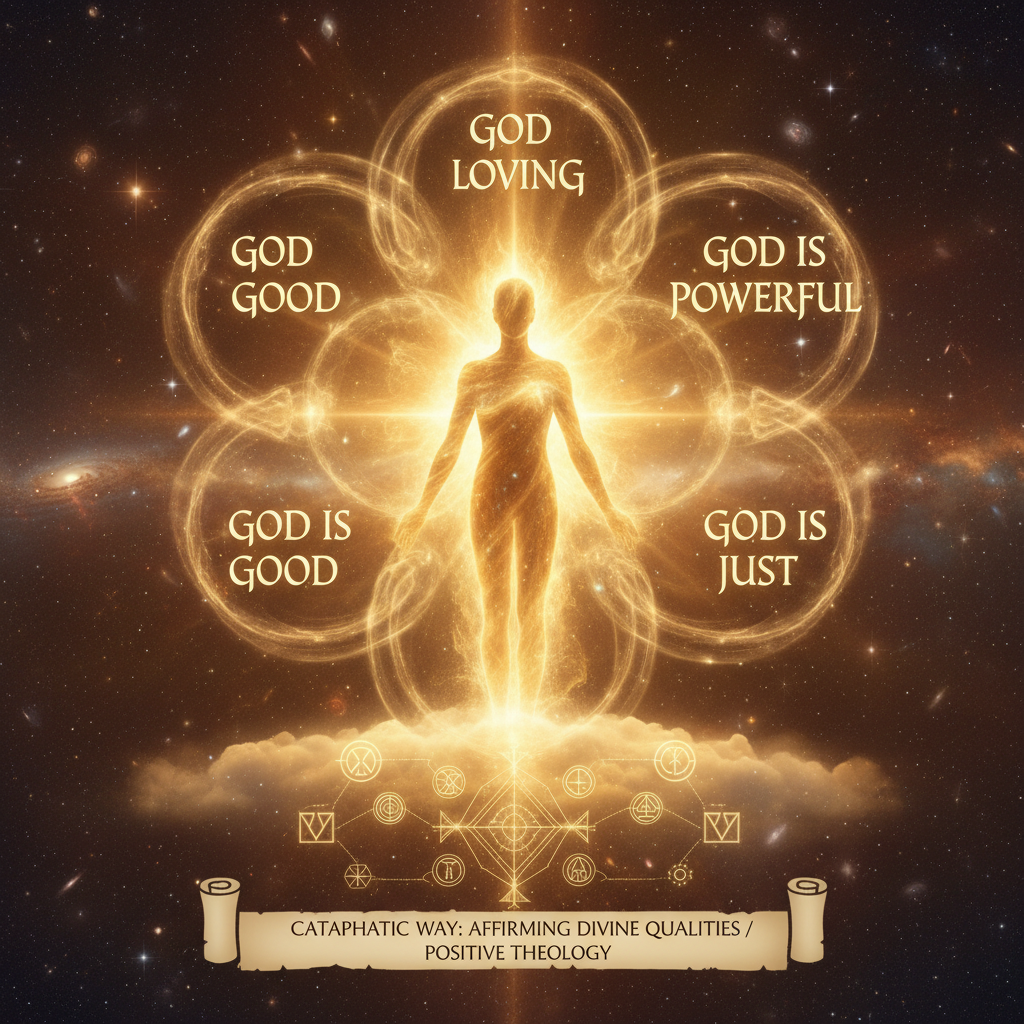
The Cataphatic Way (from Greek kataphasis = "to affirm") or Via Positiva (Latin = "positive way") argues that we can meaningfully speak positively about God—we can say what God IS, not just what God is NOT. When we say "God is good," "God is loving," or "God is omnipotent," we are making genuine, meaningful claims about God's nature and attributes. Augustine, Anselm, and Aquinas supported positive language about God. However, Aquinas refined cataphatic theology by arguing we cannot use univocal language (same meaning for God and humans—"God is good" ≠ "humans are good"). Nor can we use equivocal language (completely different meanings—too meaningless). Instead, Aquinas proposed analogical language—"God is good like human love but infinitely greater". The cataphatic way appeals to believers who want a relatable, knowable God, but critics argue it risks anthropomorphizing God or creating an inadequate mental image.
Detailed Explanation
What Is the Cataphatic Way?
Definition: Cataphatic theology (also called positive theology or via positiva) is the theological approach that attempts to describe God by affirmation—by saying what God IS.
Etymology: "Cataphatic" comes from the Greek word kataphasis, meaning "to affirm" or "affirmation". "Via Positiva" is Latin for "the positive way" or "by way of affirmation".
Core Principle: Humans can make meaningful positive statements about God. God is knowable through revelation (Scripture), creation, reason, and experience. We can affirm God's attributes: omniscience, omnipotence, omnibenevolence, justice, mercy, love.
The Contrast: Cataphatic vs. Apophatic
Apophatic Way (Via Negativa):
Says only what God is not
God is completely unknowable
Uses negative statements and denials
Cataphatic Way (Via Positiva):
Says what God is
God is knowable through self-revelation
Uses positive statements and affirmations
Sources of Cataphatic Knowledge of God
Source 1: Scripture
Biblical Foundation: The Bible contains numerous positive affirmations about God:
- "God is love" (1 John 4:8)
- "God is good" (Psalm 100:5)
- "God is just/righteous" (Psalm 89:14)
- "God is merciful" (Lamentations 3:22)
- "In the beginning, God created..." (Genesis 1:1)
Cataphatic Argument: Through Scripture, God reveals Himself to humanity. These revelations are genuine, accurate, and meaningful. We can therefore make positive assertions about God's nature based on Scripture.
Source 2: Creation (Natural Theology)
The Argument from Creation:
- Psalm 19:1—"The heavens declare the glory of God; the skies proclaim the work of His hands"
- Romans 1:20—"His eternal power and divine nature are clearly seen in what has been made"
Aquinas' Five Ways: Aquinas argued that reason can observe the natural world and deduce God's existence and attributes.
From the evidence of design, order, and causality in creation, we can affirm:
- God is the First Cause (the cause of all things)
- God is Unmoved Mover (the source of all motion)
- God is Necessary Being (must exist)
- God possesses perfection and intelligence
Theological Implications: From creation, we can positively assert that God is intelligent, powerful, creative.
Source 3: The Incarnation
God's Ultimate Self-Revelation: The Incarnation—God becoming human in Jesus Christ—is the ultimate cataphatic statement. In Jesus, God is revealed and knowable in human form.
"The ultimate cataphatic expression is Jesus – God revealed and known in human form."
Implication: Through Jesus, believers can affirm positive statements about God's character: His love, justice, mercy, righteousness.
Source 4: Experience
Personal Experience of God: Believers experience God's action and presence in their lives.
Cataphatic Statements from Experience:
- "God answered my prayer"
- "I felt God's love"
- "God guided my decision"
- "I believe God wants..."
These are cataphatic affirmations grounded in personal experience.
The Problem: Univocal vs. Equivocal Language
The Standard Cataphatic Problem
Univocal Language (Same Meaning):
Definition:
When we use the same word with the same meaning for different things.
Example:
If I say "God is good" and "My friend is good," I'm using the word "good" with the same meaning in both cases.
The Problem:
This assumes God and humans are similar enough that the same concept applies equally to both. But God is transcendent and infinite, while humans are finite and limited. Therefore, univocal language fails—we cannot simply apply human terms to God and expect them to mean the same thing.
The Alternative: Equivocal Language
Equivocal Language (Different Meanings):
Definition:
When the same word has a completely different meaning when applied to different things.
Example:
When I say "God is a rock," I mean God is strong and steadfast, but a literal rock is solid stone. The word "rock" means something entirely different in each case.
The Problem:
If words have completely different meanings when applied to God vs. humans, then we don't know what the words mean when applied to God. If I don't know what "good" means when applied to God (because it means something completely different than when applied to humans), then the statement "God is good" is meaningless.
Aquinas' Solution: Analogical Language
The Problem with Standard Cataphatic Language
Aquinas' Challenge to Simple Cataphatic Theology: Aquinas rejected both univocal and equivocal approaches.
He argued:
- Univocal language fails because God and creatures are fundamentally different
- Equivocal language fails because it makes religious language meaningless
"Univocal predication is impossible between God and creatures because the cause and effect relationship is too slight to support a single meaning for what is affirmed of the two."
— Thomas Aquinas
Aquinas' Middle Ground: Analogy
Aquinas' Solution: There is a middle ground between univocal and equivocal language: analogical language.
What Is an Analogy? An analogy is a comparison between two things that are similar in some respects but different in others. We explain something difficult to understand by comparing it to something familiar and easier to understand.
Example:
"The mind is like a computer" is an analogy.
The mind and computer are similar (both process information), but different (the mind is biological, the computer is electronic).
Two Types of Analogy
1. Analogy of Attribution:
Definition: Words applied to humans are related to words applied to God because there is a causal relationship. Our qualities (love, wisdom, goodness) are reflections or effects of God's qualities.
How It Works:
- God is the cause; we are the effects
- Our love is caused by and dependent on God's love
- Our wisdom is derived from God's wisdom
Example:
When we say "God is good" and "Humans are good," the word "good" is used primarily of God and secondarily of humans.
- God's goodness is primary (original, independent)
- Humans' goodness is secondary (derived, dependent on God)
How It Works for God:
- God is the cause; we are the effects
- Our love is caused by and dependent on God's love
- Our wisdom is derived from God's wisdom
- Creation's goodness reflects God as its source
2. Analogy of Proportion:
Definition: Words are used analogously when something is related to one thing in the same proportion that something else is related to another thing.
How It Works: A : B :: C : D (A is to B as C is to D).
How It Works:
A : B :: C : D (A is to B as C is to D)
"God's knowledge is to God as human knowledge is to humans."
God knows everything completely and perfectly to God as humans know some things incompletely to humans. The relationship is the same (knower to object of knowledge), but the scope and perfection differ infinitely.
Advantages of the Cataphatic Way
Advantage 1: Preserves Meaningful Religious Language
The Problem It Solves: If we only use apophatic (negative) language, religious language becomes meaningless. How would a believer know who God is if they can only say what He isn't?
The Cataphatic Solution: Positive language makes religious statements meaningful and informative. "God is loving" tells us something real about God's nature.
Religious Believers Need This: If we can only say negative things about God, we lose the link between God and the world. Prayer and worship become difficult and almost pointless.
Advantage 2: Aligns with Scripture and Revelation
Biblical Evidence: The entire Bible is filled with positive affirmations about God. God reveals Himself through Scripture with positive descriptions.
Believers' Understanding: Christians learn about God's nature and character from biblical texts. These are positive statements about what God is.
Theological Consequence: If Scripture is God's self-revelation, then positive language about God is justified. We can meaningfully affirm what Scripture tells us about God.
Advantage 3: Supports Natural Theology
Aquinas' Defense: Aquinas argued that human reason can gain knowledge of God through observation of the natural world. From creation, we can deduce God's existence and some of His attributes.
Implication: This provides a philosophical justification for positive language about God. We're not just relying on revelation; we can know something about God through reason.
Advantage 4: Relates God to Human Experience
The Strength: Positive language about God makes God relatable and knowable. When we say "God is loving" or "God is just," we connect these attributes to human experience.
Religious Practice: Believers naturally speak about God positively in prayer, worship, and devotion. "I believe God loves me" is a cataphatic affirmation. "God answered my prayer" is a cataphatic claim.
Criticisms of the Cataphatic Way
Criticism 1: Risks Anthropomorphism
The Problem: Using human terms (love, justice, power) to describe God might make us imagine God as merely a bigger, stronger human. This is anthropomorphism—attributing human characteristics to God.
The Danger: We might create a mental image of God that is too limited, confusing God's infinite nature with finite human qualities. We risk idolatry—worshiping an inadequate image instead of the true God.
Response: Aquinas' analogical approach mitigates this problem by acknowledging that God's attributes are infinitely greater than human ones. But critics argue even analogical language can be misleading.
Criticism 2: Implies We Understand God's Nature
The Objection: Making positive statements about God seems to assume we understand God. But Pseudo-Dionysius and others argue God is completely incomprehensible. If God is incomprehensible, how can we make any positive claims with confidence?
The Problem: The cataphatic way seems to overestimate human ability to know and understand God.
Criticism 3: Aquinas' Own Rejection of Univocal Language
The Paradox: Aquinas recognized that univocal language fails—we can't just apply the same meaning to God and humans. But if univocal language fails, and all our human language is univocal, then all our religious language fails.
Analogical language is Aquinas' attempt to solve this, but critics argue it doesn't fully work.
Peter Geach's Criticism: Even analogical language assumes some shared meaning between God and humans. If God is truly transcendent, even analogical language may be inadequate.
Criticism 4: Contradiction with Apophatic Insights
The Problem: The cataphatic way seems to contradict the apophatic tradition's insistence that God is completely ineffable.
Eastern Orthodox View: Dumitru Staniloae notes that both apophatic and cataphatic approaches are limited. Even together, they don't capture God's essence.
Theological Point: We know God through cataphatic knowledge as cause (creator, sustainer). We know God through apophatic knowledge as presence (mystical union). But neither approach lets us know God in His essence.
Scholarly Perspectives
"Although we cannot say what God is, we can say what God is like. We can use analogical language about God. For example, when we say 'God is loving,' we mean that God has a quality of love that is analogous to (similar to but greater than) human love. By using analogy, we can speak meaningfully about God without claiming to fully understand God's infinite nature."
"How do you know the God you are worshipping if you can only reliably say what he isn't? For religious believers, the via negativa contradicts certain statements in holy Scripture that describe God positively. We cannot get rid of positive descriptions of God because we then lose the link between humans and the world, making worship too difficult and almost pointless."
Key Takeaways
- ✓Cataphatic way/via positiva: say what God IS, not what He isn't
- ✓God is knowable through Scripture, creation, incarnation, experience
- ✓Positive statements meaningful: 'God is good,' 'God is loving,' 'God is powerful'
- ✓Contrast with apophatic: positive affirmation vs. negative denial
- ✓Problem 1: Univocal language fails—can't apply same meaning to God and humans
- ✓Problem 2: Equivocal language fails—different meanings make language meaningless
- ✓Aquinas' solution: Analogical language—proportional similarity
- ✓Analogy of attribution: God is primary cause; human qualities are secondary effects
- ✓Analogy of proportion: God's attributes relate to God as human attributes relate to humans
- ✓Strength: Preserves meaningful religious language needed for worship
- ✓Strength: Aligns with Scripture's positive descriptions of God
- ✓Weakness: Risks anthropomorphism (imagining God as bigger human)
- ✓Weakness: Assumes we can understand God's nature