Aquinas' Fifth Way
Summary
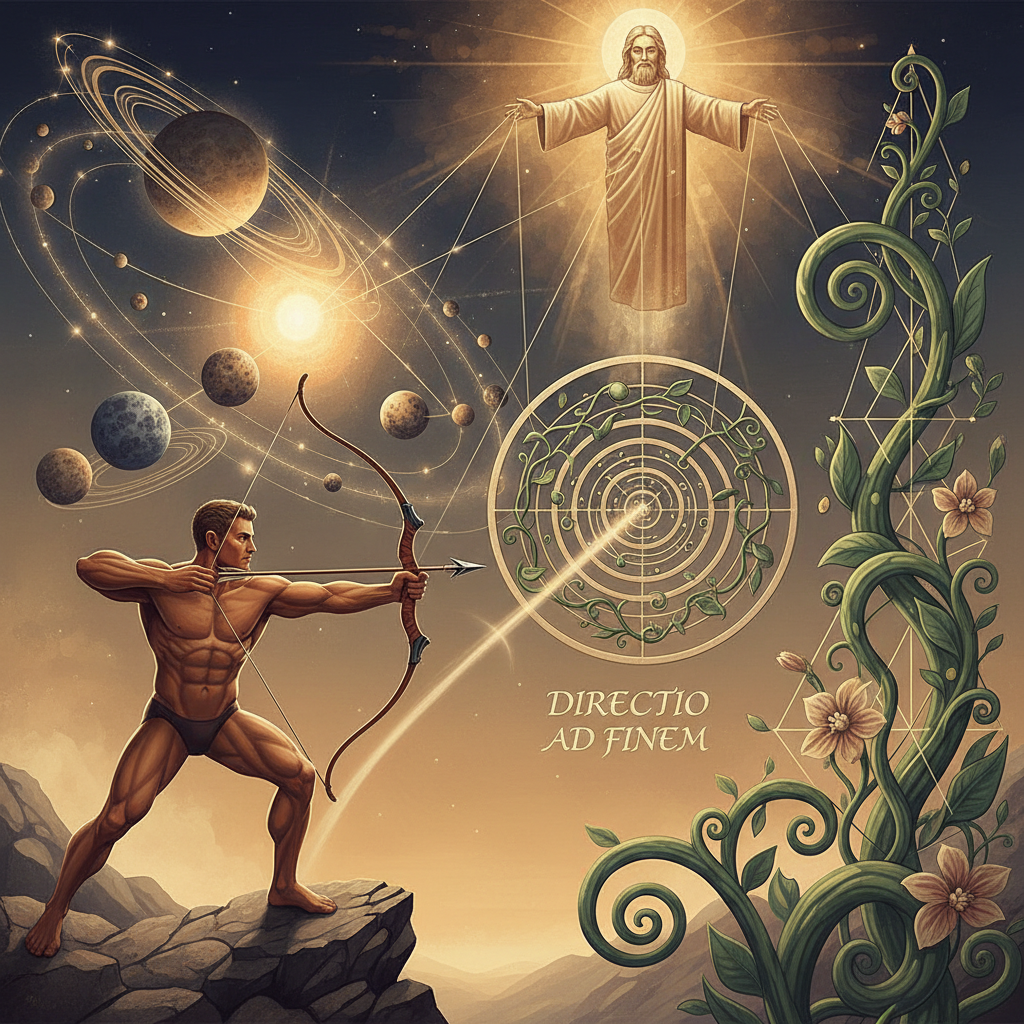
Aquinas' Fifth Way argues that God exists because we observe order and purpose in nature. Things without intelligence (like stones, plants, planets) consistently act in ordered ways to achieve specific purposes—acorns always become oak trees, not random things; the moon orbits in regular patterns. But unintelligent things can't direct themselves toward a purpose on their own.
Just like an arrow can't hit a target without an archer to direct it, natural things must be directed by an intelligent being toward their purposes. This intelligent director of all natural things is God.
Detailed Explanation
The Observation: Order and Purpose in Nature
Aquinas begins by making a simple observation: We see things in nature that lack knowledge or intelligence—natural bodies like stones, plants, celestial bodies—yet they consistently act in ordered, purposive ways.
Examples:
- Acorns: Given the right conditions, acorns always grow into oak trees. They never randomly grow into sea lions or mushrooms or pine trees. They consistently move toward the same end (becoming an oak tree)
- The moon: The moon has a regular, predictable 29.5-day cycle. It doesn't orbit randomly. It follows consistent patterns
- The sun: The sun consistently provides heat and light. It doesn't sometimes provide heat and sometimes cold
- Plants: Plants consistently grow toward the sun and draw nutrients from soil in consistent patterns
- Natural laws: Water boils at 100°C, metals expand when heated, objects fall downward—nature follows laws
Aquinas emphasizes that things act "always, or nearly always, in the same way, so as to obtain the best result". This pattern is not random or fortuitous (by chance). It is consistent, ordered, and purposive.
The Problem: How Can Unintelligent Things Be Purposive?
Here's the puzzle: these things that lack knowledge still act toward specific purposes and ends. But how can something without intelligence or knowledge achieve a goal?
An unintelligent thing has no ability to reason about purposes, no ability to plan, no ability to direct itself toward an end. Yet we observe that unintelligent natural things DO consistently move toward ends and purposes.
How is this possible?
The Solution: The Archer Analogy
Aquinas provides a famous analogy to solve this puzzle: the archer and the arrow.
An arrow, like natural bodies, is unintelligent. An arrow has no knowledge, no reasoning ability, no capacity to decide where it should go. Yet the arrow achieves its end—hitting the target—consistently and purposively.
How? Because the arrow is directed by an archer.
The archer is an intelligent being who possesses knowledge and aims. The archer directs the arrow toward its end—the target. Without the archer, the arrow would never hit the target. Without intelligence directing it, an unintelligent thing cannot achieve a purpose.
Similarly, Aquinas argues, natural unintelligent things in nature consistently achieve their purposes. Therefore, they must be directed by something intelligent.
The Logical Structure: The Syllogism
Aquinas' Fifth Way can be expressed as a logical syllogism:
Premise 1: Natural bodies, which lack intelligence, act for an end (a purpose).
Premise 2: Whatever lacks intelligence cannot move toward an end, unless it be directed by some being endowed with knowledge and intelligence.
Conclusion: Therefore, some intelligent being exists by whom all natural things are directed to their end; and this being we call God.
How This Connects to Aristotle's Teleology
Aquinas' Fifth Way is based on Aristotle's concept of the final cause—the purpose or end (telos) toward which things aim.
Remember: Aristotle said everything in nature has a telos—an end goal or purpose. An acorn's telos is to become an oak tree. An eye's telos is to see.
Aquinas takes this Aristotelian framework and asks: Who or what explains these natural purposes?
His answer: an intelligent designer—God—must direct all natural things toward their purposes. Without God directing nature's purposes, nature's apparent order and purpose would be inexplicable.
Order, Not Chance
A key part of Aquinas' argument is that this order cannot be due to chance.
If all natural things randomly pursued different purposes without order, we would see chaos. But we don't see chaos. We see consistent patterns. Acorns don't sometimes grow into oak trees and sometimes into sea lions. The moon doesn't orbit erratically.
This consistency, this order, this reliability cannot be explained by chance. It can only be explained by intelligent direction.
The Governance of the World
Aquinas titles his Fifth Way: "The governance of the world".
The idea is that the world is not just a jumble of random particles. The world is governed—ordered, directed, guided—toward purposes. This governance requires a governor—an intelligent being who directs all things.
This intelligent governor is God.
Important: This Is Not About Consciousness in Nature
An important clarification: Aquinas is NOT saying that natural things are conscious or aware of their purposes.
The acorn doesn't think to itself, "I should become an oak tree". The moon doesn't consciously choose its orbit.
Rather, these things are directed toward their purposes—they have purposes built into their nature by an intelligent designer. The purposes are "programmed in," so to speak, by God.
The Argument Is Not About First Cause
Unlike Aquinas' First Way (which argues God is the first mover), the Fifth Way is not primarily about what caused the universe to exist. It's about the order and direction of purposes within the universe.
Even if the universe has always existed, Aquinas argues, it would still need something to explain its order and purposive direction. That explanation is God.
This is why the Fifth Way is called a teleological argument—it focuses on telos (purposes, ends), not just on causation of existence.
Why This Matters: The Fifth Way vs. Other Ways
The Fifth Way is distinctive among Aquinas' five proofs:
- The First Four Ways are cosmological arguments—they argue from the existence and causation of the universe.
- The Fifth Way is a teleological argument—it argues from the order, design, and purpose in the universe.
Importantly, Aquinas himself suggested that the Fifth Way offers better support for the Christian God than the cosmological arguments do.
Why? Because the Christian God is typically portrayed as a personal, caring, purposeful being who creates with intention and direction. The Fifth Way, by focusing on order and purpose and intelligent direction, better captures this understanding of God than arguments that just focus on causation and existence.
Criticisms and Challenges
The Fifth Way has faced several major criticisms:
1. Design Appearances May Be Illusory
Maybe natural things only appear to have order and purpose, but this is due to our pattern-seeking nature, not actual design in nature. Humans are prone to seeing patterns and design where none exists.
2. Evolution Without Design
Darwin's theory of evolution explains how biological complexity and apparent design arise through natural selection—without needing an intelligent designer. Random mutations combined with selection pressure produce complex, well-adapted organisms, making the design argument seemingly unnecessary.
3. "Laws of Nature" Don't Require a Designer
Natural laws might just be the way the universe happens to work, not evidence of intelligent direction. Physics explains the regularities in nature without appealing to an intelligent designer.
4. Why Does God's Design Produce Suffering?
If God intelligently designed nature, why does it contain so much suffering, disease, predation, and waste?
5. The Complexity Problem
Even if design in the world suggests a designer, does it suggest an infinite, perfect God, or just a very skilled but finite designer?
How the Argument Remains Relevant
Despite these criticisms, the Fifth Way remains influential:
- It clearly and simply explains the intuition many people have that the universe seems designed
- Recent discoveries about fine-tuning in physics and cosmology have revived interest in design arguments
- The argument resonates with religious believers who see God's hand in the order of creation
- It provides a way to argue for God's existence using reason and observation rather than faith alone
Scholarly Perspectives
"The fifth way is taken from the governance of the world. We see that things which lack intelligence, such as natural bodies, act for an end, and this is evident from their acting always, or nearly always, in the same way, so as to obtain the best result. Hence it is plain that they achieve their end, not fortuitously, but designedly. Now whatever lacks knowledge cannot move towards an end, unless it be directed by some being endowed with knowledge and intelligence; as the arrow is directed by the archer. Therefore some intelligent being exists by whom all natural things are directed to their end; and this being we call God."
"Aquinas' argument from design is qua regularity—he sees the overall order in the world as proof of a designer: 'this being we call God.' Aquinas stated that everything works together to achieve order, despite the fact that inanimate objects have no mind or rational powers to achieve this."
Key Takeaways
- ✓The Fifth Way argues from observation of order and purpose in nature to the existence of God
- ✓Natural things without intelligence consistently act toward specific purposes—acorns become oak trees, moons orbit regularly
- ✓Unintelligent things cannot achieve purposes on their own—they need direction from an intelligent being
- ✓The archer analogy: just as an arrow needs an archer to reach its target, natural things need God to reach their purposes
- ✓This order cannot be due to chance—the consistency and reliability of nature requires intelligent explanation
- ✓It's based on Aristotle's teleology—the idea that everything has a telos (end/purpose)
- ✓The argument is a posteriori—it begins with observations of the world, not abstract reasoning
- ✓It's teleological, not just cosmological—it focuses on purposes and design, not just on causation of existence
- ✓Aquinas called this 'the governance of the world'—the idea that the world is directed toward purposes
- ✓Major criticisms include evolution, natural laws, and the problem of suffering—these explain order and design without needing God
- ✓The Fifth Way remains influential despite criticisms, especially among theists who see God's design in nature
- ✓It's one of the most understandable arguments for God's existence because it appeals to intuitive observations about nature