On This Page
Aristotle's Prime Mover
Summary
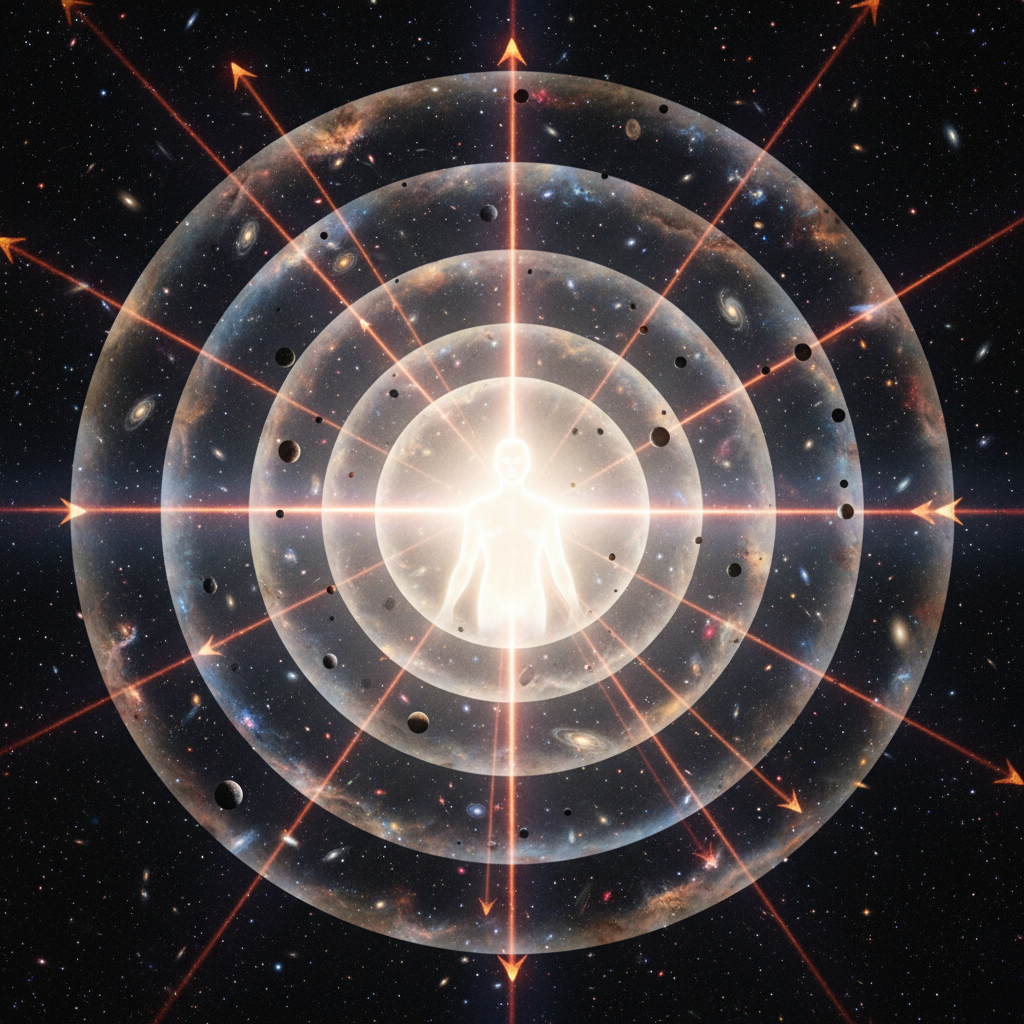
Aristotle argued that all motion and change in the universe must have an ultimate source: an "Unmoved Mover" or "Prime Mover" that causes everything else to move but is itself unchanging. This Prime Mover doesn't push or pull things physically. Instead, it moves the universe through attraction—everything is drawn toward it like a magnet. The Prime Mover is pure thought thinking about itself, completely perfect, eternal, and immaterial. It became a foundational concept for later philosophical arguments for God's existence.
Detailed Explanation
The Problem: Motion Requires an Explanation
Aristotle observed that everything in the universe is in motion or undergoing change. But nothing moves itself—every motion requires a mover. A ball doesn't roll unless someone kicks it. Water doesn't boil unless heat is applied. This leads to a question: what started all the motion in the universe?
The Infinite Regress Problem
You might think: "Thing A moved Thing B, which was moved by Thing C, which was moved by Thing D..." But this chain can't go on forever. An infinite series of movers doesn't actually explain anything—it's like saying "the universe has always been moving" without explaining WHY it moves at all. Aristotle argued there must be a FIRST mover that isn't moved by anything else.
Six Characteristics of the Prime Mover
- Immovable/Unchanging: If the Prime Mover changed, something else would have to cause that change. So it must be completely unchanging and eternal.
- Immaterial: Material things are subject to change and decay. The Prime Mover has no body or physical parts—it's pure form.
- Perfect and Complete: It lacks nothing and has no unfulfilled potential. It is pure actuality.
- Eternal: It has always existed and will always exist. Time doesn't apply to it.
- Purely Actual (No Potentiality): Everything else has potential to change, but the Prime Mover is already everything it can be.
- Thought Thinking Itself: Its activity is pure contemplation—it thinks about thinking. This is the highest form of existence.
How Does It Cause Motion Without Moving?
This is the trickiest part. The Prime Mover doesn't push or shove things around. Instead, it causes motion through final causation—it attracts things toward itself like a magnet or like how a beloved person draws others to them. Think of it this way:
- A beautiful painting doesn't physically move you, but it "moves" you emotionally by its beauty
- An ideal inspires people to action without physically pushing them
- Similarly, the Prime Mover is the ultimate object of desire and perfection. Everything in the universe "desires" or "strives" toward it, which causes all motion and change
The Prime Mover's Inner Life
The Prime Mover doesn't think about the universe (that would mean it's affected by external things). Instead, it thinks only about itself—pure thought contemplating pure thought. This might sound selfish, but for Aristotle, this is the highest and most perfect activity. It's completely self-sufficient and needs nothing outside itself.
The Prime Mover and Celestial Spheres
In Aristotle's astronomy, the Prime Mover causes the outermost celestial sphere to rotate, and this rotation is transmitted down through nested spheres that carry the stars and planets. This explained (for ancient Greeks) why the heavens move in circular patterns. We now know this astronomy is wrong, but the philosophical argument remains influential.
Comparison with the Christian God
| Characteristic | Prime Mover | Christian God |
|---|---|---|
| Eternal | Yes | Yes |
| Unchanging | Yes | Yes |
| Perfect | Yes | Yes |
| Creator of universe | No (universe is eternal) | Yes (created from nothing) |
| Personal/loving | No | Yes |
| Aware of humans | No | Yes |
| Answers prayers | No | Yes |
| Providential care | No (unaware of creation) | Yes (actively involved) |
Why Modern Physics Rejects the Prime Mover
Newton's laws of motion showed that objects in motion stay in motion unless acted upon by a force—no eternal mover is needed to keep things going. Modern cosmology explores the origin of motion through the Big Bang and quantum mechanics, not through a metaphysical First Mover.
Why It Still Matters for Philosophy of Religion
- It introduced the concept of a necessary being that explains all contingent (dependent) existence
- Medieval thinkers like Aquinas adapted it into arguments for God's existence
- It raises deep questions about whether the universe needs an ultimate explanation
- It explores the nature of perfection, eternity, and what a divine being might be like
Scholarly Perspectives
"The unmoved mover is the logical result of the application of the final cause to the whole universe. It is a mover that is pure actuality and moves by being an object of love. This latter is truly the highest cause. It is the first substance."
Author: Edward C. Halper (Professor of Philosophy, University of Georgia)
Source: Aristotle's Metaphysics: A Reader's Guide
Publisher: Continuum Press
Year: 2005
Why this works for A-level:
This quote brilliantly synthesizes Aristotle's entire metaphysical system by showing how the Prime Mover serves as the ultimate final cause of the universe. The phrase "pure actuality" captures the essential nature of the Prime Mover—it lacks all potentiality and cannot change. Crucially, Halper emphasizes that the Prime Mover moves "as an object of love," showing that it operates as a final cause, not an efficient cause—it doesn't push or act upon things but rather draws the universe toward itself through aspiration. This is a sophisticated distinction that demonstrates why the Prime Mover doesn't contradict Aristotle's principle that something unmoved cannot itself be moved.
"If something is moved it is capable of being otherwise than as it is. Therefore if its actuality is the primary form of spatial motion, then in so far as it is subject to change, in this respect it is capable of being otherwise, in place, even if not in substance. But since there is something which moves while itself unmoved, existing actually, this can in no way be otherwise than as it is…The first mover, then, exists of necessity; and in so far as it exists by necessity, its mode of being is good, and it is in this sense a first principle."
Author: Aristotle (through translator W.D. Ross)
Source: Metaphysics Book XII, Part 7
Translation: W.D. Ross Standard English Translation
Original Composition: Fourth century BCE
Why this works for A-level:
This is Aristotle's own voice articulating the core logic of the unmoved mover argument. The passage demonstrates his rigorous reasoning: anything that moves is capable of change, but the first mover must be unchangeable to avoid an infinite regress. The phrase "exists of necessity" shows that the Prime Mover is not contingent—it cannot fail to exist. The claim that "its mode of being is good" connects Aristotle's physics to his ethics and metaphysics, showing that the ultimate source of motion is also the ultimate source of value. This is essential primary source material that allows students to engage directly with Aristotle's original argument.
Key Takeaways
- ✓The Prime Mover is Aristotle's solution to the problem of what ultimately causes all motion and change in the universe
- ✓It must be immovable, immaterial, eternal, perfect, and purely actual (no potential for change)
- ✓It causes motion through final causation (attraction/desire), not efficient causation (pushing/pulling)
- ✓The Prime Mover's activity is pure thought contemplating itself—the highest form of existence
- ✓It's NOT the same as the Christian God (it's impersonal, unaware of humans, didn't create the universe)
- ✓Modern physics rejects the need for a Prime Mover, but the philosophical argument remains influential
- ✓Medieval philosophers adapted the Prime Mover concept into arguments for God's existence
- ✓This is a complex and abstract concept—don't worry if it takes time to fully grasp it!
- ✓Focus on understanding WHY Aristotle thought an unmoved mover was necessary, not just WHAT it is
- ✓Consider both the strengths (explains ultimate cause of motion) and weaknesses (assumes motion needs continuous cause) of the argument