On This Page
Aristotle's Four Causes
Summary
Aristotle believed that to truly understand anything, you need to answer four questions: What is it made of? What is its form or design? What brought it into being? And what is its purpose? These are called the Four Causes: Material, Formal, Efficient, and Final. The Final Cause (purpose) is the most important because it explains why something exists in the first place. This framework became crucial for philosophical arguments about God as the ultimate Final Cause.
Detailed Explanation
The Four Causes Explained
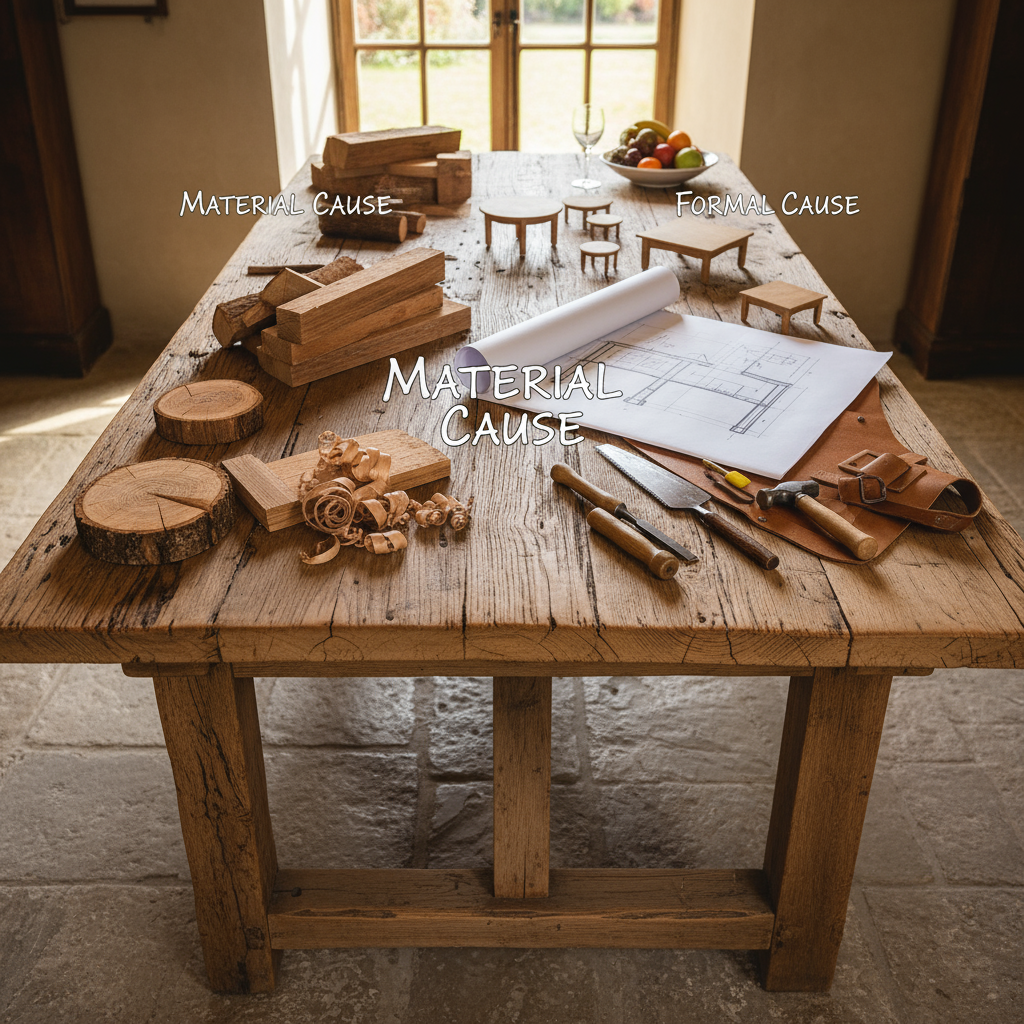
Let's use a wooden table as an example:
1. Material Cause (Hyle)
What is it made of?
The substance or matter that composes the thing. For a table: wood. For a statue: marble or bronze. For a human: flesh, blood, bones.
2. Formal Cause (Eidos)
What is its form, pattern, or structure?
The design, blueprint, or essential characteristics. For a table: the specific shape and design that makes it a table (flat surface, legs, etc.). The formal cause is what makes a thing the kind of thing it is.
3. Efficient Cause (Kinesis)
What brought it into existence?
The agent or process that made it happen. For a table: the carpenter who built it. For a child: the parents. For motion: the force that caused it. This is closest to what modern science means by "cause."
4. Final Cause (Telos)
What is its purpose or goal?
The end, aim, or function for which it exists. For a table: to provide a surface for eating, working, etc. For an acorn: to become an oak tree. For eyes: to see. This is the most important cause for Aristotle.
How the Four Causes Work Together
| Example | Material | Formal | Efficient | Final |
|---|---|---|---|---|
| Statue | Bronze/marble | Shape of a person | Sculptor | To honor someone |
| House | Bricks, wood | Architectural design | Builder | Shelter for living |
| Human | Flesh, bone | Human form/soul | Parents | To reason and flourish |
| Acorn | Plant matter | Seed structure | Oak tree | To become an oak tree |
Intrinsic vs Extrinsic Causes
- Intrinsic causes are internal to the thing: Material and Formal causes (the stuff and structure that make up the thing itself)
- Extrinsic causes are external: Efficient and Final causes (the maker and the purpose come from outside)
Why the Final Cause is Most Important
For Aristotle, you can't fully understand something until you know its purpose. The Final Cause explains WHY the thing exists and what it's meant to become. This is especially important for living things and natural processes, where purpose is built into their very nature.
Why Modern Science Rejected Final Causes
Modern science focuses only on Material and Efficient causes (what things are made of and what physical processes cause them). Science doesn't ask "why" in terms of purpose—just "how" in terms of mechanism. This is why Aristotle's teleology fell out of favor in physics and biology after the Scientific Revolution.
Connection to Philosophy of Religion
The Four Causes became central to arguments for God's existence:
- The Design Argument uses Final Cause: The universe shows evidence of purpose and design, therefore there must be a Designer (God)
- The Cosmological Argument uses Efficient Cause: Everything that exists has a cause, so there must be a First Cause (God)
- Medieval philosophers like Thomas Aquinas built entire theological systems on Aristotle's Four Causes
Scholarly Perspectives
Christopher Shields on the Four-Cause Explanatory Schema
"The necessity condition: an explanation is adequate only if it correctly cites each of the four causes; any account which omits a cause where one is available is incomplete and so inadequate. The sufficiency condition: once an explanation has cited each of the four causes, it has left nothing out, and so is complete and adequate as an objective explanation."
Source: Christopher Shields (Professor of Philosophy, University of Notre Dame; previously Oxford University), referenced in "Aristotle's Four Causes | Definition, Examples & Analysis" (2014)
Note: Shields is also the editor of The Oxford Handbook of Aristotle and author of Aristotle (2014)
Why this works for A level:
This quote brilliantly captures the completeness and comprehensiveness of Aristotle's four-cause framework. It establishes two crucial points: (1) all four causes are necessary for adequate explanation—leaving any out renders the explanation incomplete, and (2) the four causes are sufficient—once all are identified, nothing more is needed. This shows sophisticated understanding of why Aristotle insisted on four distinct types of causes rather than reducing them to one or two, distinguishing him from his predecessors who "lacked a complete understanding of the range of possible causes and their systematic interrelations".
Andrea Falcon on the Four Causes and Scientific Investigation
"Aristotle developed a theory of causality which is commonly known as the doctrine of the four causes. For Aristotle, a firm grasp of what a cause is, and how many kinds of causes there are, is essential for a successful investigation of the world around us... Aristotle's considered view is that there are four primary and irreducible kinds of causes: material, formal, efficient, and final cause."
Source: Andrea Falcon (Professor of Philosophy, Concordia University, Montreal), "Aristotle on Causality" in the Stanford Encyclopedia of Philosophy
First Published: January 11, 2006 | Substantive Revision: March 7, 2023
Why this works for A level:
Falcon emphasizes that understanding causality is not just an abstract philosophical exercise but is "essential for a successful investigation of the world around us." This connects Aristotle's metaphysics directly to his scientific method and natural philosophy. The key term "irreducible" is important: none of the four causes can be collapsed into the others or explained away—each represents a fundamentally different type of explanation. This challenges students to think about why modern science's focus on only material and efficient causes might be incomplete from an Aristotelian perspective.
Key Takeaways
- ✓Aristotle identified four types of causes: Material (what it's made of), Formal (its structure), Efficient (what made it), and Final (its purpose)
- ✓The Final Cause (purpose/telos) is the most important for understanding why something exists
- ✓All four causes work together to give a complete explanation of anything
- ✓Modern science rejected Final Causes and focuses only on Material and Efficient causes
- ✓The Four Causes framework was crucial for medieval arguments for God's existence
- ✓Understanding purpose (teleology) is essential for Aristotle's entire philosophical system
- ✓This is complex stuff—take your time with it and use examples to help you understand