On This Page
Aristotle's Use of Teleology
Summary
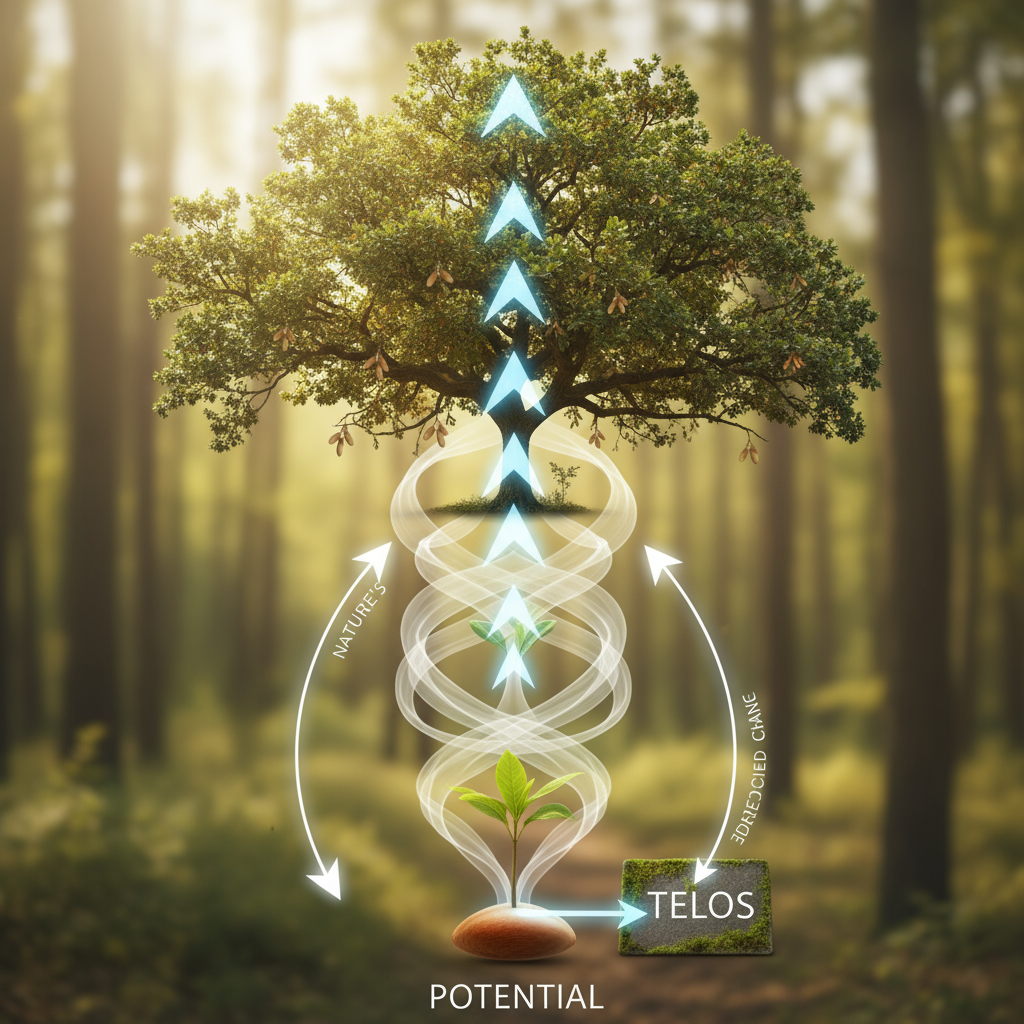
Teleology means that everything in nature has a purpose or goal (called a "telos"). An acorn's purpose is to become a tree. An eye's purpose is to see. Aristotle believed you can understand anything by understanding what it's meant to become or what it's meant to do. This is why Aristotle rejected Plato's theory—Aristotle said we CAN learn truth from nature by observing it and understanding its purposes, rather than looking for abstract Forms in another realm.
Detailed Explanation
What is Teleology?
Teleology is the study of purposes or goals. The word comes from the Greek "telos" meaning "end" or "purpose." Aristotle believed that everything in nature has a built-in purpose or goal that it naturally strives toward. Understanding this purpose is essential to understanding what something is.
Examples of Natural Purposes (Telos)
- An acorn's telos: To grow into an oak tree
- An eye's telos: To see
- A knife's telos: To cut
- A human's telos: To use reason and live virtuously (eudaimonia - flourishing)
- Fire's telos: To rise upward (in ancient physics)
Potentiality and Actuality
Central to Aristotle's teleology are the concepts of potentiality and actuality:
- Potentiality (dynamis): What something CAN become. An acorn has the potential to become an oak tree.
- Actuality (energeia/entelechy): What something IS right now, or what it becomes when it fulfills its purpose. An oak tree is the actualization of an acorn's potential.
Change and motion happen when things move from potentiality to actuality—when they fulfill their natural purpose.
The Four Causes and Teleology
Teleology is most clearly seen in Aristotle's concept of the Final Cause (one of his Four Causes). The Final Cause is the purpose or goal for which something exists. For Aristotle, the Final Cause is the most important cause because it explains WHY something is the way it is.
Aristotle vs Plato: A Different Approach
| Aspect | Plato | Aristotle |
|---|---|---|
| Where is truth? | In a separate realm of Forms | In the natural world itself |
| How do we learn? | Through reason, not senses | Through observation and reason together |
| What makes things real? | Participation in perfect Forms | Having a purpose/telos |
| Value of physical world | Imperfect, less real | Real and worthy of study |
| Method | Abstract philosophy | Empirical observation + logic |
Nature Acts for an End
Aristotle observed that natural processes are regular and predictable. Acorns always grow into oak trees, never pine trees. Eyes always develop the capacity to see. This regularity suggests that nature is goal-directed—things have built-in purposes that guide their development. This isn't conscious choice (acorns don't "decide" to become trees), but rather inherent natural tendencies.
Why Modern Science Rejected Teleology
The Scientific Revolution (16th-17th centuries) largely abandoned Aristotelian teleology because:
- Modern physics explains motion through mechanical causes, not purposes
- Evolution explains biological "purposes" through natural selection, not inherent goals
- Asking "why" (purpose) became less important than asking "how" (mechanism)
- Teleology seemed to attribute intention to non-conscious nature
Why Teleology Still Matters for Philosophy of Religion
- The Design Argument for God's existence relies on the idea that the universe shows evidence of purpose and design
- Questions about human purpose and meaning are fundamentally teleological
- Natural Law ethics (used in Catholic moral theology) depends on Aristotelian teleology
- Debates about whether the universe has a purpose remain philosophically important
Scholarly Perspectives
"Aristotle completes his theory of causality by arguing for the explanatory priority of the final cause over the efficient cause. Aristotle argues that there is no other way to explain natural generation than by reference to what lies at the end of the process. This has explanatory priority over the principle that is responsible for initiating the process of generation."
Source: Andrés Felipe Stein, "Aristotle on Causality" in the Stanford Encyclopedia of Philosophy
First Published: January 11, 2006
Substantive Revision: March 7, 2023
Why this works for A level:
This quote directly establishes the centrality of Aristotle's teleology by showing that the final cause (telos) takes explanatory priority over all other causes. It demonstrates that teleology is not merely one aspect of Aristotle's philosophy but foundational to his entire causal theory. The quote is ideal for A level essays as it shows sophisticated understanding of why Aristotle privileges purpose and end-goals in explaining natural phenomena. This is crucial for distinguishing Aristotle from mechanistic worldviews.
"Telos means 'completion, fulfillment, reaching the end'... Aristotle uses telos in the sense that every natural being carries its principle of existence within its own nature... The telos of humans is precisely to express these capacities [for thinking, understanding, and making ethical and aesthetic judgments]."
Source: Sercan Bozdoğan, "The Nature of 'the Best Constitutional Regime' and Virtuous Friendship in Aristotle's Politics"
Journal: Nature (Academic publication)
Year: 2024
Why this works for A level:
This quote illustrates how Aristotle's teleology extends beyond natural processes to human nature itself, showing that every entity has an intrinsic purpose or end that defines its essence and flourishing. This is vital for understanding that Aristotle's teleology is not merely mechanical cause-and-effect but involves purposiveness intrinsic to nature. The quote connects teleology to Aristotle's ethics—that humans have a specific telos related to our rational capacities, which grounds his virtue ethics.
Key Takeaways
- ✓Teleology is the study of purposes or goals—everything in nature has a telos (purpose)
- ✓An acorn's telos is to grow into an oak tree; an eye's telos is to see; a human's telos is to use reason and flourish
- ✓Things move from potentiality (what they can be) to actuality (what they become)
- ✓Aristotle believed we can learn truth by observing nature and understanding its purposes
- ✓This directly challenged Plato—Aristotle said the physical world IS real and worth studying
- ✓The Final Cause (purpose) is the most important of Aristotle's Four Causes
- ✓Modern science rejected teleology, preferring mechanical explanations
- ✓Teleology remains important for philosophy of religion, especially the Design Argument
- ✓Don't worry if this feels abstract—focus on understanding WHY Aristotle thought purpose was so important