On This Page
Plato's Allegory of the Cave
Summary
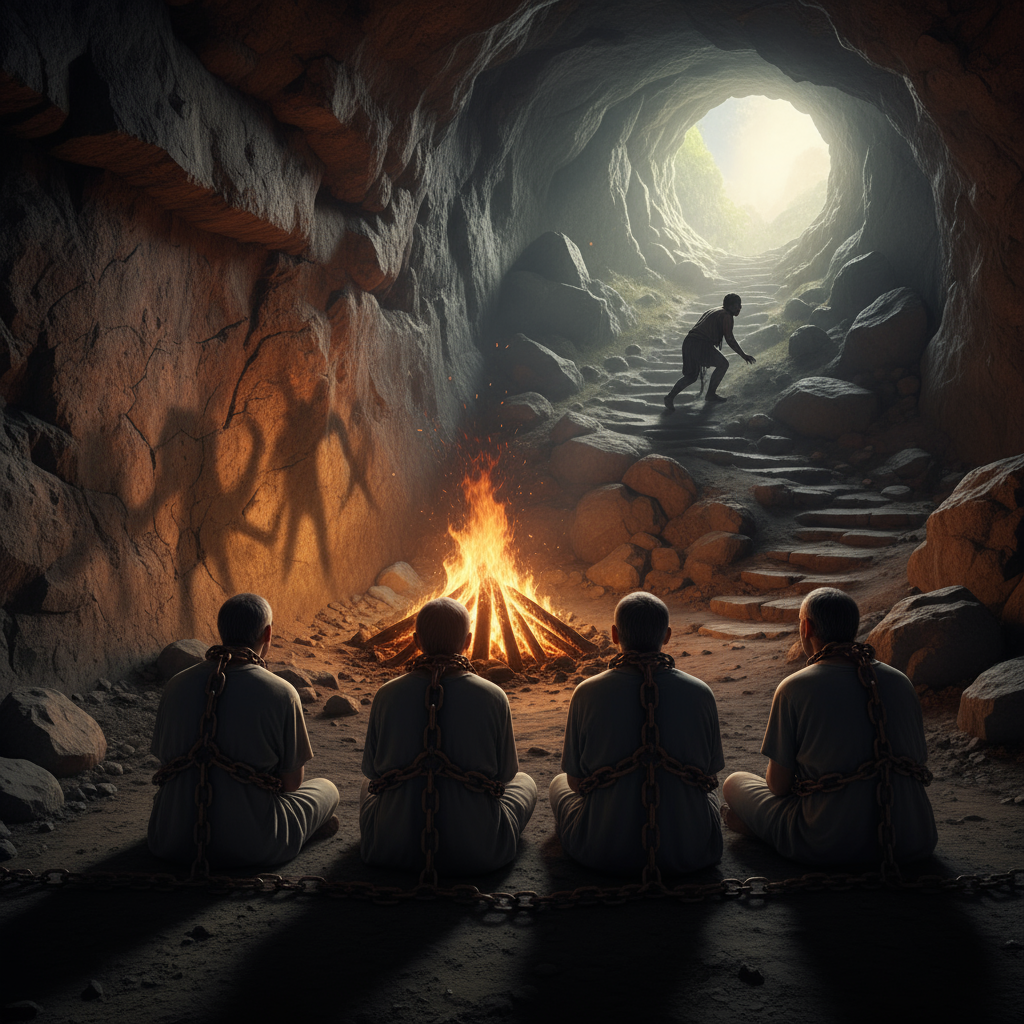
Plato tells a story about prisoners chained in a cave, watching shadows on a wall and thinking that's all that exists. One prisoner escapes and discovers the real world outside. He returns to try to free the others, but they reject him because the truth is painful and hard to accept. The allegory means: we're all trapped by illusions, the philosophical journey toward truth is difficult, and most people would rather stay comfortable than seek knowledge.
Detailed Explanation
The Story of the Cave
- The Prisoners: Imagine people chained since childhood in an underground cave. They can only look forward at a wall. They cannot turn their heads.
- The Fire and Shadows: Behind them is a fire. Between the fire and the prisoners, people walk carrying objects. The fire casts shadows of these objects on the wall.
- The Illusion: The prisoners think the shadows ARE reality. They've never seen anything else. They give names to the shadows and think they understand the world.
- The Escape: One prisoner breaks free. At first, the firelight hurts his eyes. Slowly, he climbs out of the cave. The sunlight is painful at first—he can't look directly at it.
- The Discovery: Gradually, he adjusts. He sees real trees, real animals, real people—not just shadows. He realizes the cave was a prison of illusion.
- The Return: He goes back to free the others. But his eyes are now adjusted to the light, so he stumbles in the darkness. The prisoners think he's been damaged by leaving. They refuse to believe him. They threaten to kill him if he tries to free them.
What Each Element Represents
| Element in Story | What It Represents |
|---|---|
| The Cave | The physical/visible world we experience with our senses |
| The Prisoners | Most people, who accept appearances as reality |
| The Chains | Ignorance and false beliefs that trap us |
| The Shadows | Sensory experiences and opinions (imperfect copies of truth) |
| The Fire | The physical sun (source of visible light but not ultimate truth) |
| The Escaped Prisoner | The philosopher who seeks truth |
| The Journey Out | Education and the struggle to understand truth through reason |
| The Outside World | The world of Forms (perfect, eternal truths) |
| The Sun Outside | The Form of the Good (ultimate truth and source of all knowledge) |
| The Return to Cave | The philosopher's duty to educate others |
The Four Stages of Knowledge
The allegory also represents Plato's theory of four levels of understanding:
- Imagination (Eikasia): Believing shadows/reflections are reality
- Belief (Pistis): Seeing physical objects but not understanding their true nature
- Thought (Dianoia): Using reason and mathematics to understand abstract concepts
- Knowledge (Episteme): Grasping the Forms directly through philosophical reason
Why This Matters for Philosophy of Religion
- Religious truth may be hidden: Like the sun outside the cave, God or ultimate truth might not be immediately visible in the physical world
- Spiritual enlightenment is a journey: Understanding religious truth requires effort, education, and sometimes pain (like the prisoner's eyes hurting in the light)
- Most people resist spiritual truth: Just as the prisoners rejected the escaped one, society often rejects prophets and philosophers who challenge comfortable illusions
- There's a duty to enlighten others: Those who discover truth have a responsibility to help others, even if it's difficult or dangerous
Scholarly Perspectives
"The prisoners are 'like us', says Socrates (515a). The Cave is, then, not just the degraded state of a bad society. It is the human condition."
Source: Julia Annas, An Introduction to Plato's Republic (Oxford University Press, 1981)
Author: Julia Annas (Professor of Philosophy, University of Arizona)
Why this matters for A-level:
This quote is powerful because it establishes the universal significance of the Cave allegory—it's not merely a political critique but a fundamental statement about the human condition itself. Annas is one of the most respected Plato scholars, and her interpretation emphasizes that we are all, in some sense, prisoners in the cave, mistaking shadows for reality. This provides excellent critical insight for evaluating Plato's epistemology and his view that most people live in ignorance without realizing it. The quote directly engages with Plato's text (Republic 515a) and shows sophisticated textual analysis.
"Education is not what some people declare it to be, namely, putting knowledge into souls that lack it, like putting sight into blind eyes...the power and capacity of learning exists in the soul already...education takes for granted that sight is there but that it isn't turned the right way or looking where it ought to look, and it tries to redirect it appropriately."
Source: Plato, Republic Book VII, 518b-d
Note: This passage is widely discussed in academic literature, including works by Julia Annas and other Republic scholars
Why this matters for A-level:
While this is technically Plato's own words rather than a secondary scholar's quote, it is the key passage that academic scholars universally cite when discussing the Cave allegory's meaning. It directly explains Plato's revolutionary concept of education—not as filling empty vessels but as reorienting the soul toward truth. This quote demonstrates Plato's rationalist epistemology: knowledge is already within us (recollection theory), and education means turning from the shadows (sensory world) toward the light (Forms/intelligible reality). For A-level work, you could introduce it as "As Plato explains through Socrates in the Republic..." and it demonstrates sophisticated engagement with primary sources alongside secondary scholarship.
Key Takeaways
- ✓The cave represents our everyday world of sensory experience and opinions
- ✓The shadows are illusions we mistake for reality
- ✓The journey out of the cave is education and philosophical enlightenment
- ✓The sun represents the Form of the Good—ultimate truth and knowledge
- ✓Most people prefer comfortable illusions to difficult truths
- ✓Philosophers have a duty to return and educate others, even if they're rejected
- ✓The allegory shows that knowledge is a gradual process of adjustment and growth
- ✓This story influenced Christian thought about spiritual enlightenment and salvation