On This Page
Plato's Forms: Nature and Hierarchy
Summary
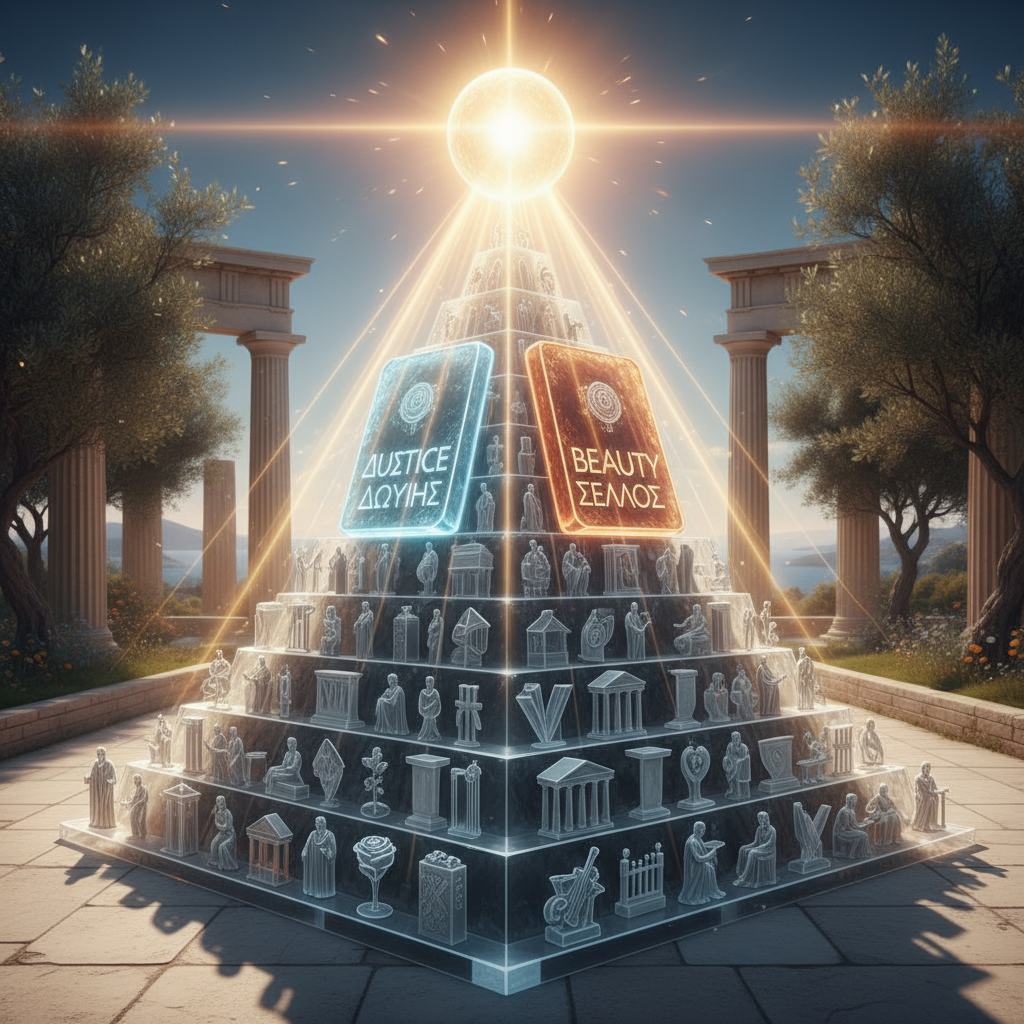
Plato believed that perfect, eternal ideas called "Forms" are the real reality, while the physical world is just an imperfect copy. These Forms are arranged in a hierarchy like a pyramid, with the Form of the Good at the very top as the most important and most real. The Form of the Good illuminates and gives meaning to all other Forms, just like the sun lights up the physical world.
Detailed Explanation
What Are the Forms?
Forms are perfect, eternal, unchanging ideas that exist in a separate realm from the physical world. For example, there is a Form of "Beauty" that is perfectly beautiful, a Form of "Justice" that is perfectly just, and a Form of "Circle" that is a perfect circle. Everything we see in the physical world is just an imperfect copy of these Forms.
Properties of the Forms
- Perfect and unchanging
- Eternal (they exist forever)
- Non-physical (they don't exist in space and time)
- Known through reason, not senses
- More real than physical objects
The Hierarchy of Forms
The Forms aren't all equal. They're arranged in a hierarchy, with some Forms being more fundamental and more real than others. This is like a pyramid:
- At the bottom are Forms of physical objects (tables, chairs, trees)
- In the middle are Forms of qualities and properties (beauty, justice, equality)
- Higher up are mathematical Forms (numbers, geometric shapes)
- At the very top is the Form of the Good
The Form of the Good
The Form of the Good is the most important Form. It's like the sun in Plato's analogy: just as the sun gives light to see physical objects, the Form of the Good gives "illumination" to understand all other Forms. It's the source of:
- Truth
- Knowledge
- Being and reality itself
- All other Forms' existence and meaning
Lower Forms Participate in Higher Forms
This means that each Form gets its meaning and reality from the Forms above it. For example, a beautiful painting participates in the Form of Beauty, which itself participates in the Form of the Good. This creates a "chain of being" where everything ultimately depends on the Form of the Good.
The Philosopher-King and Knowledge of the Forms
Plato believed that only philosophers who have trained their minds through reason can understand the Forms, especially the Form of the Good. This is why Plato argued that philosophers should rule society—they alone have access to true knowledge and can make truly just decisions.
Knowledge Through Recollection (Anamnesis)
Plato believed our souls knew the Forms before we were born. Learning is actually "remembering" what we once knew. This is why we can recognize beauty or justice even though we've never seen perfect examples—our soul remembers the Forms.
Scholarly Perspectives
Quote 1: Richard Kraut on the Nature of Forms
"The world that appears to our senses is in some way defective and filled with error, but there is a more real and perfect realm, populated by entities (called 'forms' or 'ideas') that are eternal, changeless, and in some sense paradigmatic for the structure and character of the world presented to our senses."
Source Details:
- Author: Richard Kraut
- Publication: "Plato" in the Stanford Encyclopedia of Philosophy
- Year: First published 2004; substantive revision 2022
- Publisher: Stanford University
Why this works for A level: This quote comprehensively captures the essential nature of Plato's Forms as eternal, changeless, and perfect paradigms that exist in a superior realm beyond sensory experience. It directly contrasts the "defective" sensible world with the "more real and perfect realm" of Forms, establishing both their ontological superiority and their paradigmatic function. The quote uses precise philosophical terminology ("paradigmatic," "eternal," "changeless") that demonstrates sophisticated understanding for A level assessment.
Quote 2: On the Hierarchy and the Form of the Good
"Among the most important of these abstract objects (as they are now called, because they are not located in space or time) are goodness, beauty, equality, bigness, likeness, unity, being, sameness, difference, change, and changelessness...we must investigate the form of good."
Source Details:
- Author: Richard Kraut
- Publication: "Plato" in the Stanford Encyclopedia of Philosophy
- Year: 2022 (substantive revision)
Why this works for A level: This quote establishes the hierarchical structure of Forms by identifying the most important ones and emphasizing that "we must investigate the form of good"—implying its supreme position. It demonstrates that Forms exist as non-spatial and non-temporal abstract objects, reinforcing their transcendent nature. The quote shows understanding of the Form of Good's apex position in Plato's ontological hierarchy, which is crucial for discussing how all other Forms derive their intelligibility and existence from it.
Key Takeaways
- ✓Forms are perfect, eternal ideas that are MORE real than physical objects
- ✓Forms are arranged in a hierarchy with the Form of the Good at the absolute top
- ✓The Form of the Good illuminates all other Forms just like the sun lights the physical world
- ✓Lower Forms participate in higher Forms, creating a chain of meaning and being
- ✓All knowledge comes from remembering the Forms we knew before birth
- ✓Understanding the Forms is the goal of philosophy because they reveal true reality
- ✓Don't be intimidated—this is abstract and mind-bending for everyone! Even Plato himself had doubts about parts of the theory