Plato's Reliance on Reason as Opposed to the Senses
Summary
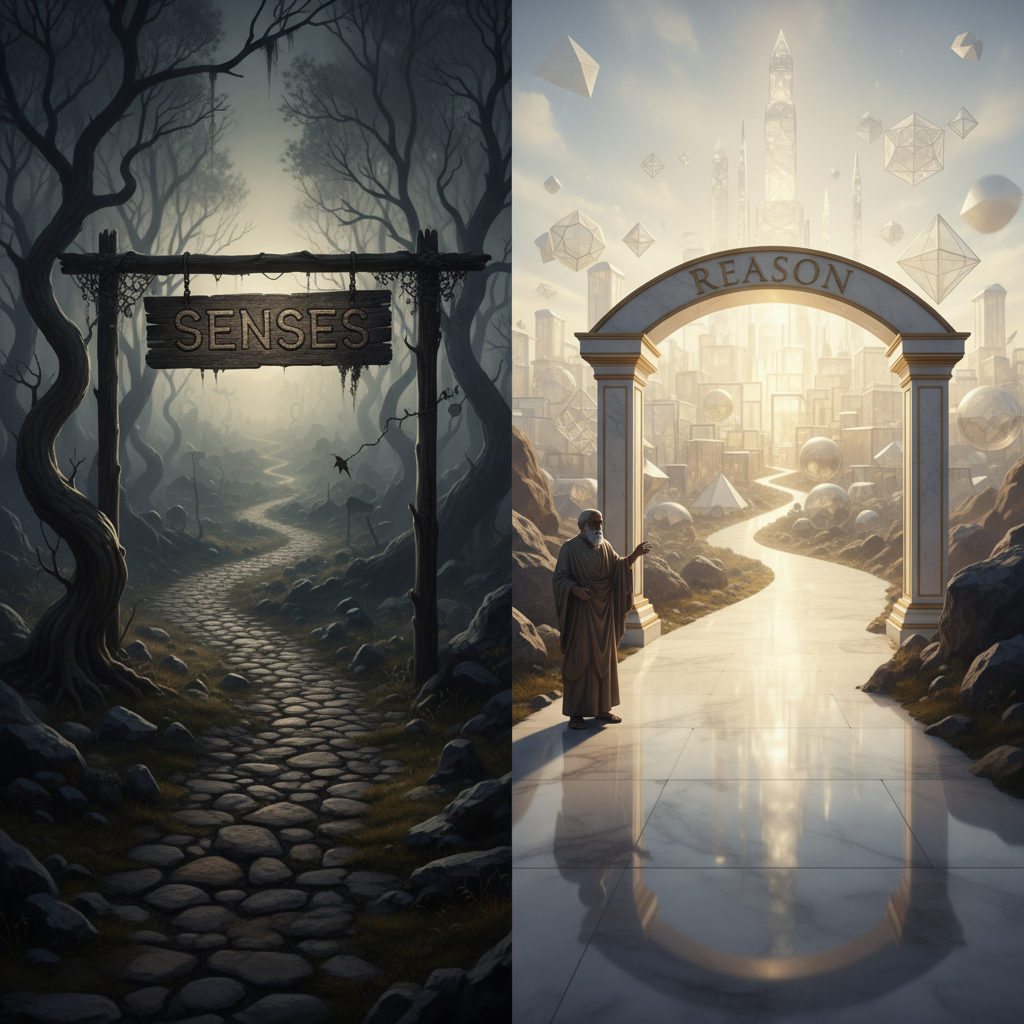
Plato believed that what we see and feel with our senses is not the real truth—it's like looking at shadows and thinking they're real. Real truth can only be found by using our minds to think deeply and reason about ideas. Our senses show us a broken, changing, imperfect world, but through reason we can understand perfect, eternal truths.
Detailed Explanation
The Problem with the Senses
Plato argued that our senses (sight, hearing, touch, taste, smell) are unreliable guides to truth because:
- They show us a world that is always changing and temporary
- They can be deceived (optical illusions, mirages, dreams)
- They only give us appearances, not reality
- Different people experience the same thing differently (subjective)
The Allegory of the Cave
Plato used this famous story to illustrate his point: Imagine prisoners chained in a cave since birth, facing a wall. Behind them is a fire, and people walk past carrying objects that cast shadows on the wall. The prisoners think the shadows ARE reality because that's all they've ever seen. But if one prisoner escapes and sees the real world outside, they realize the shadows were just illusions. The journey from the cave to sunlight represents the journey from sensory illusion to rational understanding of truth.
The World of Forms
Plato believed there are two realms:
- The Visible World: The physical world we experience with our senses (imperfect, changing, temporary)
- The World of Forms: A realm of perfect, eternal, unchanging ideas/concepts that can only be accessed through reason
Examples of Forms
- Physical circles are always slightly imperfect, but there exists a perfect Form of "Circle" that we understand through mathematics
- We see many beautiful things, but there is a Form of "Beauty" itself that makes all beautiful things beautiful
- We see just actions, but there is a Form of "Justice" that is perfect and eternal, which we can grasp through philosophical reasoning
Reason as the Path to Truth
According to Plato, we access the Forms through:
- Rational thought and philosophical inquiry
- Mathematics and logic (these deal with perfect abstract concepts)
- Dialectic (questioning and examining ideas systematically)
- Recollection (the soul "remembers" the Forms it knew before birth)
Why This Matters for Philosophy of Religion
Plato's emphasis on reason over senses has influenced religious thought for centuries. It suggests that:
- God or divine truth cannot be fully known through physical evidence alone
- Spiritual realities are more "real" than physical ones
- The soul is more important than the body
- Religious knowledge comes through contemplation and reason, not just experience
Scholarly Perspectives
"Forms are best approached not by sense perception but by pure thought alone."
"Epistêmê is of Being and doxa is of Seeming...cognitive states are individuated and defined not by a difference in justification or evidential support, but by their different object domains."
Key Takeaways
- ✓Plato believed our senses show us only shadows and illusions, not real truth
- ✓Real truth exists in a realm of perfect, eternal ideas called the Forms
- ✓We access these Forms through reason (thinking and reflection), not through seeing, hearing, or touching
- ✓This is why philosophy matters—we can use reason to explore big questions about God, justice, goodness, and meaning
- ✓Don't be frightened by this idea—it just means: think deeply, use your mind, and trust your reasoning