The Challenge of Evolution to Design Arguments
Summary
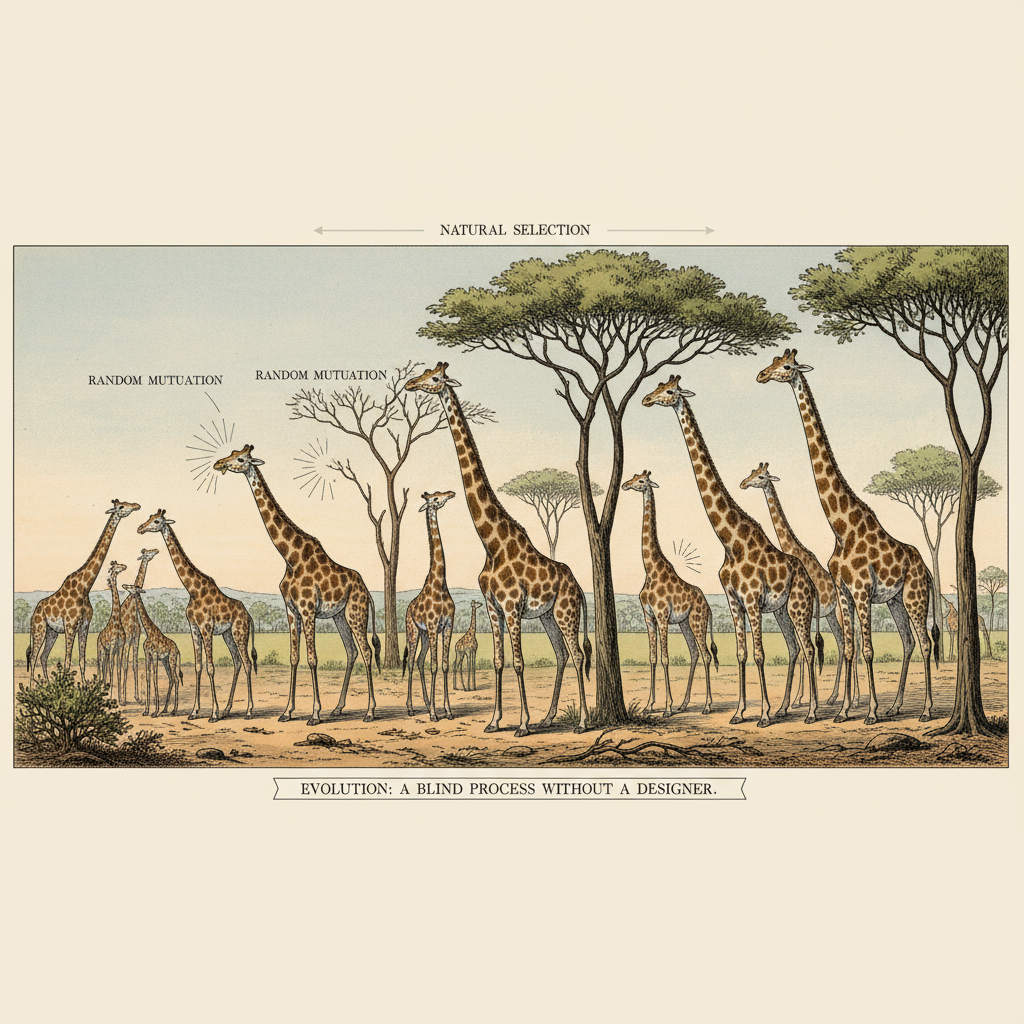
Darwin's theory of evolution by natural selection is the most powerful challenge to the design argument. Evolution explains how complexity and apparent design in living things arise through blind, unintelligent natural processes—not through an intelligent designer. Random genetic mutations create variation; individuals better adapted to their environment survive and reproduce; over millions of years, this produces complex organs like eyes without any designer directing the process. Richard Dawkins calls natural selection the "blind watchmaker"—it creates the appearance of design but is actually a mindless process. However, evolution doesn't challenge arguments about the fine-tuning of the universe's laws or constants, which is why modern design arguments focus on cosmological rather than biological design.
Detailed Explanation
Darwin's Revolution: The Discovery That Changed Everything
In 1859, Charles Darwin published On the Origin of Species by Means of Natural Selection, fundamentally changing how we understand life.
Before Darwin, the apparent design in nature—especially in living things like eyes, wings, and hearts—seemed to require an intelligent designer.
William Paley had argued just 57 years earlier (1802) that the complexity and purpose of biological organs proved God's existence, just as a watch proves a watchmaker.
But Darwin discovered a naturalistic mechanism that could explain apparent design without invoking an intelligent designer. This mechanism is evolution by natural selection.
How Natural Selection Works: The Core Mechanism
Evolution by natural selection operates through a simple but powerful process:
Step 1: Overproduction
Organisms produce more offspring than can possibly survive. For example, a fish might lay thousands of eggs, but only a few will survive to adulthood.
Step 2: Variation
Offspring have genetic variations—they're not identical to each other or to their parents. Some giraffes have slightly longer necks, some slightly shorter. Some finches have slightly larger beaks, some slightly smaller. These variations arise through random genetic mutations—changes in DNA that occur without purpose or direction.
Step 3: Competition & Struggle for Existence
More organisms are born than the environment can support, so there's a "struggle for existence"—competition for limited resources (food, mates, territory).
Step 4: Differential Survival (Natural Selection)
Organisms with advantageous traits are more likely to survive and reproduce. Organisms with disadvantageous traits are more likely to die before reproducing. Example: In an environment where trees are tall, giraffes with longer necks can reach more food, so they're more likely to survive and have offspring.
Step 5: Inheritance
The survivors pass their advantageous traits to their offspring through heredity. The longer-necked giraffes have longer-necked offspring.
Step 6: Accumulation Over Time
Repeat this process over hundreds of thousands or millions of generations, and small advantageous changes accumulate. Eventually, you get dramatic transformations—fish with basic light-sensitive cells evolve into fish with complex eyes; land mammals evolve into whales; dinosaurs evolve into birds.
The Key Insight: Apparent Design Without a Designer
Here's Darwin's revolutionary insight: Complexity and apparent purpose can arise through blind, undirected natural processes. No intelligent designer is needed.
Natural selection acts as a "blind watchmaker"—a phrase coined by evolutionary biologist Richard Dawkins.
Dawkins writes: "Natural selection, the blind, unconscious, automatic process which Darwin discovered... has no purpose in mind. It has no mind and no mind's eye. It does not plan for the future. It has no vision, no foresight, no sight at all. If it can be said to play the role of watchmaker in nature, it is the blind watchmaker."
Why This Undermines Paley's Argument
Recall Paley's logic:
P1: Things with functional complexity (parts organized for a purpose) must be designed.
P2: Living organisms have functional complexity.
C: Therefore, living organisms must be designed.
Darwin undermines Premise 1. Evolution shows that functional complexity does NOT require a designer.
There's a third option between "random chance" and "intelligent design": cumulative natural selection.
Random mutations provide variation, but natural selection—which is non-random—preserves beneficial variations and eliminates harmful ones. Over vast stretches of time, this non-random cumulative process produces complexity without any planning, foresight, or purpose.
The Human Eye: Darwin's Own Example
Darwin himself acknowledged the challenge the eye posed to his theory. He wrote: "To suppose that the eye, with all its inimitable contrivances... could have been formed by natural selection, seems, I freely confess, absurd in the highest possible degree."
However, Darwin then explained how the eye COULD evolve through gradual steps:
- Start with light-sensitive cells (like those in simple organisms)
- Add a slight depression around those cells (improves directional sensitivity)
- Deepen the depression into a cup
- Add a transparent protective layer
- The layer thickens and curves, becoming a crude lens
- Refine the lens and add muscles to adjust focus
- Add additional structures: retina, cornea, iris, etc.
Each small step provides a slight survival advantage. Individuals with better vision are more likely to survive and reproduce. Over millions of years, this produces complex eyes.
Modern research confirms that eyes have evolved independently multiple times in different lineages, showing that natural selection reliably produces this complex organ.
The Appearance of Purpose Without Actual Purpose
Aquinas and Paley argued that natural things act toward purposes (acorns become oak trees; eyes enable seeing). Evolution explains this too:
What looks like "purpose" is actually functional adaptation. Eyes don't exist "for the purpose of" seeing in any intentional sense. Rather, organisms with better vision survived better, so eyes evolved because they were useful for survival.
The "purpose" is retrospective, not prospective. Evolution doesn't look ahead and create eyes for future seeing. Instead, random mutations that happened to improve vision were preserved because they helped organisms survive.
Dawkins: "Natural selection... does not plan for the future. It has no vision, no foresight, no sight at all."
Darwin's Own Loss of Faith
Importantly, Darwin himself recognized that evolution undermined the design argument.
Before developing his theory, Darwin had studied William Paley's Natural Theology and found the design argument convincing.
But as he formulated his theory of evolution, Darwin explicitly rejected the design argument. He wrote in a letter: "The view that each variation has been providentially arranged seems to me to make natural selection entirely superfluous, and indeed takes the whole case of the appearance of new species out of the range of science."
Darwin concluded that natural selection could explain apparent design without invoking divine purpose.
Evolution and the Problem of Evil: A Double Challenge
Evolution doesn't just undermine the design argument—it actually strengthens the problem of evil.
Darwin observed the brutality of nature:
- Predators eating prey alive
- Parasites that lay eggs inside living hosts, which are then eaten from the inside
- Mass extinctions wiping out entire species
- Countless organisms dying before reproducing
- "Survival of the fittest" involving tremendous suffering
Darwin wrote that he could not see how a benevolent God could have designed such a cruel system.
Christopher Hitchens sarcastically remarked after describing evolutionary suffering: "Some design, huh?"
Does Evolution Refute ALL Design Arguments?
No—and this is crucial. Evolution explains biological design—the complexity of living organisms. But evolution does NOT explain:
1. The Laws of Nature Themselves
Evolution operates according to laws like gravity, electromagnetism, thermodynamics. But evolution cannot explain where these laws came from or why they have the precise values they do.
2. The Fine-Tuning of Physical Constants
The universe's fundamental constants (strength of gravity, electromagnetic force, speed of light, etc.) are precisely calibrated to allow life. If these constants were slightly different, stars, planets, and life couldn't exist. This fine-tuning cannot be explained by evolution because evolution requires a universe already conducive to life.
3. The Existence of the Universe
Evolution explains how life diversified once it existed. It doesn't explain why anything exists at all. The cosmological argument remains untouched by evolution.
Modern Design Arguments Post-Darwin
After Darwin, defenders of the design argument shifted strategy:
From: Arguing for design in biological structures (eyes, wings, hearts)
To: Arguing for design in:
- The laws of nature (Richard Swinburne's "temporal order")
- Fine-tuning of physical constants
- The origin of life itself (how did the first living cell arise?)
- Irreducible complexity (Michael Behe's argument that some biochemical systems can't be explained by gradual evolution)
These arguments avoid Darwin's challenge because they point to order beyond what natural selection can explain.
F.R. Tennant's Response to Darwin
Philosopher F.R. Tennant (1866-1957) developed design arguments specifically to address evolution:
Tennant's Aesthetic Principle
How did evolution produce our sense of beauty and appreciation for art? These don't provide obvious survival advantages, yet they evolved. Tennant argued: God must have directed evolution to produce aesthetic appreciation.
Response: Our aesthetic sense might be a byproduct of traits that DO help survival (like mate attraction), or it might serve functions we don't yet understand.
Tennant's Anthropic Principle
The universe's laws and constants are precisely tuned to make evolution possible. This suggests the universe was designed for life.
This argument shifts from biological design (which evolution explains) to cosmological design (which evolution doesn't explain).
The Continuing Debate
The relationship between evolution and design arguments remains contested:
Atheists/Naturalists argue:
Evolution completely undermines design arguments. Apparent design is an illusion produced by blind natural selection.
Theistic Evolutionists argue:
Evolution is HOW God created life. God designed the laws of nature such that evolution would produce complex life.
Intelligent Design Proponents argue:
Some aspects of life (irreducible complexity, information in DNA) cannot be explained by undirected evolution and require intelligent intervention.
The debate continues in philosophy of religion and science.
Scholarly Perspectives
"Natural selection, the blind, unconscious, automatic process which Darwin discovered, and which we now know is the explanation for the existence and apparently purposeful form of all life, has no purpose in mind. It has no mind and no mind's eye. It does not plan for the future. It has no vision, no foresight, no sight at all. If it can be said to play the role of watchmaker in nature, it is the blind watchmaker."
"This preservation of favourable variations and the rejection of injurious variations, I call Natural Selection... As many more individuals of each species are born than can possibly survive... it follows that any being, if it vary however slightly in any manner profitable to itself... will have a better chance of surviving, and thus be naturally selected."
Key Takeaways
- ✓Evolution by natural selection is the most powerful challenge to the teleological (design) argument
- ✓Darwin showed that complexity and apparent purpose can arise without an intelligent designer through blind natural processes
- ✓Natural selection is a 'blind watchmaker'—it creates the appearance of design but has no foresight, no purpose, no intelligence
- ✓The process: random mutations + non-random selection + vast time = complexity
- ✓Paley's key premise fails: functional complexity does NOT require a designer
- ✓Even complex organs like eyes evolved gradually through intermediate stages
- ✓Evolution also strengthens the problem of evil—nature's brutality seems inconsistent with benevolent design
- ✓However, evolution doesn't explain everything: laws of nature, fine-tuning, existence of universe
- ✓Modern design arguments shifted from biological design to cosmological fine-tuning
- ✓Darwin himself rejected the design argument after developing his theory
- ✓The debate continues: theistic evolution, intelligent design, and naturalism offer different interpretations
- ✓Evolution doesn't touch the cosmological argument—still asks why anything exists at all