Hume's Criticisms of the Design and Cosmological Arguments
Summary
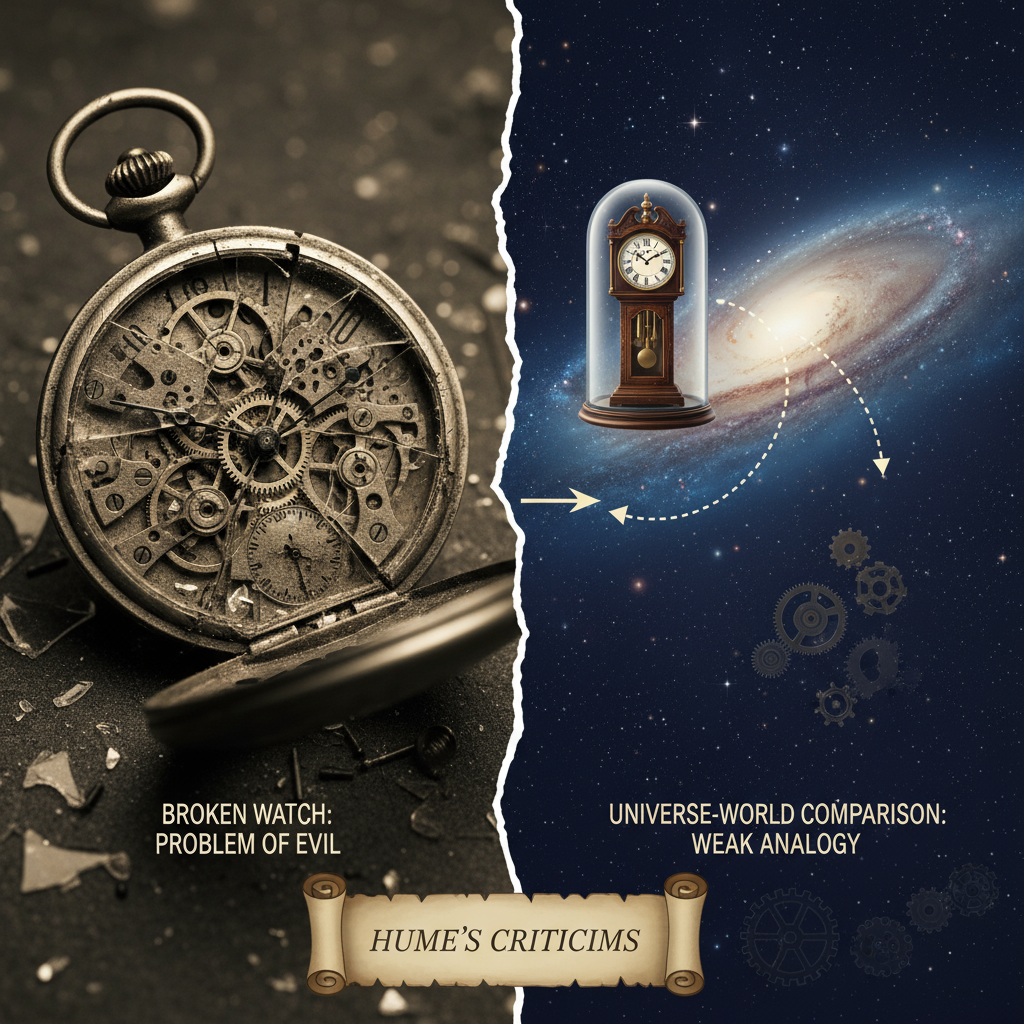
David Hume offered devastating criticisms of both design and cosmological arguments. Against the teleological argument: (1) The analogy between human artifacts and the universe is weak—the universe is organic, not mechanical; (2) Even if design exists, it could be multiple gods, a junior god, or an incompetent god; (3) The problem of evil—suffering and flaws in the universe suggest poor design or no design. Against the cosmological argument: (1) The causal principle ("everything has a cause") isn't self-evident—we can conceive of things existing without causes; (2) The fallacy of composition—just because every part has a cause doesn't mean the whole needs one; (3) Why can't the universe itself be necessary or eternal? Why does it need God?
Detailed Explanation
Who Was David Hume?
David Hume (1711-1776) was a Scottish Enlightenment philosopher and one of the most important figures in Western philosophy.
His most significant critique of arguments for God's existence appears in his Dialogues Concerning Natural Religion, written in the 1750s but published posthumously in 1779.
In the Dialogues, Hume uses three characters:
- Cleanthes – defends the design argument through analogy
- Demea – defends religious belief not grounded in evidence
- Philo – the philosophical skeptic who represents Hume's own views and critiques the arguments
Hume's criticisms remain among the most powerful challenges to these arguments.
Hume's Criticisms of the Teleological Argument
Criticism 1: The Analogy Is Weak (Disanalogy Problem)
Both Aquinas and Paley use analogical reasoning—comparing natural objects to human artifacts (arrows, watches).
But Hume argues: analogies are only strong when the two things being compared are very similar. The more different they are, the weaker the analogy becomes.
Hume's Argument:
The universe and a watch (or arrow) are vastly different:
- Watches are mechanical – made of precisely constructed metal parts working like a machine
- The universe is organic – more like a growing, living thing than a machine
Hume states: "The world resembles more an animal or a vegetable than it does a watch".
Since the universe is so unlike human artifacts, we cannot reliably infer that it has a designer just because artifacts do.
Example: Smoke from fire and smoke from dry ice look similar (similar effects), but their causes are completely different. Similarly, just because the universe and a watch both exhibit complexity doesn't mean they must have similar causes (an intelligent designer).
Response: Modern defenders like Paley argue the analogy isn't essential—the real argument is about functional complexity as an indicator of design, not about similarity to watches. Paley can be read as making a deductive or probabilistic argument rather than purely analogical: things with functional complexity are designed; nature has functional complexity; therefore nature is designed. This avoids Hume's criticism of weak analogy.
Criticism 2: Alternative Explanations (Not Necessarily the Christian God)
Even if the design argument succeeds, it doesn't prove the Christian God specifically.
Hume's Alternatives:
- Polytheism – A committee of gods designed the universe (like a house is built by a team of builders)
- A junior or apprentice god – Perhaps a less-than-perfect designer created the universe as practice
- A god who then died – The designer might no longer exist
- An embodied god – Not a transcendent spirit but a physical being
- An evil or incompetent god – Given the flaws in the universe, maybe the designer wasn't good or skilled
The Point: The design argument, even if successful, is limited. It can't establish the attributes of the Christian God: omnipotent, omnibenevolent, omniscient, eternal, immaterial.
Response: Swinburne uses Ockham's Razor: one God is simpler than multiple gods, so we should prefer that explanation. Also, defenders like Aquinas never claimed the design argument alone proves the Christian God—it's meant to support belief in some designer, which can then be supplemented by other arguments and revelation. Hume may have created a strawman—the design argument was never intended to prove everything about God.
Criticism 3: The Problem of Evil (Evidential Challenge)
If God designed the universe, why does it contain so much suffering, pain, waste, and imperfection?
Hume's Observations:
Looking at the world, we see:
- Natural evil: earthquakes, tsunamis, diseases, predation, parasitism
- Animal suffering: animals eat each other alive, suffer starvation, die painfully
- Waste and inefficiency: most organisms die before reproducing; evolution is brutal
- Poor design: the human eye has a blind spot; the birth canal is dangerously narrow
Darwin noted the viciousness of nature—digger wasps lay eggs inside living caterpillars that are eaten from the inside out when they hatch. Darwin concluded: "I cannot see evidence of design".
Hume's Logic:
If we're inferring God's attributes from observation of the world (a posteriori reasoning), then we must accept what the evidence actually shows.
The evidence shows a mix of good and bad, pleasure and pain, order and chaos. Therefore, at best, the designer is morally ambiguous—neither perfectly good nor perfectly evil. More likely, the apparent design is flawed, suggesting either an incompetent designer or no designer at all.
P1: If God is perfectly good, he would want to prevent evil.
P2: If God is omnipotent, he would be able to prevent evil.
P3: If God is omniscient, he would know how to prevent evil.
P4: But evil exists.
C: Therefore, either God is not perfectly good, not omnipotent, not omniscient, or God doesn't exist.
Response: Religious philosophers offer theodicies—explanations for why God allows evil: Free will theodicy (Plantinga), Soul-making theodicy (Hick), Punishment theodicy (Augustine). But Hume would reply: these don't explain natural evil (earthquakes, diseases, animal suffering), which humans didn't cause and which doesn't seem to serve any good purpose.
Criticism 4: The Epicurean Hypothesis (Order from Disorder)
Hume (through Philo) suggests that order could arise from disorder through purely natural processes over infinite time.
The Epicurean Hypothesis:
If particles move randomly through infinite time, eventually they will arrange themselves into ordered configurations by chance. Given enough time, even highly improbable arrangements will occur. Perhaps the universe we observe is simply one such accidental arrangement.
Implication: We don't need to invoke an intelligent designer. Random processes + infinite time = apparent order.
Response: Cleanthes (in Hume's Dialogues) rejects this as implausible—blind random processes can't produce the benevolent and complex order we observe. And modern science shows the universe isn't infinitely old—it had a beginning (Big Bang), so there hasn't been infinite time for random arrangements.
Hume's Criticisms of the Cosmological Argument
Criticism 1: The Causal Principle Is Not Self-Evident
The cosmological argument assumes the causal principle: "Everything that exists has a cause" or "Everything that begins to exist has a cause". But Hume challenges this assumption.
Hume's Argument:
The causal principle is not a necessary truth (a truth whose denial is logically contradictory). We can conceive of something coming into existence without a cause—it's not logically impossible like a "four-sided triangle".
Hume writes: "It is neither intuitively nor demonstratively certain that every object that begins to exist owes its existence to a cause".
The Test: Can you deny the causal principle without contradiction? Yes. "The universe has no cause" is conceivable—it doesn't involve a logical contradiction. Therefore, the causal principle is not analytically true (not true by definition). And since we've never observed the universe being caused, we can't establish the causal principle empirically either.
Implication: Maybe the universe just exists without a cause—a brute fact with no explanation.
Response: William Lane Craig argues that while the causal principle might not be logically necessary, it's metaphysically intuitive—deeply plausible even if not provable. The alternative—that things pop into existence from absolute nothing—seems absurd. Moreover, Aquinas doesn't claim everything needs a cause—only contingent things or things that begin to exist. God, as a necessary being, doesn't fall under the causal principle.
Criticism 2: The Fallacy of Composition
The cosmological argument seems to reason: "Every part of the universe has a cause, therefore the whole universe has a cause". But Hume argues this commits the fallacy of composition—inferring that what's true of the parts must be true of the whole.
Hume's Famous Example:
"Did I show you the particular causes of each individual in a collection of twenty particles of matter, I should think it very unreasonable, should you afterwards ask me, what was the cause of the whole twenty. This is sufficiently explained in explaining the cause of the parts".
In other words: if you explain each particle individually, you've explained the whole collection. You don't need a separate explanation for "the whole".
Application: Similarly, if every event in the universe is caused by a prior event in the universe, then we've explained the universe. We don't need to appeal to something outside the universe (God) to explain the whole.
Is This a Fallacy? Not all part-to-whole inferences are fallacious:
- Valid inference: Each brick is heavy, therefore the wall (made of bricks) is heavy
- Invalid inference: Each brick is small, therefore the wall is small
So the question is: does contingency (or needing a cause) transfer from parts to whole? Hume's point is that just because every individual event has a cause doesn't mean the infinite series as a whole needs a cause.
Response: Edward Feser argues Hume himself commits a fallacy here. Showing the immediate cause of each thing is NOT the same as providing a sufficient explanation. Example: If book A was copied from book B, which was copied from book C, which was copied from book D... extending to infinity, we still haven't explained where the information in the books came from. Each book is explained by the previous one (efficient cause), but the series as a whole lacks a sufficient explanation for its content. Similarly, even if every event in the universe is caused by a prior event, the series itself needs an explanation for why it exists rather than nothing. Aquinas is asking about sustaining causes (hierarchical dependency), not just temporal causes (sequences over time).
Criticism 3: Why Can't the Universe Be Necessary or Eternal?
If the cosmological argument requires a necessary being to explain contingent things, why can't the universe itself be that necessary being?
Hume's Challenge: "Why can't matter be eternal and necessary?". If God can exist necessarily (without needing an external cause), why can't the universe?
Hume writes: "How can anything that exists from eternity have a cause, since that relation implies a priority in time and a beginning of existence?".
Hume's Point: Theists claim God is a special exception to the causal principle—God is uncaused. But this seems like special pleading. Why not just say the universe is the exception?
Response: The universe appears contingent, not necessary: The universe is composed of contingent parts (things that might not have existed); The universe changes (necessary beings are unchanging); The universe could have been different (necessary beings couldn't be otherwise); The universe had a beginning (Big Bang)—necessary beings are eternal. Therefore, the universe doesn't have the properties of a necessary being. God, by contrast, is defined as unchanging, eternal, and existing by necessity.
Criticism 4: Infinite Regress Might Be Possible
The cosmological argument claims infinite regress is impossible—there must be a first cause. But Hume argues: Why can't there be an infinite chain of causes?
Hume's Reasoning: An infinite regress is not logically contradictory—we can conceive of it without contradiction. "Time" doesn't seem contradicted by "infinite". Just because something is difficult to imagine doesn't mean it's impossible.
Response: Aquinas would agree that a temporally infinite series (extending backward in time forever) is logically possible. But Aquinas is concerned with hierarchical dependency, not temporal sequence. In a hierarchical series (hand → stick → stone), you can't have an infinite regress because there must be a first member with independent causal power. Without the hand, the stick has no power to move the stone. Without a first cause, the whole series has no causal power.
Criticism 5: Hume's Challenge to Causation Itself
Hume's most radical challenge: we don't actually observe causal connections.
What We Observe: We see event A (lighting a match), then event B (fire appears). We see constant conjunction—A is regularly followed by B. But we never observe the necessary connection between them. We never see a "causal power" flowing from A to B.
Hume's Conclusion: Causation is just a habit of the mind—a psychological expectation, not an objective feature of reality. When we see A repeatedly followed by B, our mind forms a habit of expecting B when we see A. But this is subjective, not objective.
Implication: If causation itself is questionable, then the entire cosmological argument (which relies heavily on causation) collapses.
Response: Most philosophers reject Hume's radical skepticism about causation. Science assumes causal connections are real and discoverable. Even Hume himself acted as if causation were real in everyday life. And Hume may have been a "causal reductionist" rather than a causal skeptic—reducing causation to regular patterns (constant conjunction) rather than denying it entirely.
Scholarly Perspectives
"Did I show you the particular causes of each individual in a collection of twenty particles of matter, I should think it very unreasonable, should you afterwards ask me, what was the cause of the whole twenty. This is sufficiently explained in explaining the cause of the parts."
"Is he willing to prevent evil, but not able? then is he impotent. Is he able, but not willing? then is he malevolent. Is he both able and willing? whence then is evil?"
Key Takeaways
- ✓Hume is the most important critic of both teleological and cosmological arguments
- ✓Against design: weak analogy (universe ≠ watch), alternative explanations (polytheism, etc.), and problem of evil
- ✓The problem of evil is Hume's strongest criticism of the design argument
- ✓Evil and suffering suggest either no designer or an imperfect/malevolent designer
- ✓Against cosmological: causal principle not self-evident, fallacy of composition, universe could be necessary
- ✓Fallacy of composition: explaining each part doesn't require explaining the whole
- ✓The causal principle ('everything has a cause') is not logically necessary—we can conceive of uncaused things
- ✓Hume challenges causation itself—we don't observe necessary connections, only constant conjunction
- ✓Hume's Dialogues Concerning Natural Religion is the source of most criticisms
- ✓Philo (in the Dialogues) represents Hume's skeptical views
- ✓Modern defenders have responses to each criticism, but debates continue
- ✓Defenders argue Hume sometimes creates strawmen—the arguments weren't claiming what Hume attacks
- ✓Evolution (Darwin) later provided the strongest challenge to design arguments by explaining apparent design without a designer