Conversion Experiences
Summary
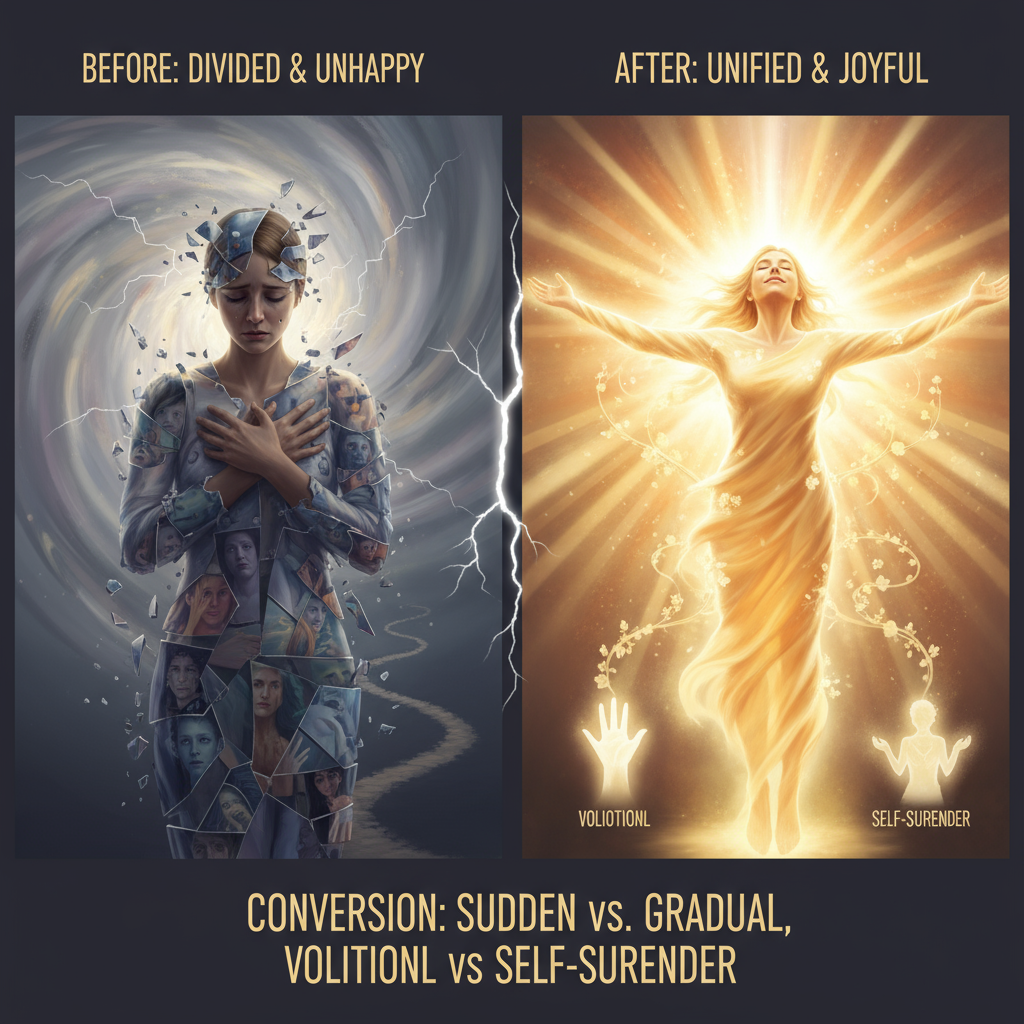
A conversion experience is a religious experience that produces a radical transformation from an old way of life to a new one based on faith. William James described conversion as the process by which "a self hitherto divided, and consciously wrong, inferior and unhappy, becomes unified and consciously right, superior and happy" through connection with religious realities. There are two types: (1) Volitional conversion—gradual, conscious choice where the person actively works toward conversion through prayer, study, and moral effort. (2) Self-surrender conversion—sudden, dramatic, passive experience where the person feels overwhelmed by divine grace and transformation happens to them. Famous examples include St. Paul's sudden conversion on the Damascus Road and John Wesley's heart-warming at Aldersgate Street.
Detailed Explanation
What Is a Conversion Experience?
A conversion experience is a transformative religious experience that radically changes someone's beliefs, values, behavior, and sense of identity.
The word "conversion" comes from the Latin convertere, meaning "to turn around" or "to turn toward". In Christian terminology, metanoia (Greek) describes this turning—a complete and fundamental change of heart, turning away from sin and toward God.
Key Features of Conversion:
- Abandoning an old way of life and adopting a new one
- Transformation from divided/unhappy self to unified/happy self
- Change in beliefs, values, moral behavior, and relationships
- New sense of purpose and direction in life
- Often life-long and enduring
William James on Conversion
William James devoted two lectures (IX and X) of his Varieties of Religious Experience to analyzing conversion.
James' Definition: "The process, gradual or sudden, by which a self hitherto divided, and consciously wrong, inferior and unhappy, becomes unified and consciously right, superior and happy, in consequence of its firmer hold upon religious realities."
Before Conversion:
- Divided self: inner conflict, contradictory desires, lack of unity
- Consciously wrong: awareness of guilt, sin, moral failure
- Inferior: feeling inadequate, incomplete, lacking
- Unhappy: depression, anxiety, existential despair
After Conversion:
- Unified: integrated personality, single purpose, coherent identity
- Consciously right: sense of being forgiven, morally aligned
- Superior: feeling complete, fulfilled, whole
- Happy: joy, peace, contentment, meaning
The Two Types of Conversion: Volitional vs. Self-Surrender
1. VOLITIONAL CONVERSION (Gradual, Active)
Definition: The person consciously chooses to convert through deliberate effort, study, and moral discipline.
Characteristics:
- Gradual process unfolding over months or years
- Active and intentional – the person takes charge of their spiritual development
- Intellectual component – involves study, reflection, reasoning about faith
- Building new habits – piece by piece constructing a new moral and spiritual life
- Voluntary and rational – a deliberate decision based on evaluation and choice
James' Description: "In the volitional type the regenerative change is usually gradual, and consists in the building up, piece by piece, of a new set of moral and spiritual habits."
Example: C.S. Lewis
C.S. Lewis, the famous Christian apologist and author, described his conversion as a "reluctant" and gradual process. For years, Lewis tried to resist Christianity intellectually. He was convinced against his will through philosophical arguments and friendships with Christians like J.R.R. Tolkien. Lewis finally surrendered intellectually and accepted Christianity. He later wrote: "I know very well when, but hardly how, the final step was taken... when we set out I did not believe that Jesus Christ is the Son of God, and when we reached the zoo I did." Lewis' conversion was gradual, intellectual, and volitional—he consciously chose to accept Christianity after long resistance.
2. SELF-SURRENDER CONVERSION (Sudden, Passive)
Definition: The person passively experiences a sudden, dramatic transformation that feels like it happens to them rather than something they do.
Characteristics:
- Sudden and dramatic – happens in a moment or brief period
- Passive – feels like being "seized" or "overwhelmed" by divine power
- Emotional intensity – often accompanied by powerful feelings (joy, terror, awe, peace)
- Sense of miracle – feels supernatural rather than natural
- Transformative – immediate and profound change in personality and behavior
- Involuntary – the person doesn't control it; it's an act of divine grace
James' Description: "The subject... feels as if he were grasped and held by a superior power" and the experience seems like "an astounding process performed upon him from above."
Example: St. Paul (Saul of Tarsus)
St. Paul's conversion on the Damascus Road (Acts 9:1-22) is the paradigmatic sudden conversion:
Before: Saul was a devout Jew who violently persecuted Christians, approving of their execution.
The Experience: While traveling to Damascus to arrest Christians, Saul was suddenly struck by a brilliant light from heaven. He fell to the ground and heard Jesus' voice: "Saul, Saul, why are you persecuting Me?" Saul was blinded for three days, during which he neither ate nor drank.
After: Saul was baptized, took the name Paul, and became Christianity's greatest missionary and theologian. He wrote much of the New Testament and eventually died a martyr for the faith he once tried to destroy.
Paul's conversion was sudden (happened in a moment), passive (he was seized by divine power), dramatic (complete reversal of beliefs and behavior), and life-long (he never wavered from his new faith).
Example: John Wesley
John Wesley (founder of Methodism) experienced conversion at Aldersgate Street, London, on May 24, 1738.
Before: Wesley was already a devout Anglican priest and missionary, but he felt he lacked true faith and assurance of salvation. He wrote: "I went to America, to convert the Indians; but oh! who shall convert me?"
The Experience: Wesley attended a Moravian meeting where someone read Luther's Preface to Romans. Wesley wrote in his journal: "About a quarter before nine, while he was describing the change which God works in the heart through faith in Christ, I felt my heart strangely warmed. I felt I did trust in Christ, Christ alone, for salvation; and an assurance was given me that He had taken away my sins, even mine, and saved me from the law of sin and death."
After: Wesley experienced profound transformation. He went on to lead the Methodist revival movement and transform Christianity in England and America.
Wesley's experience was sudden (happened in a specific moment—"a quarter before nine"), emotional ("heart strangely warmed"), passive ("assurance was given me"—not something he achieved), and transformative (gave him the assurance he had been seeking).
The Stages of Conversion
Conversion experiences typically follow a pattern or sequence of stages:
Stage 1: Dissatisfaction/Crisis
The person is unhappy with their current "system of ideas" or way of life. They experience inner conflict, guilt, emptiness, or existential despair.
Stage 2: Search
The person searches for a basis on which to make a decision. They explore alternatives, seek meaning, ask questions.
Stage 3: Crisis Point
A moment of intense crisis or "conviction of sin"—overwhelming realization of inadequacy, guilt, or need.
Stage 4: Surrender/Decision
The person either makes a conscious decision to convert (volitional) or experiences overwhelming grace and passively receives transformation (self-surrender).
Stage 5: Release and Joy
A sense of peace, joy, relief. The burden is lifted. Feelings of forgiveness, love, wholeness.
Stage 6: New Direction
A changed life with new purpose, values, behaviors, and relationships.
James' "Sick Soul" and "Healthy Soul"
James developed a psychological typology to explain why some people have more dramatic conversions than others:
The "Healthy-Minded" Soul:
- Naturally optimistic and cheerful
- Sees the world as fundamentally good
- Tends toward gradual, volitional conversion (if any)
- Religion is about growth and development
The "Sick Soul" (or "Morbid-Minded"):
- Naturally pessimistic and melancholic
- Acutely aware of evil, sin, suffering, and mortality
- Experiences profound inner division and conflict
- Tends toward sudden, dramatic self-surrender conversion
- Religion is about rescue and transformation
James' Insight: Conversion affects the "sick soul" more profoundly because they experience greater contrast between the "before" and "after" states. The sick soul experiences conversion as death and rebirth—a complete transformation of identity.
Is Conversion Natural or Supernatural?
James takes a nuanced position:
Natural Process:
From a psychological perspective, conversion can be understood as a natural developmental process. It often occurs during adolescence (ages 14-17) as part of normal identity formation, involves shifting from childhood beliefs to adult worldview, and reflects psychological maturation and integration of personality.
Supernatural Intervention:
From a religious perspective, conversion is divine grace—God working in the person's life. The sudden, dramatic quality suggests miraculous intervention. The profound transformation exceeds what natural processes alone would produce. The experiencer feels it is God's action, not their own.
James' Conclusion: Even if conversion has natural psychological components, it can still be divinely inspired. God may work through natural processes to achieve supernatural ends. The truth of conversion is found in its fruits—the lasting positive effects on the person's life.
The Evidential Value of Conversion
James argues that conversion experiences provide empirical evidence for spiritual realities:
Why Conversion Supports Belief in God:
- Dramatic life changes – radical transformation of character, behavior, values
- Lasting effects – the change endures for a lifetime
- Moral improvement – converts become happier, kinder, more loving, more purposeful
- Universal pattern – conversion follows similar stages across cultures and religions
- Subjective certainty – the convert is absolutely convinced of divine reality
The Pragmatic Test: If after conversion the person is happier, kinder, more loving, and more positive, this is evidence that the conversion experience was genuine and valuable. James emphasizes practical fruits over theoretical debates about metaphysics.
Scholarly Perspectives
"The process, gradual or sudden, by which a self hitherto divided, and consciously wrong, inferior and unhappy, becomes unified and consciously right, superior and happy, in consequence of its firmer hold upon religious realities."
"About a quarter before nine, while he was describing the change which God works in the heart through faith in Christ, I felt my heart strangely warmed. I felt I did trust in Christ, Christ alone, for salvation; and an assurance was given me that He had taken away my sins, even mine, and saved me from the law of sin and death."
Key Takeaways
- ✓Conversion is a transformative experience changing beliefs, behavior, and identity
- ✓James defined it as transformation from divided/unhappy to unified/happy self
- ✓Two types: Volitional (gradual, active choice) and Self-surrender (sudden, passive experience)
- ✓Volitional conversion is gradual, intellectual, building new habits piece by piece
- ✓Self-surrender conversion is sudden, dramatic, feels like divine intervention
- ✓St. Paul's Damascus Road experience is the classic sudden conversion
- ✓John Wesley's Aldersgate 'heart strangely warmed' is another famous sudden conversion
- ✓C.S. Lewis exemplifies gradual, intellectual, volitional conversion
- ✓Conversion typically follows stages: dissatisfaction → search → crisis → surrender → joy → new direction
- ✓James' 'sick soul' experiences more dramatic conversion than 'healthy soul'
- ✓Conversion can be both natural (psychological) and supernatural (divine grace)
- ✓Evidence for conversion's validity: lasting positive effects on character and behavior