Mystical Experiences
Summary
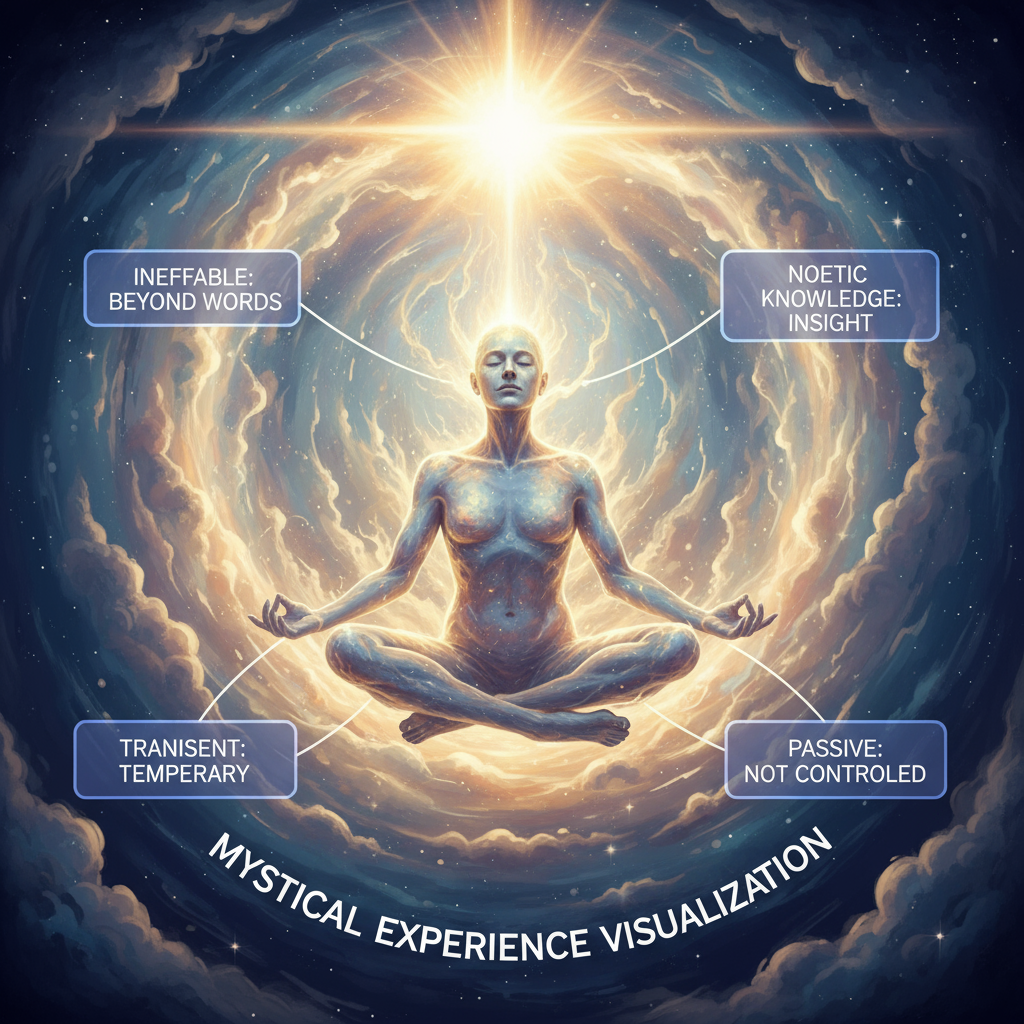
A mystical experience is a powerful religious experience where a person feels union or oneness with God, the divine, or ultimate reality. William James identified four key characteristics that define mystical experiences: (1) Ineffable — impossible to put into words; language cannot adequately describe it. (2) Noetic — it conveys deep knowledge or insight into the nature of reality that goes beyond normal intellectual understanding. (3) Transient — it's temporary, lasting only a short time. (4) Passive — the person feels taken over by a superior power; they don't control the experience. These experiences are found across all religions and cultures, often transforming the person's life profoundly.
Detailed Explanation
What Is a Mystical Experience?
A mystical experience is a specific type of religious experience characterized by a profound sense of union or oneness with the divine, God, or ultimate reality. It's more than just seeing a vision or feeling God's presence—it's an immersive, transcendent experience where the boundaries between self and the divine seem to dissolve.
Mystical experiences are found across all religious traditions—Christianity, Islam (Sufism), Judaism (Kabbalah), Hinduism, Buddhism, and even in secular contexts. People who seek out or have these experiences are often called mystics.
William James: The Pioneer of Mystical Experience Study
William James (1842-1910) was an American psychologist and philosopher who revolutionized the study of religious experience. His groundbreaking work is The Varieties of Religious Experience (1902), which examined religious experiences from across cultures and traditions.
James approached mystical experiences empirically and sympathetically—he studied actual accounts from people who had these experiences rather than dismissing them as delusions. His goal was not to prove whether these experiences came from God but to understand their nature, characteristics, and effects on human life.
James' Four Defining Characteristics of Mystical Experience
1. Ineffability (Beyond Words)
Definition: The mystical experience defies expression—it cannot be adequately described in words. James writes: "The subject of it immediately says that it defies expression, that no adequate report of its contents can be given in words."
The Paradox: Mystics still TRY to describe their experiences, but they acknowledge the descriptions are inadequate—like "trying to capture the ocean in a teacup".
2. Noetic Quality (Providing Knowledge)
Definition: Despite being ineffable, mystical experiences are felt by the experiencer to be states of knowledge—they provide profound insight into the nature of reality.
James writes: "Mystical states seem to those who experience them to be also states of knowledge. They are states of insight into depths of truth unplumbed by the discursive intellect."
3. Transiency (Temporary Duration)
Definition: Mystical experiences are fleeting and short-lived—they cannot be sustained for long periods. James writes: "Mystical states cannot be sustained for long."
Typical Duration: Most mystical experiences last anywhere from a few minutes to a couple of hours. They rarely extend beyond a day.
4. Passivity (Lack of Control)
Definition: The mystic feels unable to control the experience—it happens to them rather than being something they actively produce.
James writes: "When the characteristic sort of consciousness once has set in, the mystic feels as if his own will were in abeyance, and indeed sometimes as if he were grasped and held by a superior power."
Additional Common Characteristics
Beyond the four main marks, James and other scholars note additional features:
- Sense of Unity/Oneness: The boundaries separating oneself from ultimate reality seem to dissolve. The person feels a profound sense of interconnectedness—everything is one.
- Monistic and Pantheistic Tendencies: Mystical experiences tend toward monism (all is one) and pantheism (everything is divine or part of God).
- Feelings of Bliss, Peace, Joy: Deep and lasting feelings of happiness, peace, humility, and love often accompany the experience.
- Transformative Effects: Mystical experiences often profoundly change the person's behavior, relationships, values, and outlook on life.
W.T. Stace: Two Types of Mystical Experience
Philosopher Walter Terence Stace (1886-1967) built on James' work and distinguished two types:
1. Extrovertive Mystical Experience
"Looking outward" — perceiving unity within the external world. The plurality of objects in the world are transfigured into a single living entity. Everything external is perceived as unified, interconnected, and alive. Often occurs in nature—feeling that trees, sky, animals are all part of one divine reality.
2. Introvertive Mystical Experience
"Looking inward" — perceiving unity devoid of any external objects. A loss of identity as a separate individual—one merges into the divine reality. Experience of pure consciousness with no sensory content. Described as "an experience of no-thing-ness" or "the Void". Stace considered introvertive mysticism the higher, purer form.
James' Pluralism Argument
James made an important cumulative case based on mystical experiences:
- Mystical experiences are found in all religions and cultures across the world
- Despite different cultural and religious contexts, they share the same four characteristics (ineffable, noetic, transient, passive)
- This cannot be mere coincidence
- Therefore, there must be some real underlying reality that all these mystics are encountering
This is called James' "pluralism argument"—the universality of mystical experience across diverse traditions suggests they're accessing something genuinely real.
The Epistemic Status: Are Mystical Experiences Authoritative?
James addresses a crucial question: Do mystical experiences provide evidence for God or ultimate reality?
For the experiencer: Mystical experiences are absolutely authoritative. Why? Because they seem to be direct perceptions of reality, just like sense perceptions. If we trust our senses to give us knowledge of the physical world, we should trust mystical experiences to give knowledge of spiritual reality—at least for the person who had the experience.
For outsiders: Mystical experiences are NOT authoritative. People who didn't have the experience have no obligation to accept the mystic's claims. Just as someone who has never seen red has no reason to believe your description of it, someone who has never had a mystical experience has no reason to accept the mystic's interpretation.
James' Conclusion: Mystical experiences "break down the authority of non-mystical consciousness"—they show that ordinary rational consciousness is "only one kind of consciousness". They open up the possibility of other orders of truth and other ways of knowing reality. But they don't prove anything to those who haven't experienced them.
Scholarly Perspectives
"Mystical states seem to those who experience them to be also states of knowledge. They are states of insight into depths of truth unplumbed by the discursive intellect. They are illuminations, revelations, full of significance and importance, all inarticulate though they remain; and as a rule they carry with them a curious sense of authority for after-time."
"The handiest of the marks by which I classify a state of mind as mystical is negative. The subject of it immediately says that it defies expression, that no adequate report of its contents can be given in words. It follows from this that its quality must be directly experienced; it cannot be imparted or transferred to others."
Key Takeaways
- ✓Mystical experiences involve union or oneness with God, the divine, or ultimate reality
- ✓William James pioneered the empirical study of mystical experiences in The Varieties of Religious Experience (1902)
- ✓Four key characteristics: Ineffable, Noetic, Transient, Passive (remember: I-N-T-P)
- ✓Ineffable = beyond words; cannot be adequately described in language
- ✓Noetic = provides deep knowledge/insight into reality beyond intellectual reasoning
- ✓Transient = temporary, short-lived; cannot be sustained for long
- ✓Passive = person doesn't control it; feels taken over by a higher power
- ✓Ineffability and noetic quality are essential; transiency and passivity are common but not necessary
- ✓Stace distinguished extrovertive (outward unity) from introvertive (inward unity) mysticism
- ✓Mystical experiences are found across all religions and cultures—James' pluralism argument
- ✓They are authoritative for the experiencer but not for outsiders
- ✓Effects are often transformative and lasting, even though the experience itself is brief