Descartes' Substance Dualism
Summary
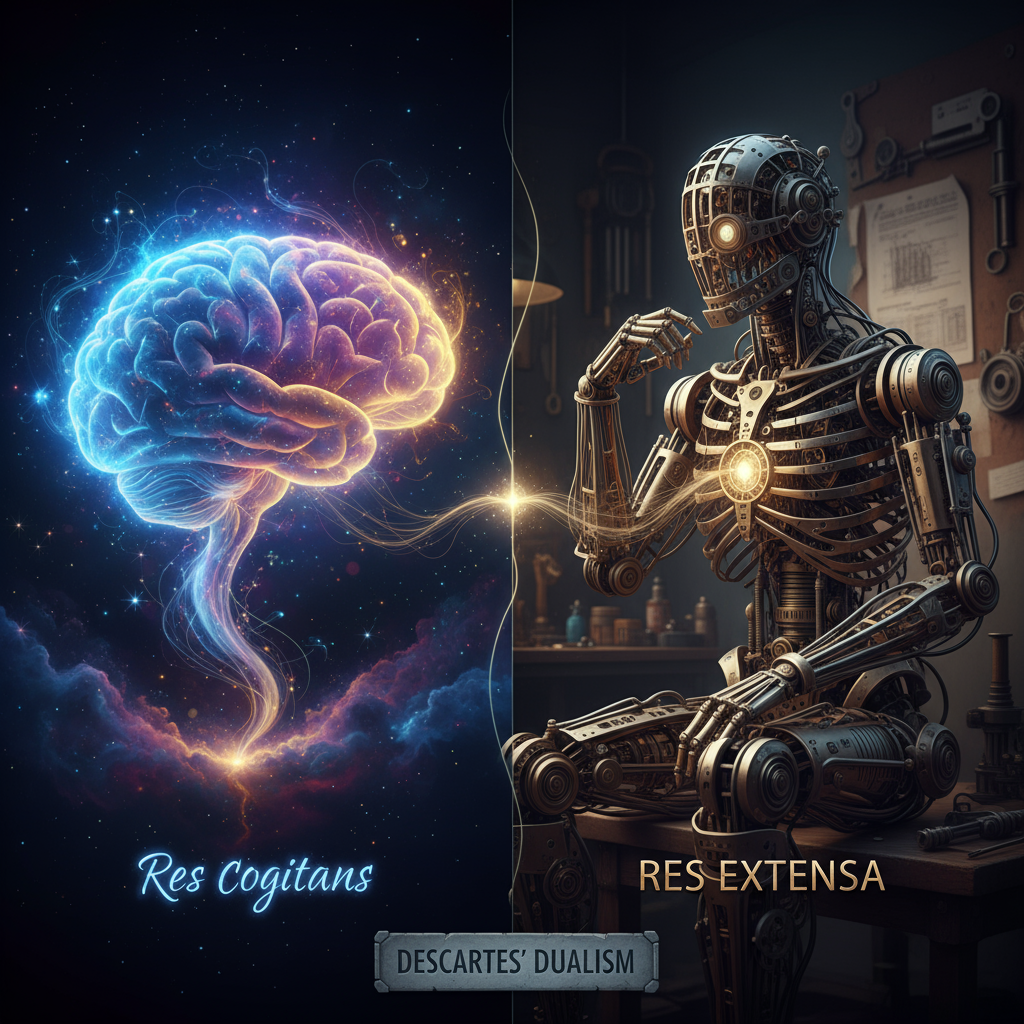
Descartes believed that reality is made of two completely different types of substance: res cogitans (thinking substance/mind) and res extensa (extended substance/body). The mind is non-physical, has no location in space, cannot be divided, and its essence is thinking. The body is physical, takes up space, can be divided, and its essence is extension. Because they have completely opposite properties, they must be two separate things that can exist independently of each other. You are essentially your mind—a thinking thing—and your body is just the physical machine that your mind interacts with.
Detailed Explanation
What Is Substance Dualism?
Substance dualism (also called Cartesian dualism after Descartes) is the theory that there are two fundamentally different kinds of substance in the universe:
- Mental substance (mind/soul)
- Physical substance (body/matter)
These are not just two different aspects of one thing. They are two completely separate, independent substances with totally different natures.
A substance, for Descartes, is something that can exist by itself without needing anything else (except God, who created everything). Mental substance can exist without physical substance, and physical substance can exist without mental substance.
Res Cogitans: The Thinking Substance (Mind)
Descartes uses Latin terms for precision. Res cogitans means "thinking thing" or "thinking substance".
The essential property of res cogitans is thought (which includes all conscious mental states: thinking, doubting, believing, willing, imagining, feeling).
Key characteristics of res cogitans:
- Non-extended – It does not take up physical space. It has no location, no dimensions, no coordinates
- Indivisible – It cannot be divided into parts. You can't split a mind in half
- Thinking – Its entire essence is to think and be conscious
- Immaterial – It is not made of physical matter
- Private – Only you have direct access to your own mental states
For Descartes, you are essentially your mind. When you say "I," you're referring to your thinking substance, not your body.
Res Extensa: The Extended Substance (Body)
Res extensa means "extended thing" or "extended substance".
The essential property of res extensa is extension—taking up space in three dimensions.
Key characteristics of res extensa:
- Extended – It occupies physical space with length, width, and height
- Divisible – It can be divided into smaller parts
- Non-thinking – It has no consciousness, no awareness, no mental states
- Material – It is made of physical matter
- Public – It can be observed by others
The body, for Descartes, is basically a sophisticated machine—a physical object governed by the laws of physics.
The Essential Difference: Complete Opposites
What makes Descartes' dualism so radical is that mind and body are defined as complete opposites:
| Property | Mind (Res Cogitans) | Body (Res Extensa) |
|---|---|---|
| Extension | Non-extended (not in space) | Extended (occupies space) |
| Divisibility | Indivisible (no parts) | Divisible (has parts) |
| Essence | Thinking | Extension |
| Consciousness | Conscious and aware | No consciousness |
| Material | Immaterial | Material |
Because they have completely opposite essential properties, they cannot be the same thing. They must be two distinct substances.
The Conceivability Argument for Substance Dualism
Descartes offers several arguments for substance dualism. The most famous is the conceivability argument:
- Premise 1: I have a clear and distinct idea of my mind as a thinking, non-extended thing.
- Premise 2: I have a clear and distinct idea of my body as an extended, non-thinking thing.
- Premise 3: If I can clearly and distinctly conceive of A existing without B, then A and B are possibly separate.
- Premise 4: If A and B are possibly separate, then they are in fact distinct substances.
- Conclusion: Therefore, mind and body are distinct substances that can exist independently of each other.
In simpler terms: I can imagine my mind existing without my body (perhaps as a disembodied consciousness). I can imagine my body existing without my mind (as a corpse or a mindless machine). If I can clearly conceive of them existing separately, then they must really be separate things.
What Are "Clear and Distinct Ideas"?
Descartes' argument relies heavily on the notion of clear and distinct perceptions.
- A clear idea is one that is vivid, obvious, and impossible to doubt while you're entertaining it.
- A distinct idea is one where you perceive exactly what belongs to the thing and nothing else—no confusion with other ideas.
For example, "I think, therefore I am" (cogito ergo sum) is clear and distinct. When you're thinking, you cannot possibly doubt that you exist as a thinking thing.
Descartes claims that whatever he clearly and distinctly perceives to be true must actually be true, because God (who exists and is not a deceiver) would not allow him to be systematically deceived about things he perceives with perfect clarity.
So when Descartes clearly and distinctly perceives that his mind is non-extended and his body is extended, he concludes this must reflect their actual natures.
The Indivisibility Argument
Descartes offers another argument based on divisibility:
- Premise 1: All physical substances are divisible because they are extended in space. (You can always divide something that takes up space.)
- Premise 2: The mind is indivisible because it has no parts. (You can't split your "self" into two selves.)
- Premise 3: By Leibniz's Law, if two things differ in their properties, they cannot be identical.
- Conclusion: Therefore, the mind cannot be identical to any physical substance, including the body.
In other words: Your body can be divided—you can lose a limb, organs can be removed. But your mind seems to be a unified whole. If you "divided" your mind, you wouldn't get two half-minds—the idea doesn't even make sense. This shows that mind and body are fundamentally different.
The "I Am a Thinking Thing" Argument
Descartes famously arrives at his first certainty: "I think, therefore I am" (Cogito, ergo sum).
He can doubt everything—his senses, his body, the external world. But he cannot doubt that he is thinking, because the very act of doubting is itself a form of thinking.
If he's thinking, then he must exist. Therefore, "I exist" is certain.
But what is this "I" that exists? Descartes concludes: I am essentially a thinking thing—a res cogitans.
He can be certain of his existence as a thinking thing without being certain that he has a body. Since he can know with certainty that he exists as a mind but cannot yet know with certainty that his body exists, the mind must be more fundamental to his identity than the body.
Even if his body turned out to be an illusion, he would still exist as a thinking thing. Therefore, he is essentially his mind, not his body.
The Interaction Problem
If mind and body are completely different substances, how do they interact?
This is the famous mind-body problem that has plagued philosophy ever since Descartes.
Descartes admits that mind and body clearly do interact:
- Mental events cause physical events (my decision to raise my arm causes my arm to move)
- Physical events cause mental events (stubbing my toe causes pain in my mind)
But how can an immaterial, non-spatial mind cause changes in a material, spatial body?
How can something with no location in space push or pull something that exists in space?
Descartes' answer: the mind and body interact at a specific location in the brain called the pineal gland.
But this answer is widely regarded as unsatisfactory, because it doesn't explain how the interaction occurs—it just identifies where it supposedly occurs.
If the mind has no spatial location, how can it be "at" the pineal gland? And how can a non-physical thing causally affect a physical thing? This remains one of the major objections to substance dualism.
Scholarly Perspectives
"On the one hand I have a clear and distinct idea of myself, in so far as I am simply a thinking, non-extended thing; and on the other hand I have a distinct idea of body, in so far as this is simply an extended, non-thinking thing. And accordingly, it is certain that I am really distinct from my body, and can exist without it."
"It is not necessary to ask whether soul and body are one, just as it is not necessary to ask whether the wax and its shape are one... For even if one and being are spoken of in several ways, what is properly so spoken of is the actuality."
Key Takeaways
- ✓Substance dualism says mind and body are two completely different substances that can exist independently
- ✓Res cogitans (thinking substance) = mind; non-extended, indivisible, immaterial, thinking
- ✓Res extensa (extended substance) = body; extended in space, divisible, material, non-thinking
- ✓Mind and body are defined as complete opposites with no properties in common
- ✓The conceivability argument: if we can clearly conceive them separately, they must be separate
- ✓The indivisibility argument: body is divisible, mind is indivisible, so they can't be the same
- ✓"I think therefore I am" proves you're essentially a thinking thing (your mind), not your body
- ✓Clear and distinct ideas are Descartes' standard for certainty—what you perceive clearly must be true
- ✓The interaction problem is the major difficulty: how can non-physical mind affect physical body?
- ✓Descartes proposed the pineal gland as where mind and body interact, but this doesn't solve the problem
- ✓This view supports belief in immortal soul—if mind is separate from body, it can survive bodily death
- ✓Most modern philosophers reject substance dualism due to the interaction problem and advances in neuroscience