Materialism
Summary
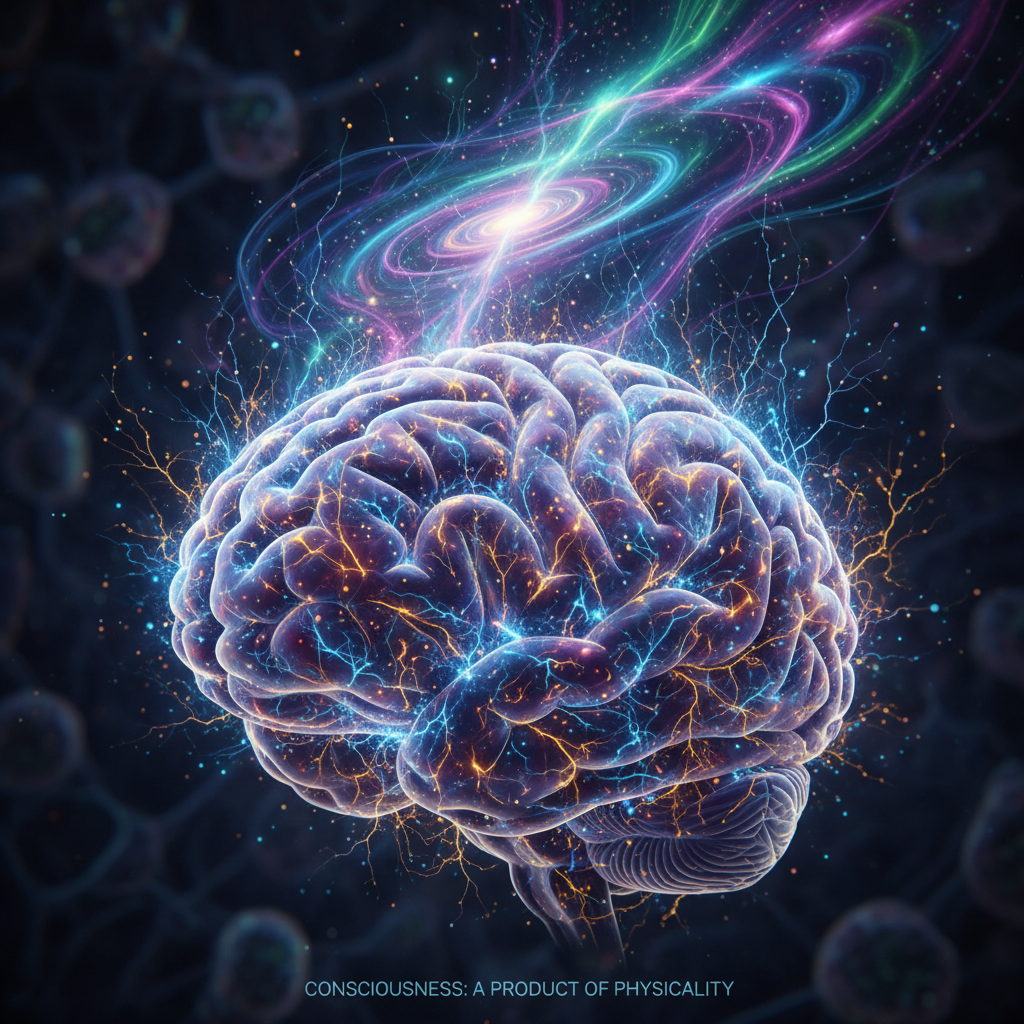
Materialism (also called physicalism) is the view that only physical matter exists—everything, including thoughts, feelings, and consciousness, is made of physical stuff or arises from physical processes. There is no immaterial soul or non-physical mind separate from the body. Your thoughts are brain activity. Your consciousness is what your brain does. When your brain stops working, you stop existing. There's nothing extra or supernatural needed to explain the mind—it's all just complicated physics happening in your brain.
Detailed Explanation
What Is Materialism?
Materialism (also called physicalism) is a fundamental philosophical position about what exists and what reality is made of.
The core claim: Everything that exists is ultimately physical or material.
More specifically, materialism asserts:
- Physical matter is the only substance that exists – There are no immaterial souls, minds, spirits, or abstract entities that exist independently of the physical world
- Everything is either made of matter or depends on matter for its existence – Including consciousness, thoughts, feelings, and all mental states
- All phenomena can ultimately be explained in terms of physical processes – Especially in terms of the brain, nervous system, and neurochemistry
- Mental states are caused by physical processes – Your thoughts arise from neural activity; your feelings result from brain chemistry
In short: There is no ghost in the machine. There is just the machine—the brain and body.
Materialism vs. Substance Dualism
To understand materialism, it's helpful to contrast it with Descartes' substance dualism:
| Aspect | Substance Dualism | Materialism |
|---|---|---|
| Substances | Two: mind (non-physical) and body (physical) | One: only physical matter |
| The mind | Immaterial, non-extended soul | Brain activity and neural processes |
| Consciousness | A non-physical property of the soul | An emergent property of the physical brain |
| Can mind exist without body? | Yes—soul can survive bodily death | No—mind ceases when brain stops |
| Explanation needed | Soul + body interaction mechanism | Only physics and neuroscience |
| Afterlife | Possible—soul is immortal | Impossible—mind dies with brain |
The fundamental difference: Dualism says there are two different kinds of things. Materialism says there is only one kind of thing—the physical.
Three Core Principles of Materialism
1. Ontological Primacy of the Physical
All that exists is either matter or depends on matter for existence.
The physical world is the most fundamental level of reality. Everything else—thoughts, feelings, consciousness—ultimately depends on and reduces to physical processes.
2. Scientific Alignment
Materialism closely aligns with the scientific worldview.
Science investigates the physical world through empirical observation and measurement. Materialism says this physical world is all there is, so science can in principle explain everything.
You don't need to invoke any supernatural or non-physical explanations. You don't need to appeal to souls, spirits, or immaterial forces. Physics and neuroscience can explain human nature.
3. Reductionism
Complex systems can be explained by understanding their simpler, constituent parts.
Your consciousness is a complex phenomenon, but materialism says it can ultimately be reduced to and explained by the activity of neurons, neurotransmitters, and brain processes.
What About Mental States?
Materialism doesn't deny that mental states exist. You really do have thoughts, feelings, beliefs, desires, and conscious experiences.
The question is: What are these mental states? What is their fundamental nature?
- Dualism says: Mental states are non-physical properties of an immaterial mind.
- Materialism says: Mental states are either identical to physical brain states or caused by physical brain states.
For example:
- Your thought "I'm hungry" is either identical to a particular pattern of neural firing in your brain, OR it's caused by that neural activity
- Your feeling of pain is either identical to C-fiber activation in your nervous system, OR it's caused by that activation
- Your decision to raise your arm is either identical to certain motor cortex activity, OR it's caused by that activity
Either way, the fundamental explanation is physical. The brain is doing the real work.
Identity Theory: Mind = Brain
One prominent materialist view is identity theory (also called mind-brain identity):
Identity theory says: Mental states ARE identical to brain states.
Not just "caused by" or "correlated with"—but literally identical.
Just like "water = H₂O" (water is identical to H₂O molecules), identity theorists say "pain = C-fiber activation" or "my thought = that particular neural pattern".
When you have the conscious experience of pain, what's actually happening is C-fiber stimulation in your nervous system. The pain experience IS that physical process.
There's no additional non-physical aspect to the pain. The pain just is the neural activity.
Consciousness and the "Hard Problem"
But here's the puzzle: Why does physical brain activity give rise to subjective experience?
When neurons fire, information is processed, and signals travel through the brain—we can observe all of this. But we don't understand why this physical process feels like something from the inside.
Philosophers call this the "Hard Problem of Consciousness"—not just explaining behavior or information processing, but explaining why there is subjective experience at all.
For a materialist, this is the hard challenge: to explain how purely physical processes can produce the subjective, qualitative feeling of consciousness.
Some materialists propose that consciousness is an emergent property—a higher-order property that emerges when physical systems reach a certain level of complexity, even though consciousness wasn't present at the level of individual particles.
But critics argue that emergence alone doesn't solve the problem—it just relocates it. How can emergence bridge the gap between non-conscious physical stuff and conscious experience?
Eliminative Materialism: The Radical Version
Some materialists take an even more extreme position called eliminative materialism:
Eliminative materialists say that many of our commonsense mental concepts—like beliefs, desires, consciousness itself—don't actually exist. They're part of an outdated, false theory of the mind (called "folk psychology").
Just as we no longer believe in phlogiston (fire element) or vital forces, eliminative materialists predict we'll eventually realize that beliefs, desires, and consciousness don't exist—they're just illusions produced by our brain.
Instead, everything should be described purely in terms of neurophysiology.
This is a controversial view even among materialists, because it seems to deny the obvious—that we really do have thoughts and conscious experiences.
Materialism and Causal Efficacy
Here's another puzzle for materialism: If everything is determined by physical laws, can our conscious thoughts actually cause anything?
Consider: You decide to raise your arm, and your arm rises. Did your conscious decision cause this, or was it just physical brain processes that would have caused the arm to rise anyway?
If materialism is true and all causation ultimately reduces to physical causation, then mental causation might be illusory.
Your conscious thought "I'll raise my arm" might be merely a by-product of neural processes that are doing the real causal work. The physical processes cause the arm to move, and the conscious thought just accompanies those physical processes without contributing anything.
This is called the problem of mental causation, and it's a serious challenge for materialism.
No Afterlife, No Reincarnation
Materialism has clear implications for beliefs about life after death:
- No heaven or hell – There's no immaterial soul that can exist in an afterlife realm
- No personal immortality – When your brain dies, you cease to exist
- No reincarnation – There's no soul to be reborn in a new body
- Death is final – It's the end of your conscious existence
This is one reason why materialism has been historically opposed by religious believers.
If materialism is true, religion's promises of eternal life are impossible.
Brief History of Materialism
Materialism is not a new idea:
- Ancient Greece: The atomists like Democritus proposed that reality consists only of atoms and void (empty space), with no room for souls or spirits
- 17th century: Thomas Hobbes argued that everything, including thinking and the mind, is ultimately matter in motion
- 19th century: The rise of scientific materialism as science explained more and more through physical causes
- 20th-21st centuries: Materialism became the dominant view among neuroscientists and most analytical philosophers of mind
Types of Materialism
| Type | Key Idea |
|---|---|
| Mechanical Materialism | Everything consists of hard material objects interacting mechanically |
| Identity Theory | Mental states are identical to brain states |
| Functionalism | Mental states are defined by what they do, not what they're made of |
| Eliminative Materialism | Common mental concepts like "beliefs" don't actually exist |
| Emergentism | Consciousness emerges from complexity, but still depends on physical processes |
Challenges to Materialism
| Challenge | Description |
|---|---|
| The Hard Problem of Consciousness | How do physical brain processes produce subjective conscious experience? |
| The Mental Causation Problem | If everything is determined by physics, can conscious thoughts actually cause anything? |
| The Conceivability Problem | We can conceive of consciousness existing without any physical brain—does this prove materialism false? |
| Qualia and Subjective Experience | How can the objective facts of neuroscience explain the subjective "what it's like" to experience color or pain? |
| The Explanatory Gap | There seems to be an unbridgeable gap between physical facts and conscious experience |
Scholarly Perspectives
"On the materialist view, on the other hand, the only substances there are are physical ones: things like brains and bodies. When these are arranged in the right ways, and have the right kinds of properties, then thinking and feeling and self-consciousness happens. There aren't any such non-physical substances as what the dualists call 'souls.'"
"Materialism asserts that everything in the universe is ultimately physical or material, including the mind. Mental states, consciousness, and everything we associate with the mind are seen as arising from or reducible to physical processes in the brain."
Key Takeaways
- ✓Materialism says only physical matter exists—there's no immaterial soul or non-physical mind
- ✓Everything, including consciousness and thought, is ultimately physical—it arises from or is identical to brain processes
- ✓Mental states are either identical to brain states or caused by brain states—either way, the fundamental explanation is physical
- ✓It contrasts sharply with Descartes' substance dualism, which says mind and body are two different kinds of substance
- ✓Materialism aligns with science—it says everything can be explained through physics and neuroscience without needing to appeal to the supernatural
- ✓The "Hard Problem" is explaining how physical brain activity produces subjective conscious experience
- ✓Mental causation problem: if everything is physical causation, can conscious thoughts actually cause anything?
- ✓Materialism denies afterlife and immortality—when your brain dies, you cease to exist
- ✓Identity Theory says pain = C-fiber activation, thoughts = specific neural patterns—they're literally identical, not just correlated
- ✓Eliminative Materialism takes the view to an extreme, denying that many mental concepts like "beliefs" even exist
- ✓Most contemporary neuroscientists and many philosophers accept materialism as the best account of mind
- ✓Materialism remains controversial because it seems to conflict with our intuitions about consciousness and free will