Falsification symposium
Summary
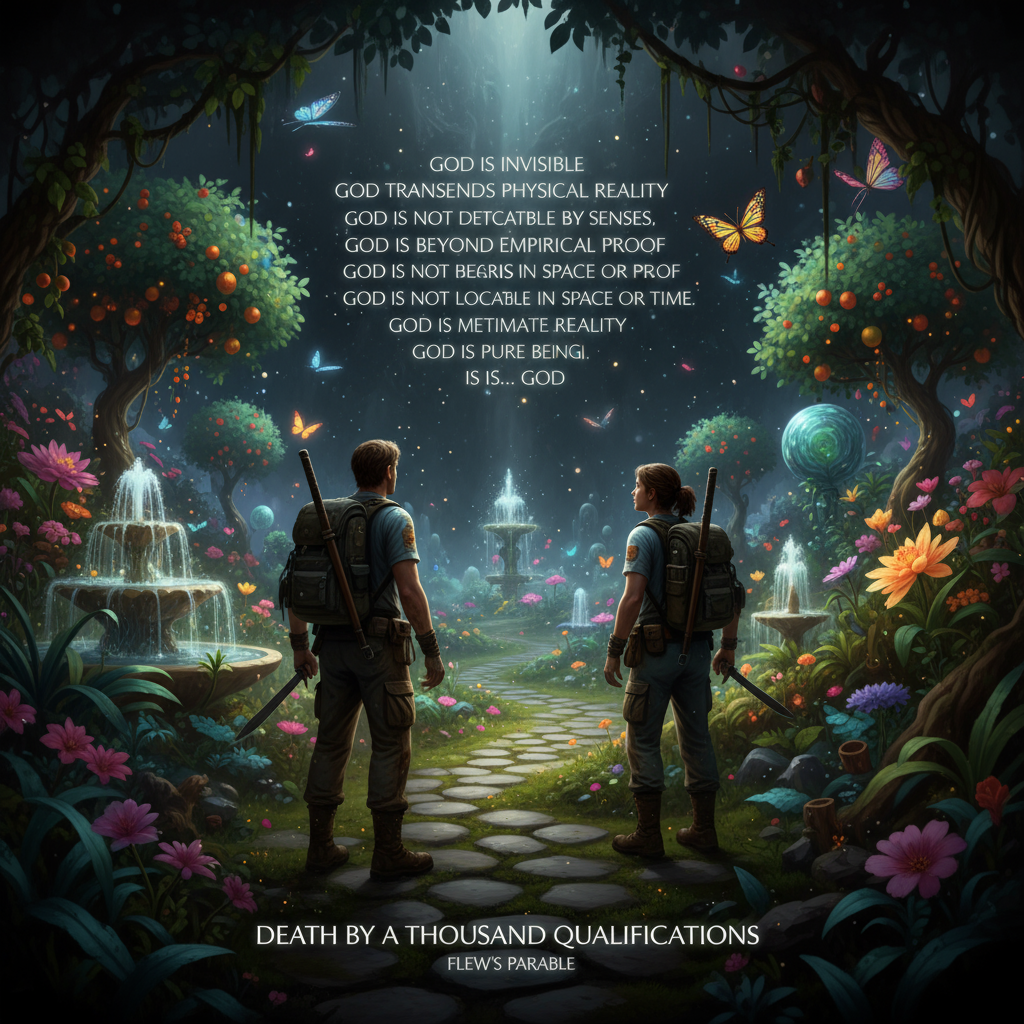
Antony Flew developed falsificationism as an alternative to logical positivism's verification principle. Instead of asking "What would verify this statement?" he asked "What would falsify it? What would prove it false?". If a statement has no conceivable falsifier (nothing could prove it false), then it makes no claim about reality and is meaningless. Applied to religion: "God loves us" is unfalsifiable because believers adjust their beliefs to accommodate any evidence (suffering, evil, tragedy). Flew illustrates this with John Wisdom's Parable of the Invisible Gardener: two explorers find a beautiful garden but never see a gardener. As they add qualifications ("The gardener is invisible," "He transcends physical reality"), eventually the original claim "There is a gardener" dies "a death of a thousand qualifications". R.M. Hare responds that religious language isn't cognitive (fact-stating) but expresses non-cognitive "bliks" (unprovable worldviews). Basil Mitchell argues Flew misunderstands believers who have limits to what would falsify their faith.
Detailed Explanation
Who Was Antony Flew?
Antony Garrard Newton Flew (1923-2010) was a British philosopher.
- He initially championed falsificationism as a response to logical positivism
- He later became famous for defending atheism throughout much of his career
- His major work: "Theology and Falsification" (1950), expanded into the Falsification Symposium (1971)
The Falsification Principle
What Is Falsification?
Definition:
- Falsification is the criterion that a statement is meaningful only if it is possible to conceive of evidence that would prove it false
- If there is no conceivable way to falsify a statement (no possible evidence could disprove it), then the statement is meaningless because it makes no claim about reality
Why Falsification Over Verification?
- Flew and others recognized problems with Ayer's verification principle
- Scientific theories can never be conclusively verified (only supported by evidence)
- But theories can be falsified—evidence can disprove them
Example:
- "All swans are white" cannot be verified (we can't check every swan)
- But it can be falsified—finding one black swan proves it false
- So falsification is a better criterion than verification
The Difference Between Falsifiable and Unfalsifiable
Falsifiable Statements:
Have conceivable evidence that would prove them false.
Examples:
- "It will rain tomorrow" (if it doesn't rain, it's false)
- "There is life on Mars" (if we find no evidence of life, it's false)
- "Jesus rose from the dead" (if we find Jesus' body, it's false)
Unfalsifiable Statements:
Have no conceivable evidence that could prove them false.
Examples:
- "God exists" (believers adjust belief to accommodate any evidence)
- "God loves us" (suffering doesn't count as disproving it)
- "There are invisible fairies in the garden" (if we can't see them, believers say they're invisible)
Flew's Parable of the Invisible Gardener
The Story (Wisdom's Original, Flew's Version)
The Setup:
- Two explorers come upon a beautiful, well-maintained garden in the middle of a jungle
- Explorer A: "There must be a gardener who tends this garden!"
- Explorer B: "I don't see anyone. Where is this gardener?"
The Qualifications
Round 1 - The Invisible Gardener:
- A: "The gardener is invisible."
- B: "OK, but an invisible gardener should leave traces—footprints, disturbed earth. I don't see any."
Round 2 - Beyond Physical Reality:
- A: "The gardener transcends physical reality. He exists in a spiritual dimension."
- B: "But then in what sense is he a 'gardener' at all? What difference does his existence make?"
Round 3 - Testing God:
- A: "He cannot be tested. Trying to verify or falsify his existence shows a lack of faith."
- B: "But then you're saying he has no properties that distinguish him from a non-existent gardener!"
Round 4 - Beyond Understanding:
- A: "His ways are beyond our understanding. We cannot comprehend why he lets the garden deteriorate sometimes."
- B: "So you admit the garden sometimes deteriorates? Then what good is he?"
The Conclusion
Flew's Question:
"But what remains of your original assertion [that there is a gardener]?"
Flew's Point:
- Each qualification removes another property from the concept of "gardener"
- Eventually, nothing remains that distinguishes the "invisible, spiritual, untestable, incomprehensible gardener" from no gardener at all
The Death of a Thousand Qualifications:
- Flew concludes: God has "died a death of a thousand qualifications"
- By adding qualifications to protect God from falsification, believers have made the concept meaningless
Flew's Application to Religious Language
The Argument
Flew's Claim:
- Religious believers refuse to allow their statements to be falsified
- They will not admit any evidence that would count against their beliefs
- Therefore, religious language is unfalsifiable and thus meaningless
Examples of Unfalsifiable Religious Language
"God is loving":
- Believer: "God loves us all."
- Questioner: "But what about evil and suffering?"
- Believer: "God works in mysterious ways. Suffering serves a purpose we don't understand."
- Questioner: "But then nothing counts as evidence against God's love!"
- Result: The statement is unfalsifiable and meaningless.
"Prayer is answered":
- Believer: "I prayed and God answered my prayer."
- Questioner: "What if the prayer goes unanswered?"
- Believer: "God's answer is sometimes 'no.' Or He answers in ways we don't expect."
- Questioner: "So anything counts as God answering? Then nothing counts as God NOT answering!"
- Result: The statement is unfalsifiable and meaningless.
Religious Language "Intends" to Be Cognitive
Flew's Important Qualification:
- Flew doesn't say religious language is meaningless in every sense
- Religious language has emotional, moral, and social meanings
But:
- Religious language "intends" or "presupposes" to make factual claims about reality
- When a believer says "God exists," they're trying to assert something true about reality
However:
- This factual claim is unfalsifiable, so it fails to be a genuine assertion about reality
- It becomes meaningless as a factual claim
R.M. Hare's Response: Bliks
Who Was R.M. Hare?
Richard Mervyn Hare (1919-2002) was a British philosopher who developed the concept of "bliks" as a response to Flew's falsification principle.
What Is a Blik?
Definition:
- A blik is a non-cognitive, unfalsifiable belief about the world that nonetheless remains meaningful and life-shaping to those who hold it
- A blik is not based on reason or evidence
- It cannot be verified or falsified
- Yet it profoundly affects how one lives and interprets reality
Hare's Parable: The Mad Student
The Story:
A paranoid student believes that all university dons want to murder him.
Hare asks: "What would convince him this is false?"
Answer: Nothing—every action the dons take, he interprets as part of the murder plot.
- If they're friendly: "They're being friendly to gain my trust before they murder me"
- If they're hostile: "They're showing their true murderous intentions"
- If they ignore him: "They're planning my murder secretly"
The Key Point:
- This belief is completely unfalsifiable
- Yet it remains extremely meaningful to the student—it shapes everything he does
- It's not that the student has no reasons for his belief; rather, no possible experience would change his mind
Hare's Application to Religion
Religious Bliks:
Similarly, religious faith might be a blik. Religious believers have a non-cognitive, unfalsifiable worldview that shapes how they interpret all events.
Examples:
- Believers interpret coincidences as "God's guidance"
- Believers interpret suffering as "God's test"
- Believers interpret answered prayers as "miracles"
The Point:
- This doesn't make religion meaningless
- Religious faith is profoundly meaningful because it shapes believers live
- But religious faith is not a factual claim subject to falsification
- It's a commitment to a way of seeing the world
Why Bliks Are Meaningful Despite Being Unfalsifiable
Hare's Argument:
- Flew is wrong to dismiss unfalsifiable statements as meaningless
- Meaning is not determined by falsifiability alone
Some of the most meaningful things in life are unfalsifiable bliks:
- How you interpret other people's intentions
- Whether you see the world as fundamentally friendly or hostile
- Whether you trust others or assume treachery
- These interpretive frameworks are not false—they're different ways of seeing reality
Hare's Conclusion:
- Religious faith is a blik—a meaningful, unfalsifiable worldview
- It's not a factual claim subject to empirical testing
- Therefore, Flew's criterion of falsification doesn't apply
Basil Mitchell's Response: The Parable of the Stranger
Who Was Basil Mitchell?
Basil Mitchell (1917-2011) was a British philosopher and theologian who offered a middle position between Flew and Hare in the Falsification Symposium.
Mitchell's Critique of Flew
The Problem:
- Mitchell argues Flew misrepresents how religious believers actually think and behave
- Flew claims believers refuse to allow anything to count against their faith
- But: Many religious believers DO have limits to what would falsify their faith—they just might not know those limits in advance
Mitchell's Parable: The Stranger
The Story (simplified):
During a wartime occupation, a believer in a stranger's benevolence meets a stranger who is sometimes kind, sometimes cruel.
- Believer: "I believe this stranger is fundamentally good, even when he does cruel things."
- Partisan: "But at what point would you abandon this belief? Is there a limit?"
- Believer: "I don't know exactly. But yes, if the cruelty continued indefinitely, I'd eventually lose faith."
Mitchell's Key Distinctions
Three Types of People:
1. The Thoughtless Believer:
- Blandly dismisses all contrary evidence—refuses to admit anything counts against his belief
- This person has no meaningful belief because nothing could change it
2. The Partisan:
- Admits that many things may count against his belief
- There ARE limits to what he'll tolerate, but he doesn't know them in advance
- He continues to believe in the stranger's goodness provisionally, pending future evidence
3. The Madman:
- Nothing can count against his belief—he's irrational and delusional
Mitchell's Application to Religion
Most Religious Believers Are Partisans:
- Mitchell argues that most religious believers are "partisans," not "madmen"
- They do have limits to what would falsify their faith
Examples:
- If Jesus' body were found, Christianity would be falsified
- If there were NO suffering, believers might lose faith (no challenge, no meaning)
- If God demanded something morally abhorrent, believers might lose faith
The Difference:
- Religious believers simply can't specify their falsification criteria in advance
- They must experience the evidence and then judge whether it falsifies their faith
Mitchell's Conclusion:
- Flew is wrong that religious language is unfalsifiable
- Much religious language is falsifiable, even if the falsification cannot be known beforehand
Strengths of Flew's Falsification Principle
Strength 1: More Plausible Than Verification
The Argument:
- Falsification is more realistic than verification as a criterion for meaningful scientific language
- Scientific theories can never be conclusively verified—they can only be provisionally supported
- But they can be falsified by contradictory evidence
Strength 2: The Parable Is Powerful
The Insight:
- Flew's Parable of the Invisible Gardener powerfully illustrates how believers adjust their concepts of God to avoid falsification
- It captures the intuition that unfalsifiable claims are meaningless
Strength 3: Highlights the Problem of Qualifications
The Achievement:
- Flew identifies a real problem: religious language does face the challenge that believers continuously add qualifications
- This is recognizable in religious discourse—"God is beyond our understanding," "God works mysteriously," etc.
Criticisms of Flew's Falsification Principle
Criticism 1: Mitchell's Point—Believers Do Have Limits
Mitchell's Objection:
- Flew assumes believers will never abandon their faith
- But: Many believers would abandon faith if certain conditions obtained
- They simply don't know what those conditions are in advance
- This makes their statements actually falsifiable, even if they can't articulate the falsification criteria beforehand
Evidence:
- St. Paul said if Jesus didn't rise from the dead, faith is "pointless"
- This shows Christianity can be falsified—by disproving the Resurrection
Criticism 2: St. Paul's Argument
The Point:
1 Corinthians 15:14: "If Christ has not been raised, our preaching is useless and so is your faith."
This suggests Christianity is falsifiable—falsified by showing Jesus didn't rise from the dead.
Implications:
- If Christianity is falsifiable, Flew is wrong that religious language is unfalsifiable
- Some religious believers DO allow their beliefs to be potentially falsified
Criticism 3: Hare's Point—Bliks Are Meaningful Despite Being Unfalsifiable
Hare's Objection:
- Flew assumes only falsifiable statements are meaningful
- But: Unfalsifiable beliefs (bliks) can be profoundly meaningful
- The most life-shaping interpretive frameworks are often unfalsifiable
- Therefore, meaningfulness doesn't require falsifiability
Criticism 4: Flew's Distinction Between Cognitive and Non-Cognitive
The Problem:
Flew says religious language is "non-cognitive" (not fact-stating) but "intends" to be cognitive.
This is confusing:
- If religious language is non-cognitive, why does it matter that it "intends" to be cognitive?
- If believers don't intend to make factual claims, Flew's criticism misses the point
Criticism 5: The Problem of Evil
The Objection:
- If believers have a limit (say, extreme suffering) at which they'd abandon faith, then "God is good" should be falsifiable by evil
- But believers continuously hold that God is good despite evil
- This suggests either: Believers don't have this limit (Flew is right), OR Believers don't actually believe evil falsifies "God is good"—in which case it's not really a limit
- Either way, the problem persists
Criticism 6: Ayer's 1976 Admission
The Turnaround:
- In 1976, A.J. Ayer admitted that the verification principle had severe problems
- Similarly, falsificationism has problems as a universal criterion for meaning
- Both verification and falsification may be too restrictive
Scholarly Perspectives
"To assert that such and such is the case is necessarily equivalent to denying that such and such is not the case... Now suppose we continue to make cautious adjustments to our original assertion, 'There is a gardener.' We shall be constantly on the watch for the telling move, the final argument. But the believer will still not allow what would count as a definitive disproof of his theory. And by degrees the assertion ceases to be an assertion and becomes a mere shadow of itself... The believer causes God to 'die a death of a thousand qualifications.'"
"The student's belief 'All dons want to murder me' is unfalsifiable. No evidence will convince him otherwise. Yet his belief is not meaningless—it profoundly shapes how he lives and interprets reality. Similarly, religious faith might be a 'blik'—an unfalsifiable, non-cognitive worldview that is nonetheless deeply meaningful to believers."
Key Takeaways
- ✓Flew: falsification principle—meaningful if conceivably falsifiable
- ✓Alternative to verification: falsifiable is more realistic for science
- ✓Religious language unfalsifiable: believers adjust beliefs to protect faith
- ✓Parable of Invisible Gardener: qualifications remove properties until nothing remains
- ✓"Death of a thousand qualifications": God dies as meaningful concept
- ✓Hare's response: bliks are unfalsifiable yet deeply meaningful
- ✓Mad student doesn't admit anything counts against belief; still meaningful
- ✓Religious faith as blik: worldview shaping interpretation, not fact-stating
- ✓Mitchell: believers ARE partisans with limits to faith, not madmen
- ✓St. Paul: Christianity falsifiable by showing Jesus didn't resurrect
- ✓Mitchell: falsification possible but unknown in advance
- ✓Problem: can believers really have limits if they keep adjusting beliefs?