Wittgenstein's language games
Summary
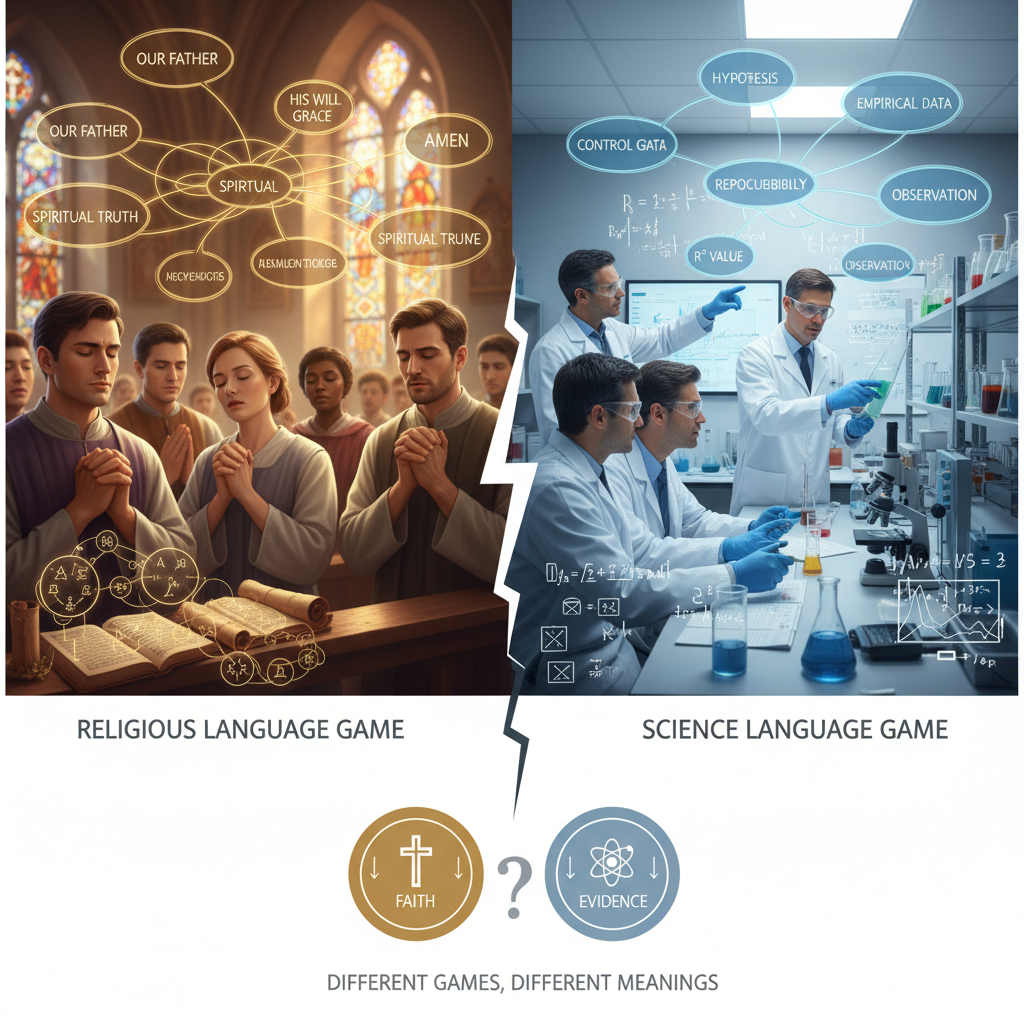
Ludwig Wittgenstein (1889-1951) completely changed his mind about language later in his career. In his early work (Tractatus), he agreed with logical positivists that language must describe reality logically. But in his later work (Philosophical Investigations), he argued that words get their meaning from how they are used in different contexts—like how the rules of chess make sense within chess but wouldn't apply to checkers. Wittgenstein called these contexts "language games"—ways of using language woven into human activities and forms of life. Applied to religion: "God exists" is meaningful within the religious language game where believers pray, worship, and live according to religious practices. It's not that the statement is meaningless (Ayer was wrong); it's that meaning depends on context. D.Z. Phillips developed this into Wittgensteinian philosophy of religion: religious language is not about proving facts but about expressing a form of life. Criticism: this leads to fideism (faith separated from reason) and anti-realism (God doesn't objectively exist, only within the religious game).
Detailed Explanation
Who Was Ludwig Wittgenstein?
Ludwig Josef Johann Wittgenstein (1889-1951) was an Austrian-British philosopher who had two completely different philosophical periods:
1. Early Wittgenstein (Tractatus Logico-Philosophicus, 1921)
- Language must have one-to-one correspondence with reality
- Language must be logically pure
- Religious language is meaningless because it doesn't picture reality
- "Whereof one cannot speak, thereof one must be silent"
2. Later Wittgenstein (Philosophical Investigations, 1953)
- Language is diverse and context-dependent
- Language is lived practice, not pure logic
- Religious language can be meaningful within its own context
- "Don't ask for the meaning, ask for the use!"
The Crisis of Early Wittgenstein
The Problem with Pure Logic
- Early Wittgenstein believed language was like a perfect calculus (mathematical system)
- Each word corresponds to one object
- Sentences are combinations of words forming logical pictures of reality
The Realization
- This view is far too restrictive
- Real language is messy, flexible, context-dependent
- Words don't have fixed, single meanings
The New Insight
Later Wittgenstein realized language is "living" and "organic", not a perfect logical machine.
Language Games: The Core Concept
What Is a Language Game?
Definition:
- A language game is a way of using language woven into a human activity
- Words get their meaning from how they are used within that activity
- Different activities have different rules for how language works
Wittgenstein's Famous Quote:
"The speaking of language is part of an activity, or a form of life."
The Builder's Example
Wittgenstein's Illustration:
Imagine two builders constructing a stone wall. Builder A calls out only four words: "Block!" "Pillar!" "Slab!" "Beam!" Builder B responds by bringing the appropriate stone.
Within this language game:
- Each word means something specific
- "Block!" doesn't mean "Bring me a pillar"—it means "Bring me a block"
- The rule of the game determines the meaning
- The meaning is tied to the action—the call-and-response activity
Outside the game:
- If A says "Block!" to someone not playing this game, they might not understand
- The word's meaning depends on context—on being in this particular game
Multiple Language Games
Wittgenstein's Point:
There are countless language games, not just one universal language.
Examples of different language games:
- Giving orders (military command)
- Asking questions (philosophy class)
- Cracking jokes (comedy show)
- Praying (religious worship)
- Doing science (empirical investigation)
- Playing chess (game with pieces)
- Blessing (religious act)
- Cursing (expressing emotion)
- Translating (between languages)
Key Point:
- Each game has its own rules
- You can only understand language if you know which game is being played
- You can't judge one game by the rules of another game
Family Resemblance
The Problem with Defining "Game"
Wittgenstein's Question:
What do all games have in common? What makes something a "game"?
Attempted Definitions Fail:
- Some games have winners and losers; others don't (throwing a ball)
- Some games need multiple players; others don't (solitaire)
- Some games are competitive; others are cooperative
- Some games have rules; others are more open-ended
The Realization:
- There's no single feature that all games share
- But we still call all of them "games"
- How is this possible?
Wittgenstein's Solution: Family Resemblance
The Family Analogy:
- Family members don't all look alike
- Each member resembles some others in different ways
- John has his mother's eyes, his father's nose, his sister's smile
- But there's no single feature all family members share
- Yet we still call them a "family"
Applied to Games:
Similarly, games are related by overlapping and crisscrossing similarities:
- Some games resemble others in having competition
- Some resemble others in having rules
- Some resemble others in being recreational
- But no single feature defines all games
Wittgenstein's Quote:
"We see a complicated network of similarities overlapping and crisscrossing: sometimes overall similarities, sometimes similarities of detail."
Important Consequence:
- We don't need a universal definition to meaningfully use a word
- Words get their meaning from how we use them, not from a logical essence
Language Games and Religion
Religious Language As a Language Game
The Application:
Religion is a language game with its own rules, activities, and form of life.
Religious practices that constitute the form of life:
- Praying
- Worshiping
- Reading sacred texts
- Performing rituals
- Making ethical commitments
- Living according to religious values
Religious language is meaningful within this game:
When a believer says "God watches over me," this is meaningful because it:
- Expresses faith and trust
- Shapes how they live their life
- Fits within the religious form of life
- Follows the internal rules of religious practice
The statement is not making a scientific claim:
- It's not like saying "There is a surveillance camera on my roof"
- It's expressing commitment to a way of living
Comparison to Science
Science is also a language game:
It has its own rules, activities, and form of life.
In the scientific game:
- Words mean what empirical observation shows
- Statements are testable and falsifiable
- The form of life is rational investigation of the physical world
Religious language doesn't work like scientific language:
- You can't test "God loves me" in a laboratory
- It operates by different rules
Both can be meaningful within their own games:
- Science is meaningful for those playing the scientific language game
- Religion is meaningful for those playing the religious language game
The Crucial Point
You cannot judge religious language by scientific rules:
- That's like criticizing chess for not following the rules of checkers
- Similarly: You cannot understand religious language unless you participate in the religious form of life
- An atheist outside the game cannot judge whether religious statements are meaningful to those inside the game
D.Z. Phillips: Wittgensteinian Philosophy of Religion
Who Was D.Z. Phillips?
- Dewi Zephaniah Phillips (1934-2006) was a Welsh philosopher
- He pioneered the application of Wittgenstein's ideas to the philosophy of religion
- His major works: The Concept of Prayer (1965), Religion Without Explanation (1976)
Phillips' Main Ideas
Religion Is Not About Factual Claims:
- Phillips argues that believers don't claim that God factually exists
- Instead, they live in a religious form of life
- Religious language is confessional—expressing faith and commitment, not making propositions
Religious Rituals and Prayer:
- Rituals and prayers are not attempts to change God's mind or communicate with an entity
- They are expressions of one's participation in a form of life
- Prayer is part of what it means to be religious
The Irrelevance of Truth and Falsity:
- The question "Is God really there?" is not what religion is about
- Religion is about how one lives—the activities, commitments, values you embrace
- Whether God "objectively exists" is irrelevant to the religious form of life
Strengths of Wittgenstein's Approach
Strength 1: Avoids Logical Positivism's Problems
The Achievement:
- Wittgenstein's theory solves the problems created by Ayer's verification principle
- Religious language is not meaningless
- It's meaningful within its own context
The Explanation:
- Ayer and logical positivists made a mistake: they thought all meaningful language must be scientific
- Wittgenstein shows there are multiple forms of meaningful language
Strength 2: Captures How Religious Believers Actually Use Language
The Strength:
- Religious believers don't use religious language like scientists use scientific language
- They use it expressively, not descriptively
- Wittgenstein's theory honors this difference
Examples:
- "God forgives me" expresses reconciliation and new beginnings, not a description of an event
- "I trust in God" expresses commitment and hope, not a factual claim
- Prayer expresses petition and devotion, not communication with an entity
Strength 3: Shows Logical Positivism Is Self-Defeating
The Argument:
- Ayer criticizes religious language for being unverifiable
- But Wittgenstein shows: different language games have different criteria for meaningfulness
- To demand religious language meet scientific criteria is to misunderstand what religious language is doing
Criticisms of Wittgenstein's Approach
Criticism 1: Ayer's "Witches and Fairies" Objection
Ayer's Challenge:
- If Wittgenstein's theory is correct, then we must accept witchcraft language as meaningful
- Witches have their own form of life with their own language game
- By Wittgenstein's logic, their statements about magic and fairies are meaningful within their game
- Surely this is absurd!
Implication:
- If we can't reject witchcraft language, the theory is too permissive
- It seems to make any arbitrary system meaningful just by being a form of life
Criticism 2: Fideism
What Is Fideism?
- Fideism is the view that faith alone provides knowledge of God, not reason
- Reason cannot evaluate religious claims
How Wittgenstein's Theory Leads to Fideism:
If religion is a completely separate language game from science:
- Religious language has no rational justification
- Scientific reasoning cannot critique religious belief
- Religion is purely a matter of faith, not reason
The Problem:
- This seems to isolate religion from rational criticism
- It suggests anything goes as long as it's part of a form of life
Criticism 3: Anti-Realism
The Worry:
- Wittgenstein's theory suggests that when a believer says "God exists," they're not claiming that God objectively exists
- Instead, they're just expressing participation in a form of life
- This is theological anti-realism—God doesn't exist independently; God only exists within the religious game
Is This What Religion Teaches?
- Most religious believers would say no
- They believe God objectively exists in reality, independent of their belief
- Wittgenstein's theory seems to undermine this realist understanding
Criticism 4: How Do We Choose Between Language Games?
The Question:
If different language games have different rules for what's meaningful:
- How do we choose which game to play?
- What makes the religious game better than the witchcraft game?
- What makes the scientific game more justified than the fortune-telling game?
Wittgenstein's Answer:
- We can't choose based on some external standard
- Each game is valid within itself
The Problem:
- This seems to suggest relativism—all games are equally valid
- But surely some language games are better grounded than others!
Criticism 5: Doesn't Religious Language Make Claims About Reality?
The Objection:
- Can't religious believers ask whether God really exists?
- Don't they care whether their beliefs correspond to reality?
Wittgenstein's response (implied):
- This question shows you're thinking like a scientist or philosopher, not like a religious believer
- A believer doesn't ask "Does God objectively exist?"—they live as if He does
Counter-objection:
- But this seems to trivialize religious belief
- It suggests religion is just a way of living, not a claim about what's true
Scholarly Perspectives
"The speaking of language is part of an activity, or a form of life... The meaning of a word is its use in the language. And the meaning of a statement is not to be understood by the steps you would take to verify or falsify it, but by the context in which it is used. There are as many different language games as there are different human activities."
"Religion is a form of life and religious language is a language game. Religious statements are not attempts to describe objective reality but expressions of faith and commitment within a religious form of life. Those outside the religious language game cannot judge the meaningfulness of those inside the game."
Key Takeaways
- ✓Early Wittgenstein (Tractatus): language must picture reality logically; religious language meaningless
- ✓Later Wittgenstein (Philosophical Investigations): language gets meaning from use, not logic
- ✓Language games: ways of using language woven into activities with internal rules
- ✓Builder example: "Block!" means something within the building game context
- ✓Multiple games: ordering, praying, joking, doing science—each with different rules
- ✓Family resemblance: games relate like family members—overlapping similarities, no single essence
- ✓Religious language is a language game with its own form of life (prayer, worship, rituals)
- ✓Religious statements meaningful within their game; can't judge by scientific rules
- ✓D.Z. Phillips: religion is form of life expressing faith, not factual claims about reality
- ✓Avoids logical positivism's problems: religious language IS meaningful (within its context)
- ✓Captures how believers actually use language: expressively, not scientifically
- ✓Criticisms: fideism (faith isolated from reason), anti-realism (God doesn't objectively exist), relativism