Logical positivism incl. Ayer's verification
Summary
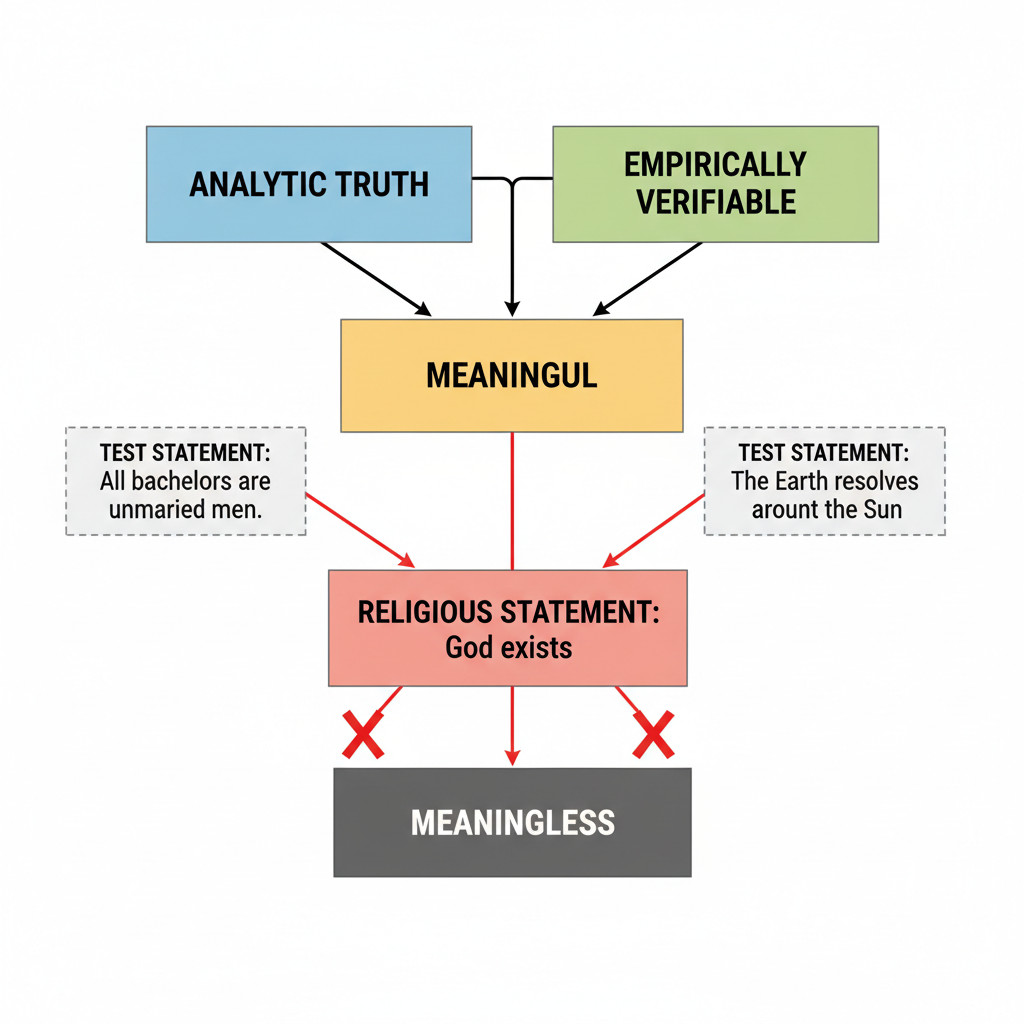
Logical positivism was a 20th-century philosophical movement (Vienna Circle, 1920s-30s) that aimed to eliminate metaphysics and establish philosophy on scientific foundations. At its heart was the verification principle: a statement is meaningful only if it is either (1) analytically true (true by definition, like "all bachelors are unmarried") or (2) empirically verifiable (can be tested through sense experience). A.J. Ayer (1910-1989) brought logical positivism to the English-speaking world in his book Language, Truth and Logic (1936). Applied to religion: "God exists" is neither analytic nor empirically verifiable, so it's meaningless (not false, but literally without meaning). Major criticism: the verification principle is self-defeating—it's neither analytic nor empirically verifiable, so by its own standard, it's meaningless.
Detailed Explanation
What Is Logical Positivism?
Historical Context:
- Logical positivism (also called logical empiricism) was a philosophical movement that originated in Vienna, Austria in the 1920s.
- The Vienna Circle was a group of philosophers and scientists who met regularly to discuss philosophy of science.
- Key figures: Moritz Schlick, Rudolf Carnap, Otto Neurath, Carl Hempel.
Core Mission:
- Establish philosophy on a scientific foundation
- Eliminate metaphysics from philosophical discourse
- Develop a unified science using logical analysis and empirical verification
- Align philosophy with scientific methods
Philosophical Influences:
- David Hume's empiricism and Hume's Fork
- Auguste Comte and Ernst Mach's positivism
- Einstein's general relativity as exemplar of science
- Kant's analytic-synthetic distinction
The Verification Principle
The Core Principle
The Verification Principle (Verifiability Criterion of Meaning):
"A statement is cognitively meaningful if and only if it is either: Analytically true (true by definition/logic), OR Empirically verifiable (can be verified through sense experience)"
What "Cognitively Meaningful" Means:
- Possessing truth value (can be true or false)
- Corresponding to a possible state of affairs
- Being intelligible or understandable as scientific statements are
What Happens to Statements That Fail:
- Statements that are neither analytic nor empirically verifiable are meaningless.
- Not false—literally without meaning.
- They are pseudo-statements that fail to make any claim about reality.
Two Types of Meaningful Statements
1. Analytic Statements (A Priori)
Definition: True by virtue of their own meaning or logical form.
Examples:
- "All bachelors are unmarried"
- "2 + 2 = 4"
- "Triangles have three sides"
- "If all men are mortal and Socrates is a man, then Socrates is mortal"
Characteristics:
- A priori (known independently of experience)
- Tautologies (true by definition)
- Necessary truths (couldn't be otherwise)
- Uninformative about the world (don't tell us facts about reality)
2. Synthetic Statements (A Posteriori)
Definition: Claims about the world that must be verified empirically through sense experience.
Examples:
- "The cat is on the mat"
- "Water boils at 100°C"
- "There is life on other planets"
- "The table is brown"
Characteristics:
- A posteriori (known through experience)
- Contingent (could be true or false)
- Informative about the world (tell us facts about reality)
- Verifiable through observation
A.J. Ayer and Language, Truth and Logic
Who Was A.J. Ayer?
- Sir Alfred Jules Ayer (1910-1989) was a British philosopher.
- He studied with the Vienna Circle in Vienna and brought logical positivism to the English-speaking world.
- His most famous work: Language, Truth and Logic (1936), written when he was only 26 years old.
Ayer's Application to Religious Language
The Argument:
Consider the statement: "God exists"
Question 1: Is it analytic?
- No—it's not true by definition.
- It's not part of the meaning of "God" that He exists.
- (Compare: "All bachelors are unmarried" is analytic because "unmarried" is part of the definition of "bachelor")
Question 2: Is it empirically verifiable?
- No—God is transcendent (beyond the physical world).
- There is no conceivable observational evidence that could establish whether "God exists" is true or false.
- We cannot use our five senses to verify God's existence.
Conclusion:
- "God exists" is meaningless.
- Not false—literally without meaning.
Ayer's Quote (paraphrased):
Religious language is "not untrue, but without meaning". "There exists a transcendent God" has no literal significance.
Ayer Is Not an Atheist
Ayer's Controversial Claim:
Ayer says he's not even an atheist.
Why?
- An atheist says they don't believe in God.
- But that's still to give the word "God" meaning.
- Ayer claims the word "God" is meaningless, so there's nothing to believe or disbelieve in.
Strong vs. Weak Verification
The Problem with Strong Verification
Strong Verification (Vienna Circle's Original Position):
A statement is meaningful if it can be conclusively verified as true or false beyond any doubt through sense experience.
The Problem:
This is too restrictive. It rules out as meaningless:
- Historical statements (we can't conclusively verify the past)
- Scientific laws (e.g., "All humans are mortal"—we can't test every human)
- General statements ("Water boils at 100°C"—we can't test every water molecule)
- Statements about the past (can't be observed now)
Ayer's Own Admission:
Ayer himself critiqued strong verification in his second edition, saying it "has no possible application".
Ayer's Solution: Weak Verification
Weak Verification (Ayer's Revised Position):
A statement is meaningful if it's probable or if we know in principle how to verify it.
Ayer's Quote:
"The question that must be asked about any putative statement of fact is not, 'Would any observations make its truth or falsehood logically certain?' but simply, 'Would any observations be relevant to the determination of its truth or falsehood?'"
What This Allows:
- Historical statements (in principle, we could have observed the past)
- Scientific theories (observations are relevant to their truth)
- "There is life on other planets" (we could in principle verify this)
- "All humans are mortal" (probability weighs in favor; observations are relevant)
What It Still Excludes:
- Religious statements ("God exists"—no observations could be relevant)
- Ethical statements ("Murder is wrong"—not empirically verifiable)
- Aesthetic statements ("This painting is beautiful"—subjective)
Implications for Religious Language
Religious Language Is Meaningless
The Claim:
All religious statements are meaningless.
Examples:
- "God exists"
- "God is love"
- "God answers prayers"
- "Jesus rose from the dead"
- "There is an afterlife"
None of these can be empirically verified, so they're all meaningless.
But Religious Language Has Emotive Meaning
Ayer's Distinction:
- Ayer acknowledges religious language has emotive value.
- It expresses feelings, emotions, and attitudes.
But:
- This is not cognitive meaning.
- Religious language doesn't make factual claims about reality.
- It's like saying "Boo!" or "Hooray!".
Ayer's "Boo/Hooray Doctrine":
- All evaluative judgments (including religious and ethical ones) are merely emotional reactions.
- "God is good" = "Hooray for God!"
- "Murder is wrong" = "Boo to murder!"
Criticisms of Logical Positivism
Criticism 1: The Self-Defeating Problem
The Most Famous Criticism:
The verification principle is self-defeating.
The Argument:
- Consider the verification principle itself: "A statement is meaningful only if it is analytic or empirically verifiable".
- Question: Is this statement analytic or empirically verifiable?
- Answer: No.
- It's not analytic (not true by definition)
- It's not empirically verifiable (we can't test it through sense experience)
Conclusion:
- By its own standard, the verification principle is meaningless.
- If the principle is meaningless, then logical positivism collapses.
Ayer's Response:
Ayer admitted this problem and responded that the verification principle is a "methodological stipulation"—a tool for philosophical purposes, not a factual claim.
Problem with Ayer's Response:
- This seems like special pleading.
- If the principle is just a stipulation, why should we accept it?
Criticism 2: Excludes Too Much
The Problem:
Strict adherence to the verification principle would render vast areas of human discourse meaningless:
Ethics:
- "Murder is wrong"
- "We ought to help the poor"
- All moral statements become meaningless
Aesthetics:
- "This painting is beautiful"
- "Beethoven's music is sublime"
- All aesthetic judgments become meaningless
Science:
- Universal laws ("All swans are white") can never be conclusively verified
- Statements about unobservable entities (electrons, quarks) can't be directly verified
- Theoretical statements in physics become problematic
History:
- We can't directly observe the past
The Absurdity: We'd have to say that ethics, aesthetics, much of science, and history are meaningless. This is clearly implausible.
Criticism 3: Fails to Account for Induction
The Problem:
- Science relies on inductive reasoning—generalizing from particular observations to universal laws.
- But induction can never conclusively verify universal statements.
Example:
- "All swans are white" can't be verified by observing some white swans.
- We'd have to observe every swan that has ever existed or will exist.
Implication:
- Scientific laws become meaningless or problematic under the verification principle.
- But science is supposed to be the paradigm of meaningful discourse for logical positivists.
Criticism 4: Quine's "Two Dogmas of Empiricism"
W.V.O. Quine's Critique:
- Quine argued that the analytic-synthetic distinction (foundational to logical positivism) cannot be maintained.
- There's no clear way to distinguish analytic from synthetic statements.
- If the distinction collapses, the verification principle collapses.
Criticism 5: Karl Popper's Alternative
Popper's Critique:
- Karl Popper argued that verification is the wrong criterion.
- Scientific theories can never be verified, only falsified.
Popper's Falsification Principle:
- A statement is meaningful if it's falsifiable (if observations could potentially show it's false).
- This is a more permissive criterion that avoids some of logical positivism's problems.
Criticism 6: Statements About Unobservables
The Problem:
- Modern science talks about unobservable entities—electrons, quarks, black holes, etc.
- These can't be directly observed.
- But surely statements about them are meaningful.
- Yet they're problematic for the verification principle.
Ayer's Later View
Ayer's 1976 Admission
The Famous Interview:
In a 1976 interview, Ayer was asked what he saw as the main defects of logical positivism.
Ayer's Response:
"Nearly all of it was false."
But he added:
It was "true in spirit"—the principles of empiricism and emphasis on language and meaning were valuable.
Scholarly Perspectives
"A sentence is factually significant [meaningful] if, and only if, we know how to verify the proposition it purports to express—that is, if we know what observations would lead us to accept the proposition as true or reject it as false. 'God' is a metaphysical term which means it is about something beyond the empirical world, so there can be no way to empirically verify it."
"The verification principle is self-defeating. The statement 'a statement is meaningful only if it is analytic or empirically verifiable' is itself neither analytic nor empirically verifiable. Therefore, according to its own criteria, the verification principle is meaningless."
Key Takeaways
- ✓Logical positivism: eliminate metaphysics; establish philosophy on scientific foundations
- ✓Vienna Circle (1920s-30s): Schlick, Carnap, Neurath, Hempel
- ✓Verification principle: meaningful = analytic OR empirically verifiable
- ✓Analytic: true by definition (tautologies, logic, math)
- ✓Empirically verifiable: testable through sense experience
- ✓Ayer (1910-1989): brought logical positivism to English-speaking world
- ✓Language, Truth and Logic (1936): Ayer's famous work
- ✓"God exists": neither analytic nor verifiable → meaningless
- ✓Not false but literally without meaning—pseudo-statement
- ✓Strong verification: conclusive proof—too restrictive, rules out science
- ✓Weak verification: probable or in principle verifiable—Ayer's revision
- ✓Self-defeating criticism: principle itself neither analytic nor verifiable
- ✓Ayer 1976: "Nearly all of it was false" but "true in spirit"