Divine Free Will
Summary
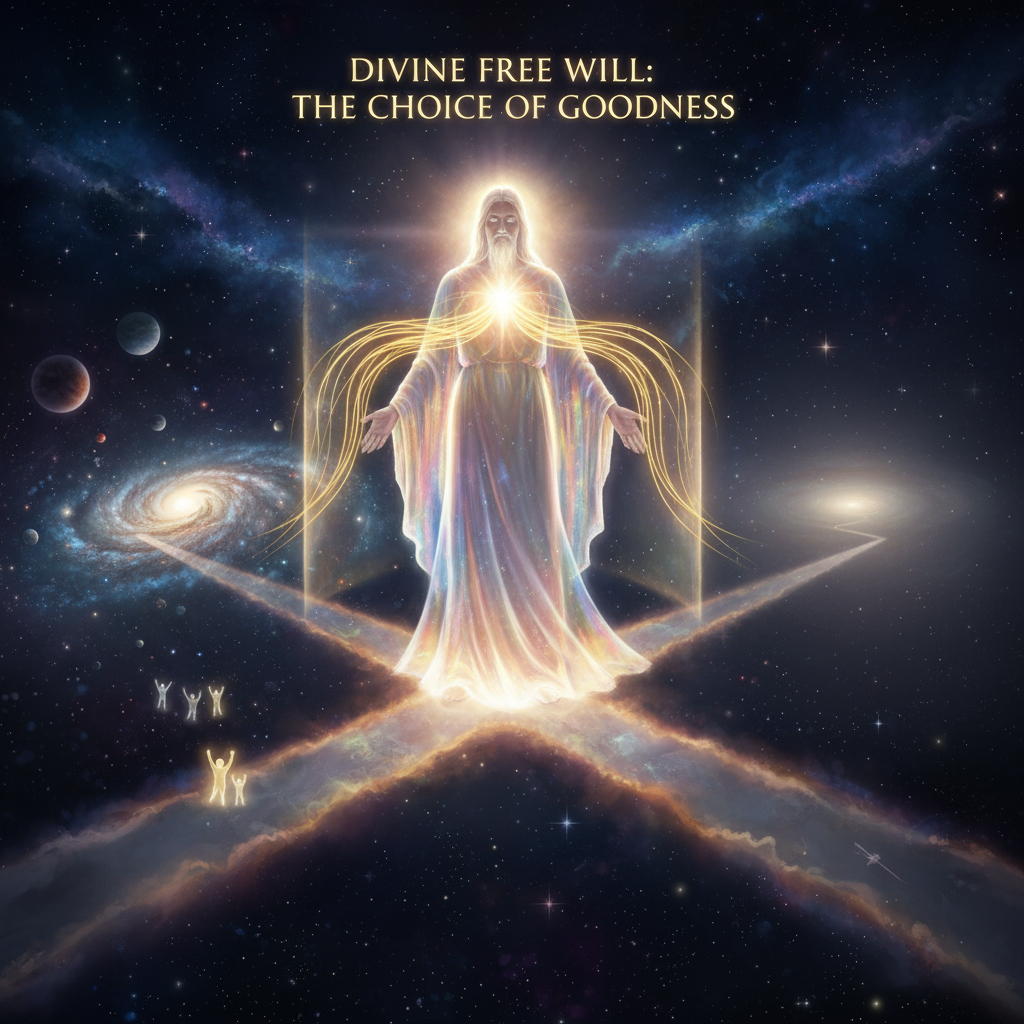
The question "Does God have free will?" creates a paradox: If God is perfectly good and omniscient, can He genuinely choose? God cannot sin (choose evil) because His nature is perfectly good—but does this mean He lacks free will? Two responses: (1) Anselm/Aquinas: Free will means the ability to choose good, not evil. God has perfect free will because He always chooses good freely; evil is not a real option but mere privation (nothingness). (2) Compatibilism: God's choices are determined by His perfect nature, but they're still free because they flow from His own desires without external coercion. The theological dilemma: God is immutable (unchanging) and eternal (outside time), so how can He make choices (which require deliberation and change)? Aquinas' solution: God makes one eternal act of will that encompasses all choices timelessly; suppositional necessity means once God wills something from eternity, it must occur—but He freely chose which eternal will to have.
Detailed Explanation
The Central Question: Does God Have Free Will?
The Problem
- God is necessarily all-knowing and all-good
- If God is all-knowing, He knows at all times all possible actions He can take
- If God is all-good, He cannot choose any action except the one that is "most good"
- Therefore, God seems "chained by His own being" and "forced to act in a specific way"
- Does this mean God lacks free will?
Defining Free Will
Human Free Will (Libertarian):
- The ability to freely choose between alternative options
- When I choose tea, I could have chosen coffee instead—the choice was genuinely open
- Requires: power of contrary choice (ability to do otherwise)
The Question for God:
- Can God do otherwise than what He actually does?
- Or is God's action determined by His perfect nature?
THE PROBLEM: God's Attributes Seem to Exclude Free Will
Problem 1: God's Perfect Goodness
The Argument:
- P1: God is essentially perfectly good—He cannot be evil
- P2: Therefore, God cannot choose evil
- P3: Free will requires the ability to choose between good and evil
- C: Therefore, God does not have free will
The Dilemma:
- If God can choose evil, He's not perfectly good
- If God cannot choose evil, He lacks free will
Problem 2: God's Immutability
What Is Divine Immutability?
- God is unchanging and unchangeable
- God cannot change in His nature, knowledge, or will
- Numbers 23:19: "God is not a man, that He should lie, nor a son of man, that He should change His mind"
The Problem for Free Will:
Making a choice requires:
- Considering alternatives (deliberation)
- Transitioning from potency to act (change from "could do X" to "actually doing X")
- Temporal process (time to think and decide)
But God is immutable—He doesn't change, deliberate, or experience temporal succession. So how can God make choices?
Problem 3: God's Eternity (Timelessness)
The Argument:
- P1: God is eternal—He exists outside time
- P2: Choice requires temporal process (deliberation, then decision)
- P3: Therefore, God cannot choose in the way we do
- C: God's eternity seems to preclude free will
Problem 4: Divine Simplicity
What Is Divine Simplicity?
- God is simple—He has no parts or distinctions
- God's essence, existence, will, knowledge, and power are all identical
The Problem:
- If God's will is identical to His essence, and His essence is necessary, then His will is necessary
- There's no distinction between what God can do and what God actually does
- Therefore, God's "choices" are determined by His nature, not freely made
Kenny's Objection from Simultaneity:
- P1: Simultaneity is a transitive relation
- P2: If A is simultaneous with B, and B is simultaneous with C, then A is simultaneous with C
- P3: On the timeless view, God is simultaneous with all events
- P4: Therefore, if God is simultaneous with the burning of Rome AND simultaneous with me typing these words, then the burning of Rome is simultaneous with me typing these words
- C: But the burning of Rome is not simultaneous with me typing—this is absurd. Therefore, divine timelessness is incoherent.
SOLUTION 1: Anselm's Redefinition of Free Will
Freedom as Choosing the Good
Anselm's Key Move:
- Free will is NOT the ability to choose between good and evil
- Rather, free will IS the ability to choose the good
Anselm's Argument:
- P1: Evil is privatio boni (absence/privation of good)—it's nothing
- P2: Choosing evil means choosing nothing
- P3: Real choice is choosing something, not nothing
- C: True free will is the ability to choose right
"God by nature can only choose good, but it would be wrong to say that he doesn't have free will. Free will IS the ability to choose right."
— Anselm (paraphrased)
The Rightness of Action
- Part of the rightness of any action is choosing to do it freely
- Being forced to do the right thing doesn't show goodness
- Therefore, God's freely choosing good (even though He cannot choose evil) demonstrates His perfect freedom and goodness
Implication
- God has perfect free will because He always freely chooses good
- His inability to sin is not a limitation but a perfection
- Just as being unable to lie or contradict Himself isn't a limitation on omnipotence, being unable to sin isn't a limitation on free will
SOLUTION 2: Aquinas' Eternal Act of Will
God's Free Will Without Change
Aquinas' Key Insight:
- God's very substance is an eternal act of will
- This is not an act having temporal duration—God is His own act of choosing
What God Wills Necessarily
- God necessarily wills His own goodness and existence
- Why? Because God's will is identical to His goodness and existence (divine simplicity)
- God cannot will against His own nature
What God Wills Freely
- God does not necessarily will things other than Himself
- God freely chooses whether to:
- Create the universe or not
- Create this particular universe or a different one
- Create humans or not
"God only wills Himself necessarily... However, He is free to will anything else."
— Thomas Aquinas
Suppositional Necessity
The Key Concept:
- Suppositional necessity: Once God wills something (from eternity), He wills it immutably—it cannot change
- But: God freely chose which eternal will to have
Aquinas' Example:
- Given that God has willed to create this universe, He cannot now change His mind (because He's immutable)
- However, God was free to will to create this universe or not create it
- His choice to create was free, even though once made, it's eternally fixed
The Analogy:
Imagine God eternally holding a remote control with two buttons: "Create" and "Don't Create"
- God freely pressed "Create" from eternity
- Once pressed (eternally), it can't be un-pressed
- But God was genuinely free to press either button
No Real Distinction Between Potency and Act
The Problem:
- For us, there's a distinction between:
- Potency (what we can do)
- Act (what we actually do)
- We have many potentialities that we don't actualize
For God:
- God is pure act—He has no potentiality
- There's no distinction between what God can do and what God does
How Is This Freedom?
- God is determined by His own nature to act freely
- With respect to creating lesser goods, God is determined to be not-determined
- His nature determines that His will regarding creation is not necessary, and therefore perfectly free
SOLUTION 3: Compatibilism About Divine Free Will
God's Freedom Is Compatibilist
The Compatibilist Definition:
Free will doesn't require the ability to do otherwise (libertarian freedom). Rather, free will requires:
- Acting according to one's desires
- Freedom from external coercion
Applied to God:
- God's actions flow from His own perfect nature
- No external force compels God
- Therefore, God's choices are genuinely free, even though they're determined by His nature
Jonathan Edwards' Account
- Freedom is "the ability to act according to one's desires"
- God always acts according to His desires (which are perfectly good)
- Therefore, God is supremely free—more free than anyone else
The Catholic Catechism:
"The more one does what is good, the freer one becomes. There is no true freedom except in the service of what is good and just."
In this view, perfect goodness = perfect freedom.
SOLUTION 4: Divine Simplicity and Unique Freedom
God Is "Freedom Itself"
The Thomistic View:
God is uniquely free in a way nothing else is.
Why?
- Everything else has some external source or origin that determines it
- But God is Being Itself—no external power can constrain Him except Himself
- And by divine simplicity, God is Himself, His Will, His divine nature, His freedom
- His existence and essence are identical
The Implication
- The only account for who God is (including what He necessarily wills) is God Himself
- God's "necessity" is something willed by Him freely
- Advocates of divine simplicity call God "Freedom Itself"
The Self-Determined God
Key Point:
- God is determined by nothing but Himself
- God's nature determines Him to act freely
- This is not a contradiction—it's the perfection of freedom
The Analogy:
- You cannot choose to levitate (physically impossible), but this doesn't mean you lack free will
- Similarly, God cannot choose to be evil (metaphysically impossible given His nature), but this doesn't mean He lacks free will
The Theological Paradox: Free Will and Predestination
The Problem for Humans
Calvinism:
- If God is sovereign and knows all, then He has predestined who will be saved (the elect) and who will be damned (the reprobate)
- This seems to eliminate human free will
The Dilemma:
- If God knows what we'll do, we can't do otherwise
- If we can't do otherwise, we lack free will
- But if we lack free will, we're not morally responsible
Process Theology Solution
Process Theology's Claim:
- God cannot have complete knowledge of the future
- The future is not determined but open to possibilities as a result of free will
- This limits divine omniscience to preserve human freedom
Criticisms and Problems
Criticism 1: Redefining Freedom Doesn't Solve the Problem
The Objection:
- Anselm's redefinition seems like avoiding the problem rather than solving it
- We normally understand free will as the power to do otherwise
- Saying "freedom is just choosing good" changes the definition to avoid the paradox
Criticism 2: Modal Collapse
The Problem:
- If God's nature determines His choices, and God's nature is necessary, then everything God does is necessary
- This leads to modal collapse—the distinction between necessity and contingency collapses
- If God necessarily creates this world, then this world is necessary (not contingent)
- But we think the world is contingent—it could have not existed
Criticism 3: God Seems Causally Determined
The Objection:
- If God must choose the "most good" action, His choice is causally determined by His nature
- This looks like determinism, not freedom
- Even if no external force compels God, His internal nature compels Him
Criticism 4: Logical Possibilities vs. Real Possibilities
The Problem:
- Aquinas says other worlds are "logically possible" but not "metaphysically possible" given that God has already chosen this world
- But if they're not really possible, were they ever genuinely options for God?
- If not, God's "choice" wasn't a real choice
Quick Reference: Does God Have Free Will?
| View | Answer | Key Claim |
|---|---|---|
| Anselm | Yes | Free will = ability to choose good; God has perfect freedom |
| Aquinas | Yes | God makes one eternal act of will; suppositional necessity |
| Compatibilism | Yes | Freedom = acting on desires without coercion; God perfectly free |
| Divine Simplicity | Yes | God is "Freedom Itself"; self-determined |
| Critics | No/Problematic | God's nature determines choices; not genuine freedom |
Scholarly Perspectives
"God by nature can only choose good, but it would be wrong to say that he doesn't have free will. Free will IS the ability to choose right. Doing the right thing by being forced does not show goodness. Anselm accepts Augustine's premise that evil is a privation of good, and so choosing evil is choosing nothing. Choosing means choosing something good."
"While he necessarily wills those goods that are equivalent to his own being, such as his own existence and his own goodness, he nonetheless does not necessarily will lesser goods than his own goodness, such as his will to create this world or that world or not to create at all... Thus, when God chooses freely to create this world as opposed to any other, this choice does not make him to somehow become a 'contingent' being. He is still the one and only Necessary Being, but he makes a free choice that in no way contradicts his existential necessity."
Key Takeaways
- ✓The paradox: If God is perfectly good, can He genuinely choose (or is He determined by His nature)?
- ✓Problem 1: God cannot sin—does this mean He lacks free will?
- ✓Problem 2: God is immutable (unchanging)—how can He make choices?
- ✓Problem 3: God is eternal (timeless)—choice requires temporal process
- ✓Anselm's solution: Free will = ability to choose good, not evil; God has perfect freedom
- ✓Evil is privatio boni (nothingness); choosing evil = choosing nothing
- ✓Aquinas' solution: God makes one eternal act of will encompassing all choices
- ✓Suppositional necessity: Once God wills X (from eternity), He can't change; but He freely chose which eternal will to have
- ✓Compatibilism: Freedom = acting on own desires without coercion; God supremely free
- ✓Divine simplicity: God is 'Freedom Itself'—self-determined, constrained only by Himself
- ✓Criticisms: Redefines freedom; leads to modal collapse; still looks like determinism
- ✓Connection to human free will: If God lacks freedom, how can we have it?