Eternity
Summary
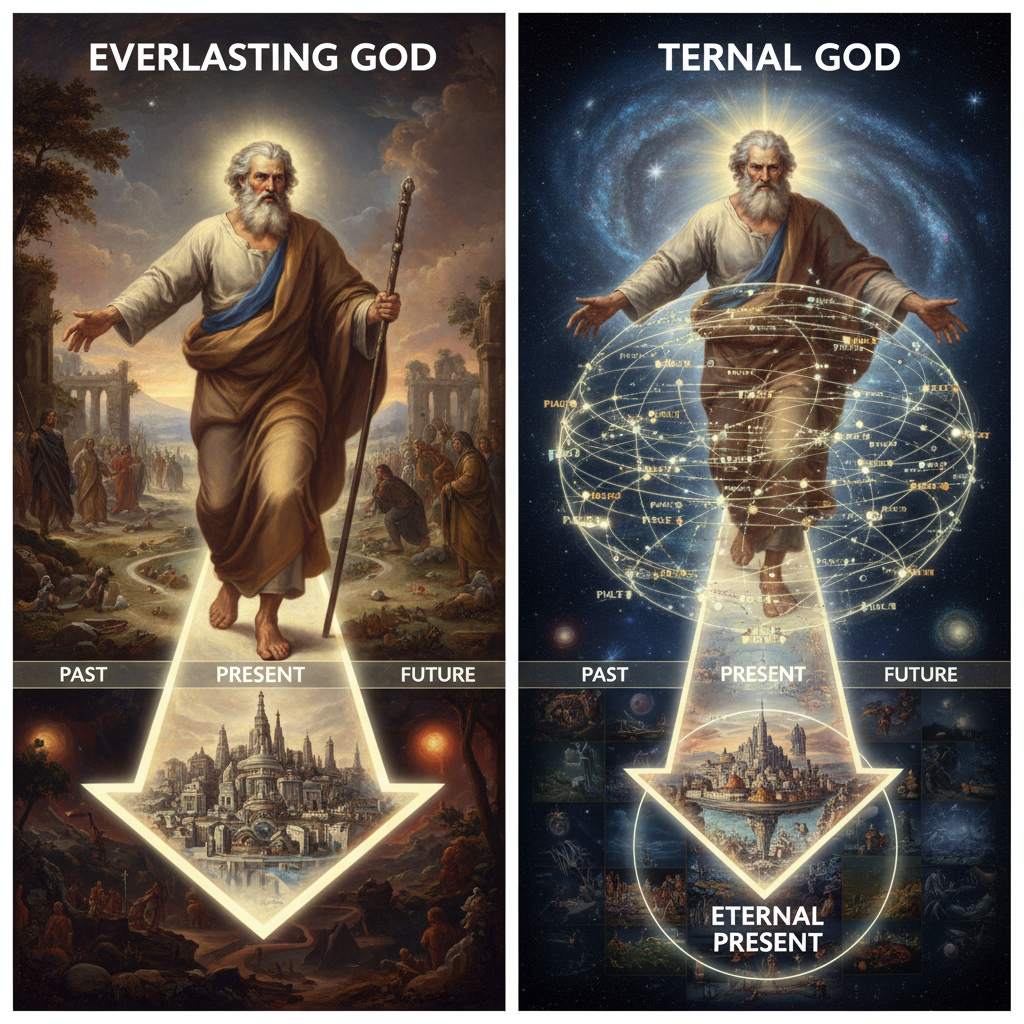
There are two competing views of God's relationship to time: (1) Everlasting (temporal): God exists within time—He was there at the beginning and will exist forever, experiencing time moment by moment like we do. (2) Eternal (timeless): God exists outside time—He has no past, present, or future, but experiences all of time simultaneously in an "eternal present." Boethius (6th century) argued God is eternal, using the definition: "the complete possession all at once of illimitable life." God doesn't have foreknowledge of the future; rather, He sees all time (past, present, future) simultaneously, like viewing an entire parade from a helicopter while we stand on the street seeing one float at a time. This solves the free will problem: God knows what we freely choose, not before we choose but timelessly. Critics (Swinburne, Kenny) argue a timeless God is incoherent—how can God act, love, or relate to temporal beings if He's outside time?
Detailed Explanation
Two Competing Views of Divine Eternity
Religious philosophers disagree fundamentally about God's relationship to time.
View 1: God Is Everlasting (Within Time)
- God exists within time
- God experiences temporal succession (one moment after another)
- God has always existed and will always exist—He never began and will never end
- God experiences past, present, and future like we do, but without beginning or end
View 2: God Is Eternal (Outside Time/Timeless)
- God exists outside time altogether
- God does not experience temporal succession
- God has no past, present, or future—these concepts don't apply to Him
- All of time exists simultaneously in God's "eternal present"
The Traditional View: God as Eternal (Timeless)
Boethius' Definition of Eternity
Anicius Manlius Severinus Boethius (c. 480-524 CE) was a Roman philosopher and Christian theologian. His masterwork: The Consolation of Philosophy (written while imprisoned awaiting execution).
Boethius' Famous Definition:
"Eternity is the complete possession all at once of illimitable life."
Or in fuller form: "Eternity is the simultaneously-whole and perfect possession of boundless life, which lacks nothing of the future and has lost nothing of the past."
What This Means:
- "Complete possession": God possesses His entire life fully and perfectly; nothing is missing, nothing is incomplete
- "All at once": God experiences all of His life simultaneously; no temporal succession—no "before" and "after"
- "Illimitable life": God's life has no beginning and no end; but more importantly, it has no temporal extension at all
The Eternal Present
Boethius' Key Insight:
- Humans experience time in succession—one moment at a time (past → present → future)
- An eternal being experiences all moments simultaneously
- What we call "past" and "future" are just as present to God as what we call "present" is to us
Boethius' Quote:
"God's knowledge, transcending all movement of time, dwells in the simplicity of its own changeless present, and, embracing the whole infinite sweep of the past and of the future, contemplates all that falls within its simple cognition as if it were now taking place."
The Parade Analogy
Imagine time as a parade:
Humans (within time):
- We're standing on the street watching the parade pass by
- We see one moment at a time—float #5 is passing now
- Float #4 is in the past (already passed us)
- Float #6 is in the future (hasn't reached us yet)
God (outside time):
- God is in a helicopter high above the parade
- God sees the entire parade all at once—beginning, middle, and end simultaneously
- All "floats" (moments) are equally present to God
The Point: God doesn't view time unfolding sequentially. God views all of time at once in His eternal present.
Anselm's Four-Dimensional View
Anselm (1033-1109) developed Boethius' view further using a higher dimension analogy.
Think of dimensions:
- 1D: A line (length only)
- 2D: A square (length + width)
- 3D: A cube (length + width + height)
- 4D: A hypercube (length + width + height + time)
Anselm's Argument:
- We exist in 3D space + 1D time (we experience time sequentially)
- God exists in a "higher dimension" where all of time is contained
- Just as a cube "contains" all the squares that make it up, God's eternity "contains" all moments of time
Brian Leftow's Summary:
"Anselm had come to see eternity as like a super-temporal dimension, 'containing' time and temporal entities rather as time 'contains' space and spatial entities."
Implication:
- God is temporally omnipresent—present at every moment of time, all at once
- God and all temporal events are ET-simultaneous (eternally simultaneous)
- Even two events that are temporally distinct (e.g., the Fall of Rome and today) are nonetheless simultaneous with God in eternity
How Eternity Solves the Omniscience-Free Will Problem
The Problem Revisited
The Dilemma:
- If God knows what I will do tomorrow, then I cannot do otherwise
- If I cannot do otherwise, I lack free will
- But if I lack free will, God cannot justly judge me
- Therefore, omniscience seems incompatible with omnibenevolence and free will
Boethius' Solution
The Key Insight:
- God does not know the future before it happens
- Rather, God knows all events as they happen—but "as they happen" means "in the eternal present" where all time exists simultaneously
How This Preserves Free Will:
- God sees the results of our free choices
- He doesn't predict them or determine them
- Just as watching someone walk doesn't cause them to walk, God's timeless observation of our choices doesn't cause or determine them
The Chariot Analogy (Boethius):
My knowledge that a chariot passed me at a particular time does not make it travel faster or slower or take that route. My knowledge of its motion is contingent on its motion and does not make its motion logically or naturally necessary. Similarly, God's knowledge of our actions is contingent on our free actions—it doesn't determine them.
The Crucial Distinction:
- God is ET-simultaneous (eternally simultaneous) with all temporal events, including our future actions
- God knows what we will do next, but only because God eternally sees what we do with our free will at all the times of our life
- God's knowledge does not determine our actions, so we still have free will
Stump and Kretzmann: ET-Simultaneity
Eleonore Stump and Norman Kretzmann developed Boethius' view in modern terms.
Two Types of Simultaneity:
1. T-Simultaneity (Temporal Simultaneity):
- Two events occur at the same temporal moment
- Example: The clock striking 12 and the new year beginning
2. ET-Simultaneity (Eternal-Temporal Simultaneity):
- An eternal event and a temporal event occur "together" in a special sense
- All temporal events are ET-simultaneous with God's eternal present
The Key Point: Even though the Fall of Rome and today are not T-simultaneous with each other, they are both ET-simultaneous with God. God experiences them "together" in His eternal present.
Strengths of the Eternal (Timeless) View
- Solves the Free Will Problem: God's timeless knowledge is compatible with libertarian free will
- Reflects God's Perfection: God would be subject to change if He was within time. A perfect being cannot change (immutability). Therefore, God must be outside time
- Shows God Is Not Limited: Time is God's creation, not something that constrains Him. If God existed in time, He would be limited by time
- Consistent with Divine Simplicity: If God were everlasting in time, He would have temporal parts (past, present, future). But God is simple (without parts). Therefore, God must be eternal (timeless)
- Supported by Great Thinkers: Augustine, Boethius, Anselm, Aquinas all defended divine timelessness. Contemporary defenders: Eleonore Stump, Norman Kretzmann, Paul Helm, Brian Leftow
Criticisms of the Eternal (Timeless) View
Criticism 1: Anthony Kenny—Timelessness Is Incoherent
Sir Anthony Kenny argues the concept of a timeless God is "radically incoherent".
Kenny's Objection from Simultaneity:
- P1: Simultaneity is a transitive relation
- P2: If A is simultaneous with B, and B is simultaneous with C, then A is simultaneous with C
- P3: On the timeless view, God is simultaneous with all events
- P4: Therefore, if God is simultaneous with the burning of Rome AND simultaneous with me typing these words, then the burning of Rome is simultaneous with me typing—this is absurd. Therefore, divine timelessness is incoherent
Response (Stump & Kretzmann):
- Kenny misunderstands the concept
- T-simultaneity (temporal) is transitive
- ET-simultaneity (eternal-temporal) is not transitive
- Two events can both be ET-simultaneous with God without being T-simultaneous with each other
Problem with the Response: Some philosophers argue this just relocates the problem—it doesn't really solve it.
Criticism 2: Richard Swinburne—Timelessness Is Unbiblical and Incoherent
Richard Swinburne (contemporary philosopher) rejects divine timelessness:
Argument 1: Unbiblical
- The Hebrew Bible shows no knowledge of the doctrine of timelessness
- Scripture consistently portrays God as within time—acting, responding, changing His mind
- "From everlasting to everlasting, thou art God" (Psalm 90:2) describes everlasting duration, not timelessness
Argument 2: Incompatible with Divine Action
- If God has no concept of past, present, or future, how can God pick a particular time in history and intervene directly?
- God has no concept of human time, making divine action impossible
Argument 3: Incompatible with Personal Relationship
- When did God do things?
- A timeless God would be unmoved by prayers of the suffering
- Prayer and worship require a God who can respond in time
Argument 4: Incompatible with the Incarnation
- How can a timeless God become incarnate in time as Jesus?
- The Incarnation requires God to enter time and experience temporal succession
Criticism 3: William Lane Craig—God Became Temporal at Creation
Craig's Hybrid View: God was timeless before (logically, not temporally) creation. But God became temporal at the moment of creation.
Craig's Argument:
- P1: Without creation, God exists alone—changeless and timeless
- P2: At creation, God enters into a new relation with the universe
- P3: This is at least an extrinsic change (relational change)
- P4: Change requires time
- C: Therefore, God became temporal at creation
Criticism of Craig (Erik Wielenberg):
Craig's view is logically contradictory. At the moment of creation (t₁), God must be both timeless (to have the power to create) and temporal (because He's acting at a time). This is impossible—God cannot be both timeless and temporal at t₁.
The Modern View: God as Everlasting (Temporal)
The Shift in Contemporary Philosophy
- Historical View: From Augustine through Aquinas, the dominant view was that God is timeless
- Contemporary View: Now, the dominant view among philosophers is that God is temporal. God's eternal nature is thought of as being everlasting rather than timeless
What This Means:
- God never came into existence and will never go out of existence
- But God exists at each moment in time
- God experiences temporal succession (one moment after another)
Proponents:
Richard Swinburne, William Lane Craig (since creation), Nicholas Wolterstorff, Oscar Cullmann, Process theologians
Comparison Table: Eternal vs. Everlasting
| Element | Eternal (Timeless) | Everlasting (Temporal) |
|---|---|---|
| Relationship to Time | Outside time altogether | Within time forever |
| Temporal Succession | No succession; all at once | Experiences moments sequentially |
| Past/Present/Future | All simultaneously present | Has past, present, future |
| Change | Absolutely unchanging | Can change relationally |
| Free Will Solution | Sees our choices in eternal present | Uses compatibilism or open theism |
| Main Defenders | Boethius, Anselm, Aquinas | Swinburne, Craig (post-creation) |
| Main Criticism | Incoherent; can't act in time | Limits God; makes God changeable |
Scholarly Perspectives
"Eternity is the complete possession all at once of illimitable life... God's knowledge, transcending all movement of time, dwells in the simplicity of its own changeless present, and, embracing the whole infinite sweep of the past and of the future, contemplates all that falls within its simple cognition as if it were now taking place."
"The Hebrew bible shows no knowledge of the doctrine of timelessness. God is everlasting. He exists at all times past and time future... The idea of timelessness and God is incoherent."
Key Takeaways
- ✓Two views: Everlasting (within time forever) vs. Eternal (outside time)
- ✓Boethius' definition: 'complete possession all at once of illimitable life'
- ✓Eternal God sees all time simultaneously in 'eternal present'
- ✓Parade analogy: we see one moment; God sees whole parade at once
- ✓Anselm: eternity is higher dimension containing all of time
- ✓ET-simultaneity: God simultaneous with all events; events not simultaneous with each other
- ✓Solves free will: God sees what we freely choose, not before but timelessly
- ✓Kenny's criticism: simultaneity is transitive; timelessness leads to absurdity
- ✓Swinburne: timelessness is unbiblical and makes divine action impossible
- ✓Craig: God was timeless, became temporal at creation (hybrid view)
- ✓Traditional view (Augustine-Aquinas): God is timeless
- ✓Modern dominant view: God is everlasting within time
- ✓Debate continues; no consensus among contemporary philosophers