Logical Problem of Evil
Summary
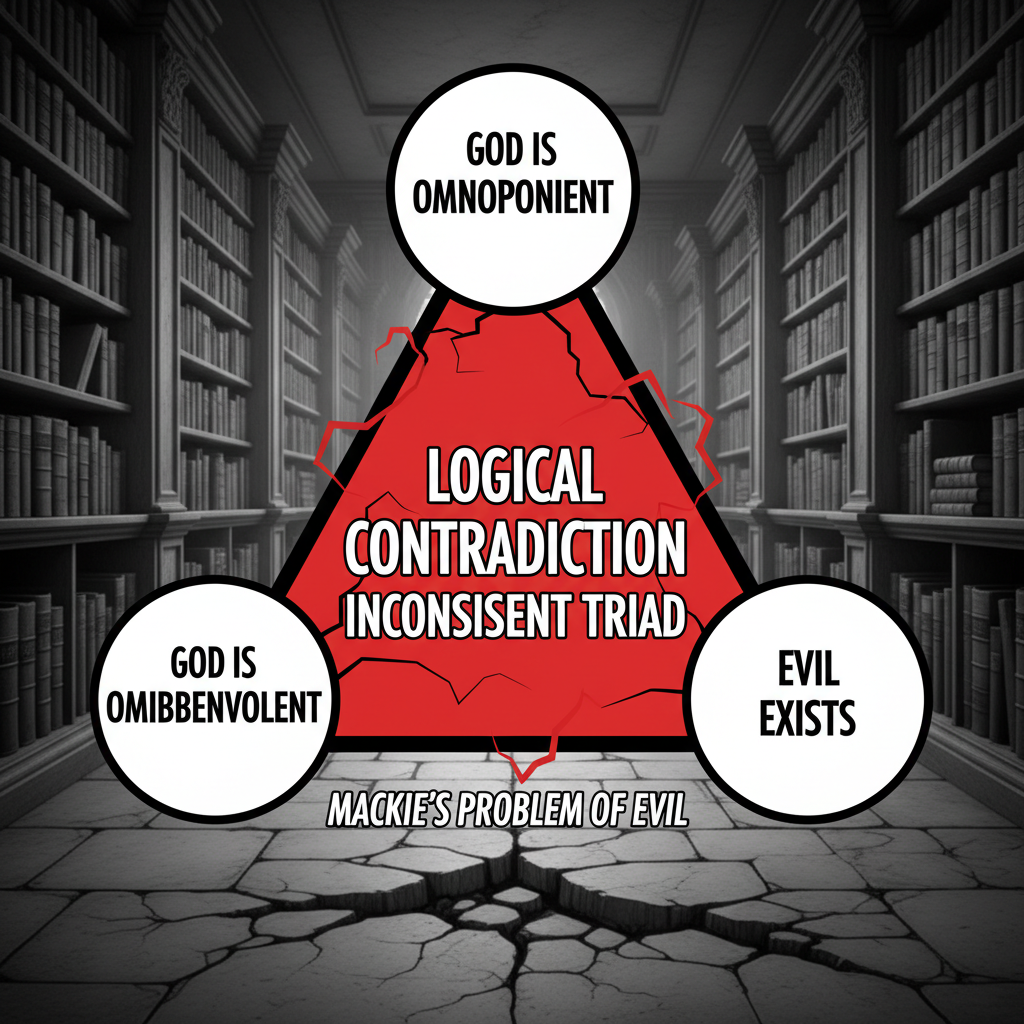
The logical problem of evil argues that God's existence is logically impossible given that evil exists. Epicurus asked: "Is God willing to prevent evil but not able? Then he is not omnipotent. Is he able but not willing? Then he is malevolent." J.L. Mackie formulated this as the inconsistent triad: three statements that cannot all be true—(1) God is omnipotent, (2) God is omnibenevolent, (3) Evil exists. Since we clearly observe evil, at least one of the other two must be false. This is a deductive, a priori argument—if the premises are true, the conclusion (God doesn't exist) must be true.
Epicurus' Formulation: The Quadrilemma
Who Was Epicurus?
Epicurus (341-270 BCE) was an ancient Greek philosopher who was one of the first to formulate the problem of evil systematically.
The Four-Part Dilemma
Epicurus presented the problem as four mutually exclusive logical possibilities:
Option 1: God is willing to prevent evil but not able
Conclusion: God is not omnipotent (not all-powerful). Problem: This contradicts the definition of God as omnipotent.
Option 2: God is able to prevent evil but not willing
Conclusion: God is malevolent (evil or indifferent). Problem: This contradicts the definition of God as omnibenevolent.
Option 3: God is both able and willing to prevent evil
Question: Then where does evil come from? Why does it exist? Problem: If God has both the power and the desire to eliminate evil, evil shouldn't exist. But it does.
Option 4: God is neither able nor willing to prevent evil
Question: Then why call him God? Problem: A being lacking both power and goodness doesn't deserve the title "God".
All four options lead to problems for theism. Since evil clearly exists, and assuming God must be both omnipotent and omnibenevolent, God cannot exist.
J.L. Mackie's Formulation: The Inconsistent Triad
Who Was J.L. Mackie?
John Leslie Mackie (1917-1981) was an Australian philosopher who presented the most influential modern version of the logical problem of evil in his 1955 article "Evil and Omnipotence".
The Three Propositions
Mackie argued that the following three propositions form an inconsistent triad—they cannot all be true at the same time:
You can only accept TWO of these three: Accept 1 + 2 (God is omnipotent and omnibenevolent) → Deny 3 (evil doesn't exist); Accept 1 + 3 (God is omnipotent, evil exists) → Deny 2 (God isn't omnibenevolent); Accept 2 + 3 (God is omnibenevolent, evil exists) → Deny 1 (God isn't omnipotent).
Why They're Inconsistent
Mackie argues that these three propositions, together with two additional assumptions, create a logical contradiction:
- Additional Assumption 1: An omnipotent being has the power to eliminate evil
- Additional Assumption 2: An omnibenevolent being has the motivation to eliminate evil
Mackie says: "A good thing always eliminates evil as far as it can". The logical problem is not saying "Given the amount of evil, God probably doesn't exist" (that's the evidential problem). The logical problem is saying: "It is logically impossible for God and evil to coexist"—there is a logical contradiction (like 2+2=5) in affirming both God's existence and evil's existence.
Responses to the Logical Problem
Why the Logical Problem Can Be Defeated
Because the logical problem makes such a strong claim (God and evil are logically incompatible), it can be defeated by showing even one logically possible scenario where God and evil coexist. You don't have to prove this scenario is true or even likely—just that it's possible.
Response 1: The Free Will Defense (Plantinga)
Moral evil (evil caused by humans) results from the misuse of free will. God cannot remove evil without removing free will—this would be logically impossible. A world with free will (even though it allows evil) is more valuable than a world without free will. Therefore, it's better for evil to exist (as a consequence of free will) than for it not to exist.
Plantinga's Response: Transworld Depravity
Alvin Plantinga introduced the concept of transworld depravity (TWD): a person suffers from transworld depravity if in every possible world where that person has significant free will, they commit at least one morally wrong action. It's logically possible that all creaturely essences (all possible persons God could create) suffer from transworld depravity. If this is true, then there is no possible world where creatures have free will and never do evil. God cannot actualize such a world because it's logically impossible—like creating a square circle.
Response 2: The Soul-Making Theodicy (Irenaeus & Hick)
Creating humans fully developed (morally perfect from the start) was logically impossible. Why? A fully developed soul is one that has chosen good over evil. This requires having made a choice. Therefore, it's logically impossible for God to create us already fully developed. God's solution: Create us undeveloped (imperfect, immature) and allow us freedom to grow morally by choosing good over evil. Evil is necessary for this soul-making process—we need challenges, temptations, and suffering to develop virtue.
Response 3: Augustine's Theodicy
Evil is privatio boni—the absence or privation of good, not a positive thing in itself. Just as blindness is not a "thing" but the absence of sight, and darkness is not a "thing" but the absence of light, similarly, evil is not a "thing"—it's the absence of goodness. God didn't create evil, because evil has no positive existence to create. Evil arose when Adam and Eve chose to turn away from God—they chose absence of good (evil). It's consistent with God's divine justice to allow evil as punishment for sin.
The Current Status of the Debate
Most contemporary philosophers (even many atheists) agree that Plantinga's free will defense successfully defeats the logical problem of evil. Philosophers like William Rowe, William Alston, and Robert Adams have acknowledged this. Plantinga showed that it's logically possible for God and evil to coexist (via transworld depravity or the value of free will). This is enough to refute the claim that God and evil are logically incompatible.
The debate has largely shifted from the logical problem to the evidential problem. The evidential problem argues: even if God and evil are logically compatible, the amount and types of evil in the world make God's existence unlikely (not impossible, just improbable). This is an inductive rather than deductive argument.
Scholarly Perspectives
"Is God willing to prevent evil, but not able? Then he is not omnipotent. Is he able, but not willing? Then he is malevolent. Is he both able and willing? Then whence cometh evil? Is he neither able nor willing? Then why call him God?"
"God is omnipotent; God is wholly good; and yet evil exists. There seems to be some contradiction between these three propositions, so that if any two of them were true the third would be false. But at the same time all three are essential parts of most theological positions: the theologian, it seems, at once must and cannot consistently adhere to all three."
Key Takeaways
- ✓Logical problem: God and evil are logically incompatible (impossible to coexist)
- ✓Deductive and a priori—based on logical analysis, not empirical observation
- ✓Epicurus' quadrilemma: four possibilities, all problematic for theism
- ✓Mackie's inconsistent triad: omnipotence + omnibenevolence + evil cannot all be true
- ✓Only need two of the three; evil clearly exists, so God must lack omnipotence or omnibenevolence
- ✓Can be defeated by showing even one logically possible scenario where God and evil coexist
- ✓Free will defense: evil results from free choice; logically impossible to have free beings who never sin
- ✓Plantinga's transworld depravity: possibly all persons would sin in any world with free will
- ✓Soul-making: logically impossible to create fully developed souls; we must choose good over evil
- ✓Augustine: evil is privation of good (absence), not a positive thing God created
- ✓Most philosophers think Plantinga defeated the logical problem
- ✓Debate shifted to evidential problem: not logical impossibility but evidential unlikelihood