Omnipotence
Summary
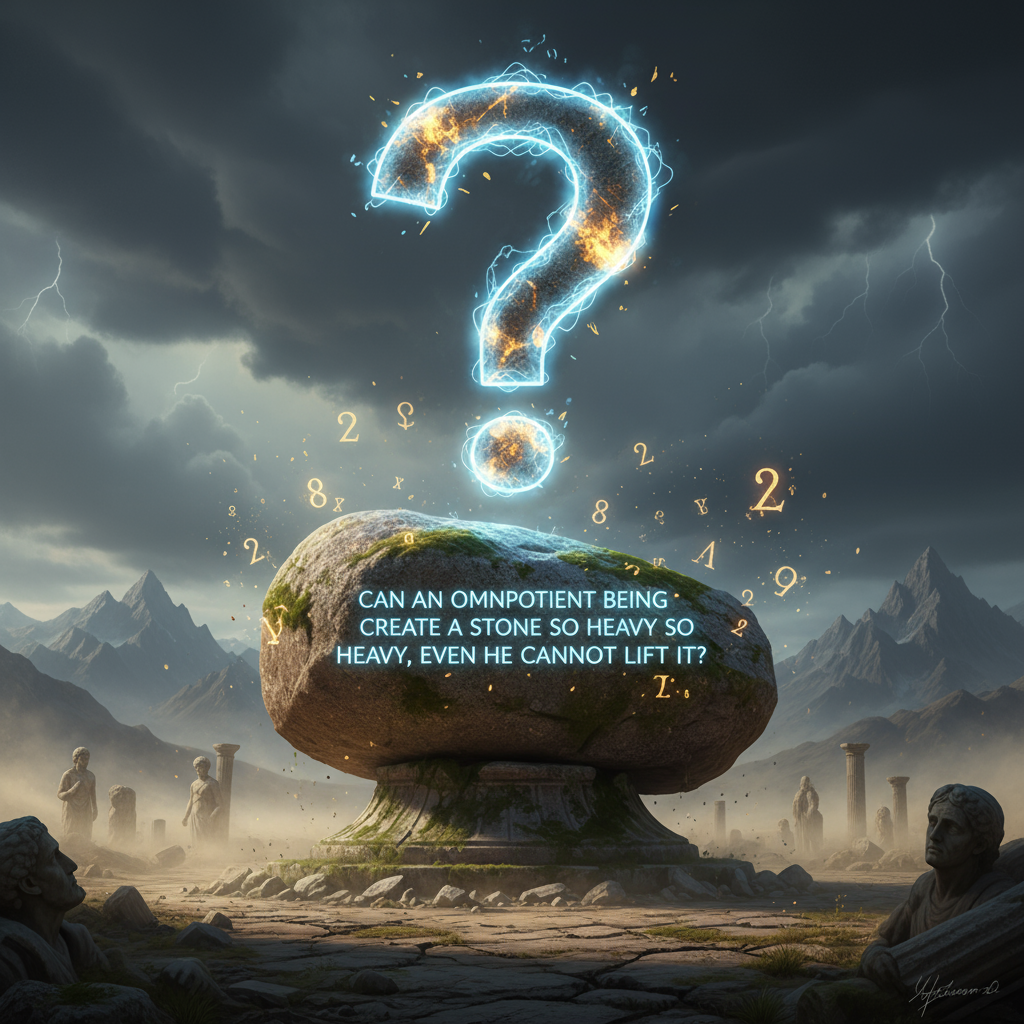
Omnipotence means "all-powerful"—God has maximal power and can do anything. But what does "anything" mean? There are two main views: (1) Descartes' view: God can do absolutely anything, including logical impossibilities like creating square circles or making 2+2=5, because God created logic itself. (2) Aquinas' view (standard): God can do anything logically possible but cannot do what is logically impossible, because logical impossibilities are not real "things" but meaningless word combinations. The famous Paradox of the Stone tests omnipotence: "Can God create a rock so heavy He cannot lift it?" If yes, He can't lift it (not omnipotent). If no, He can't create it (not omnipotent). Aquinas' response: a "rock too heavy for an omnipotent being to lift" is a logical impossibility, like a square circle, so the question is meaningless.
Detailed Explanation
What Is Omnipotence?
Omnipotence comes from Latin: omni (all) + potens (powerful).
Basic Definition: God is all-powerful—maximally powerful. There cannot exist a being with more power than God.
But this simple definition raises difficult philosophical questions:
- Does omnipotence mean God can do literally anything?
- Or does it mean God can do anything logically possible?
- Can God sin? Can God lie? Can God change the past?
- Can God cease to exist? Can God create a married bachelor?
These questions have generated centuries of philosophical debate.
Two Competing Definitions of Omnipotence
Definition 1: Aquinas' View (Logical Possibility View)
Thomas Aquinas (1225-1274) developed the most influential and widely accepted definition of omnipotence.
Aquinas' Definition: "God can do anything that is logically possible."
In other words: God can do anything that does not involve a logical contradiction.
What This Means:
God CAN do:
- Create universes
- Perform miracles
- Know everything
- Be present everywhere
- Create life
- Raise the dead
God CANNOT do:
- Create square circles
- Make 2+2=5
- Create married bachelors
- Create a rock too heavy for Himself to lift
- Make Himself not exist
- Change the past
- Do evil (contradicts His perfect goodness)
Why God Cannot Do the Logically Impossible: Aquinas argues that logical impossibilities are not real "things" at all. They are meaningless combinations of words. A "square circle" is not a thing that could exist—it's a contradiction in terms.
"Whatever implies contradiction does not come within the scope of divine omnipotence, because it cannot have the aspect of possibility. Hence it is better to say that such things cannot be done, than that God cannot do them."
— Thomas Aquinas
C.S. Lewis' Support: "Meaningless combinations of words do not suddenly acquire a meaning because we prefix to them two other words 'God can.'" In other words: adding "God can" before nonsense doesn't make it make sense. "God can create a square circle" is just as meaningless as "square circle".
Definition 2: Descartes' View (Voluntarism/Absolute Power View)
René Descartes (1596-1650) took a radically different approach.
Descartes' Definition: "God can do absolutely anything—including the logically impossible." God could create square circles, make 2+2=5, or make contradictions true.
Why Descartes Believes This:
- God Created Logic: God is the creator of everything, including the laws of logic. Since God created logic, God is not bound by logic. Logic is posterior (comes after) God's existence, not prior to it.
- God's Supremacy: If God cannot do something (even a logical impossibility), then there's something greater than God (namely, logic itself). But nothing can be greater than God. Therefore, God must be able to override logic.
- God's Immensity: "Nothing can exist which does not depend on God, because of God's immensity." If logic existed independently of God, logic would be eternal and necessary alongside God. But this undermines God's supremacy.
Problems with Descartes' View:
- Destroys Logical Necessity: If God can make 2+2=5, then nothing is necessarily true. All logic, mathematics, and reasoning become arbitrary.
- Makes Theology Meaningless: If God can do the logically impossible, then any statement about God becomes meaningless. "God is good" could mean "God is evil" if God can override logic.
- Undermines Rationality: If logic is not binding, then rational discourse about God becomes impossible. We couldn't meaningfully discuss or understand God at all.
The Paradox of the Stone (The Omnipotence Paradox)
The Classic Formulation
"Can God create a rock so heavy that He cannot lift it?"
This is the most famous challenge to omnipotence.
The Dilemma:
- If God CAN create such a rock: Then there exists something God cannot do (lift the rock). Therefore, God is not omnipotent.
- If God CANNOT create such a rock: Then there exists something God cannot do (create the rock). Therefore, God is not omnipotent.
Either way, it seems God is not omnipotent.
Aquinas' Response: The Question Is Meaningless
George Mavrodes' Formulation (following Aquinas): The paradox assumes that "a rock too heavy for an omnipotent being to lift" is a coherent concept. But it's not.
On the assumption that God IS omnipotent, the phrase "a stone too heavy for God to lift" becomes self-contradictory. Why? Because it means: "a stone which cannot be lifted by Him whose power is sufficient for lifting anything". This is a logical contradiction, like "an unmovable object that can be moved".
The Key Insight: It is God's very omnipotence that makes the existence of such a stone logically impossible. For a finite being (like a human), it's possible to create an unliftable rock (e.g., you could build a boat too heavy to lift). But for an omnipotent being, "unliftable" is a contradiction—because omnipotence means the power to lift anything.
Conclusion: The question is equivalent to asking: "Can God create a square circle?" The answer is no, but this doesn't limit God's omnipotence—it just shows the question is nonsense.
Peter Vardy's View: Self-Imposed Limitation
Peter Vardy offers a middle-ground position: God's omnipotence is limited, but the limitation is self-imposed. God chose to create a logically ordered universe where He binds Himself to logical laws.
Why God Self-Limited: To create free, rational humans who can understand and interact with reality. If God constantly violated logic, the universe would be chaotic and unintelligible. Free will and moral responsibility require a stable, predictable world governed by logic.
This view combines elements of both Descartes and Aquinas: Like Descartes, it accepts that God created logic and technically could change it. Like Aquinas, it explains why God doesn't violate logic in practice. God is bound by logic by choice, not by necessity.
Other Limitations on Omnipotence
Can God Sin?
Aquinas' Answer: No. God cannot sin or do evil because this would contradict His perfect goodness (omnibenevolence). But this doesn't limit omnipotence: Evil is a privation (absence of good), not a positive thing. Asking "Can God do evil?" is like asking "Can God fail to be good?"—it's asking for a contradiction.
Can God Change the Past?
Aquinas' Answer: No. Changing the past involves a logical contradiction. If an event happened, then by definition it cannot also not have happened. Asking God to change the past is asking for a contradiction.
Can God Cease to Exist?
Aquinas' Answer: No. God is a necessary being—He exists by His very nature. Asking God to cease existing contradicts His necessary existence. It would be like asking God to make a necessary being contingent—a logical impossibility.
Strengths and Criticisms
Strengths of Aquinas' Definition:
- Preserves logical coherence and maintains the validity of logic, mathematics, and rational discourse
- Makes theology meaningful and allows us to make coherent statements about God's nature
- Widely accepted by most philosophers and theologians as the standard definition
- Dissolves apparent paradoxes by showing they involve logical impossibilities
Criticisms and Problems:
1. Seems to Limit God
Objection: If God cannot do logical impossibilities, isn't God limited? Doesn't this make logic greater than God?
Response: God is not limited by being unable to do nonsense. "Logical impossibilities" are not real things—they're meaningless word combinations. It's not a limitation to be unable to do nothing.
2. Who Created Logic?
Objection: If God is bound by logic, where did logic come from? Did God create logic (Descartes), or does logic exist independently of God?
Response 1 (Vardy): God created logic and chose to bind Himself to it.
Response 2 (Classical Theism): Logical truths are necessary truths—they exist in all possible worlds. They reflect God's rational nature but are not created by God.
3. The Paradox Remains Troubling
Objection: Even if "a rock God cannot lift" is logically impossible when God is omnipotent, the paradox still seems to show a limitation. A non-omnipotent being (a human) CAN create an unliftable object. An omnipotent being (God) CANNOT. Doesn't this show that omnipotence is actually more limited than finite power in some respect?
Response: This confuses different senses of "can" and "cannot". A human "can" create an unliftable object because humans are weak. God "cannot" create an unliftable object because God is infinitely powerful. The inability flows from God's power, not from weakness.
Comparison: Two Definitions of Omnipotence
| Element | Aquinas (Standard View) | Descartes (Voluntarism) |
|---|---|---|
| Definition | God can do anything logically possible | God can do absolutely anything, including logical impossibilities |
| Square circles? | No—meaningless nonsense | Yes—God created logic |
| Logic's status | Necessary truths binding on God | Created by God, God can change |
| Paradox of stone | Meaningless question (like square circle) | God can create and lift it (contradiction okay) |
| Strengths | Preserves logical coherence and theology | Emphasizes God's absolute supremacy |
| Weaknesses | Seems to limit God | Destroys logic and meaningful discourse |
Scholarly Perspectives
"Whatever implies contradiction does not come within the scope of divine omnipotence, because it cannot have the aspect of possibility. Hence it is better to say that such things cannot be done, than that God cannot do them."
"Meaningless combinations of words do not suddenly acquire a meaning because we prefix to them two other words 'God can.'"
Key Takeaways
- ✓Omnipotence means 'all-powerful'—God has maximal power
- ✓Two main definitions: Aquinas (logically possible) vs. Descartes (absolutely anything)
- ✓Aquinas (standard view): God can do anything logically possible but not logical impossibilities
- ✓Logical impossibilities are meaningless word combinations, not real things
- ✓Paradox of the stone: Can God create a rock so heavy He can't lift it?
- ✓Aquinas' response: 'rock too heavy for omnipotent being' is self-contradictory like square circle
- ✓C.S. Lewis: 'God can' + nonsense ≠ meaningful statement
- ✓Descartes: God created logic, so can override it (controversial view)
- ✓Vardy: God self-imposed limitations to create stable, rational universe
- ✓God cannot sin, change past, or cease to exist—these are logical contradictions
- ✓Most philosophers accept Aquinas' definition as standard
- ✓Debate continues over whether logic limits God or reflects God's nature