Omniscience
Summary
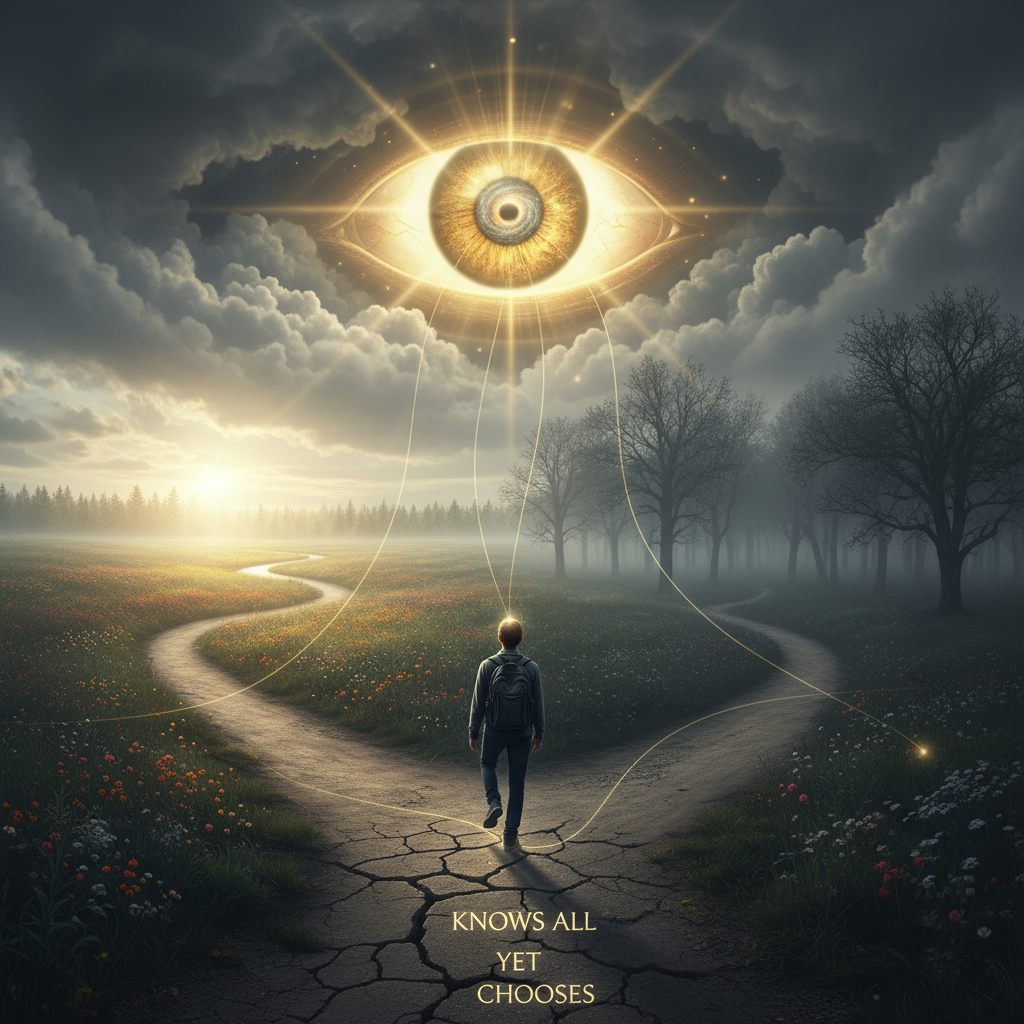
Omniscience means "all-knowing"—God knows all true propositions perfectly and infallibly. The major philosophical problem: omniscience seems incompatible with free will. If God knows what you'll do tomorrow (e.g., choose tea over coffee), then it must be true you'll choose tea. But if it's already true, can you really freely choose coffee instead? If God's knowledge is infallible, then the future is fixed, destroying libertarian free will. There are four main responses: (1) Boethius/Aquinas: God is eternal (outside time), so He sees all time simultaneously in an "eternal present"—He knows what you freely choose, not beforehand but timelessly. (2) Compatibilism: Free will just means freedom from coercion; God's foreknowledge is compatible with this. (3) Open Theism: God doesn't know the future because it doesn't exist yet—He knows all possibilities. (4) Molinism: God has "middle knowledge"—He knows what you would freely choose in any circumstance, then creates the world accordingly.
Detailed Explanation
What Is Omniscience?
Omniscience comes from Latin: omni (all) + scientia (knowledge).
Basic Definition: God is all-knowing—He has perfect, complete knowledge of everything.
More Precise Philosophical Definition: "S is omniscient if and only if, for every true proposition p, if p is true, then S knows p."
In other words: God knows all true propositions and knows them infallibly (cannot be mistaken).
What God Knows:
- Every fact about the past
- Every fact about the present
- Every thought in every mind
- Every true proposition
- (Debated) Every fact about the future
The Omniscience-Free Will Problem
The Central Paradox
The Problem: If God knows the future, then human free will seems impossible.
The Argument for Incompatibility:
- P1: God is omniscient—He knows all true propositions.
- P2: Therefore, God knows what I will do tomorrow (e.g., "Kevin will choose waffles for breakfast").
- P3: If God knows with certainty that I will choose waffles, then it is necessarily true that I will choose waffles.
- P4: If it is necessarily true that I will choose waffles, then I cannot choose otherwise (cannot choose French toast).
- P5: If I cannot choose otherwise, then I do not have libertarian free will (the power of contrary choice).
- C: Therefore, omniscience and libertarian free will are incompatible.
What Is Libertarian Free Will?
Libertarian Free Will: The view that humans have genuine freedom to choose between alternative options.
- When I choose tea, I could have chosen coffee instead—the choice was genuinely open
- Requires: Power of contrary choice (ability to do otherwise)
- No determinism: my choices are not causally determined by prior events
- Agent causation: I am the ultimate source of my actions
Why This Matters: Libertarian free will is essential for moral responsibility. If I couldn't have chosen otherwise, how can I be held morally accountable? How can God justly reward or punish me for choices I was determined to make?
The Dilemma
Either:
- God is omniscient BUT we don't have free will
- Or: We have free will BUT God is not omniscient
Both options are problematic for classical theism.
Four Main Responses to the Problem
Response 1: Boethius' Eternal God Solution (Aquinas, Anselm)
Who Was Boethius? Boethius (c. 480-524 CE) was a Roman philosopher and Christian theologian. His major work: The Consolation of Philosophy (written while imprisoned before execution).
Boethius' Solution: God Is Eternal (Outside Time)
- God does not exist in time (everlasting)
- Rather, God exists outside time (eternal)
- God does not experience time unfolding moment by moment (past → present → future) like we do
- Instead, God experiences all of time simultaneously in one "eternal present"
The Analogy:
Imagine time as a parade:
Humans: We're standing on the street watching the parade pass by. We see one moment at a time (float #5 is currently passing, #6 is in the future).
God: God is in a helicopter high above, seeing the entire parade all at once—beginning, middle, and end simultaneously.
How This Solves the Problem:
- God does not know the future before it happens
- Rather, God knows all events as they happen—but "as they happen" means "in the eternal present" where all time exists simultaneously
- God sees the results of our free choices, not predictions of them
- Just as watching someone walk doesn't cause them to walk, God's timeless observation of our choices doesn't cause or determine them
Criticisms:
- Timeless Knowledge Is Incoherent: Anthony Kenny argues that a timeless God is "radically incoherent." Action requires time (a before and after). How can God act, choose, or relate to temporal beings if He's outside time?
- Language Becomes Meaningless: What do "love," "power," "benevolence" mean in a timeless sense? These terms presuppose temporal relationships.
- Still Doesn't Preserve Freedom: Even if God sees our choices in an "eternal present," if His knowledge is infallible, then what He knows must happen. Whether He knows it "before" or "timelessly," the result is the same: we cannot do otherwise.
Response 2: Compatibilism
What Is Compatibilism? The view that free will is compatible with determinism. God's foreknowledge determines the future, but we still have free will.
How? By Redefining Free Will: Free will does not require the power to do otherwise (libertarian freedom). Rather, free will requires only:
- The action is desired by the agent
- The agent is not externally coerced
Example: If I choose tea because I genuinely want tea (not because someone forced me), then my choice is free—even if God knew I would choose tea and I couldn't have done otherwise.
Criticisms:
- Doesn't Preserve Genuine Freedom: Critics argue compatibilism redefines "free will" out of existence. If I couldn't have done otherwise, my "choice" was an illusion.
- Undermines Moral Responsibility: If God determined my choices, how am I truly responsible? I'm just doing what God predetermined.
Response 3: Open Theism (Dynamic Omniscience)
What Is Open Theism? The view that God does not know the future because the future doesn't exist yet. God knows all true propositions, but propositions about future free choices have no truth value (they're neither true nor false).
The Argument:
- P1: Future free choices don't exist yet.
- P2: Only things that exist can be known.
- P3: Therefore, even an omniscient being cannot know future free choices.
- P4: But God still knows everything knowable—He knows all possibilities and what would result from each.
- C: Therefore, God is still omniscient (knows everything knowable) and we have libertarian free will.
What God Knows (Open Theism):
- All of the past (completely and perfectly)
- All of the present (completely and perfectly)
- All possible futures (every possible outcome)
- All counterfactuals of possibility (what could happen)
What God Doesn't Know: Which future will actually occur (because free creatures haven't chosen yet). As we make free choices, God learns which possibilities become actualized.
Criticisms:
- Contradicts Scripture: Many biblical prophecies (e.g., Isaiah 44-46, predictions about Jesus) require God to know the future with certainty. Open theists respond: God ensures prophecies through His power, not foreknowledge.
- God Makes Mistakes: If God doesn't know the future, He can make poor decisions. Genesis 6:6 says God "regretted" making humans—open theists see this as literal (God made a mistake).
- Doesn't Solve Problem of Evil: Whether God knew evil was coming from eternity or just two minutes ago, He still allows it when He could prevent it.
- Limits God's Sovereignty: God cannot guarantee His long-term plans will succeed. He's taking risks and hoping humans cooperate.
Response 4: Molinism (Middle Knowledge)
What Is Molinism? Named after Luis de Molina (1535-1600), a Spanish Jesuit. The view that God has middle knowledge (Latin: scientia media).
What Is Middle Knowledge? Knowledge of counterfactuals of freedom—what free creatures would freely choose in any possible circumstance.
Example: God knows: "If Kevin were offered waffles and French toast at 8am on Tuesday, Kevin would freely choose waffles." This is knowledge of what Kevin would do, not what Kevin will do (until God creates that scenario).
Three Types of Divine Knowledge (Molinism):
- 1. Natural Knowledge: Knowledge of all necessary truths (logic, mathematics). God knows these simply by understanding His own nature.
- 2. Middle Knowledge: Knowledge of all counterfactuals of freedom. God knows what any possible creature would freely choose in any possible circumstance.
- 3. Free Knowledge: Knowledge of what will actually happen in the world God decides to create.
How Molinism Works:
- God surveys all possible worlds using His middle knowledge
- God knows exactly what every possible free creature would do in every possible circumstance
- God chooses to create a world that pleases Him (one where His plans succeed)
- God creates that world, knowing how everyone will freely choose
How This Solves the Problem: God knows the future because He knows what we would freely choose and then creates circumstances where we make those choices. Our choices are still genuinely free (libertarian freedom). But God's sovereignty is preserved—He orchestrates everything by choosing which world to actualize.
Criticisms:
- Counterfactuals May Not Have Truth Values: Before I'm created, is it true that "Kevin would choose waffles if offered waffles and French toast"? Some philosophers argue such statements have no truth value until the choice is actually made.
- Threatens Divine Immutability: If God's knowledge depends on counterfactuals about creatures, doesn't this make God dependent on something outside Himself?
- The Grounding Problem: What makes counterfactuals of freedom true or false? If my free choice makes them true, then God couldn't have known them before creating me.
Scholarly Perspectives
"Eternity is the possession of endless life whole and perfect at a single moment... God's knowledge, transcending all movement of time, dwells in the simplicity of its own changeless present, and, embracing the whole infinite sweep of the past and of the future, contemplates all that falls within its simple cognition as if it were now taking place."
"Knowledge does not stand in causal relation. Just as an infallible weather barometer that 'knows' it will rain does not cause the rain, God simply knows how a person with libertarian freedom would freely choose in a specific circumstance."
Key Takeaways
- ✓Omniscience means all-knowing—God knows all true propositions perfectly and infallibly
- ✓The major problem: omniscience seems incompatible with libertarian free will
- ✓If God knows I'll choose tea, then I can't choose coffee—but then I lack free will
- ✓Boethius/Aquinas: God is eternal (outside time), sees all time simultaneously in 'eternal present'
- ✓Compatibilism: redefines free will as freedom from coercion; compatible with determinism
- ✓Open theism: God doesn't know future because it doesn't exist yet; knows all possibilities
- ✓Molinism: God has 'middle knowledge'—knows what we would freely choose in any circumstance
- ✓Libertarian free will: genuine power to do otherwise; essential for moral responsibility
- ✓Compatibilist free will: acting on desires without coercion; determinism compatible
- ✓Each solution has strengths and serious criticisms
- ✓Most sophisticated solution: Molinism (middle knowledge)
- ✓The debate remains unresolved in contemporary philosophy