Application of All Four Ethical Theories to Sex Ethics
Summary
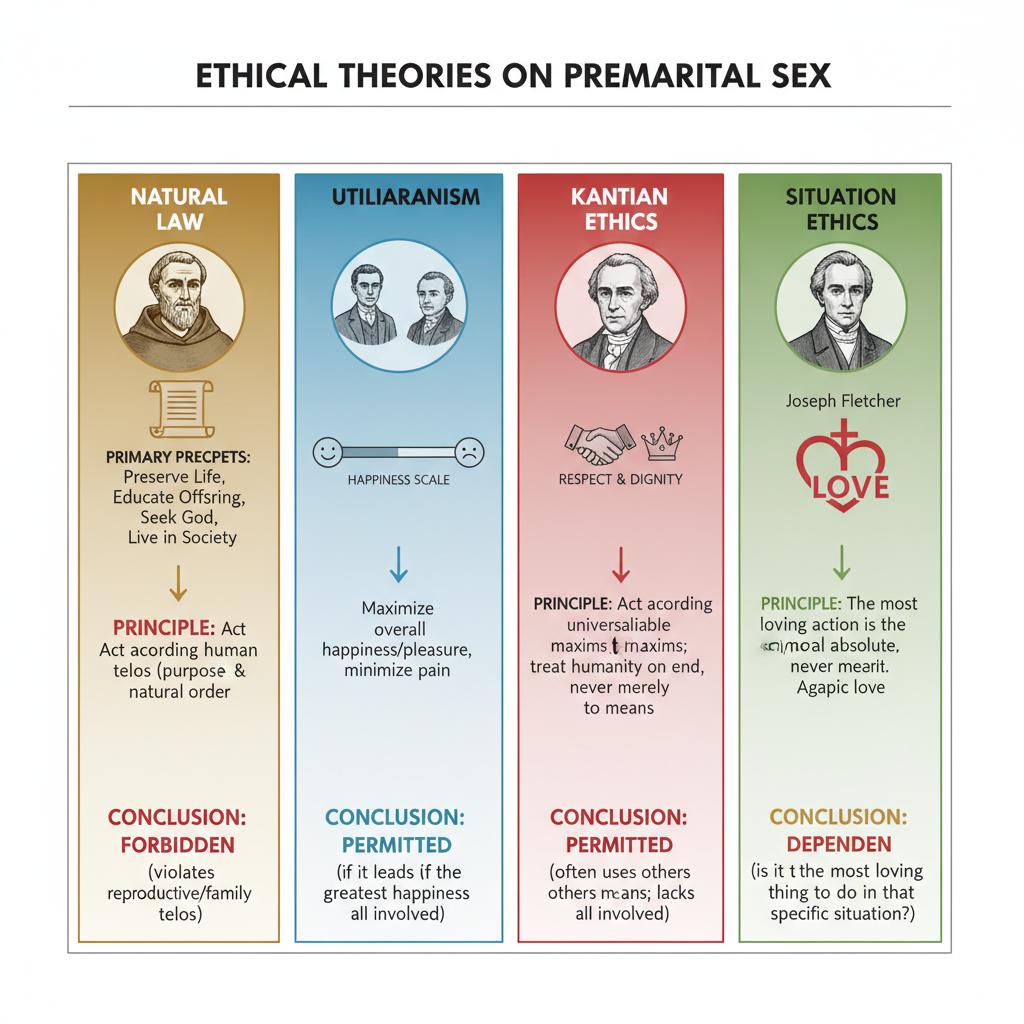
The four major ethical theories give very different answers to sexual ethics questions. Natural Law (Aquinas) strictly forbids sex outside marriage because it violates the procreative and unitive purposes ordained by God—premarital, extramarital, and homosexual sex all violate human telos. Utilitarianism (Bentham/Mill) permits sex if it maximizes happiness and involves consent, judging each case by consequences rather than absolute rules. Kantian Ethics (Kant) requires mutual respect, commitment, and consent—marriage provides the committed framework, while casual sex risks objectification. Situation Ethics (Fletcher) rejects all absolute rules, holding that only agape (unconditional love) matters—what is loving varies by context. These approaches produce fundamentally different conclusions about sexual morality, from absolute prohibition to contextual flexibility.
Detailed Explanation
Natural Law Approach (Aquinas)
Core Principle
Everything has a purpose (telos) given by God. Sex's purpose is procreation and bonding within marriage to create stable families for children.
Primary Precepts Applied
- Reproduction: Sex must aim at creating children.
- Education: Children need stable married families to be properly educated.
- Worship God: Following God's divine law on sexuality.
Conclusions on Sexual Issues
Premarital Sex: FORBIDDEN
Violates procreative purpose; children born outside marriage lack stable education.
Extramarital Sex: FORBIDDEN
Breaks marital fidelity; undermines family stability; violates procreative purpose.
Homosexuality: FORBIDDEN
Cannot procreate; "contrary to nature"; fails both purposes of sex.
Contraception: FORBIDDEN
Separates procreative from unitive purpose; interferes with natural design.
Strengths
- Clear, absolute rules provide moral certainty.
- Protects children and family stability.
- Grounded in universal human nature (not cultural relativism).
Weaknesses
- Outdated: Developed in medieval context; doesn't account for modern contraception, women's rights, LGBTQ+ people.
- Ignores consequences: Doesn't consider whether strict rules actually maximize human flourishing.
- Cultural relativism problem: Different cultures have different sexual norms—suggests telos is culturally constructed, not universal.
- Procreation obsessed: Reduces sex to reproduction, ignoring bonding and pleasure in committed relationships.
Utilitarianism Approach (Bentham & Mill)
Core Principle
Sex is permissible if it maximises overall happiness (pleasure, satisfaction, well-being) and involves consent and avoidance of harm.
No Intrinsic Rules
Only consequences matter. There's nothing inherently wrong with any sexual act—judge each by outcomes.
Conclusions on Sexual Issues
Premarital Sex: GENERALLY PERMITTED
Gives pleasure; consensual; no inherent harm. Wrong only if causes regret, disease, or unintended pregnancy.
Extramarital Sex: GENERALLY FORBIDDEN
Usually causes betrayal, jealousy, mistrust—more suffering than pleasure. Exception: consenting open marriage if both genuinely happy.
Homosexuality: PERMITTED
Consensual; brings happiness to same-sex couples. Rejecting it causes depression, suicide, suffering. Irrational prejudice has no moral weight.
Casual Sex: DEPENDS
OK if both consent and enjoy; wrong if causes regret, STDs, emotional harm, or unequal power.
The Harm Principle (Mill)
The only reason to restrict someone's sexual freedom is if it harms others. Consensual acts between adults shouldn't be criminalized or moralized—people should be free to pursue happiness.
Strengths
- Respects individual liberty and pleasure.
- No arbitrary taboos; evaluates consequences rationally.
- Supports harm reduction (contraception, sex education) over prohibition.
- Accounts for cultural variation—what maximizes happiness varies by context.
Weaknesses
- Calculation Problem: Hard to predict long-term consequences; subjective mental states difficult to measure.
- Measurement Problem: How do we quantify and compare different people's happiness?
- Minority Oppression: If a majority finds homosexuality disgusting, Act Utilitarianism seems to justify oppressing homosexuals to avoid offending the majority.
- Ignores Rights: No absolute rights to dignity or respect—if society benefits, individuals can be sacrificed.
Kantian Ethics Approach (Kant)
Core Principle
Never treat another person merely as a means to an end; always treat them as an end in themselves. Sexual activity must involve mutual respect, consent, equality, and commitment.
The Problem with Sexual Desire Alone
Kant viewed sexual desire as potentially degrading—it can make a person "no better than a beast". Lust treats the other person as an object for gratification. Even mutual sexual satisfaction (without love/commitment) risks treating partners as things, not as rational persons.
The Solution: Marriage
Only marriage allows morally acceptable sexual expression because marriage is a contract of mutual commitment where both partners agree to care for the "whole person," not just sexual gratification. Both partners consent as equals. Marriage expresses affection and respect, not just lust.
Important: Not Based on Procreation
Kant's reasoning is NOT based on procreation (unlike Natural Law). He explicitly states that infertile couples can marry and have sex legitimately. The purpose of marriage is companionship and respect, not producing children.
Conclusions on Sexual Issues
Premarital Sex: PROBLEMATIC
Lacks formal commitment; danger of treating each other as means, not respecting personhood.
Marital Sex: PERMISSIBLE
Based on mutual promise-keeping; partners committed to each other's welfare; respects dignity.
Extramarital Sex: FORBIDDEN
Breaks promise to spouse; disrespects their dignity; uses third party without honesty.
Homosexuality: PERMISSIBLE
If in committed, loving, equal relationships where both treat each other with respect and mutual consent, there's no violation of the categorical imperative.
Strengths
- Protects dignity and prevents objectification.
- Emphasizes commitment and respect—avoiding exploitation.
- Provides clear requirements (consent, commitment, equality).
- Works for same-sex relationships—gender is irrelevant; respect and commitment are what matter.
Weaknesses
- Conservative conclusion: Only permits sex within marriage; many find this restrictive.
- Ignores emotions: Kant's emphasis on duty over emotional connection seems cold.
- Ignores consequences: Doesn't consider whether strict rules actually promote human flourishing or happiness.
- Prostitution problem: Even if two consenting adults agree to sex for money, Kant's emphasis on respect might forbid it—but can't a sex worker and client respect each other's autonomy and bodily freedom?
Situation Ethics Approach (Fletcher)
Core Principle
There are NO absolute sexual rules. The only rule is agape (unconditional Christian love). "The situationist follows a moral law or violates it according to love's need" (Fletcher). Each situation is unique; what's most loving in one context might be wrong in another.
Applied to Sexual Issues
Premarital Sex: DEPENDS
If it expresses genuine love and commitment, it's good. If it's selfish lust, it's wrong.
Extramarital Sex: DEPENDS
Usually wrong (betrays spouse). But if helping someone escape abuse, or reuniting with family, it might be the most loving choice.
Homosexuality: DEPENDS
In a homophobic society, staying closeted might be most loving (self-protection). In a free society, expressing love is most loving.
Casual Sex: DEPENDS
If both genuinely care for each other and consent, it's OK. If one is using the other, it's wrong.
Famous Example: War Captive Scenario
A woman is imprisoned in a war zone. She deliberately gets pregnant by a guard to be released so she can return to her starving family.
- Natural Law says: Adultery and fornication—forbidden.
- Utilitarianism says: Complex calculation—depends on overall happiness.
- Kant says: Using her body as means to escape—problematic; also deception.
- Fletcher says: LOVING CHOICE. Her sacrifice out of agape for family is the most loving act.
Strengths
- Compassionate and flexible: Doesn't condemn people in impossible situations.
- Respects context: Recognizes that moral rules can't account for all situations.
- Prioritizes love: Makes agape (genuine care for others) the moral center.
Weaknesses
- Too relativistic: Gives no clear guidance; anything could be justified as "loving".
- "Slippery slope": If there are no rules, what prevents sexual exploitation and abuse?
- Subjectivity: Who decides what's "loving"? People often rationalize selfish acts as love.
- No social standards: If everyone followed Situation Ethics, sexual ethics would collapse into chaos.
Comparison Table
| Sexual Issue | Natural Law | Utilitarianism | Kantian | Situation Ethics |
|---|---|---|---|---|
| Premarital Sex | ❌ Forbidden | ✓ Permitted (if consensual, safe) | ❓ Problematic (lacks commitment) | ✓ Depends on love |
| Extramarital Sex | ❌ Forbidden | ❌ Usually forbidden (harm) | ❌ Forbidden (breaks promise) | ✓ Depends on love |
| Homosexuality | ❌ Forbidden | ✓ Permitted | ✓ Permitted (if respectful) | ✓ Depends on love |
| Casual Sex | ❌ Forbidden | ✓ Permitted (if consensual) | ❓ Problematic (objectification) | ❓ Depends on love |
| Contraception | ❌ Forbidden | ✓ Permitted | ✓ Permitted | ✓ Permitted |
| Cohabitation | ❌ Forbidden | ✓ Permitted | ❌ Problematic | ✓ Permitted if loving |
Scholarly Perspectives
Natural Law Perspective
"The purpose of sex is procreation and the unitive bonding of husband and wife within marriage. All sex outside marriage—whether premarital, extramarital, or homosexual—violates this natural purpose. Children need stable married families for proper education. Therefore, sexual ethics must be grounded in the objective purposes of human nature, not subjective feelings or desires."
Source: Aquinas and Natural Law doctrine applied to sexual ethics. Traditional religious approach emphasizing procreation, family stability, and objective telos.
Kantian Ethics Perspective
"Sex is morally acceptable only when it expresses mutual respect, free consent, and commitment. All partners must be treated as ends in themselves, never merely as means to sexual gratification. Marriage provides the framework of commitment necessary for this respect. Premarital cohabitation lacks this commitment and risks reducing partners to objects. However, same-sex relationships fully committed to mutual respect are equally morally acceptable, since gender is irrelevant to respect and dignity."
Source: Kantian sexual ethics. Emphasis on dignity, respect, consent, and commitment rather than procreation or consequences.
Key Takeaways
Natural Law
- Sex only for procreation within marriage.
- Forbids premarital, extramarital, and homosexual sex.
- Strength: Clear rules protect children and family.
- Weakness: Outdated; ignores modern understanding and consequences.
Utilitarianism
- Sex permissible if it maximizes happiness and involves consent.
- Judge each case by consequences, not rules.
- Strength: Respects liberty; pragmatic; supports harm reduction.
- Weakness: Calculation problem; ignores rights; can justify oppression of minorities.
Kantian
- Sex requires mutual respect, consent, commitment.
- Marriage provides committed framework; casual sex risks objectification.
- Strength: Protects dignity; prevents exploitation; supports LGBTQ+ relationships.
- Weakness: Conservative; ignores emotions; ignores consequences.
Situation Ethics
- No absolute rules; only agape (love) matters.
- What's loving varies by context.
- Strength: Compassionate; flexible; respects individual situations.
- Weakness: Too relativistic; no clear guidance; opens door to rationalization.