Developments in Religious Beliefs on Sexual Ethics
Summary
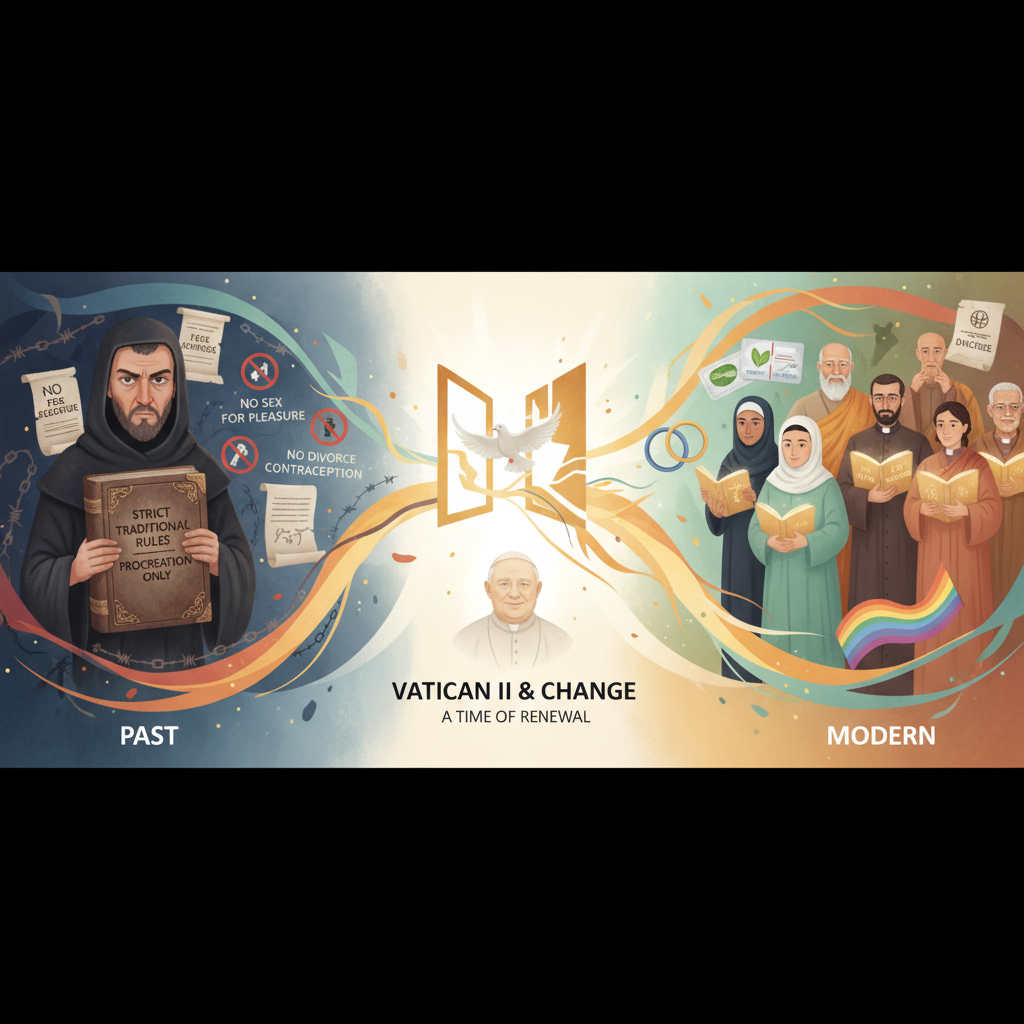
Religious attitudes on sexual ethics have transformed dramatically over the past century, moving from strict prohibition to more nuanced positions. Until 1930, all Christian churches condemned contraception; now only the Catholic Church officially opposes it. The watershed moment was the 1930 Lambeth Conference when Anglicans became the first to permit contraception. Vatican II (1962-1965) opened Catholic dialogue with modernity, recognizing sex has both unitive and procreative purposes. This shift enabled Protestant churches to move toward accepting LGBTQ+ relationships—some now ordain gay clergy and bless same-sex unions. The drivers of change include social movements, scientific understanding of sexuality, and hermeneutical shifts (reading Scripture contextually rather than literally). Conservative religious groups resist these changes, arguing they represent cultural capitulation rather than moral evolution. The debate centers on whether churches should adapt to modern understanding or maintain eternal truths.
Detailed Explanation
Historical Context: Traditional Teaching
Medieval and Early Modern Period (500-1800s)
Core Doctrines:
- All Christian churches taught sex was only for procreation within marriage
- Contraception was a grave sin in all denominations
- Pleasure in sex was viewed with suspicion (legacy of Augustine)
- Premarital and extramarital sex were absolutely forbidden
- Homosexuality condemned as "sodomy"—a grave sin against nature
The First Major Shift: Contraception (1930)
The Lambeth Conference (1930)
Historical Significance:
The Anglican Church became the first Christian church to permit contraception, marking a fundamental breach in unanimous Christian teaching.
Key Justification:
Sexual relations could be unitive (bonding) without being procreative. This separated the two purposes of sex for the first time in Christian history.
Protestant Response
- Within decades, all Protestant denominations followed the Anglican lead
- Recognized contraception enables family planning and women's health
- Acknowledged economic and social factors justify limiting family size
Catholic Response
Humanae Vitae (1968):
Pope Paul VI reaffirmed that all contraception is immoral because it separates the procreative from the unitive aspect of sex. This isolated the Catholic Church from Protestant consensus.
Dissent:
Many Catholics and theologians disagreed. Contraception use among Catholics is now widespread, despite official teaching.
Why This Matters:
This was the first crack in the unanimity of Christian sexual ethics. It showed churches could reinterpret natural law arguments and that modern circumstances (women's health, economic factors) could justify change.
Vatican II (1962-1965): Opening to the Modern World
What Was Vatican II?
The Second Vatican Council was a major Catholic Church ecumenical council that reformed Catholic teachings and practices in light of modern times.
Key Outcomes for Sexual Ethics
1. Dialogue with Modern World
Opened engagement with modern psychology, science, and secular philosophy
2. Dual Purpose of Sex
Acknowledged sex has a unitive purpose (bonding) in addition to procreative
3. Pastoral Compassion
Shifted from condemning people to pastoral compassion and accompaniment
4. Laity's Voice
Recognized the laity's voice in moral reasoning (not just hierarchy)
Impact on Homosexuality
Vatican II did not explicitly change teaching on homosexuality, but opened the door to dialogue and re-examination. Post-Vatican II theologians began questioning whether Scriptural condemnations were absolute or contextual.
Natural Law Evolution: From Procreation-Only to Dual Purpose
Traditional View (Aquinas)
- Sex's only legitimate purpose was procreation
- Sex purely for pleasure or bonding (without intent to procreate) was sinful
- This condemned contraception, sterile marriage, and all nonprocreative sex
Modern Natural Law (Post-Vatican II)
- Sex has two complementary telos: procreative and unitive
- These purposes do not need to occur in every act
- Heterosexual couples can use contraception and still express marital love
Implications
This opened the door to accepting contraception.
But it also raised new questions:
If procreation isn't required in every act, why is same-sex sex wrong? Some theologians argue committed same-sex relationships fulfill the unitive purpose, making them morally acceptable.
Changing Attitudes on LGBTQ+ Issues
Catholic Church
Official Teaching (Remains Unchanged):
- Homosexuality is "intrinsically disordered"
- Homosexual acts are immoral; homosexual orientation is not
- Gay Catholics called to celibacy
But Pastoral Practice Evolving:
- Pope Francis has shown greater pastoral compassion
- 2016 Synod acknowledged attitudes have shifted since gay marriage legalization
- Some bishops quietly bless same-sex couples (defying official policy)
Anglican Church
Journey of Change:
- 1991: Report Issues in Human Sexuality reaffirmed heterosexual marriage as normative but acknowledged pastoral care for gay people
- 2012-2014: Voted to permit ordination of gay clergy in same-sex relationships
- 2023: General Synod voted to bless same-sex unions (though stopping short of calling them "marriages")
Reasoning:
- Scripture read contextually: Levitical laws applied to pagan practices, not loving relationships
- Jesus's emphasis on love and justice overrides specific biblical prohibitions
- Sexual orientation is not a choice; denying gay people marriage is unjust
Other Protestant Denominations
Fully Accepting Churches:
United Church of Christ, Presbyterian Church (USA), Evangelical Lutheran Church—ordain gay clergy, bless same-sex unions
Moving Toward Acceptance:
Methodist Church, Baptist Union—increasingly accepting
Remaining Traditional:
Evangelical Churches, Pentecostal Churches, Orthodox Churches—maintain traditional teaching against homosexuality
Islam
Traditional Position:
Quran and Islamic law condemn homosexual acts as haram (forbidden). Most Muslim-majority countries criminalize homosexuality.
Modern Development:
Some Muslim scholars and activists argue for reinterpretation, but face significant pushback. Progressive Muslim organizations exist but remain marginal. Unlike Christianity, minimal institutional change in Islamic sexual ethics.
Factors Driving Change
1. Cultural and Social Influence
As society became more secular and accepting of premarital sex, divorce, and homosexuality, religious institutions felt pressure to adapt. Legal recognition of same-sex marriage (2001 in Netherlands, 2015 US Supreme Court) created social pressure on churches.
2. Scientific Understanding
Psychology and medicine confirmed sexual orientation is innate, not chosen. Contraception became medically safe for women's health. Sexuality understood as part of human flourishing, not just procreation.
3. Hermeneutical Shifts
Churches moved from literal biblical interpretation to contextual and historical reading. Recognized that culture shapes how we read Scripture. Argued that spirit of Scripture (love, justice) differs from specific prohibitions.
4. Vatican II Precedent
Once the Catholic Church showed institutional capacity to change, other churches felt permitted to do so. Opened conversation: Are ancient teachings always binding?
Resistance to Change
Conservative Religious Response
- View changing sexual ethics as a "betrayal of Scripture"
- Argue accepting premarital sex and homosexuality causes societal decay and family breakdown
- Fear churches are caving to secular pressure rather than standing on eternal truth
- Warn of moral relativism replacing absolute standards
Islamic Perspective
- Sexual ethics are divinely ordained and cannot change with culture
- Western pressure to accept homosexuality is cultural imperialism
- Religious institutions adopting secular values represent abandonment of faith
The "Coming of Age" Argument (Fletcher & Robinson)
Situation Ethics Perspective
Fletcher and Robinson argue humanity has "come of age"—become more educated, civilized, and capable of moral autonomy.
Core Claim:
- In the past, people needed strict rules because they lacked education and sophistication
- Now we can trust people to think through complex sexual ethics contextually, not by rigid rules
- This justifies more liberal, nuanced positions on premarital sex, homosexuality, and divorce
Critique
- Some argue removing traditional norms has led to exploitation and promiscuity, not mature reasoning
- The #MeToo movement suggests society still needs norms to prevent abuse
- Complete sexual freedom hasn't created happiness; it's created confusion and harm
Scholarly Perspectives
Traditional/Conservative Perspective
"For nearly 2,000 years, all Christian churches unanimously condemned contraception as a violation of natural law. The 1930 Anglican acceptance of contraception marked a fundamental breach of Christian moral teaching. When churches abandon their historic teachings for the sake of cultural conformity, they cease to be prophetic voices and become mere puppets of secular society. The crisis of sexual ethics today—with widespread premarital sex, divorce, and now homosexual relationships—is the inevitable result of this capitulation."
Context: This represents the conservative view that religious institutions have compromised their convictions by adapting to modern culture rather than maintaining eternal truths.
Progressive/Liberal Perspective
"Vatican II opened the Church to dialogue with the modern world and recognized that ancient teachings must be read contextually, not literalistically. As our understanding of human sexuality, psychology, and justice evolves, so must religious ethics. God loves all people—gay and straight—and created them in His image. A truly compassionate reading of Scripture recognizes that justice and love demand acceptance of LGBTQ+ people and relationships. Religious institutions that refuse to evolve risk becoming irrelevant and perpetuating harm."
Context: This represents the progressive view that religious institutions can and should evolve in response to new understanding while remaining faithful to core values of love and justice.
Key Takeaways
Contraception Watershed (1930)
First crack in unanimous Christian teaching; showed institutional change was possible
Vatican II (1962-1965)
Pivotal moment opening Catholic Church to dialogue with modernity and recognizing dual purpose of sex
Hermeneutical Shift
From literal reading of Scripture to contextual and historical interpretation
LGBTQ+ Acceptance
Most progressive churches now ordain gay clergy and bless same-sex unions; Catholics remain conflicted
Drivers of Change
Social/cultural influence, scientific understanding, Vatican II precedent, hermeneutical innovation
Conservative Resistance
Traditional churches argue change represents moral compromise and cultural capitulation
Fletcher's "Coming of Age"
Argues humanity mature enough for contextual ethics; critics say it enables exploitation
Islam's Position
Has resisted change more than Christianity; traditional Islamic sexual ethics remain largely unchanged
Timeline of Change
| Year/Event | Development | Impact |
|---|---|---|
| Pre-1930 | All churches condemn contraception | Sexual ethics rigid, procreation-focused |
| 1930 | Anglican Church permits contraception | First major shift in Christian ethics |
| 1930s-1960s | Protestants follow Anglican lead | Contraception accepted outside Catholicism |
| 1962-1965 | Vatican II Council | Opens dialogue; recognizes unitive purpose |
| 1968 | Humanae Vitae reaffirms contraception ban | Catholic Church remains isolated on issue |
| 1991 | Anglican Issues in Human Sexuality report | Begins dialogue on homosexuality |
| 2000s-2020s | Protestant denominations ordain gay clergy | Major shift toward LGBTQ+ acceptance |
| 2023 | Anglican Church blesses same-sex unions | Near-complete institutional acceptance |